CBSE • News Explainer
CBSE Kaushal Bodh Skill Education Training Begins
The Central Board of Secondary Education launched its offline Capacity Building Programme series for middle school educators on November 14, 2026, starting across Maharashtra centres in Pune and Nashik. The training equips teachers of Classes 6 to 8 to roll out NCERT's hands-on Kaushal Bodh activity textbooks.
Quick answer
CBSE Kaushal Bodh skill education training is a nationwide professional development drive preparing middle school educators to implement NCERT's vocational curriculum for Classes 6 to 8. It equips teachers to conduct hands-on projects across three work domains, evaluate student portfolios, and schedule 110 mandatory hours into regular school timetables.
Key takeaways
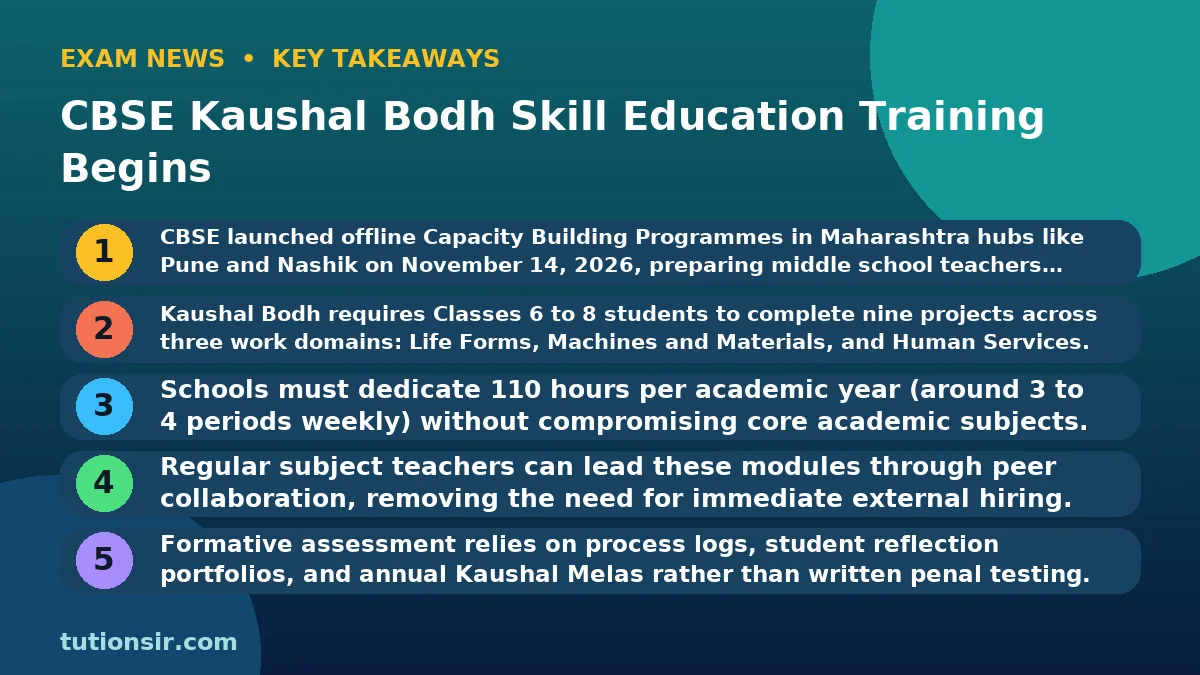
- CBSE launched offline Capacity Building Programmes in Maharashtra hubs like Pune and Nashik on November 14, 2026, preparing middle school teachers for skill education.
- Kaushal Bodh requires Classes 6 to 8 students to complete nine projects across three work domains: Life Forms, Machines and Materials, and Human Services.
- Schools must dedicate 110 hours per academic year (around 3 to 4 periods weekly) without compromising core academic subjects.
- Regular subject teachers can lead these modules through peer collaboration, removing the need for immediate external hiring.
- Formative assessment relies on process logs, student reflection portfolios, and annual Kaushal Melas rather than written penal testing.
Try Tution Sir free for your class and subject.
No card. Registering takes about two minutes.
What Is the CBSE Kaushal Bodh Skill Education Training Initiative?
The CBSE Kaushal Bodh skill education training initiative is an offline Capacity Building Programme (CBP) designed to train middle school teachers to lead experiential vocational learning under the National Education Policy (NEP) 2020. The rollout started on November 14, 2026, with focused sessions across major nodal centres in Maharashtra, including Pune and Nashik, before expanding through regional Sahodaya School Complexes nationwide.
Organised by the CBSE Department of Skill Education in collaboration with the National Council of Educational Research and Training (NCERT) and the Pandit Sunderlal Sharma Central Institute of Vocational Education (PSSCIVE), this programme trains teachers on the newly published 'Kaushal Bodh' activity workbooks. It shifts middle school vocational instruction from occasional craft lectures to structured, inquiry-led project work.
- Focus on practical competencies: Moving students away from rote memorisation toward practical problem-solving.
- Experiential pedagogy: Training teachers to facilitate exploratory learning rather than delivering lecture-driven instructions.
- Standardised delivery: Aligning internal school assessments with the National Curriculum Framework for School Education (NCF-SE) 2023.
What Are the Three Forms of Work Covered Under Kaushal Bodh?
Kaushal Bodh organises all vocational modules across three forms of work: Work with Life Forms, Work with Machines and Materials, and Work in Human Services. Over the three middle school years (Classes 6, 7, and 8), every student must finish nine projects in total—undertaking exactly one project per form of work during each academic year.
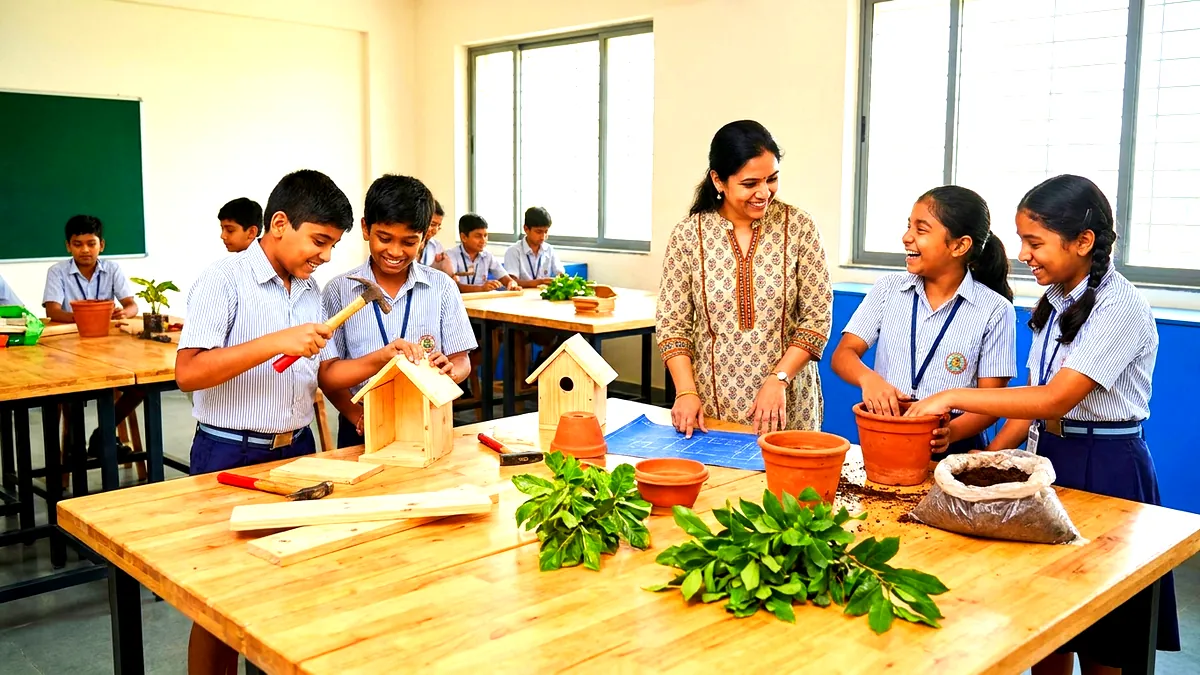
In 'Work with Life Forms', students participate in agriculture, kitchen gardening, nursery raising, composting, and local biodiversity surveys. In 'Work with Machines and Materials', students use simple mechanical tools to explore woodcraft, bamboo work, pottery, basic circuitry, tinkering, and introductory block-based programming. In 'Work in Human Services', learners develop social empathy and community awareness through nutrition audits, heritage documentation, hospitality basics, and organizing community awareness drives.
How to Implement Kaushal Bodh Projects in the School Timetable
Schools can integrate the required 110 annual vocational hours by scheduling one double period and one single period each week, or by using block-period timetabling. CBSE guidelines require approximately 110 instructional hours per year for Classes 6 to 8 skill education. This easily translates to 3 to 4 regular class periods weekly.
School coordinators do not need to cut core language, science, or mathematics instructional hours. Instead, schools can reassign existing Work Experience, SUPW, and club periods to create uninterrupted 80-minute experiential learning blocks. For instance, dedicating Wednesday afternoons to hands-on tinkering or garden care allows students sufficient time to set up materials, execute their activity, record observations, and clean up safely.
| Curricular Domain | Illustrative NCERT Projects | Associated Academic Subjects | Annual Time Allocation |
|---|---|---|---|
| Work with Life Forms | Kitchen gardening, compost creation, medicinal plant nursery, local flora documentation | Science, Biology, Environmental Studies | ~35 Hours (1 Project/Year) |
| Work with Machines & Materials | Bamboo/wood crafting, tie-and-dye fabric design, toy making, basic electronics & block coding | Mathematics, Physics, Art, Computer Science | ~40 Hours (1 Project/Year) |
| Work in Human Services | Community nutrition audit, puppetry for social awareness, school water audit, heritage recording | Social Science, Languages, Health Education | ~35 Hours (1 Project/Year) |
Who Teaches Kaushal Bodh? Non-Specialist Teacher Allocation
Existing subject teachers from science, mathematics, social science, and arts departments can facilitate Kaushal Bodh modules without requiring schools to hire dedicated vocational instructors. CBSE designed the Kaushal Bodh activity handbooks with clear, step-by-step facilitation guides tailored specifically for regular subject educators.
For example, a biology or general science teacher can supervise 'Work with Life Forms' projects such as soil testing and seed germination. Mathematics and physics teachers can steer 'Work with Machines and Materials' projects such as simple mechanics and home energy audits. Meanwhile, social science and language teachers can easily facilitate 'Work in Human Services' modules such as community water mapping and oral history archives.
CBSE Kaushal Bodh Assessment and Portfolio Guidelines
Kaushal Bodh evaluates students through continuous formative assessment, structured reflection logs, and annual skill exhibitions rather than pen-and-paper exams. Assessment criteria focus on student curiosity, persistent effort, collaboration, adherence to tool safety, and the documentation of personal problem-solving journeys.
Each learner maintains an individualized Kaushal Bodh Portfolio containing project plans, rough sketches, photographic records, and reflective write-ups. Schools conclude the academic session with a 'Kaushal Mela' (skills fair) where students display working prototypes and explain their learning outcomes to peers, parents, and community members. This approach rewards real learning over test scores.
Composite Skill Lab Setup: Low-Cost Alternatives for Schools
Schools that have not yet constructed an advanced 600-square-foot Composite Skill Lab can fulfill Kaushal Bodh mandates by transforming existing science laboratories or art rooms into modular maker corners. CBSE Circular Skill-75/2024 gives affiliated schools time until August 22, 2027, to complete permanent lab construction, ensuring no school faces immediate compliance hurdles.
Budget-conscious and rural schools can start immediately using low-cost community resources. Toolboxes containing basic hand tools, discarded electronic appliances for dismantling, raised soil beds on school grounds, and basic measuring instruments cost very little. Schools can also partner with local artisans, potters, carpenters, and self-help groups to deliver authentic vocational demonstrations without heavy upfront capital investment.
How Can Schools Register Teachers for CBSE Kaushal Bodh Training?
School principals and coordinators can register their middle stage teachers directly through the CBSE Training Portal (cbseit.in) or through circulars published on the official CBSE academic website (cbseacademic.nic.in). Nominations are also processed through local CBSE Sahodaya School Complexes coordinating regional offline venues.
As schools modernize their classrooms under NEP 2020, educators and learners preparing for board exams or CTET teacher certifications can turn to platforms like Tution Sir for structured curriculum breakdowns, pedagogical resources, and interactive test preparation.
Institutions should regularly track notifications from the CBSE Department of Skill Education to secure workshop seats early, as offline capacity building sessions maintain strict batch limits to preserve hands-on mentoring quality.
Frequently asked questions
What is Kaushal Bodh in CBSE middle school curriculum?
Kaushal Bodh is a compulsory vocational education subject introduced for CBSE Classes 6 to 8. Aligned with NEP 2020 and NCF-SE 2023, it replaces traditional rote craft work with structured, hands-on, project-based learning across three real-world work categories.
Is Kaushal Bodh skill education mandatory for CBSE Classes 6 to 8?
Yes, CBSE has made Kaushal Bodh mandatory for all affiliated schools across Classes 6, 7, and 8. Schools are required to schedule around 110 hours per academic session and ensure students complete three evaluated projects every year.
Who is eligible to attend the CBSE Kaushal Bodh capacity building training?
Middle stage school educators teaching Classes 6 to 8 are eligible. This includes general science, mathematics, social studies, arts, and computer teachers who will facilitate practical Kaushal Bodh modules in their schools.
What are the three forms of work covered under Kaushal Bodh?
The three forms of work defined by NCF-SE 2023 are: Work with Life Forms (agriculture, plants, animal care), Work with Machines and Materials (tools, crafts, electronics, coding), and Work in Human Services (community services, health, hospitality).
How many hours and projects are required for Kaushal Bodh in an academic year?
Students must complete 110 instructional hours each academic year. During this time, every student undertakes three detailed projects—one chosen from each of the three forms of work—completing nine total projects from Class 6 to 8.
How can schools register teachers for CBSE Kaushal Bodh training programmes?
Principals can register teachers via the official CBSE Training Portal (cbseit.in) under the Capacity Building Programme schedule or through notification links sent by their regional CBSE Centre of Excellence (CoE) and Sahodaya School Complexes.
Is there any registration fee for CBSE skill education teacher training workshops?
CBSE capacity building programmes generally charge nominal registration fees (around ₹1,000 to ₹1,500 per participant for multi-day workshops) or provide them free of cost when hosted directly by Board-supported nodal centres. Schools must check the specific CoE circular for fee confirmations.
What is a Composite Skill Lab and is it required for Kaushal Bodh?
A Composite Skill Lab is a dedicated learning space (minimum 600 sq. ft.) equipped with tools for life forms, materials, and services. CBSE has mandated it for all affiliated schools by August 22, 2027. Until then, existing labs and makeshift workshops can be used.
Sources and official links
- CBSE Academic - Skill Education Framework
- NCERT Kaushal Bodh Textbooks & Curriculum
- Pandit Sunderlal Sharma Central Institute of Vocational Education (PSSCIVE)
Exam rules and notifications change. Confirm dates, fees and eligibility on the official website before acting. Spotted an error? Email support@tutionsir.com. See our editorial policy.
Keep learning
CBSE IPS Portal Evaluation Data Verification 2026
The Central Board of Secondary Education has issued urgent operational instructions directing Chief Nodal Supe
Read →NHRC notice Education Ministry Children's Day Veer Baal Diwas
The National Human Rights Commission has directed the Union Ministry of Education to submit an Action Taken Re
Read →CBSE Mumbai Book Festival 2026: Bagless Days Full Guide
The Central Board of Secondary Education has directed affiliated schools across the Mumbai Metropolitan Region
Read →Do not let another week go by without a plan
Reading about the exam does not raise marks. Practice does. Register free now and start with the one topic that worries you most. Small daily practice beats a last-minute rush.
- Free plan, no card needed
- Ask any doubt and get a step-by-step answer
- Practice questions with explanations
Free plan, no card needed. Your progress is saved to your account.