CBSE Compliance · Inclusive Education
CBSE PRASHAST portal inclusive education module: 2026 Guide
The Central Board of Secondary Education has issued Circular No. 14/2026, ordering affiliated schools to complete staff viewing of the inclusive education module by December 3, 2026. The 30-minute training on the PRASHAST portal targets both teaching and non-teaching personnel.
Quick answer
The Central Board of Secondary Education directed all affiliated schools to screen a mandatory 30-minute inclusive education sensitization module for teaching and non-teaching staff through the PRASHAST portal (prashast.education.gov.in) by December 3, 2026. The training builds whole-school empathy to support Children with Special Needs under the RPwD Act 2016.
Key takeaways
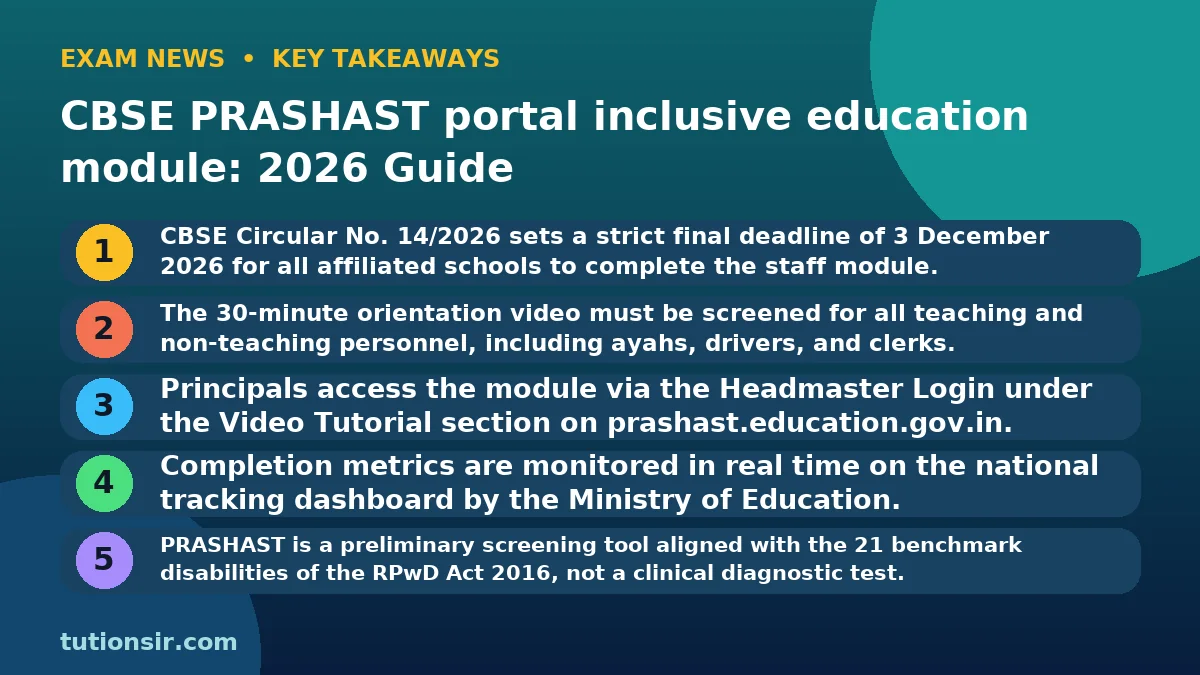
- CBSE Circular No. 14/2026 sets a strict final deadline of 3 December 2026 for all affiliated schools to complete the staff module.
- The 30-minute orientation video must be screened for all teaching and non-teaching personnel, including ayahs, drivers, and clerks.
- Principals access the module via the Headmaster Login under the Video Tutorial section on prashast.education.gov.in.
- Completion metrics are monitored in real time on the national tracking dashboard by the Ministry of Education.
- PRASHAST is a preliminary screening tool aligned with the 21 benchmark disabilities of the RPwD Act 2016, not a clinical diagnostic test.
Try Tution Sir free for your class and subject.
No card. Registering takes about two minutes.
What is the CBSE PRASHAST portal directive for school staff?
In Circular No. 14/2026 released by CBSE Secretary Varun Bhardwaj, the Central Board of Secondary Education directed heads of all affiliated institutions to facilitate the screening of a 30-minute inclusive education sensitization module for their entire staff. This directive follows the board's earlier communication (Circular No. TRG-20/2026 dated 5 October 2026), which initially scheduled the orientation for 7 October 2026. While thousands of schools participated in the opening phase, the board observed that complete submission records from multiple institutions remain pending.
To ensure universal compliance across every CBSE zone, the board established a final window ending on 3 December 2026. The directive originates from policies framed by the Department of School Education & Literacy (DoSEL), Ministry of Education, in partnership with the National Council of Educational Research and Training (NCERT) and Samagra Shiksha. The initiative shifts school culture from isolated special-education silos into a whole-school model where every adult on campus understands and respects the daily requirements of Children with Special Needs (CwSN).
Clearing the confusion: Sensitizing staff vs screening students for disabilities
A common administrative misunderstanding arose when circular summaries mentioned 'screening staff'. The directive does not require schools to screen staff members for disabilities. Instead, it mandates projecting or screening an instructional 30-minute video module to sensitize the staff. This training prepares the entire school ecosystem to support early childhood identification without creating counterproductive labels.
Concurrently, the PRASHAST app 2.0 screening ecosystem operates as a two-stage student evaluation tool in classrooms. General teachers use Part-1 to record observable behavioral and developmental indicators across 21 benchmark conditions recognized by the Rights of Persons with Disabilities (RPwD) Act 2016. Special educators and counselors subsequently use Part-2 to validate those initial observations and coordinate referral camps with district medical boards. Sensitizing the staff is the prerequisite step so teachers and caretakers can administer student screenings accurately.
Who is required to watch the 30-minute inclusive education sensitization module?
CBSE has explicitly stated that the module is not reserved exclusively for subject teachers or designated special educators. Because a student's daily school experience encompasses buses, gates, corridors, and dining halls, inclusive behavior must be practiced by all personnel.
School heads are instructed to schedule screening batches without suspending ongoing classroom instruction. The mandate encompasses all the following roles:
- Heads of Schools (HoS), principals, vice-principals, deans, and academic coordinators.
- All general primary, trained graduate, and postgraduate teachers across every academic subject.
- Special educators, school counselors, student wellness officers, and vocational trainers.
- School bus drivers, conductors, transit attendants, and campus security staff.
- Classroom support staff, aayahs, peons, and sanitation personnel.
- Administrative clerks, front-office receptionists, accountants, and hostel wardens.
| Feature | Sensitization Module (Circular 14/2026) | Student Disability Screening (PRASHAST 2.0) |
|---|---|---|
| Target Audience | Teaching and non-teaching staff (drivers, ayahs, clerks) | Enrolled students across primary and secondary grades |
| Primary Purpose | Build whole-school empathy, accessibility awareness, and respect | Early identification of learning barriers and developmental conditions |
| Duration / Instrument | 30-minute orientation video available in 12 languages | Two-part digital checklist (Part-1: Teacher; Part-2: Specialist) |
| Access Point | prashast.education.gov.in (Headmaster Login > Video Tutorial) | PRASHAST Mobile App (linked to UDISE+ student IDs) |
| Compliance Deadline | 3 December 2026 (strictly monitored on national dashboard) | Ongoing academic session (integrated with Samagra Shiksha camps) |
| Diagnostic Authority | Not applicable (purely an awareness program) | Screening only; medical boards issue legal RPwD certificates |
How can school principals access the sensitization module on prashast.education.gov.in?
Access to the training material is consolidated through the institutional administrative dashboard. Principals and designated headmasters must follow these concrete steps to access the video tutorial and register institutional completion:
First, navigate to the official PRASHAST portal at prashast.education.gov.in using a desktop browser. Select the 'Headmaster Login' option and enter your institutional credentials, which synchronize with your school's UDISE+ (Unified District Information System for Education Plus) code and registered password.
Second, locate the 'Video Tutorial' tab on the left-hand navigation menu. The 30-minute inclusive education video module is hosted here in 12 Indian languages, allowing non-teaching personnel to view the orientation in their primary regional tongue.
Third, organize group viewing sessions in auditoriums, AV rooms, or staggered departmental shifts. Once your institution completes the session, ensure attendance records are verified. The national tracking dashboard maintained by the Ministry of Education logs viewing metrics at the school, block, district, and state levels in real time.
RPwD Act 2016: Benchmark disabilities covered under PRASHAST screening
The PRASHAST framework draws its legal basis directly from the Rights of Persons with Disabilities (RPwD) Act 2016, which expanded recognized conditions from 7 to 21 categories. The sensitization module equips staff to recognize non-visible conditions that are frequently misconstrued as indiscipline, lethargy, or low intellectual ability.
The 21 disabilities covered under PRASHAST include: Blindness, Low Vision, Leprosy Cured Persons, Hearing Impairment (deaf and hard of hearing), Locomotor Disability, Dwarfism, Intellectual Disability, Mental Illness, Autism Spectrum Disorder, Cerebral Palsy, Muscular Dystrophy, Chronic Neurological Conditions, Specific Learning Disabilities (Dyslexia, Dyscalculia, Dysgraphia), Speech and Language Disability, Thalassemia, Hemophilia, Sickle Cell Disease, Multiple Disabilities including Deafblindness, Acid Attack Victims, and Parkinson's Disease.
Pedagogical relevance for CTET, State TET, and B.Ed aspirants
For candidates preparing for the Central Teacher Eligibility Test (CTET) and State TET examinations, the nationwide rollout of PRASHAST 2.0 represents a core syllabus area under Child Development and Pedagogy (CDP). Questions regarding inclusive education frameworks, universal design for learning (UDL), and provisions under the RPwD Act 2016 carry significant weight in both Paper 1 and Paper 2.
Future educators must understand that PRASHAST is strictly an initial screening and observation checklist, never a diagnostic certification. Clinical diagnosis and disability certificate issuance remain the exclusive statutory domain of certified medical specialists at district assessment camps. Grasping this institutional distinction gives competitive candidates an advantage in pedagogical assessments.
Aspiring educators honing their child development concepts can utilize Tution Sir to access structured pedagogy question banks, simulated CTET mock tests, and inclusive classroom case studies tailored to current educational policies.
Frequently asked questions
What is the CBSE PRASHAST portal directive for school staff?
CBSE Circular No. 14/2026 mandates that all affiliated school heads facilitate the screening of a 30-minute inclusive education module for their entire staff using prashast.education.gov.in. It trains personnel to support Children with Special Needs.
What is the deadline for CBSE schools to complete the PRASHAST staff screening?
The final deadline set by CBSE is 3 December 2026. While an initial screening was held on 7 October 2026, pending schools must complete the module and verify completion before this cutoff.
Who is required to watch the 30-minute inclusive education sensitization module?
The training is mandatory for all personnel: principals, subject teachers, special educators, clerical staff, receptionists, hostel wardens, security guards, bus drivers, transit attendants, and ayahs without disrupting essential school operations.
How can school principals access the sensitization module on prashast.education.gov.in?
Principals log into prashast.education.gov.in using their official Headmaster Login credentials linked to their UDISE+ code. They then navigate to the 'Video Tutorial' section to stream or project the 30-minute module.
Is PRASHAST screening a diagnostic test or an initial screening tool?
PRASHAST is strictly an initial pre-assessment screening checklist developed by NCERT. It does not provide medical diagnosis or label students. Official disability certifications can only be issued by registered district medical boards.
How many disabilities are covered under the PRASHAST screening checklist?
The PRASHAST checklist covers 21 benchmark disability conditions specified under the Rights of Persons with Disabilities (RPwD) Act 2016, including physical, intellectual, sensory, neurological, and specific learning disabilities.
How does the national tracking dashboard monitor school completion of the module?
The PRASHAST portal integrates with real-time analytics maintained by the Ministry of Education. School completion logs are visible directly to block, district, state, and national administrators via centralized administrative dashboards.
Sources and official links
- Central Board of Secondary Education (CBSE)
- PRASHAST Portal (Ministry of Education)
- Press Information Bureau (PIB)
- Central Institute of Educational Technology (CIET-NCERT)
Exam rules and notifications change. Confirm dates, fees and eligibility on the official website before acting. Spotted an error? Email support@tutionsir.com. See our editorial policy.
Keep learning
CBSE Circular Acad-78/2026 Bal Vivah Mukt Bharat: Full Guide
The Central Board of Secondary Education has directed all affiliated schools to actively participate in the na
Read →CBSE IPS Portal Evaluation Data Verification 2026
The Central Board of Secondary Education has issued urgent operational instructions directing Chief Nodal Supe
Read →CBSE Mumbai Book Festival 2026: Bagless Days Full Guide
The Central Board of Secondary Education has directed affiliated schools across the Mumbai Metropolitan Region
Read →Do not let another week go by without a plan
Reading about the exam does not raise marks. Practice does. Register free now and start with the one topic that worries you most. Small daily practice beats a last-minute rush.
- Free plan, no card needed
- Ask any doubt and get a step-by-step answer
- Practice questions with explanations
Free plan, no card needed. Your progress is saved to your account.