CISCE • Board Exam Regulations
CISCE Exam Rules Frisking AI Gadgets: 2027 Exam Guide
The Council for the Indian School Certificate Examinations has authorised centre heads to frisk ICSE and ISC candidates while placing a strict prohibition on wearable AI devices. This decisive move ensures absolute examination transparency across all affiliated test centres nationwide.
Quick answer
The CISCE exam rules frisking AI gadgets empower centre heads to physically inspect candidates to prevent unfair means. The council strictly bans AI-assisted spectacles, smart rings, Bluetooth audio eyewear, and digital recording pens, while mandating continuous CCTV coverage. Ordinary analog watches and simple prescription glasses remain permitted under invigilator scrutiny.
Key takeaways
- Centre heads are officially authorised to conduct physical frisking of candidates at their discretion before entry.
- CISCE strictly bans AI smart glasses, smart rings, Bluetooth spectacles, fitness bands, and translation pens.
- ICSE Class 10 examinees are barred from using calculators, while ISC Class 12 students may use approved non-programmable models.
- Continuous CCTV camera surveillance is mandatory inside all examination halls and entry areas.
- Students using therapeutic medical devices or accessibility accommodations must seek advance formal approval from CISCE.
Get a free study plan and practice questions for your class.
No card. Registering takes about two minutes.
Why Did CISCE Authorise Candidate Frisking and Ban Wearable AI?
The Council for the Indian School Certificate Examinations (CISCE) has officially overhauled its examination instructions for ICSE Class 10 and ISC Class 12 candidates. As reported by The Times of India, centre school heads are now explicitly empowered to conduct physical frisking of examinees before they enter the examination rooms. This decision arrives alongside an extensive ban on wearable artificial intelligence hardware and miniaturised smart equipment.
The regulatory update follows rapid advancements in consumer electronics, where recording hardware, micro-earpieces, and augmented-reality optical chips can be embedded within everyday objects. CISCE Chief Executive and Secretary Dr. Joseph Emmanuel underscored the need for vigilant administrative controls, noting that an examination system's credibility rests firmly on fairness, strict administrative integrity, and public confidence. Giving centre superintendents clear discretion to carry out inspections closes critical enforcement loopholes.
Which AI Gadgets and Wearables Are on the CISCE Prohibited Items List?
The council's updated circular specifies that no smart or connected wearable equipment may be brought inside the examination perimeter under any pretext. Candidates who inadvertently carry these items to school must deposit them outside the testing wing before reporting to their assigned room.
The comprehensive CISCE prohibited items list targets devices capable of capturing images, recording speech, transferring data over wireless protocols, or retrieving text. Invigilation personnel have been instructed to pay particular attention to ordinary-looking accessories that conceal microchips.
- AI-assisted eyewear, camera-equipped glasses, and Bluetooth spectacles.
- Smart rings, fitness activity trackers, and health monitoring bands.
- Smartwatches of any operating system, digital programmable timepieces, and pagers.
- Scanner pens, text-translation styluses, voice recorders, and micro-dictaphones.
- Mobile phones, Bluetooth earbuds, wireless neckbands, and concealed magnetic earphones.
- Cheating chits, loose handwritten reference sheets, printed notes, and blank scrap papers.
What Items Are Permitted Inside the ICSE and ISC Exam Hall?
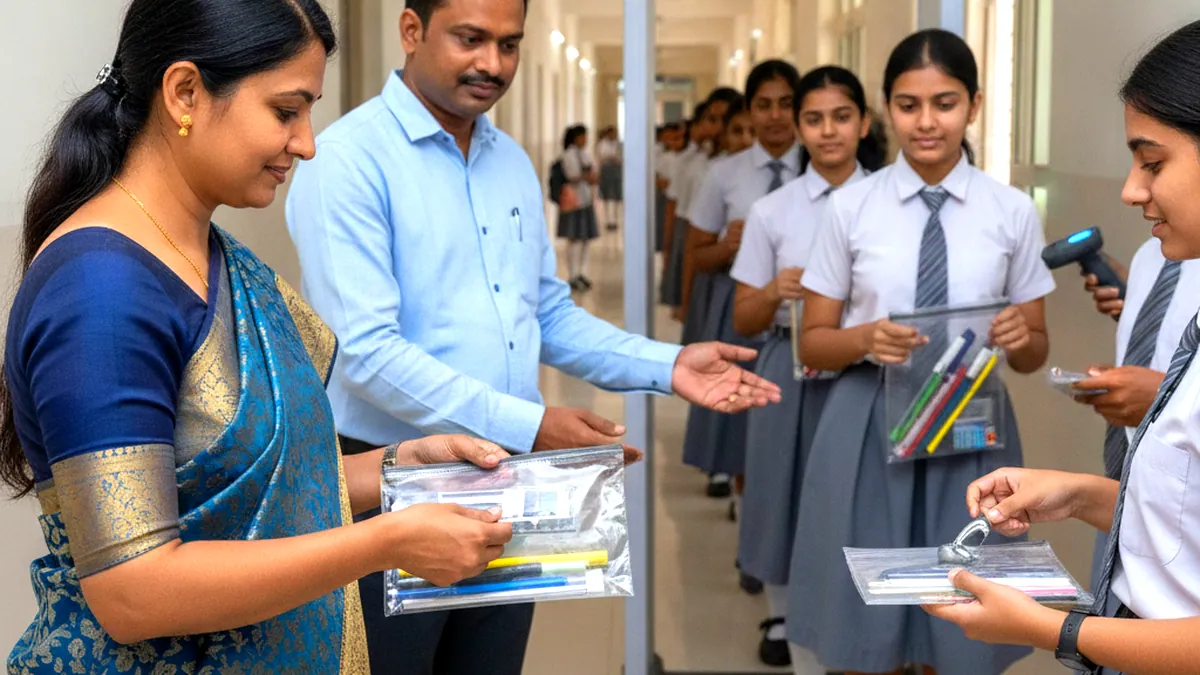
To prevent confusion at the school gate, students should pack only bare essentials in accordance with the official ICSE board exam instructions. All personal stationary must be carried inside a completely transparent, see-through pencil pouch. Tinted, printed, or opaque pouches will be turned away during morning entry screenings.
Candidates may wear basic, prescription-only eyesight spectacles with standard non-electronic frames. Standard analog wristwatches featuring mechanical hands are generally acceptable for monitoring remaining time, though any watch with digital screens, memory modules, or wireless connectivity remains strictly prohibited. Transparent, unlabelled water bottles are allowed on desks.
| Item Category | Permitted Items (Allowed) | Banned Items (Strictly Prohibited) |
|---|---|---|
| Stationery | Blue/black ballpoint pens, pencils, erasers, transparent geometry boxes | Opaque pencil cases, correction pens, scanner pens, text-translation pens |
| Calculators | Non-programmable scientific models (ISC Class 12 only) | Any calculator for ICSE Class 10; programmable models for Class 12 |
| Wearables & Eyewear | Plain analog wristwatches, simple prescription corrective spectacles | AI smart glasses, Bluetooth spectacles, smartwatches, smart fitness rings |
| Communication | None permitted inside the examination room | Smartphones, SIM-enabled devices, wireless earbuds, micro-earpieces |
| Personal Comfort | Completely transparent water bottles, sanctioned medical aids (pre-approved) | Opaque steel flasks, loose paper slips, cheat sheets, digital wallets |
Are Calculators Allowed in ICSE Class 10 and ISC Class 12 Exams?
There is a crucial regulatory difference between Class 10 and Class 12 that examinees must understand clearly. For ICSE Class 10 examinations, calculators of every design—whether simple arithmetic, graphic, or scientific—are completely barred from all subjects, including Mathematics and Commercial Studies. Carrying a calculator into a Class 10 paper constitutes an examination irregularity.
Conversely, for ISC Class 12 board examinations, students are permitted to use non-programmable, standalone scientific calculators for specified STEM and Commerce papers (such as Mathematics, Physics, Chemistry, and Accounts). Permitted hardware is restricted to standard battery-operated scientific models with up to two lines of display (such as the Casio fx-82MS or equivalent). Programmable models with multi-megabyte matrix memory, alphanumeric text recall, or wireless networking are strictly disallowed.
How Will Candidate Frisking Be Conducted at Exam Centres?
CISCE has clarified that physical inspections must be executed with full respect for candidate dignity and emotional composure. Frisking is intended as a preventive deterrent, not a punitive measure. Centre principals and school heads retain discretion regarding how security lines are organised, but standard education board protocols apply.
Under standard operational safety norms, male staff members inspect male students, while designated female educators conduct screenings for female candidates in separate, dignified screening enclosures. Frisking is focused on coat pockets, collar linings, socks, and stationery pouches. Centres are also deploying metal-detecting wands at entry doorways alongside compulsory closed-circuit television (CCTV) coverage that records student entries and examination desks continuously.
What Are the Rules for Students with Medical Needs and Accommodations?
Students who require specialised electronic or mechanical devices for health preservation—such as continuous glucose monitors (CGMs), external insulin infusion pumps, or digital cochlear implants—must not assume automatic clearance on exam morning. These devices risk being stopped at the gate unless supported by advance paperwork.
School heads must forward medical documentation to CISCE well ahead of the exam season to secure formal accommodation certificates. Neurodiverse candidates requiring sensory support, magnifiers, or designated scribes must similarly hold verified council concessions. On exam day, carrying a copy of this official CISCE clearance letter alongside your admit card prevents delays at the security checkpoint.
What Action Does CISCE Take Under Unfair Means (UFM) Regulations?
Being found in possession of an unauthorised gadget inside the exam room carries severe consequences under CISCE Unfair Means (UFM) regulations, regardless of whether the candidate actively consulted the device. Proximity and possession alone constitute a breach of examination integrity.
Penalties can range from immediate disqualification and cancellation of the subject paper to complete debarment from board examinations for several successive years. Students should build calm exam-day habits early: arrive 45 minutes before bell time, systematically empty pockets at home, and double-check stationary kits before boarding school transport. For steady, structured subject mastery without eleventh-hour anxiety, students can also rely on comprehensive practice papers and intelligent doubt resolution on Tution Sir.
Frequently asked questions
Are exam centre heads allowed to frisk candidates before CISCE board exams?
Yes. CISCE has formally authorised centre heads to use their discretion in frisking ICSE and ISC examinees prior to room entry. The physical checks are designed to ensure no banned electronics or unauthorized paper notes pass through security perimeters.
Which AI gadgets and wearable devices are strictly prohibited by CISCE?
CISCE has banned all wearable artificial intelligence gear. This includes smart glasses equipped with cameras or head-up displays, Bluetooth spectacles, smart health rings, smartwatches, digital audio transmitters, and optical translation pens.
Can students wear analog or digital watches during ICSE and ISC examinations?
Candidates may wear simple analog wristwatches featuring standard clock faces to manage writing pace. However, all digital wristwatches, programmable digital timers, fitness trackers, and smartwatches are strictly barred from the exam room.
Are smart rings and Bluetooth-enabled spectacles banned in CISCE exams?
Yes, smart rings and Bluetooth-enabled frames are explicitly prohibited under the council's updated instructions. Because these accessories look similar to normal jewellery or reading glasses while concealing microchips, invigilators will verify frames closely.
Are calculators allowed for ICSE Class 10 and ISC Class 12 exams?
No calculators are allowed for ICSE Class 10 examinees under any circumstances. For ISC Class 12, students are permitted to use approved, standalone non-programmable scientific calculators for designated quantitative subjects such as Mathematics, Physics, and Chemistry.
Is CCTV camera surveillance mandatory in CISCE exam centres?
Yes. Continuous CCTV camera coverage is compulsory across all CISCE examination centres. Cameras must monitor the halls, entryways, and sensitive storage locations to provide an objective video record of exam integrity.
What action does CISCE take if a student is caught with prohibited electronic items?
Possessing a prohibited device inside the examination hall triggers CISCE's Unfair Means regulations. Depending on the inquiry findings, the board can cancel the candidate's paper, nullify their entire examination result, or bar them from future board examinations.
Sources and official links
Exam rules and notifications change. Confirm dates, fees and eligibility on the official website before acting. Spotted an error? Email support@tutionsir.com. See our editorial policy.
Keep learning
ICSE Class 10 Exam Timing 2027: Start Time and Duration
The Council for the Indian School Certificate Examinations is advancing morning board exams by one hour starti
Read →ICSE & ISC Date Sheet 2027: Class 10 and 12 Exam Dates
The Council for the Indian School Certificate Examinations (CISCE) will publish the ICSE and ISC board examina
Read →CISCE Date Sheet 2027: ICSE 10th & ISC 12th Schedule Out
The Council for the Indian School Certificate Examinations (CISCE) has officially released the comprehensive t
Read →Do not let another week go by without a plan
Knowing the ICSE dates is step one. Using the weeks before them well is what decides marks. Register free now and start with the one topic that worries you most. Small daily practice beats a last-minute rush.
- Free plan, no card needed
- Ask any doubt and get a step-by-step answer
- Practice questions with explanations, chapter by chapter
Free plan, no card needed. Your progress is saved to your account.