ICSE Board · Academic Assessment
CISCE OECD Benchmark Test: Class 10 Maths & Science
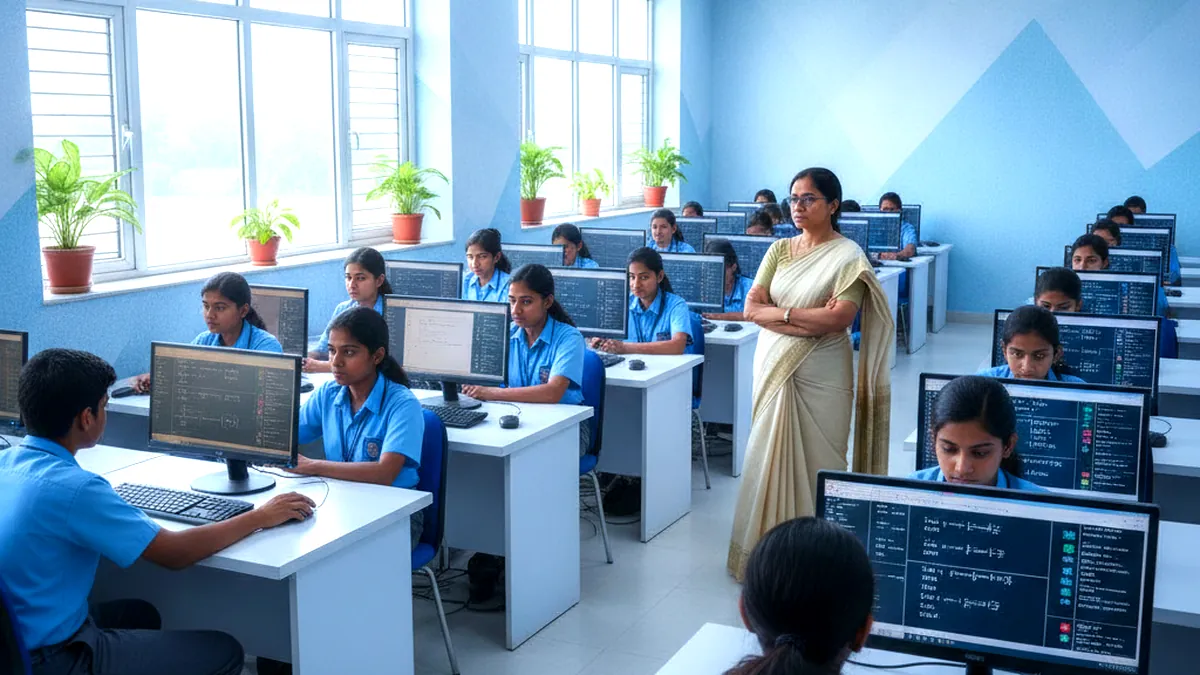
The Council for the Indian School Certificate Examinations (CISCE) is partnering with the OECD to conduct an international benchmark test for Class 10 students across selected affiliated schools. The initiative measures real-world reasoning in Mathematics and Science without altering board marks.
Quick answer
The CISCE OECD benchmark test is a national diagnostic assessment conducted by CISCE in collaboration with the OECD. Administered through the PISA for Schools framework, it evaluates 15- and 16-year-old ICSE Class 10 students on real-world application in Mathematics, Science, and Reading without impacting board exam marks.
Key takeaways
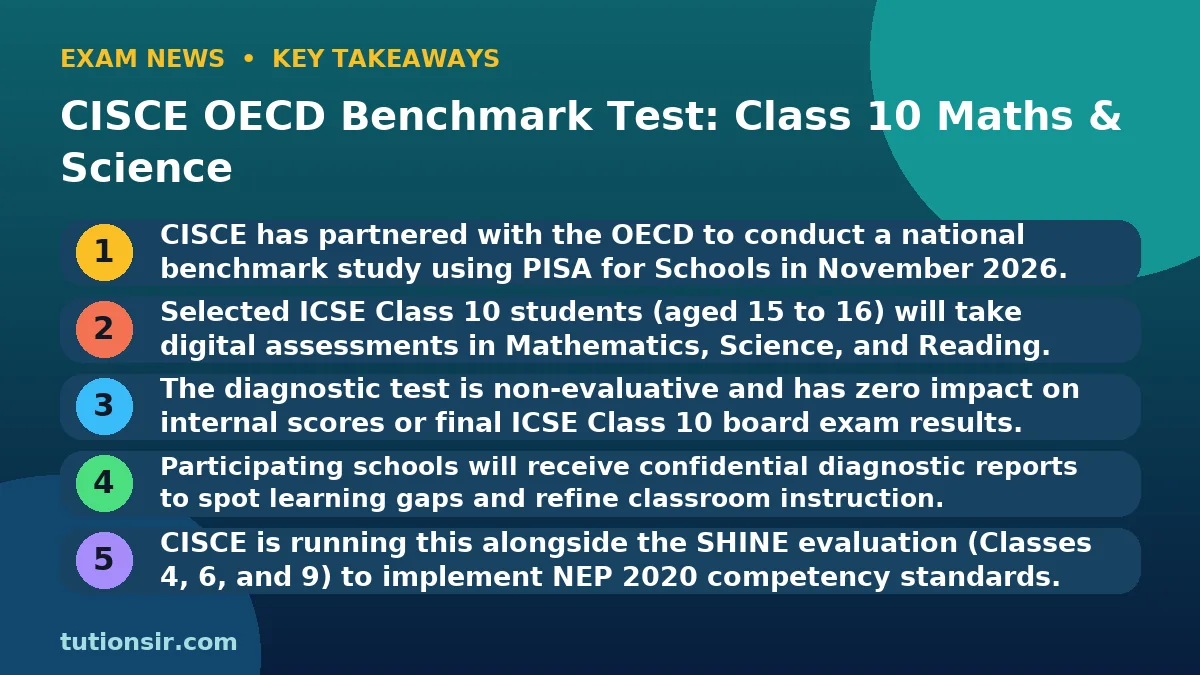
- CISCE has partnered with the OECD to conduct a national benchmark study using PISA for Schools in November 2026.
- Selected ICSE Class 10 students (aged 15 to 16) will take digital assessments in Mathematics, Science, and Reading.
- The diagnostic test is non-evaluative and has zero impact on internal scores or final ICSE Class 10 board exam results.
- Participating schools will receive confidential diagnostic reports to spot learning gaps and refine classroom instruction.
- CISCE is running this alongside the SHINE evaluation (Classes 4, 6, and 9) to implement NEP 2020 competency standards.
Get a free study plan and practice questions for your class.
No card. Registering takes about two minutes.
Why Is CISCE Conducting a National Study With the OECD?
Indian school education is transitioning from textbook rote learning toward critical thinking and practical problem-solving. As part of this academic shift, the Council for the Indian School Certificate Examinations (CISCE) has joined hands with the Organisation for Economic Co-operation and Development (OECD) to evaluate learning outcomes across affiliated institutions, as reported by Careers360 and The Telegraph.
According to official communications from CISCE Chief Executive and Secretary Dr. Joseph Emmanuel, the joint study pairs national diagnostics with global benchmarks. By collecting field evidence from selected ICSE schools, the board intends to understand how well Indian learners navigate unfamiliar contexts compared to their global peers. This aligns with the mandates of the National Education Policy (NEP 2020) and the national assessment centre PARAKH, which advocate for competency-based school education.
PISA for Schools vs CISCE SHINE: What Is the Difference?
CISCE's dual assessment strategy operates on two distinct tracks. The foundational track is CISCE SHINE (Student Holistic Insight and Nurturing Evaluation), an indigenous computer-based assessment for younger learners in Classes 4, 6, and 9 held between November 15 and December 7. SHINE assesses English, Mathematics, and Science to provide early-stage diagnostics within the national curriculum framework.
In contrast, the Class 10 exercise utilizes PISA for Schools, a globally standardised evaluation developed by the OECD. Target learners are 15- to 16-year-old secondary students. While SHINE benchmarks internal curriculum mastery over time, PISA for Schools measures international functional literacy. Class 10 candidates do not regurgitate memorised proofs; instead, they solve multi-step problems based on scientific inquiries, graphs, and everyday mathematical models. Shortlisted institutions for the PISA component are notified through official board circulars by mid-November.
Will the CISCE OECD Test Marks Affect ICSE Class 10 Board Exam Results?
No, the CISCE OECD benchmark test marks will not affect your ICSE Class 10 board exam results, admit cards, or internal school grades. Students and parents frequently worry that unexpected test scores could jeopardise board aggregates or stream allocation in Class 11, but CISCE has confirmed that this assessment is entirely diagnostic.
Neither student marksheets nor school progress reports will record individual marks from this exercise. Instead, participating schools receive an institutional diagnostic dossier from the OECD. This dossier highlights collective classroom proficiencies, gender distribution in analytical skills, and areas where conceptual understanding lags. The council uses anonymised data to build a national-level perspective on curriculum implementation.
| Feature | ICSE Class 10 Board Exam | CISCE OECD PISA for Schools |
|---|---|---|
| Primary Purpose | Summative evaluation of academic syllabus | Diagnostic benchmark of real-world reasoning |
| Assessment Areas | Prescribed subjects across Groups I, II, and III | Applied Mathematics, Science, and Reading literacy |
| Question Format | Direct numericals, definitions, and theory questions | Contextual scenarios, infographics, and data analysis |
| Impact on Student Grade | Determines final Class 10 marksheet and pass certificate | Zero impact on student marks, GPA, or board results |
| Administration Mode | Pen-and-paper written exam | Digital, computer-based assessment |
| Reporting Output | Individual subject scores and pass division | Institutional and national competency diagnostic report |
How Do OECD Scenario-Based Questions Differ From ICSE Exams?
Traditional ICSE examinations excel at testing depth of syllabus coverage, procedural accuracy, and precise terminology. Students are accustomed to balancing chemical equations, solving direct quadratic equations, or stating Newton's laws from memory. In an OECD assessment, the format shifts entirely to applied literacy.
In OECD Mathematics, for instance, a candidate might be presented with real flight delay statistics, fluctuating solar panel outputs, or foreign exchange rates and asked to determine cost efficiency over five years. Rather than just applying a formula, the student must select relevant variables, filter out extraneous numbers, and justify their mathematical reasoning.
In OECD Science, questions avoid standard definitions like 'define osmosis.' Instead, students receive simulated lab data, such as water purification test results in an agricultural community, and must evaluate which hypothesis the findings support. The reading domain follows a similar path, testing whether a student can evaluate source bias, compare contrasting opinion pieces, and extract evidence from non-continuous texts such as infographics and flowcharts.
Logistics for Schools: Lab Infrastructure and Student Selection
CISCE is selecting affiliated schools through a randomised sampling methodology designed to represent diverse geographic and socio-economic demographics. Selected institutions are responsible for smooth execution through their existing computer laboratories.
Principals and IT coordinators must ensure standard testing parameters prior to exam day:
Because tests are computer-administered, schools must verify uninterrupted internet bandwidth, functional client systems, and power backup solutions. Invigilators undergo specific briefing sessions to ensure that testing protocols remain strictly objective, without teacher intervention during problem-solving sessions.
How Students Can Build Competency-Based Analytical Skills
Preparing for an OECD benchmark test does not require buying new textbooks or enrolling in cram courses. In fact, typical test-preparation techniques often backfire because PISA-styled questions explicitly avoid predictable syllabus patterns. Instead, students should cultivate curiosity and regular reading habits.
A productive weekly routine involves reading editorial columns, examining data visualisations in reputable science journals, and translating real-world scenarios into mathematical relationships. For instance, when studying commercial mathematics, students can analyse household electricity tariffs or compare bank savings schemes.
Learners wanting structured practice for both competency-based questions and upcoming ICSE board examinations can use platforms like Tution Sir, which provides AI-driven problem sets and personalised concept diagnostics tailored to the evolving Indian curriculum. Consistent practice builds the cognitive endurance needed to read dense scenario prompts without feeling overwhelmed.
Frequently asked questions
What is the OECD benchmark test for CISCE Class 10 students?
It is a computer-based diagnostic evaluation conducted by CISCE alongside the OECD using the PISA for Schools framework. It measures how effectively 15- and 16-year-old ICSE Class 10 students apply Mathematics, Science, and Reading skills to real-life challenges, offering benchmark insights against international educational standards.
Is the OECD PISA test mandatory for all ICSE Class 10 students?
No, it is not mandatory for every ICSE student. CISCE chooses participating schools and cohorts using a randomised sampling procedure to ensure a nationally representative study. Only students in selected schools notified by CISCE will take the benchmark test in November.
Will the OECD benchmark test marks be added to ICSE Class 10 board exam results?
No, the scores will not be added to your board results. The OECD benchmark assessment is strictly diagnostic and non-evaluative for the individual. The results do not appear on report cards, affect internal grades, or influence eligibility for Class 11 stream selection.
Which subjects are tested in the CISCE OECD benchmark assessment?
The assessment evaluates proficiency across three core domains: Mathematical Literacy, Scientific Literacy, and Reading Literacy. Questions are presented as real-world scenarios, requiring candidates to interpret charts, verify scientific claims, and apply mathematical logic rather than recalling memorised textbook definitions.
What is the difference between CISCE SHINE and PISA for Schools?
CISCE SHINE is an internal, curriculum-linked assessment conducted between November 15 and December 7 for Classes 4, 6, and 9. PISA for Schools is an OECD-partnered international benchmark conducted in November specifically for 15- to 16-year-old secondary learners in Class 10.
How can ICSE Class 10 students prepare for OECD Maths and Science questions?
Students should focus on understanding core principles rather than memorising formulas. Practise interpreting graphs, reading non-fiction articles, solving scenario-based word problems, and discussing everyday science applications. Approaching problems logically and reading data carefully is the best preparation.
Sources and official links
Exam rules and notifications change. Confirm dates, fees and eligibility on the official website before acting. Spotted an error? Email support@tutionsir.com. See our editorial policy.
Keep learning
CISCE SHINE 2026 Registration: Fast-Track Notice Out
The Council for the Indian School Certificate Examinations (CISCE) has directed all affiliated institutions to
Read →NHRC notice Education Ministry Children's Day Veer Baal Diwas
The National Human Rights Commission has directed the Union Ministry of Education to submit an Action Taken Re
Read →ICSE Class 10 Date Sheet 2027: Dates + Study Plan
The date sheet tells you when. This guide tells you how to use the 13 weeks before the first paper, so that ea
Read →Do not let another week go by without a plan
Knowing the ICSE dates is step one. Using the weeks before them well is what decides marks. Register free now and start with the one topic that worries you most. Small daily practice beats a last-minute rush.
- Free plan, no card needed
- Ask any doubt and get a step-by-step answer
- Practice questions with explanations, chapter by chapter
Free plan, no card needed. Your progress is saved to your account.