CTET · Exam Guide
CTET Paper 1 Preparation Strategy: 60-Day Self-Study Plan
Qualifying CTET Paper 1 without expensive coaching is completely achievable with the right blueprint. This beginner-focused 60-day roadmap unpacks syllabus nuances, NCERT facts, and child-centric pedagogy to ensure you clear the qualifying cutoff comfortably.
Quick answer
A successful CTET Paper 1 preparation strategy requires mastering the 75 pedagogy marks across Child Development, Maths, EVS, and Languages, reading NCERT Class 3 to 5 textbooks, and solving past papers. By dedicating 3 to 4 hours daily over a structured 60-day timetable, beginners can surpass the 90-mark qualifying cutoff without coaching.

Key takeaways
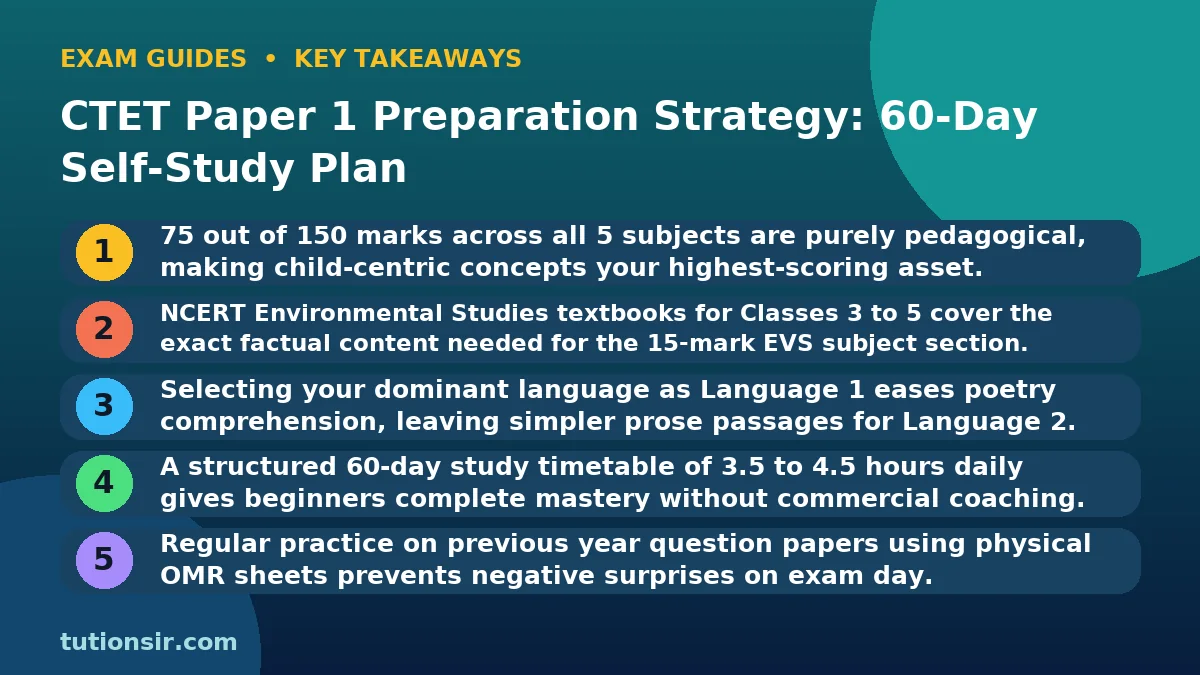
- 75 out of 150 marks across all 5 subjects are purely pedagogical, making child-centric concepts your highest-scoring asset.
- NCERT Environmental Studies textbooks for Classes 3 to 5 cover the exact factual content needed for the 15-mark EVS subject section.
- Selecting your dominant language as Language 1 eases poetry comprehension, leaving simpler prose passages for Language 2.
- A structured 60-day study timetable of 3.5 to 4.5 hours daily gives beginners complete mastery without commercial coaching.
- Regular practice on previous year question papers using physical OMR sheets prevents negative surprises on exam day.
What Is the CTET Paper 1 Syllabus and Exam Pattern?
The Central Teacher Eligibility Test (CTET), conducted by the Central Board of Secondary Education (CBSE) under guidelines from the National Council for Teacher Education (NCTE), determines eligibility for teaching Classes 1 to 5 in central government schools such as KVS and NVS, union territories, and private unaided institutions.
The Paper 1 examination consists of 150 multiple-choice questions carrying 150 marks, with a total duration of 150 minutes (2.5 hours). There is no negative marking for incorrect responses. The exam covers five compulsory sections of 30 marks each: Child Development and Pedagogy (CDP), Mathematics, Environmental Studies (EVS), Language 1, and Language 2.
According to NCTE notification benchmarks, candidates in the General category must secure at least 60% (90 out of 150 marks) to qualify. Candidates belonging to Scheduled Castes (SC), Scheduled Tribes (ST), Other Backward Classes (OBC-NCL), and Persons with Benchmark Disabilities (PwBD) typically receive a 5% concession, requiring 55% (82 out of 150 marks), though exact recruitment concessions depend on the recruiting state or board policy.
- Child Development and Pedagogy: 30 Questions / 30 Marks (15 on Child Development, 5 on Inclusive Education, 10 on Learning and Pedagogy)
- Mathematics: 30 Questions / 30 Marks (15 Content from primary curriculum + 15 Pedagogical Issues)
- Environmental Studies: 30 Questions / 30 Marks (15 Content based on NCERT themes + 15 Pedagogical Issues)
- Language 1: 30 Questions / 30 Marks (15 Reading Comprehension of 1 prose and 1 poem + 15 Pedagogy of Language Development)
- Language 2: 30 Questions / 30 Marks (15 Reading Comprehension of 2 prose passages + 15 Pedagogy of Language Development)
The 50% Pedagogy Rule: Why CTET Paper 1 Is Won in the Mind, Not Rote Learning
Beginners often fall into the trap of memorising mathematical formulas, obscure environmental trivia, and deep grammatical terminology. In reality, CTET is an aptitude test designed to evaluate whether you think like a progressive primary educator aligned with the National Curriculum Framework (NCF 2005) and NEP 2020.
A closer look at the marking blueprint reveals the '50% pedagogy rule': out of 150 marks, exactly 75 marks are dedicated to pedagogical issues across the five sections. Child Development and Pedagogy accounts for 30 marks, while Mathematics, EVS, Language 1, and Language 2 each allocate exactly 15 marks to pedagogy.
This design means that if you understand child-centric classroom principles, you can secure up to 70 out of those 75 pedagogy marks without advanced arithmetic or grammar knowledge. By combining that foundation with basic NCERT Class 3 to 5 content, clearing the 90-mark barrier becomes natural and stress-free.
The Positive and Negative Keyword Technique for Pedagogy
CBSE constructs multiple-choice questions with distinct philosophical triggers. When evaluating options, immediately eliminate choices containing negative keywords such as rote learning, cramming, passive listening, segregation, punishing, standardising testing, teacher-centric control, drill-and-practice, or labeling children by ability.
Conversely, correct options in pedagogy consistently feature positive constructivist keywords: active participation, hands-on exploration, peer learning, diagnostic teaching followed by remedial instruction, prior knowledge, scaffolding, learning by doing, inclusive classrooms, and treating errors as windows into children's conceptual thinking.
What Is the Difference Between Language 1 and Language 2 in CTET Paper 1?
The difference between Language 1 and Language 2 in CTET Paper 1 lies primarily in the comprehension section: Language 1 tests proficiency as the primary medium of instruction and includes one prose passage alongside one poem, whereas Language 2 features two prose passages with no poetry.
Choosing which language to designate as Language 1 and Language 2 is one of the most critical decisions in your CTET Paper 1 self study plan. For example, if you are equally familiar with Hindi and English, choosing Hindi as Language 1 and English as Language 2 is usually the higher-scoring combination.
Interpreting Hindi poetry (kavita) and answering poetic inference questions is generally more intuitive for native speakers than deciphering archaic idioms and poetic meters in English poetry. Meanwhile, facing two prose passages in English Language 2 enables straightforward scanning for factual answers, saving time and mental energy during the exam.
- Language 1 Comprehension (15 Marks): One prose or drama passage (approx. 9 marks) plus one poem (approx. 6 marks). Tests literary appreciation, inference, and contextual vocabulary.
- Language 2 Comprehension (15 Marks): Two unseen prose passages (discursive, literary, scientific, or narrative). Factual questions are direct and quicker to verify.
- Pedagogy in Both (15 Marks each): Topics are virtually identical—Principles of Language Teaching, Role of Listening and Speaking, Multilingualism as a Resource, and Remedial Teaching.
| Subject & Focus Area | Marks Breakdown | Recommended Study Days | Primary Learning Resources | Target Safe Score |
|---|---|---|---|---|
| Child Development & Pedagogy (CDP) | 30 Marks (Core Theories & Inclusion) | Days 1 to 15 | D.El.Ed / B.Ed Textbooks, Past CBSE Papers | 26+ / 30 |
| Environmental Studies (EVS) | 15 Content + 15 Pedagogy (30 Marks) | Days 16 to 30 | NCERT Class 3 to 5 'Looking Around' Textbooks | 24+ / 30 |
| Mathematics (Primary Stage) | 15 Content + 15 Pedagogy (30 Marks) | Days 31 to 42 | NCERT Class 3 to 5 Maths, Teaching-Learning Tools | 22+ / 30 |
| Language 1 (e.g., Hindi / Regional) | 15 Comprehension + 15 Pedagogy (30 Marks) | Days 43 to 46 | NCERT Language Pedagogy, PYQ Passages & Poems | 24+ / 30 |
| Language 2 (e.g., English / Hindi) | 15 Comprehension + 15 Pedagogy (30 Marks) | Days 47 to 50 | Unseen Prose Practice, Krashen & Chomsky Notes | 22+ / 30 |
| Mock Drills, OMR Practice & Revision | Full 150-Mark Simulated Tests | Days 51 to 60 | CBSE Official Question Papers (Last 5 Years) | 118+ / 150 |
Subject-Wise NCERT Booklist and Study Techniques for Paper 1
Preparing without coaching requires relying on standard, board-recommended materials rather than bloated private guides. The official CBSE syllabus directly aligns with NCERT publications and elementary teacher training curricula like the Diploma in Elementary Education (D.El.Ed).
For Child Development and Pedagogy, your primary anchor should be the core developmental theories of Jean Piaget (cognitive development stages, assimilation, accommodation), Lev Vygotsky (Zone of Proximal Development, More Knowledgeable Other, private speech), and Lawrence Kohlberg (levels of moral development). Complement these with inclusive education principles, addressing learning disabilities such as dyslexia, dyscalculia, and dysgraphia.
For Environmental Studies (EVS), the 15 content marks come directly from NCERT Class 3, 4, and 5 textbooks: 'Looking Around' (Aas Paas). You must master the 6 central themes prescribed by CBSE: Family and Friends (with subthemes: Relationships, Work and Play, Animals, Plants), Food, Shelter, Water, Travel, and Things We Make and Do.
For Mathematics, focus on primary arithmetic: numbers, place value, operations, patterns, shapes, spatial understanding, measurement, money, and time. In pedagogy, learn concepts like Van Hiele's levels of geometric thought, inductive vs deductive methods, and mathematical tools like geoboards, abacuses, and dot paper.
For Languages, do not waste weeks studying heavy grammar manuals. CTET questions test grammar strictly in the context of the reading passages (nouns, pronouns, antonyms, prefixes, tense forms). Focus your time on language pedagogy: Stephen Krashen's language acquisition hypothesis, Chomsky's Language Acquisition Device (LAD), and basic language skills (LSRW: Listening, Speaking, Reading, Writing).
How Should Beginners Structure a 60-Day Self-Study Timetable?
A realistic 60-day study timetable requires 3.5 to 4.5 hours of focused, daily commitment divided into two dedicated slots. Beginners should not attempt to study all five subjects each day; instead, rotate subjects to build deep conceptual clarity before moving to comprehensive revisions.
Below is an actionable, week-by-week 60-day breakdown designed for first-time aspirants, working professionals, and student teachers preparing from home.
Phase 1: Days 1 to 15 — CDP Core Theories and Child Psychology
Dedicate the first two weeks to building an unshakeable foundation in Child Development and Pedagogy. Study growth vs development, heredity and environment, and socialisation agents (family, school, peers).
Spend Days 6 to 11 deeply analysing Piaget, Vygotsky, and Kohlberg. Practice at least 20 past questions after completing each theorist. Spend Days 12 to 15 on Inclusive Education, gifted learners, and learning disabilities. Strong CDP mastery will automatically uplift your pedagogical score across all remaining subjects.
Phase 2: Days 16 to 30 — NCERT EVS Content and Pedagogy
Read NCERT Class 3 'Looking Around' on Days 16 to 18, Class 4 on Days 19 to 23, and Class 5 on Days 24 to 27. Create concise, one-page bullet summaries of key facts: nesting habits of birds (weaver bird, sunbird), elephant herd dynamics, Khejadi trees, desert oak, Mid-Day Meal guidelines, and traditional water reservoirs (bawris).
Dedicate Days 28 to 30 to EVS pedagogy, learning how integrated EVS combines science, social science, and environmental education, and studying activities that promote open-ended questioning.
Phase 3: Days 31 to 42 — Primary Mathematics and Pedagogical Issues
Use Days 31 to 37 to solve basic NCERT Class 3 to 5 maths problems involving fractions, patterns, weights, measures, time conversions, perimeter, and 2D/3D shapes. Keep your arithmetic steps quick and tidy.
From Days 38 to 42, focus exclusively on maths pedagogy: how children learn mathematics, diagnostic testing, common misconceptions, error analysis, and the use of concrete manipulatives (Dienes blocks, tangrams).
Phase 4: Days 43 to 50 — Language 1 and Language 2 Mastery
Practice two unseen passages (one prose, one poem) daily for Language 1, and two prose passages for Language 2. Work on skimming and scanning strategies to locate answers without rereading whole paragraphs.
Cover core language pedagogy theories: Chomsky's innate universal grammar, B.F. Skinner's imitation model, Krashen's natural order, multilingualism as an instructional resource, and remedial teaching protocols.
Phase 5: Days 51 to 60 — Full-Length PYQ Drills and OMR Mastery
During the final 10 days, stop learning new theoretical topics. Solve one complete previous year question paper (from 2021 to 2025/2026 cycles) every alternate day in an exam-like environment from 9:30 AM to 12:00 PM.
Use physical printouts of CTET OMR sheets and fill them with a black or blue ballpoint pen. Use the alternate recovery days (Days 52, 54, 56, 58, 60) to maintain an error log, reviewing every incorrect or guessed question to eliminate lingering conceptual doubts.
Mock Test Strategy, OMR Time Allocation, and Error Analysis
Time management is where many well-prepared candidates stumble. 150 questions in 150 minutes allows exactly one minute per question, but bubbling an OMR sheet manually consumes 15 to 20 minutes across 150 bubbles.
Adopt a staggered bubbling strategy: solve an entire 30-question section in your question booklet, cross-verify your answers, and then bubble all 30 responses onto the OMR sheet at once. Never leave all 150 bubbles for the last 15 minutes, as an accidental one-row shift can invalidate dozens of answers.
- Minutes 0 to 25: Child Development and Pedagogy (Solve 30 questions + bubble OMR)
- Minutes 25 to 50: Environmental Studies (Solve 30 questions + bubble OMR)
- Minutes 50 to 80: Language 1 (Solve 30 questions including poetry + bubble OMR)
- Minutes 80 to 110: Language 2 (Solve 30 questions including both prose passages + bubble OMR)
- Minutes 110 to 140: Mathematics (Solve 15 pedagogy + 15 calculation questions + bubble OMR)
- Minutes 140 to 150: Final review of skipped questions and unbubbled entries
Common Beginner Mistakes to Avoid During CTET Paper 1 Preparation
Many candidates spend weeks reading general static GK, history, and advanced general science books for the EVS section. CTET Paper 1 EVS does not test competitive civil services GK; it strictly tests NCERT primary environmental science and classroom pedagogy.
Another classic mistake is purchasing bulky English and Hindi grammar guides to memorise rules of sandhi, samas, figures of speech, or verb conjugations. In CTET, grammatical questions are contextual and rarely exceed 3 to 4 marks across the entire paper.
Finally, candidates frequently neglect verifying answer keys with the official CBSE provisional and final answer keys. Unofficial answer keys from commercial coaching centres often misinterpret pedagogy questions. Relying exclusively on official CBSE answer keys ensures your thinking aligns with the examiners' scoring logic.
For candidates balancing teaching duties or family routines, practicing interactive pedagogy quizzes and tracking weak chapters with adaptive digital platforms like Tution Sir can streamline your revision and reinforce child-centric elimination habits during your final prep weeks.
Frequently asked questions
Can a beginner clear CTET Paper 1 in 60 days through self-study?
Yes, beginners can comfortably clear CTET Paper 1 in 60 days through self-study by dedicating 3.5 to 4.5 hours daily. Because 75 out of 150 marks are based on pedagogy and the content is rooted in NCERT Class 3 to 5 concepts, focused conceptual study and previous year papers are sufficient without expensive coaching.
What is the passing cut-off mark for CTET Paper 1 for General and reserved categories?
According to official CBSE and NCTE guidelines, candidates in the General category must score a minimum of 60% (90 out of 150 marks) to qualify. Candidates belonging to SC, ST, OBC, and PwBD categories require 55% (82 out of 150 marks) to receive the CTET qualifying eligibility certificate.
Which NCERT books should I read for CTET Paper 1 EVS and Maths?
For EVS, thoroughly read NCERT Class 3, 4, and 5 textbooks titled 'Looking Around' (Aas Paas). All 15 content questions are drawn directly from their chapters. For Mathematics, review NCERT Class 3 to 5 'Math-Magic' to master foundational concepts such as fractions, shapes, measurements, and numerical patterns.
How should I prepare Child Development and Pedagogy (CDP) for CTET Paper 1?
Master the developmental theories of Jean Piaget, Lev Vygotsky, and Lawrence Kohlberg. Understand progressive education, inclusive classrooms, learning disabilities (dyslexia, dyscalculia), and formative assessment. Solve past CBSE question papers to learn how to identify child-centric, constructive choices and eliminate punitive or rote-learning options.
What is the difference between Language 1 and Language 2 in CTET Paper 1?
In Language 1, the 15-mark comprehension section contains one prose passage and one poem. In Language 2, comprehension contains two prose passages without poetry. The remaining 15 marks in both sections cover language pedagogy. Candidates generally score higher by selecting their primary native language as Language 1.
How many hours should I study daily for CTET Paper 1 in a 2-month plan?
Beginners should study 3.5 to 4 hours daily. Divide this time into two separate sessions: a 2-hour morning slot focused on conceptual theories and NCERT reading, and a 1.5 to 2-hour evening slot dedicated to solving previous year questions and pedagogical error analysis.
Is there any negative marking in the CTET Paper 1 exam?
No, there is no negative marking in CTET Paper 1. Each of the 150 questions carries 1 mark, and zero marks are deducted for incorrect answers. Candidates should attempt every question on the OMR sheet, using educated elimination on difficult pedagogy items.
How important are previous year question papers (PYQs) for CTET Paper 1?
Previous year question papers are the most vital resource for CTET. Over 40% of pedagogical concepts and framing patterns repeat across exam cycles. Solving official CBSE question papers from recent online and offline exams ensures familiarity with question styles, OMR pacing, and child-centric options.
Sources and official links
- Central Teacher Eligibility Test (CTET) Official Portal
- National Council of Educational Research and Training (NCERT)
- Central Board of Secondary Education (CBSE)
Exam rules and notifications change. Confirm dates, fees and eligibility on the official website before acting. Spotted an error? Email support@tutionsir.com. See our editorial policy.
Keep learning
CTET Paper 2 Preparation: Maths, Science & SST Plan
Passing CTET Paper 2 means balancing teaching ideas with strong subject knowledge. The exam covers NCERT sylla
Read →CTET CDP: Topic-Wise Weightage and Prep Strategy
Child Development and Pedagogy (CDP) has 30 compulsory marks in both CTET Paper 1 and Paper 2. It forms the fo
Read →UP Special TET Answer Key 2026: How to File Objections
The Uttar Pradesh Education Service Selection Commission has published the provisional response keys for the U
Read →CTET free practice and syllabus
Free practice and study help
Read →West Bengal TET practice
Free practice and study help
Read →Practise what you just read
Free plan, no card needed. Full mock tests and the complete question bank are on the Pro plan.