Class 9 to 12 · Physics Strategy
How to Solve Physics Numericals Easily: 5-Step Guide
Struggling to solve numerical problems even when you remember every formula is the single most common frustration for secondary and higher secondary physics students. Here is a battle-tested, step-by-step problem-solving method designed to eliminate calculation anxiety and unlock full step marks.
Quick answer
To solve physics numericals easily, use a five-step sequence: read the problem to decode hidden values, sketch a diagram or free-body diagram, convert all quantities to standard SI units, select the formula and isolate the unknown variable, and calculate the final value with correct units and physical sanity checks.

Key takeaways
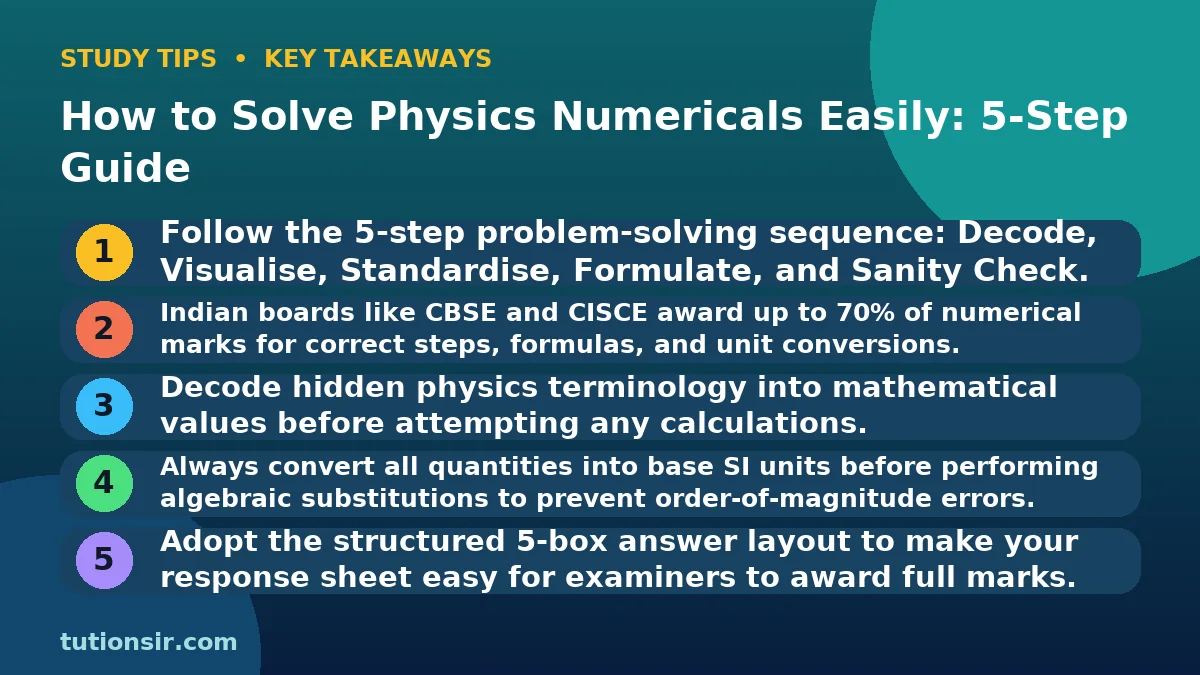
- Follow the 5-step problem-solving sequence: Decode, Visualise, Standardise, Formulate, and Sanity Check.
- Indian boards like CBSE and CISCE award up to 70% of numerical marks for correct steps, formulas, and unit conversions.
- Decode hidden physics terminology into mathematical values before attempting any calculations.
- Always convert all quantities into base SI units before performing algebraic substitutions to prevent order-of-magnitude errors.
- Adopt the structured 5-box answer layout to make your response sheet easy for examiners to award full marks.
Why do students get stuck on physics numericals despite knowing formulas?
Most students do not fail physics numericals because of poor mathematical skills or forgotten equations; they struggle because of cognitive overload during the translation phase. When you read a word problem, your brain must simultaneously read narrative English, map physical phenomena to conceptual definitions, filter out distractor information, retrieve relevant mathematical equations, convert mismatched metrics, and execute multi-step arithmetic.
When these operations happen at once without a structured sequence, working memory becomes saturated. You end up staring at a blank answer sheet or randomly plugging numbers into whichever formula feels familiar. To overcome numerical phobia across Class 9, Class 10, Class 11, and Class 12, you must treat numerical problem-solving as an algorithmic pipeline rather than an act of creative guesswork.
- Cognitive overload occurs when interpreting narrative text, physical conditions, and algebraic manipulation simultaneously.
- Formula hunting—scanning equations to match given letters—bypasses fundamental conceptual reasoning.
- Unstructured scrap calculations lead to misplaced negative signs and arithmetic carry-over errors.
- Lack of visual grounding keeps abstract scenarios unorganised on the answer page.
The 5-step framework: how to approach physics problems systematically
A repeatable problem-solving routine turns unpredictable exam questions into predictable mechanical steps. Whether you are tackling Class 10 Light and Electricity or Class 12 Electrostatics and Magnetism, this 5-step framework guarantees clarity and secures maximum step marks.
Step 1: Decode the Problem Narrative. Read the question twice. On the first pass, understand the physical story without touching your pen. On the second pass, underline key terms and write down every parameter explicitly in the 'Given' section. Look for implicit numerical clues embedded in everyday English phrases.
Step 2: Visualise with a Diagram or Free-Body Diagram (FBD). Physics describes spatial interactions. Drawing a clean diagram takes 30 seconds but eliminates over 80% of sign errors. In ray optics, sketch the optical axis, focal points, and object position. In mechanics, sketch an FBD isolating the mass and all contact or field forces. In current electricity, redraw the circuit to clearly distinguish series and parallel branches.
Step 3: Standardise Units to the SI System. Never substitute values directly from the question prompt. Convert every parameter into standard SI units immediately upon recording it. For instance, convert centimetres to metres, milliamperes to amperes, and hours to seconds. Performing conversions before choosing an equation prevents catastrophic order-of-magnitude mistakes.
Step 4: Select Formula, Isolate the Variable, and Substitute. Identify the core governing principle that connects the known variables to the unknown target. Write the general symbolic equation first. Next, manipulate the algebra to isolate the target variable on the left-hand side before inserting numbers. Only after the expression is rearranged should you substitute your standard values.
Step 5: Compute, Express in Scientific Notation, and Run a Sanity Check. Carry out the arithmetic methodically, keeping significant figures in mind. Always append the mandatory unit. Finally, spend ten seconds evaluating physical plausibility: is the speed of your car faster than light? Is your calculated focal length negative for a convex lens? If a value defies fundamental physical principles, retrace your substitution and algebra.
How do board examiners award step marking in physics numerical questions?
Both the Central Board of Secondary Education (CBSE) and the Council for the Indian School Certificate Examinations (CISCE), along with state bodies such as WBBSE and WBCHSE, employ strict step-marking schemes in their official evaluation guidelines. Evaluators do not simply glance at the final line; they award partial marks for every milestone achieved in your solution.
A standard 3-mark numerical question in CBSE or ISC Physics generally adheres to a predictable distribution. Half a mark is designated for correctly stating the primary formula in standard algebraic notation. Another full mark is allocated for substituting the correct SI values into that formula. Half a mark evaluates intermediate mathematical derivation or simplification, while the final mark is split between the correct numerical magnitude (half mark) and the proper unit with sign (half mark).
This breakdown means that even if you make a calculation error in the final arithmetic multiplication, a structured layout guarantees you retain 2 to 2.5 marks out of 3. Conversely, writing a correct final answer without intermediate steps, formula citations, or correct units often yields only 1 mark out of 3 because evaluators cannot verify your methodology.
| Narrative Phrase in Question | Hidden Physics Meaning | Mathematical Translation | Typical Topic / Chapter |
|---|---|---|---|
| Starts from rest / released from rest | Initial velocity is zero | u = 0 m/s | Kinematics / Motion |
| Brought to rest / comes to a stop | Final velocity is zero | v = 0 m/s | Kinematics / Work-Energy |
| Dropped from a certain height | Initial velocity is zero under downward gravity | u = 0 m/s, a = +g (taking downwards as +) | Gravitation / Motion in a Straight Line |
| Thrown vertically upward to maximum height | Velocity vanishes instantaneously at peak height | v = 0 m/s at h_max | Motion under Gravity |
| Uniform velocity / moving at steady speed | Zero acceleration, net external force is zero | a = 0 m/s², F_net = 0 N | Laws of Motion |
| Ideal voltmeter / open circuit branch | Infinite internal resistance, draws zero current | R -> ∞, I_branch = 0 A | Current Electricity |
| Ideal ammeter / short-circuited component | Zero resistance, potential difference across it vanishes | R = 0 Ω, ΔV = 0 V | Current Electricity |
| Infinitely far away / object at infinity | Object distance approaches negative infinity | u = -∞, 1/u = 0 | Ray Optics & Wave Optics |
| Series resonance in LCR circuit | Inductive and capacitive reactances balance each other | X_L = X_C, Z = R, cos(φ) = 1 | Alternating Current (Class 12) |
How to convert units accurately and avoid common metric traps
Unit incompatibility ruins more numerical solutions than theoretical misconceptions. Boards purposefully embed metric traps into word problems to examine whether candidates possess practical scientific literacy. Mastering metric prefixes and dimensional equivalence is essential for clean problem solving.
One frequent trap involves speed and velocity expressed in kilometres per hour. To convert km/h to metres per second (m/s), multiply the value by the factor of 5/18. To convert m/s back to km/h, multiply by 18/5. In electricity and electrostatics, values frequently appear with sub-multiples: microfarads (1 µF = 10⁻⁶ F), picofarads (1 pF = 10⁻¹² F), and milliamperes (1 mA = 10⁻³ A). In Class 10 Commercial Energy, remember that 1 kilowatt-hour (kWh) equals 3.6 × 10⁶ Joules.
Always perform dimensional checks when in doubt. If an equation purports to calculate force, ensure the combined units resolve dimensionally to kg·m/s² (Newtons). Writing units alongside your intermediate substitution steps ensures that unit mismatches reveal themselves before you finalise your answer.
Solved numericals of physics: step-by-step demonstrations for Class 10 and Class 12
Reviewing clean, step-by-step demonstrations illustrates how the 5-step framework translates directly into pristine answer sheet presentation.
Class 10 Example (Electricity & Joule's Heating): An electric iron of resistance 20 Ω takes a current of 5 A. Calculate the heat developed in 30 seconds.
- Given Data: Resistance (R) = 20 Ω; Current (I) = 5 A; Time (t) = 30 s. All units are already in base SI.
- To Find: Heat developed (H) in Joules.
- Formula: By Joule's Law of Heating, H = I² · R · t.
- Substitution & Calculation: H = (5)² × 20 × 30 = 25 × 20 × 30 = 25 × 600 = 15,000 J (or 1.5 × 10⁴ J).
- Final Boxed Answer: Heat developed, H = 1.5 × 10⁴ J (or 15 kJ).
- Sanity Check: Energy is positive, resistance and current are positive, and the order of magnitude aligns with domestic heating appliances.
Class 12 Example (Optics & Cartesian Sign Convention)
Problem: A concave mirror produces a real image of size 3 cm for an object of size 1 cm placed at a distance of 15 cm in front of the mirror. Calculate the focal length of the mirror.
Step 1 (Given & Sign Convention): Object height h = +1.0 cm; Object distance u = -15 cm (by New Cartesian Sign Convention, object is in front of the reflecting surface); Real image height h' = -3.0 cm (real images are inverted).
Step 2 (Magnification): m = h' / h = -v / u. Therefore, (-3.0) / (+1.0) = -v / (-15). This yields -3 = v / 15, which means v = -45 cm.
Step 3 (Mirror Formula): 1/f = 1/v + 1/u. Substituting values: 1/f = 1/(-45) + 1/(-15) = -1/45 - 3/45 = -4/45.
Step 4 (Focal Length Calculation): f = -45 / 4 = -11.25 cm.
Step 5 (Final Answer & Sanity Check): Focal length f = -11.25 cm. The negative sign confirms the mirror is concave, and the image distance is larger than the object distance, aligning with magnification m = 3.
How toppers eliminate silly calculation errors during physics exams
High-scoring students rarely possess superhuman mental math capability; instead, they rely on rigid visual layouts and calculation discipline. If your rough calculations are scattered across margins in tiny illegible scrawls, transposing numbers back to the main solution inevitably introduces transcription errors.
Dedicate a 2-inch right-hand column on your physical answer booklet explicitly ruled off and titled 'Rough Work'. Perform all long multiplications, divisions, and square root extractions in this column. Keep every line of scratchwork legible so that if an answer appears suspicious during your final review, you can audit your arithmetic within seconds.
Furthermore, avoid calculating intermediate decimals prematurely. When solving multi-stage problems, work with exact fractions, common denominators, and algebraic terms as long as possible. Cancel terms across numerators and denominators before expanding, and reserve decimal division for the very final step to avoid compounding rounding errors.
A structured daily practice strategy to build numerical confidence
Mastering physics numericals requires deliberate, habituated practice rather than passive re-reading of textbooks. Commit to solving 5 to 8 numericals every single day rather than attempting 50 questions in a frantic weekend sprint. Distributed practice enhances cognitive schema retention and cements formula familiarity.
Maintain a dedicated 'Formula & Error Log'. Dedicate the first 10 pages of your notebook to master formula sheets grouped by chapter, including explicit definitions of each variable and its standard SI unit. In the remainder of the notebook, log every numerical you attempted and got wrong, highlighting whether the failure arose from a concept error, a missed sign convention, a metric trap, or an arithmetic slip.
When studying independently, pairing textbook exercises with diagnostic self-testing tools such as Tution Sir helps secondary and higher secondary students pinpoint precisely whether their roadblocks stem from theoretical gaps or algebraic execution errors, streamlining exam revision.
Frequently asked questions
Why do I get stuck while solving physics numericals even after knowing all formulas?
You get stuck because knowing formulas is purely memory-based, whereas solving numericals requires translating worded scenarios into physical conditions. Students often struggle to identify hidden values, convert mismatched units, and rearrange algebraic expressions before calculating. Following a structured step-by-step problem-solving framework eliminates this bottleneck.
How to identify which formula to use in physics numericals?
List all given quantities and the required unknown parameter with their standard algebraic symbols. Compare your list against your formula memory bank to find the single equation containing those exact variables. If no single equation fits, identify an intermediate variable linking two related formulas.
How do board examiners award step marking in physics numerical questions?
CBSE, CISCE, and state boards allocate marks across distinct steps: 0.5 marks for stating the correct general formula, 0.5 to 1 mark for correct numerical substitution, 0.5 marks for intermediate algebraic simplification, and 0.5 to 1 mark for the correct final answer with its standard SI unit.
What is the best way to convert units accurately in physics problems?
Convert every parameter into standard SI base units immediately upon writing the 'Given' section before choosing an equation. Memorise key conversion multipliers, such as multiplying km/h by 5/18 to get m/s, or multiplying microfarads (µF) by 10⁻⁶ to convert to farads.
How can I avoid sign convention mistakes in ray optics and mechanics numericals?
Always establish a Cartesian coordinate axis before writing values. In ray optics, measure all distances from the pole or optical centre, assigning negative values opposite to incident light. In mechanics, sketch a Free-Body Diagram and define one direction as positive for all velocity, displacement, and acceleration vectors.
Is drawing a diagram or free-body diagram mandatory for board exam numericals?
While not strictly mandatory for every 1-mark problem, official CBSE and ISC marking schemes allocate explicit credit for ray diagrams and circuit sketches in 3-mark and 5-mark questions. Moreover, sketching diagrams prevents sign mistakes, spatial confusion, and incorrect vector additions.
How many physics numericals should a school student practice daily?
Solving 5 to 8 focused numericals daily is far more effective than marathon cramming sessions. Dedicate 30 to 45 minutes every evening to solve a mixture of standard textbook problems and past years' board questions (PYQs), logging every calculation mistake in an error notebook.
How do toppers eliminate silly calculation errors during physics exams?
Toppers maintain a dedicated, legible 'Rough Work' column on the right side of the answer sheet. They keep expressions in fractional and algebraic form until the final step to simplify common factors, and always perform a sanity check on signs, magnitudes, and units before proceeding.
Sources and official links
- Central Board of Secondary Education (CBSE)
- Council for the Indian School Certificate Examinations (CISCE)
- National Council of Educational Research and Training (NCERT)
Exam rules and notifications change. Confirm dates, fees and eligibility on the official website before acting. Spotted an error? Email support@tutionsir.com. See our editorial policy.
Keep learning
How to Avoid Silly Mistakes in CBSE Class 10 Maths: Guide
Every year, thousands of Class 10 board students drop from a 95 to an 85 not from a lack of mathematical knowl
Read →How to Write Long Answers in Social Science Class 10
Struggling to convert bulky Social Science chapters into crisp, high-scoring answers? Master the exact point-w
Read →ICSE ISC Date Sheet 2027: CISCE Routine Expected Soon
The Council for the Indian School Certificate Examinations (CISCE) will publish the ICSE and ISC board examina
Read →Practise what you just read
Free plan, no card needed. Full mock tests and the complete question bank are on the Pro plan.