School Education • Policy & Pedagogy
National Education Day 2026: Shift to Experiential Learning
On November 11, schools and boards across India mark National Education Day, honouring India's first Education Minister, Maulana Abul Kalam Azad. In 2026, schools are turning assemblies and classrooms into interactive hubs of experiential learning aligned with the National Education Policy 2020.
Quick answer
National Education Day 2026 is observed across India on November 11 to honour Maulana Abul Kalam Azad’s birth anniversary. In 2026, educational boards and schools nationwide are leveraging the observance to implement experiential learning mandates under NEP 2020, replacing mechanical rote memorisation with inquiry-based, hands-on, and real-world problem-solving activities.
Key takeaways
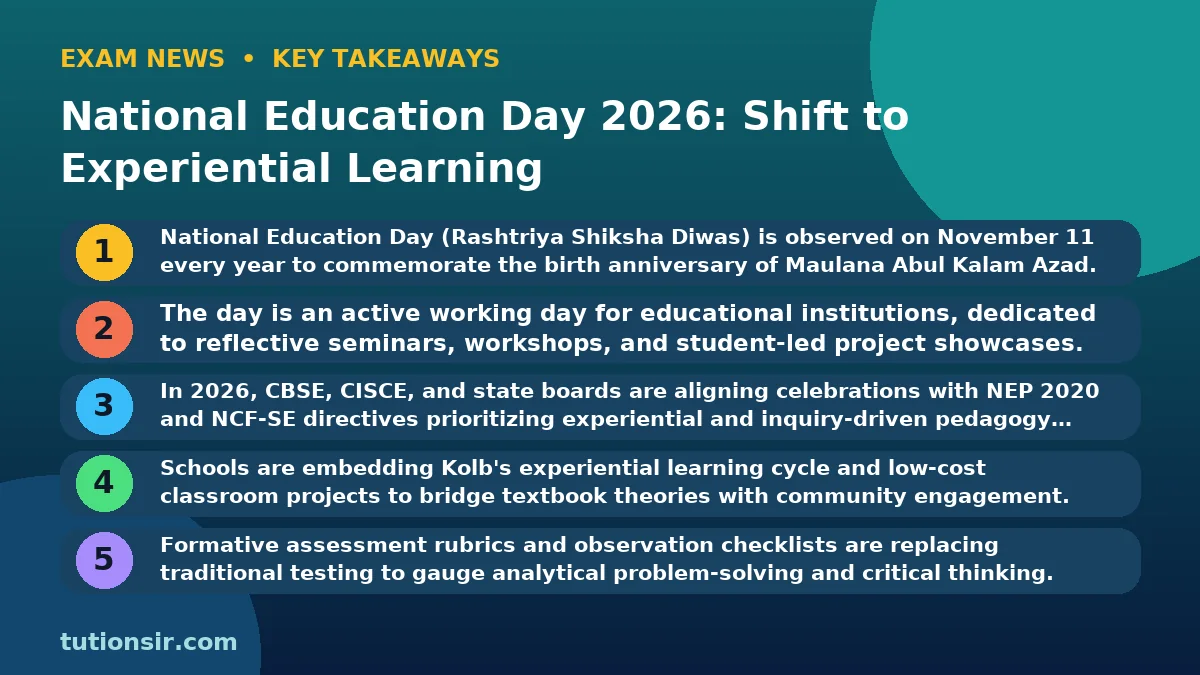
- National Education Day (Rashtriya Shiksha Diwas) is observed on November 11 every year to commemorate the birth anniversary of Maulana Abul Kalam Azad.
- The day is an active working day for educational institutions, dedicated to reflective seminars, workshops, and student-led project showcases.
- In 2026, CBSE, CISCE, and state boards are aligning celebrations with NEP 2020 and NCF-SE directives prioritizing experiential and inquiry-driven pedagogy over rote memorisation.
- Schools are embedding Kolb's experiential learning cycle and low-cost classroom projects to bridge textbook theories with community engagement.
- Formative assessment rubrics and observation checklists are replacing traditional testing to gauge analytical problem-solving and critical thinking.
Try Tution Sir free for your class and subject.
No card. Registering takes about two minutes.
Why Is National Education Day Celebrated on November 11 in India?
National Education Day is celebrated across India on November 11 each year to commemorate the birth anniversary of Maulana Abul Kalam Azad, independent India's first Minister of Education. The Ministry of Human Resource Development (now the Ministry of Education) formally designated the observance on September 11, 2008. Unlike national public holidays, the government specified that November 11 would remain an active working day for schools, colleges, and universities so students and educators could participate in meaningful academic deliberations.
Maulana Azad served as Union Education Minister from August 15, 1947, until his death on February 2, 1958. During this foundational decade, he established the architectural framework of modern Indian education. He championed free and compulsory primary schooling for children up to 14 years of age, expanded secondary education, and pioneered national infrastructure for technical and higher studies. Azad was instrumental in establishing the first Indian Institute of Technology (IIT Kharagpur in 1951), the University Grants Commission (UGC in 1953), and prominent cultural bodies including the Sahitya Akademi, Sangeet Natak Akademi, Lalit Kala Akademi, and the Indian Council for Cultural Relations (ICCR).
A vital yet frequently overlooked pillar of Azad's philosophy was his concept of 'social education'. Azad maintained that schooling must not remain confined to textbook literacy; it should cultivate civic responsibility, scientific temper, and an active commitment to democratic community life.
What Is the Significance of National Education Day 2026 in Indian Classrooms?
National Education Day 2026 marks a decisive turning point in how schools mark Rashtriya Shiksha Diwas. For decades, campus celebrations were limited to morning assembly speeches, memorised recitation competitions, and routine essay submissions. In 2026, educational authorities—including the Central Board of Secondary Education (CBSE), the Council for the Indian School Certificate Examinations (CISCE), and state education boards—are directing institutions to use the day as an operational testbed for modern, learner-centred pedagogies.
Under the directives of the National Education Policy 2020 (NEP 2020) and the National Curriculum Framework for School Education (NCF-SE), schools are shifting their focus to practical problem-solving exhibitions, science discovery galleries, and interdisciplinary discussions. For secondary students preparing for upcoming board assessments, the 2026 observance serves as a vital reminder: board question papers increasingly test application, data analysis, and conceptual clarity rather than mechanical rote recall.
How Does NEP 2020 Promote Experiential Learning Over Rote Learning?
NEP 2020 explicitly identifies experiential learning as the standard pedagogy for all stages of school education, requiring classrooms to move away from passive lecture delivery. According to CBSE curricular guidelines, experiential learning is a sense-making process where students interact through hands-on activities, arts integration, sports integration, and real-world investigations.
Pedagogically, this approach operationalises David Kolb's four-stage Experiential Learning Cycle within everyday Indian classrooms:
- Concrete Experience: Students engage directly in a tangible activity, such as measuring shadows to study sunlight angles or conducting a local biodiversity count.
- Reflective Observation: Learners discuss and record what they observed, highlighting patterns, discrepancies, and unexpected results.
- Abstract Conceptualisation: Teachers guide students to connect their observations with textbook principles, mathematical formulas, and scientific laws.
- Active Experimentation: Students apply their new conceptual insights to solve a fresh problem, such as designing an energy-saving plan for their home or school.
| Curricular Dimension | Traditional Rote Model | NEP 2020 Experiential Model |
|---|---|---|
| Classroom Dynamic | Teacher-centric; passive listening and rote notes | Student-centric; active inquiry, debate, and hands-on tasks |
| Core Learning Objective | Verbatim recall of facts to score in examinations | Deep conceptual mastery, problem-solving, and transferability |
| Application of Concepts | Abstract formulas memorised without real-world context | Concepts derived through concrete experimentation and data |
| Civic and Social Link | Textbook theory separated from community life | Projects tied to civic responsibility and community needs |
| Primary Assessment Tool | Summative, one-time high-stakes pen-and-paper exams | Continuous formative rubrics, learning portfolios, and peer review |
Step-by-Step Experiential Learning Blueprints for Indian Schools
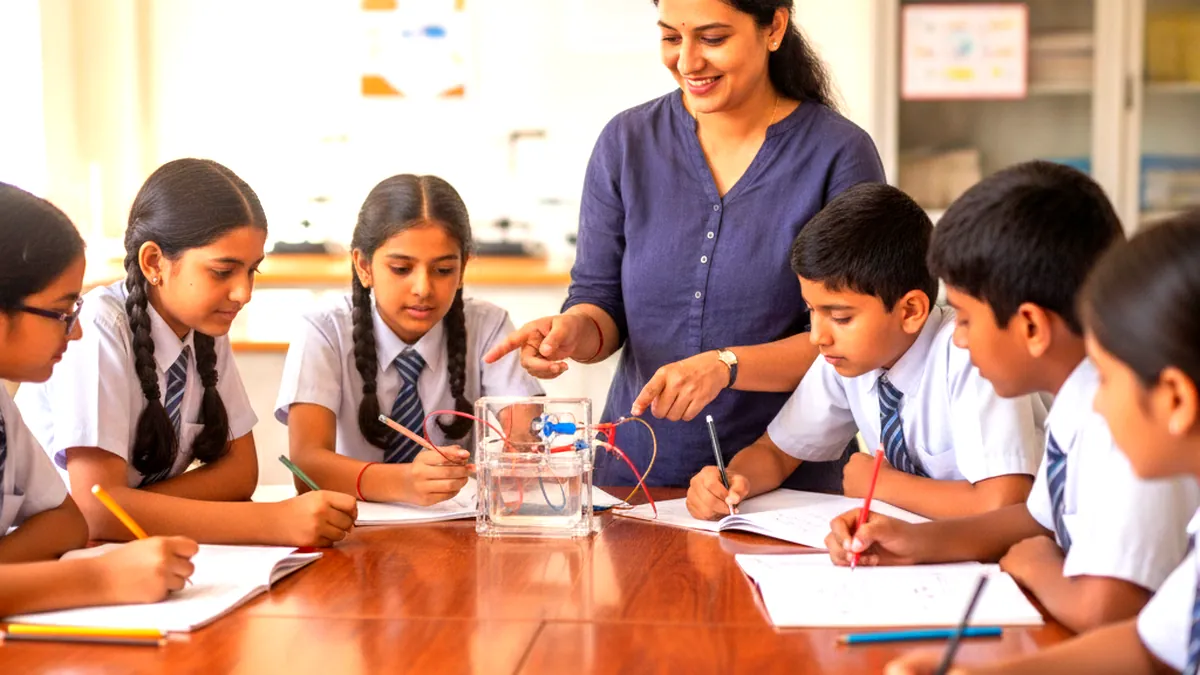
Implementing experiential learning does not require expensive high-tech laboratories. Schools with large class sizes can execute structured, low-cost projects that align directly with board syllabi and Maulana Azad's vision of community-rooted education. Here are three practical blueprints:
1. Science and Mathematics: The Campus Utility and Energy Audit
Students work in groups to calculate the daily electricity or water usage of their school building. They read meters, map water outlets, calculate wattage consumption from appliances, and plot consumption patterns against weekly class timetables. This transforms abstract chapters on units of energy, ratios, and environmental conservation into immediate empirical data.
2. Social Science: The Local Oral History and Heritage Project
Connecting with Azad’s emphasis on civic awareness, students interview elderly residents, local artisans, or municipal workers regarding neighborhood changes over past decades. They record findings, evaluate economic changes, and present reports connecting ground realities to syllabus concepts in urbanisation, livelihood diversification, and governance.
3. Vocational and Skill Education: Low-Cost Engineering and Prototyping
Leveraging CBSE's 10 Bagless Days initiative and Atal Tinkering Lab modules, middle-school students use discarded household cardboard, syringes, and plastic tubing to construct hydraulic arms or simple drip-irrigation models. They test pressure thresholds, document mechanical failures, and iterate designs collaboratively.
Formative Assessment Framework: Evaluating Hands-On Learning
A common barrier in Indian schooling has been the tendency to evaluate hands-on projects through conventional written tests. To overcome this, NEP 2020 emphasizes continuous, competency-based formative assessment that tracks how a student thinks, investigates, and collaborates.
Teachers and teacher-eligibility aspirants (such as those preparing for CTET or State TET pedagogy modules) can apply three clear evaluation mechanisms: rubric-based inquiry scoring (evaluating question formulation, data collection, and reasoning), learning portfolios (where students archive drafts, sketches, and self-critiques), and peer-review checklists. By assessing the learning process rather than only a polished final score, teachers nurture genuine metacognition and confidence in every learner.
What to Do Next: Actionable Guide for Students, Teachers, and Aspirants
Educational institutions and individual learners can take concrete steps to sustain this pedagogical momentum beyond November 11:
Students preparing for CBSE, ICSE, or state board examinations (such as WBBSE and WBCHSE) should review textbook topics through real-world applications and concept maps rather than passive reading. Incorporating targeted competency-based question banks helps identify conceptual blind spots early; learners can also practice with adaptive platforms like Tution Sir to reinforce deep concept clarity and master higher-order thinking skills.
Teachers should embed at least one experiential inquiry module into each syllabus unit, using low-cost locally available resources and collaborative rubrics. Teacher aspirants targeting CTET and State TET exams should study constructivist learning theories, Bloom's revised taxonomy, and NEP 2020 school guidelines, as modern pedagogy papers heavily reward candidates who understand active, child-centred instructional design.
Frequently asked questions
Why is National Education Day celebrated on November 11 in India?
National Education Day is celebrated on November 11 to commemorate the birth anniversary of Maulana Abul Kalam Azad, independent India's first Education Minister. The Ministry of Human Resource Development designated this date in 2008 to honour his foundational contributions to India's schooling and higher education architecture.
Who was Maulana Abul Kalam Azad and what was his contribution to education?
Maulana Abul Kalam Azad was a leading freedom fighter, scholar, and India's first Minister of Education from 1947 to 1958. He laid the foundation of India's higher education system by establishing the first IIT at Kharagpur, the UGC, and national academies promoting art, literature, and culture.
Is National Education Day a public holiday for schools and colleges?
No, National Education Day is not a public holiday. The central government's 2008 notification explicitly stated that November 11 would remain a working day so educational institutions across the country could conduct seminars, symposia, and academic workshops to celebrate educational progress.
What is the difference between Teacher's Day and National Education Day?
Teacher's Day is celebrated on September 5 to honour teachers on the birth anniversary of Dr. Sarvepalli Radhakrishnan. National Education Day is observed on November 11 on Maulana Abul Kalam Azad's birth anniversary to evaluate national educational policies, literacy development, and pedagogical reforms across India.
How does NEP 2020 define experiential learning in schools?
NEP 2020 defines experiential learning as an active, hands-on pedagogical approach that integrates inquiry-based exploration, arts, sports, and cross-curricular projects. It shifts classroom focus from memorising textbook chapters to understanding core concepts through observation, reflection, and real-world problem-solving.
What activities are conducted in schools on National Education Day?
Schools organise student debates, science and social exhibitions, critical thinking workshops, community service drives, and project showcases. Rather than only delivering speeches, institutions engage learners in hands-on challenges and interdisciplinary discussions that mirror NEP 2020 learning goals.
How can teachers implement experiential learning in large classrooms?
Teachers can implement experiential learning by organising collaborative group investigations, using low-cost materials for experiments, introducing think-pair-share discussions, and leveraging 10 Bagless Days activities. Formative rubrics and peer evaluations allow teachers to assess student progress efficiently without adding grading burdens.
How does experiential learning help students preparing for board exams?
Modern board exam question papers from CBSE and state boards emphasize competency-based, case-study, and analytical questions. Experiential learning builds intuitive conceptual clarity, helping students interpret unfamiliar problem scenarios quickly instead of struggling with fragile rote-memorised formulas.
Sources and official links
- Central Board of Secondary Education (CBSE)
- Ministry of Education, Government of India
- National Council of Educational Research and Training (NCERT)
Exam rules and notifications change. Confirm dates, fees and eligibility on the official website before acting. Spotted an error? Email support@tutionsir.com. See our editorial policy.
Keep learning
CBSE Mumbai Book Festival 2026: Bagless Days Full Guide
The Central Board of Secondary Education has directed affiliated schools across the Mumbai Metropolitan Region
Read →CBSE Circular Acad-78/2026 Bal Vivah Mukt Bharat: Full Guide
The Central Board of Secondary Education has directed all affiliated schools to actively participate in the na
Read →CBSE IPS Portal Evaluation Data Verification 2026
The Central Board of Secondary Education has issued urgent operational instructions directing Chief Nodal Supe
Read →Do not let another week go by without a plan
Reading about the exam does not raise marks. Practice does. Register free now and start with the one topic that worries you most. Small daily practice beats a last-minute rush.
- Free plan, no card needed
- Ask any doubt and get a step-by-step answer
- Practice questions with explanations
Free plan, no card needed. Your progress is saved to your account.