WBBSE • Syllabus Update
West Bengal School Curriculum Overhaul: Key Changes
West Bengal has finalized sweeping revisions to its school education syllabus, reshaping middle and secondary school learning across state-run institutions. The update introduces fresh biographical modules, updates technology coursework, and reshuffles existing socio-political chapters.
Quick answer
The West Bengal school curriculum overhaul is a comprehensive syllabus revision by the state education department. It incorporates the life of Dr. Syama Prasad Mookerjee, removes the Singur movement and Kanyashree chapters, introduces ICT for Classes 5 to 8, and integrates the complete national song Vande Mataram across state textbooks.
Key takeaways
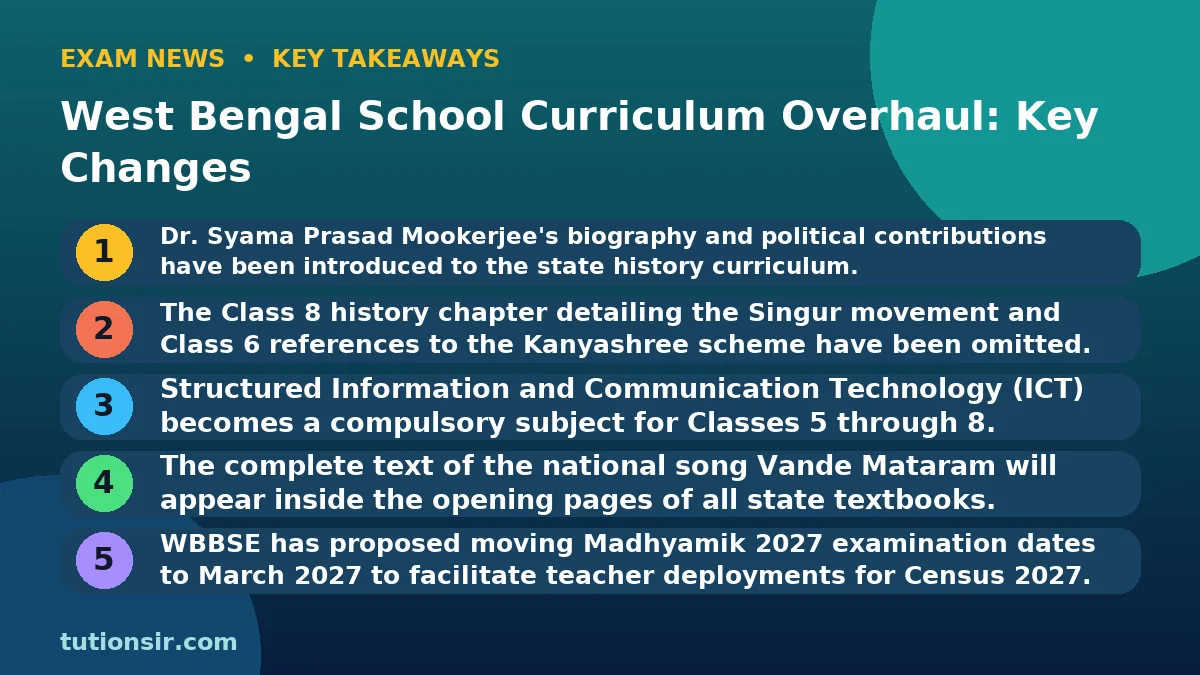
- Dr. Syama Prasad Mookerjee's biography and political contributions have been introduced to the state history curriculum.
- The Class 8 history chapter detailing the Singur movement and Class 6 references to the Kanyashree scheme have been omitted.
- Structured Information and Communication Technology (ICT) becomes a compulsory subject for Classes 5 through 8.
- The complete text of the national song Vande Mataram will appear inside the opening pages of all state textbooks.
- WBBSE has proposed moving Madhyamik 2027 examination dates to March 2027 to facilitate teacher deployments for Census 2027.
Why did West Bengal drop the Singur movement from the Class 8 syllabus?
West Bengal School Education Minister Deepak Barman confirmed that the state Syllabus-cum-Curriculum Committee, chaired by Prof. Debashis Chatterjee, completed an extensive review of state-approved learning materials. Among the most notable omissions is the chapter on the Singur anti-land acquisition movement, which previously formed part of the Class 8 history textbook, 'Ateet O Oitijhyo' (Past and Heritage).
The committee noted that modern school history must focus on foundational historical analysis rather than contemporary regional political developments. Officials stated that content regarding land agitations and party-led protests carried contemporary political connotations better addressed in advanced social sciences at higher secondary levels.
Educators and textbook review panels had raised concerns over the years that contemporary political movements were given disproportionate weight compared to foundational periods of modern Indian nation-building. Consequently, the revised syllabus redirects middle-school learners toward broader constitutional milestones and historical movements.
- Omission applies directly to Class 8 history textbook 'Ateet O Oitijhyo'.
- Shift aims to prioritize broad historical frameworks over modern political agitation.
- School assessments from the upcoming academic session will exclude Singur movement questions.
What new lessons on Dr. Syama Prasad Mookerjee are added to school textbooks?
Under the revised framework, textbooks will highlight the biographical profile, intellectual contributions, and political career of Dr. Syama Prasad Mookerjee. As the founder of the Bharatiya Jana Sangh, former Union Minister, and the youngest Vice-Chancellor of Calcutta University, Dr. Mookerjee's contributions to Bengal's socio-political history will receive dedicated instructional space.
The curriculum committee highlighted Dr. Mookerjee's role during the Partition of Bengal in 1947, his educational reforms in higher learning, and his contributions to independent India's initial industrial and economic policies. Secondary school students will study his speeches, leadership during the Bengal famine relief efforts, and his advocacy for national integration.
This addition marks a notable curricular shift aimed at introducing students to multifaceted political thinkers from Bengal who shaped national discourse after independence.
In which classes will the Kanyashree scheme chapter be dropped?
The curriculum restructuring also impacts primary and lower-secondary supplementary readers. Modules detailing the state government's flagship conditional cash transfer programme, Kanyashree Prakalpa, have been dropped from Class 6 textbooks, specifically within health, hygiene, and social awareness reading sections.
The education department explained that lower-secondary textbooks should emphasize universal child rights, nutrition fundamentals, and health literacy, rather than specific state welfare delivery schemes. While the administrative success of Kanyashree remains acknowledged in administrative circles, pedagogical panels recommended keeping classroom literature neutral from state-run scheme promotion.
Teachers are instructed to focus Class 6 social awareness periods on adolescent health, physical fitness, gender equality, and preventive healthcare instead of programme-specific administrative procedures.
| Class / Level | Curriculum Component | Key Revision | Subject / Text Impacted |
|---|---|---|---|
| Class 6 | State Welfare Modules | Removal of Kanyashree scheme references | Health and Physical Education / Social Awareness |
| Classes 7 & 8 | Language Learning | Introduction of compulsory third-language coursework | Language Curriculum |
| Class 8 | History & Heritage | Omission of Singur movement; inclusion of Dr. S.P. Mookerjee | Ateet O Oitijhyo (History) |
| Classes 5 to 8 | Digital Literacy | Mandatory structured ICT curriculum with practicals | Information & Communication Technology |
| All Classes (5 to 10) | National Heritage | Printing of full Vande Mataram lyrics in textbooks | All Prescribed State Textbooks |
| Class 10 (Madhyamik 2027) | Board Examinations | Proposed date shift to March 2-16, 2027 | Madhyamik Pariksha Schedule |
Structured ICT curriculum and language additions introduced for Classes 5 to 8
To modernize academic standards and align state schooling with contemporary digital demands, Information and Communication Technology (ICT) has been formalized as a regular subject from Class 5 through Class 8. Previously treated as an extracurricular or optional laboratory activity, ICT will now follow a prescribed syllabus with structured theoretical and practical examinations.
The ICT syllabus covers computer fundamentals, file management, cyber ethics, safe internet usage, and introductory algorithmic thinking. State schools are slated to receive updated computer lab guidelines to ensure uniform delivery across both rural and urban institutions.
Additionally, a compulsory third-language textbook will be implemented for Classes 7 and 8, expanding linguistic foundations alongside first-language and English coursework. Furthermore, every prescribed textbook printed by the state will now carry the complete lyrics of the national song, 'Vande Mataram', on its inside cover pages.
Why are the 2027 WBBSE Madhyamik examination dates proposed to be rescheduled?
Alongside syllabus adjustments, administrative timelines for secondary education face adjustments. The West Bengal Board of Secondary Education (WBBSE) has proposed rescheduling the 2027 Madhyamik examinations from their traditional mid-February slot (tentatively February 15-25) to a new window between March 2 and March 16, 2027.
This proposed shift is directly tied to the upcoming nationwide Census of India 2027 operations. Because thousands of state school teachers serve as designated census enumerators and supervisors, holding secondary board exams concurrently would cause severe logistical disruptions.
In tandem, the West Bengal Council of Higher Secondary Education (WBCHSE) is preparing to push the Higher Secondary (HS) Semester IV examinations past mid-March 2027. Students, heads of institutions, and parents should track official notifications on board websites (wbbse.wb.gov.in and wbchse.wb.gov.in) for confirmed timetables.
How will the West Bengal curriculum overhaul affect WB TET and board exam aspirants?
The syllabus adjustments carry direct implications for competitive exam aspirants, including those preparing for the West Bengal Teacher Eligibility Test (WB TET), the State Level Selection Test (SLST), and state civil service exams. Aspirants must adjust their historical preparation to incorporate Dr. Syama Prasad Mookerjee's institutional and socio-political initiatives.
For classroom teachers, the immediate priority is bridging the gap during the transition year. Educators must align existing lesson plans with the state's updated learning outcomes until physical copies of the revised textbooks reach every district depot.
Candidates preparing for state board assessments and teacher eligibility tests can turn to dedicated educational platforms like Tution Sir to access updated practice papers, structured chapter summaries, and digital quizzes that reflect the latest WBBSE curriculum guidelines.
Frequently asked questions
Why was the Singur movement chapter removed from the West Bengal Class 8 syllabus?
The Syllabus-cum-Curriculum Committee omitted the Singur movement chapter from the Class 8 history textbook 'Ateet O Oitijhyo' to reduce contemporary political content in middle school. The committee prioritized foundational national history, social reforms, and constitutional milestones over modern regional political movements.
What new lessons on Dr. Syama Prasad Mookerjee are added to West Bengal school textbooks?
Textbooks will feature Dr. Syama Prasad Mookerjee's life, his tenure as Calcutta University's youngest Vice-Chancellor, his role in the 1947 Bengal Partition deliberations, his service as independent India's first Minister of Industry and Supply, and his founding of the Bharatiya Jana Sangh.
In which classes will the Kanyashree scheme chapter be dropped in West Bengal schools?
References to the Kanyashree Prakalpa cash transfer scheme have been omitted from Class 6 textbooks. The revision focuses the health and social awareness curriculum strictly on universal physical fitness, adolescent health, nutrition, and child rights rather than specific state welfare programs.
When will the overhauled West Bengal school curriculum take effect?
The revised syllabus guidelines will take effect starting in the upcoming academic session. Revised textbooks containing the new chapters, structured ICT modules, and omitted sections are being prepared for phased distribution across state-run and state-aided schools.
What new subjects and languages are being introduced for Classes 5 to 8 in West Bengal?
Information and Communication Technology (ICT) has been introduced as a structured, compulsory subject with regular assessments for Classes 5 through 8. In addition, Classes 7 and 8 will receive compulsory third-language textbooks to strengthen multilingual learning.
Why are the 2027 WBBSE Madhyamik examination dates proposed to be rescheduled?
WBBSE proposed shifting the Madhyamik 2027 exams from mid-February to March 2–16, 2027, to avoid overlap with Census of India 2027 duties, as thousands of secondary school teachers will be deployed as official census enumerators.
Is the pass-fail or no-detention policy being revised in West Bengal schools?
The current curriculum announcements focus on textbook content, ICT inclusion, and board exam routines. Any official updates regarding the continuous assessment or detention frameworks under the National Education Policy will be communicated separately via official School Education Department circulars.
How will the West Bengal curriculum overhaul affect WB TET candidates and board exam aspirants?
WB TET and state recruitment aspirants must update their preparation regarding modern Indian political figures, notably Dr. Syama Prasad Mookerjee. Board examinees will be evaluated strictly on the revised textbook chapters, excluding omitted modules on Singur and Kanyashree.
Sources and official links
- School Education Department, Government of West Bengal
- West Bengal Board of Secondary Education
- West Bengal Council of Higher Secondary Education
Exam rules and notifications change. Confirm dates, fees and eligibility on the official website before acting. Spotted an error? Email support@tutionsir.com. See our editorial policy.
Keep learning
WBBSE Madhyamik 2027 Postponement: March Dates Proposed
The West Bengal Board of Secondary Education has submitted a formal proposal to reschedule the 2027 Madhyamik
Read →WBBSE Madhyamik Answer Script Evaluation: 2026 Rules
The West Bengal School Education Department is overhauling secondary examination paper checking to publish Cla
Read →WBCHSE Semester System Review: Syllabus & Exam Update
The West Bengal Council of Higher Secondary Education (WBCHSE) has begun a performance review of its semester
Read →Practise what you just read
Free plan, no card needed. Full mock tests and the complete question bank are on the Pro plan.