Study Habits • Exam Strategy
How to Avoid Feeling Sleepy While Studying at Night: 7 Ways
Struggling to keep your eyes open over textbooks after a long day of school or coaching? Drowsiness is not a lack of willpower, but a biological reaction to poor lighting, heavy meals, and passive study habits that you can systematically fix tonight.
Quick answer
To avoid feeling sleepy while studying at night, switch to cool-white desk lighting (5000K–6500K), replace passive reading with active problem-solving or handwritten notes, sit upright away from your bed, eat a light, low-glycemic dinner, sip cool water regularly, and tackle heavy numerical subjects when drowsy.

Key takeaways
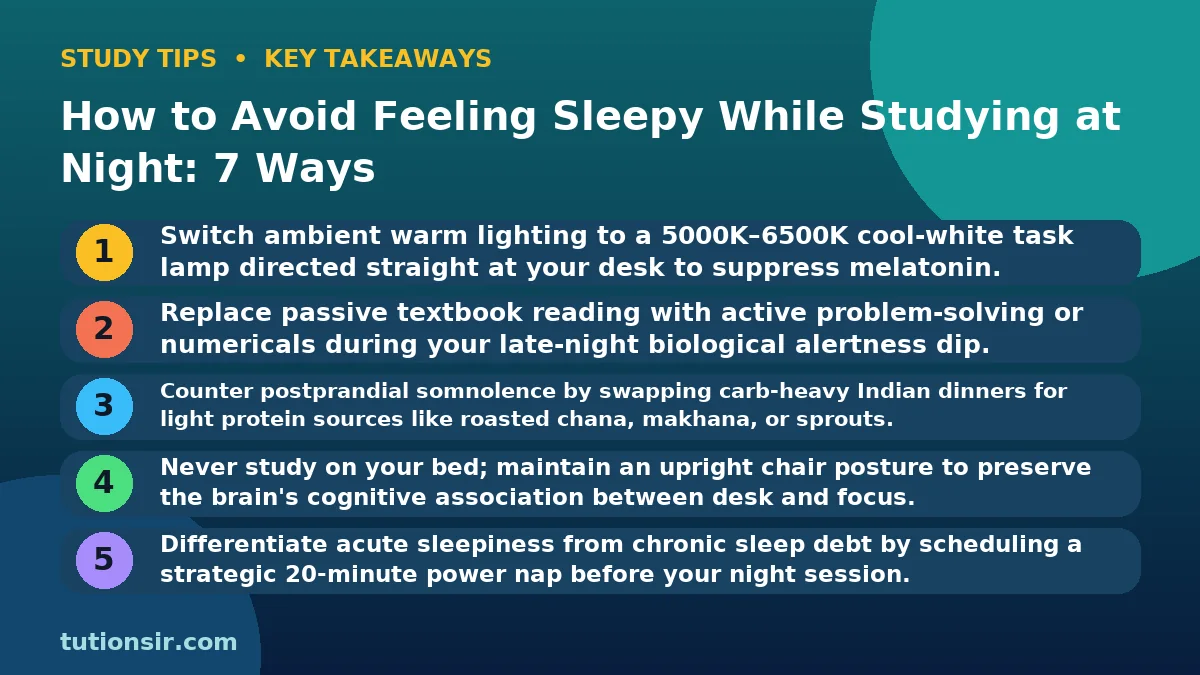
- Switch ambient warm lighting to a 5000K–6500K cool-white task lamp directed straight at your desk to suppress melatonin.
- Replace passive textbook reading with active problem-solving or numericals during your late-night biological alertness dip.
- Counter postprandial somnolence by swapping carb-heavy Indian dinners for light protein sources like roasted chana, makhana, or sprouts.
- Never study on your bed; maintain an upright chair posture to preserve the brain's cognitive association between desk and focus.
- Differentiate acute sleepiness from chronic sleep debt by scheduling a strategic 20-minute power nap before your night session.
Why do I feel so sleepy as soon as I start studying at night?
You feel sleepy while studying at night primarily because your brain interprets low cognitive friction, warm lighting, and physical stillness as biological signals to sleep. During the day, continuous physical activity and sensory stimulation suppress the accumulation of adenosine, a neurochemical that builds up in your brain during waking hours and creates sleep pressure. When you sit down quietly at a desk in the evening, this accumulated adenosine binds to neural receptors, signaling that it is time to wind down.
Compounding this chemical shift is your circadian rhythm, the body's internal 24-hour master clock regulated by the suprachiasmatic nucleus (SCN) in the hypothalamus. As twilight fades, your eyes detect declining ambient illumination, prompting the pineal gland to synthesize and release melatonin, the sleep hormone. If you attempt to read dense textbook theory under dim yellow bedroom lighting, your brain reduces autonomic arousal, causing your eyelids to droop within minutes.
- Adenosine buildup: Sustained mental effort throughout school or coaching hours raises sleep pressure.
- Melatonin onset: Dim ambient light triggers biological sleep pathways regardless of your exam deadlines.
- Passive visual monotony: Staring at uniform blocks of black-and-white text lacks the cognitive demand needed to maintain cortical activation.
Rule 1: Master Your Light Spectrum to Suppress Melatonin
The fastest physical mechanism to stop feeling sleepy while studying is upgrading your study lighting. Most Indian households rely on warm white or yellow ambient ceiling bulbs (ranging between 2700K and 3000K color temperature). While warm tones create a cozy domestic atmosphere, the Sleep Foundation notes that warm light signals the brain that evening has arrived, encouraging melatonin secretion. Studying under warm illumination actively works against your neurological alertness.
To stay awake at night while studying, illuminate your workspace with a cool-white task lamp calibrated between 5000K and 6500K (daylight white). Cool light contains a high proportion of blue wavelengths. When these wavelengths strike the intrinsically photosensitive retinal ganglion cells (ipRGCs) in your eyes, they inhibit melatonin production and stimulate alertness. Position the lamp directly over your books or desk surface to avoid casting hand shadows, and keep the main room light switched on to eliminate extreme contrast glare, which strains the optic nerve and induces rapid fatigue.
Rule 2: Fix Postprandial Somnolence: The Indian Dinner Dilemma
What you eat for dinner directly dictates your evening alertness. Millions of students preparing for CBSE, ICSE, or state board exams eat large, carbohydrate-dense dinners consisting of white rice, buttery rotis, and starchy potato curries right before sitting down to study. This triggers postprandial somnolence—commonly known as a food coma. High-glycemic carbohydrates cause a rapid spike in blood glucose, followed by an insulin surge that drives competing amino acids into muscle tissue, leaving tryptophan free to enter the brain and convert into serotonin and melatonin.
To avoid sleepiness during night study, restructure your evening nutritional intake. Eat your main evening meal at least 60 to 90 minutes before your study session begins, or keep dinner remarkably light. Focus on lean protein, dietary fiber, and complex carbohydrates with a low glycemic index.
- Avoid heavy carbohydrate dinners: Cut back on large portions of polished white rice, deep-fried snacks, and heavy gravies.
- Choose sustained-energy foods: Opt for light dal, paneer bhurji, boiled eggs, or multigrain rotis with green leafy vegetables.
- Stock smart study snacks: If hunger strikes around midnight, avoid sugary biscuits or chips; reach for roasted chana (Bengal gram), roasted makhana (fox nuts), or a handful of almonds and walnuts.
- Hydrate with chilled water: Keep a stainless steel flask of cold water at your desk. Mild dehydration drops blood pressure and slows brain perfusion, making drowsiness worse. Sipping water every 20 minutes keeps your cellular metabolism active.
| Time Block | Natural Alertness Level | Recommended Study Activity | Optimal Subject / Task Type |
|---|---|---|---|
| 08:30 PM – 09:30 PM | Moderate to High (Post-dinner) | Structured conceptual review & summary notes | Biology diagrams, History events, CTET Child Pedagogy theory |
| 09:30 PM – 10:30 PM | Peak Evening Focus | Timed practice tests & writing long-form answers | English essay writing, Chemistry reactions, Commerce accountancy |
| 10:30 PM – 10:45 PM | Energy Transition | Physical break: light walk, hydration, facial splash | No study; step away from desk, avoid mobile screens |
| 10:45 PM – 12:15 AM | Circadian Dip Window (Heavy Drowsiness Risk) | High-engagement problem solving (Handwriting & calculating) | Physics numericals, Mathematics calculus/algebra, Quantitative Aptitude |
| 12:15 AM – 12:25 AM | Physical Reset | Stretching, sip cold water, healthy crunch snack | Snack on roasted chana or makhana; perform 20-20-20 eye break |
| 12:25 AM – 01:30 AM | Second Wind Alertness | Interactive PYQs, flashcard active recall, self-quizzing | Previous Years' Board Questions, mock MCQ drills, formula recap |
Rule 3: Replace Passive Reading with Active Recall and Numericals
If you open an NCERT History chapter or a long biology text at 11:00 PM, you will almost certainly fall asleep. Passive reading—silently tracking words line by line across a page—requires minimal cognitive involvement. Your mind wanders, your processing slows, and you slip into micro-sleeps. Active recall, by contrast, forces neural firing across the prefrontal cortex, which keeps your nervous system awake.
Whenever you find yourself struggling with how to study late night without feeling sleepy, abandon passive reading immediately. Pick up a pen and convert your revision into active production. Solve five numerical problems from Physics or Mathematics, translate a paragraph of theory into a handwritten mind map, or recite concepts out loud from memory while standing up. Engaging your motor cortex through writing and speaking physically prevents the brain from entering sleep mode.
The Late-Night Pen-in-Hand Rule
Never sit at a night study table with empty hands. If you are reviewing theoretical subjects for exams like WBBSE Madhyamik, WBCHSE Higher Secondary, or CTET Child Development, keep a rough notebook beside you. Summarize each page into three bullet points from memory, solve multiple-choice questions, or write out formula sheets from scratch. Physical note-taking forces alertness.
Rule 4: Align Subject Difficulty with Your Circadian Alertness Curve
Most students fail at late-night revision because they schedule their subjects backward. They begin their evening at 8:00 PM with energetic Mathematics problem-solving, and then save exhausting, dense reading—such as Political Science, English Literature, or Organic Chemistry mechanisms—for 1:00 AM when their biological alertness is at its lowest. This guarantees drowsiness.
Strategic night studying requires assigning high-cognitive-demand tasks to your natural alertness dips. Between 11:30 PM and 1:30 AM, human circadian alertness dips significantly. During this window, schedule subjects that require active computation, structural problem-solving, or interactive practice. If you are preparing for competitive teaching tests like CTET or West Bengal TET, use this late window for quantitative aptitude and logical reasoning questions rather than reading educational psychology doctrine.
Rule 5: Re-Engineer Your Study Station Away from Your Bed
Studying while propped up on pillows on your bed is the single most common cause of sudden sleepiness. The human brain relies on environmental conditioning and associative learning. For years, your bed has been associated with sleep, physical relaxation, and thermal comfort. When you place a textbook on your lap in bed, your central nervous system initiates posture-related relaxation protocols: your heart rate declines, postural muscles relax, and your brain prepares for sleep.
To avoid feeling sleepy while studying at night, construct an ergonomic study boundary: sit on a firm, straight-backed wooden or ergonomic desk chair with both feet flat on the floor. Keep your back upright. The physical exertion required by postural muscles to maintain an upright spine sends steady proprioceptive feedback to your brainstem, activating the reticular activating system (RAS) that keeps you conscious and alert. Keep your bed strictly reserved for sleep.
Rule 6: Treat Chronic Sleep Debt with Strategic Power Naps
You cannot outsmart basic biology if you are carrying severe sleep debt. High school students preparing for CBSE or CISCE board examinations frequently balance rigorous 7:00 AM to 3:00 PM school hours with evening coaching until 7:30 PM. Sitting down to study from 9:00 PM to 2:00 AM on four hours of sleep for three nights in a row produces severe cognitive impairment. The Indian Council of Medical Research (ICMR) and international sleep authorities recommend 7 to 8 hours of restorative sleep for young adults.
If you plan to study until 1:30 AM or 2:00 AM, take a strategic 20-minute power nap between 6:30 PM and 7:30 PM, immediately after returning from school or coaching. Healthline and sleep research confirm that limiting naps to 20 minutes prevents you from entering Stage 3 slow-wave deep sleep. This avoids sleep inertia—that heavy, disoriented grogginess that follows waking from deep sleep. A brief 20-minute rest clears adenosine, restoring focus for late-night work without interfering with your main sleep cycle.
Rule 7: Deploy Physical Reset Protocols When Eyelids Get Heavy
When drowsiness strikes suddenly in the middle of a study block, relying solely on mental determination rarely works. You need quick physical resets to elevate your heart rate and peripheral circulation. Instead of fighting heavy eyelids at your desk, implement a two-minute somatic reset routine.
First, get up and splash cold tap water across your eyes, forehead, and the back of your neck. Cold stimulation triggers the mammalian diving reflex, sharpens autonomic vigilance, and instantly constricts dilated facial blood vessels. Second, walk around your room or hallway at a brisk pace for three minutes while breathing deeply through your nose. Finally, stretch your chest and hamstrings. Increasing blood circulation pumps fresh oxygenated blood to your cerebral cortex, clearing mental fog.
- Cold water splash: Apply cold water over your face and neck to stimulate the trigeminal nerve.
- Pacing while reading: If reviewing definitions or historical dates, stand up and pace across your room while reciting out loud.
- The 20-20-20 visual rest: Every 20 minutes, look at an object at least 20 feet away for 20 seconds to relax your eye ciliary muscles and reduce optic exhaustion.
- Cool room temperature: Keep your study space well-ventilated; a warm, stuffy room increases carbon dioxide levels, inducing sluggishness.
The Night Owl Study Timetable and Alertness Matrix
Consistency is key when working late. To study late at night without feeling drowsy, structure your evening using the 50-10 Pomodoro model: fifty minutes of intense active work followed by a ten-minute non-screen physical break. The timetable below illustrates how an Indian board or competitive exam aspirant can organize a highly productive night session from 8:30 PM to 1:30 AM.
Common Night Study Mistakes Indian Students Must Avoid
Many students attempt to pull late-night study sessions using counterproductive habits that worsen sleepiness. The most pervasive mistake is excessive caffeine consumption. Drinking three or four cups of sweet milky chai or strong instant coffee between 10:00 PM and 1:00 AM might keep you awake temporarily, but caffeine has an average half-life of 5 to 7 hours. It overstimulates your heart rate, creates nervous jitters, and severely fragments your deep sleep once you finally go to bed, leaving you exhausted the next morning.
Another critical error is switching between passive digital scrolling and studying. When students feel drowsy, they often unlock their smartphones to browse social media for a quick dopamine kick. While bright screen light stimulates the retina, rapid task-switching depletes your cognitive reserves, leaving your brain more exhausted when you return to your textbook.
Finally, do not sit through drowsiness on auto-pilot. When you notice yourself re-reading the exact same sentence three times without comprehension, stop immediately. Close the physical book, stand up, and switch to solving previous years' questions (PYQs) or interactive practice quizzes. Engaging with structured question-and-answer formats—such as practicing chapter-wise board exam questions on Tution Sir—re-engages your problem-solving faculties and keeps your brain sharp until you complete your daily target.
Your Pre-Night Study Checklist
Before you sit down for your evening study session, complete this quick environmental and physical checklist to ensure your room and body are primed for alert focus.
- Desk Check: Clear all unrelated clutter, books, and dirty plates off your study table.
- Lighting Check: Ensure your 5000K–6500K desk task lamp is on and aimed directly at your working surface.
- Ergonomic Check: Position your desk chair upright away from your bed; adjust chair height so your feet rest flat.
- Hydration Check: Place a 1-liter bottle of cool water and a cup beside your table.
- Nutrition Check: Verify that your dinner was light and that you have roasted chana or makhana ready for a late snack.
- Material Check: Print out or organize your target question sets, rough scratchpads, and pens before opening your books.
- Phone Check: Put your smartphone in 'Do Not Disturb' mode and place it in another room or out of arm's reach.
Frequently asked questions
Why do I feel so sleepy as soon as I start studying at night?
You feel sleepy because passive reading, low physical movement, and dim warm lighting mimic natural sleep cues. During waking hours, adenosine builds up in your brain; when you sit quietly, this sleep pressure activates. Melatonin also rises at night, lowering heart rate and body temperature, which leads to immediate drowsiness.
How can I study late at night without feeling drowsy?
To study late without feeling drowsy, use a bright cool-white desk lamp (5000K–6500K), sit upright on a sturdy chair away from your bed, and replace passive reading with active writing or solving numerical problems. Sip cool water regularly and keep your study room well-ventilated.
What should I eat for dinner to avoid feeling sleepy while studying?
Eat a light, protein-rich meal with low-glycemic carbohydrates at least one hour before studying. Avoid large portions of white rice, heavy rotis, and oily curries that cause blood-sugar spikes and postprandial somnolence. For late-night snacks, choose roasted makhana, roasted chana, or a small handful of nuts.
Does drinking coffee or tea help you stay awake while studying at night?
A small cup of black tea or coffee can temporarily block adenosine receptors and boost alertness. However, drinking tea or coffee late at night disrupts deep sleep architecture hours later. Limit caffeine to one cup early in the evening and avoid caffeinated drinks after 11:00 PM.
Is it better to study early in the morning or late at night for exams?
Neither is inherently superior; optimal timing depends on your natural chronotype. Morning study benefits from high cortisol and a refreshed brain ideal for analytical work, while night study offers fewer household distractions. Consistency matters most: stick to one steady schedule and get 7 to 8 hours of sleep.
How does studying on the bed cause sleepiness?
Studying on the bed triggers psychological conditioning and physical relaxation. Your brain associates your bed with rest, releasing calming neurotransmitters. Reclining reduces postural muscle engagement, lowers blood flow to the brain, and leads quickly to micro-sleeps. Always study seated upright at a designated desk.
What is the best study technique to stay active during night study?
The best technique is combining active recall with the Pomodoro Technique. Work in focused 50-minute blocks with 10-minute movement breaks. Instead of reading passively, write notes from memory, solve previous years' exam questions, or recite concepts out loud while pacing.
How many hours of sleep do students need during board exam preparation?
Adolescents and young adults preparing for board or competitive exams require 7 to 8 hours of continuous sleep each night. Sleep deprivation impairs memory consolidation in the hippocampus, reducing recall during exams. Sacrificing sleep below six hours diminishes cognitive efficiency, focus, and retention.
Sources and official links
- Sleep Foundation
- Healthline
- National Library of Medicine (PMC)
- Centers for Disease Control and Prevention (CDC)
Exam rules and notifications change. Confirm dates, fees and eligibility on the official website before acting. Spotted an error? Email support@tutionsir.com. See our editorial policy.
Keep learning
How to Increase Handwriting Speed in Board Exams: Top Tips
Every year, thousands of Indian board examinees lose 10 to 15 marks simply because their hands cannot keep up
Read →How to Avoid Silly Mistakes in CBSE Class 10 Maths: Guide
Every year, thousands of Class 10 board students drop from a 95 to an 85 not from a lack of mathematical knowl
Read →Madhyamik Study Timetable: 3-Month Class 10 Routine
As the November school test examinations conclude, Class 10 WBBSE candidates enter the decisive 90-day countdo
Read →Practise what you just read
Free plan, no card needed. Full mock tests and the complete question bank are on the Pro plan.