Board Exams · Writing Skills
How to Increase Handwriting Speed in Board Exams: Top Tips
Every year, thousands of Indian board examinees lose 10 to 15 marks simply because their hands cannot keep up with their thoughts during 3-hour descriptive papers. Mastering writing speed without sacrificing neatness is an essential exam skill that turns hard-earned knowledge into maximum scores.
Quick answer
To increase handwriting speed in board exams without losing legibility, use a dynamic tripod grip powered by forearm movement rather than finger clutching. Choose a lightweight 0.5mm to 0.7mm pen, streamline letterforms by reducing decorative loops, and target an endurance pace of 25 to 30 words per minute.

Key takeaways
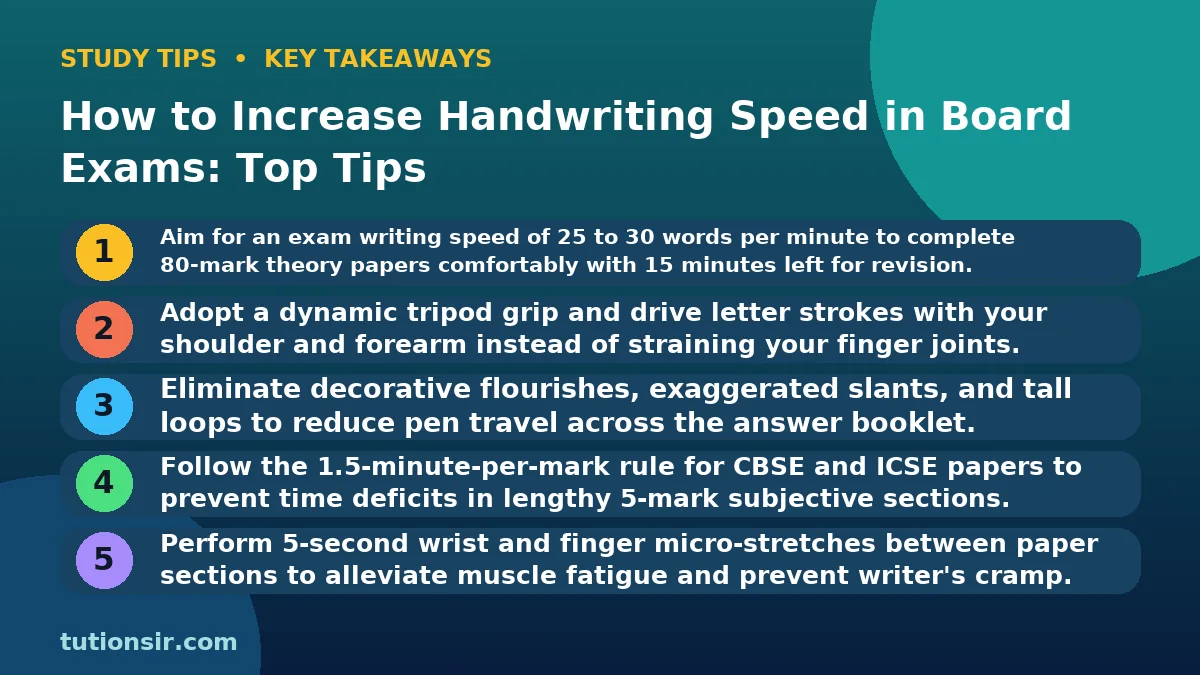
- Aim for an exam writing speed of 25 to 30 words per minute to complete 80-mark theory papers comfortably with 15 minutes left for revision.
- Adopt a dynamic tripod grip and drive letter strokes with your shoulder and forearm instead of straining your finger joints.
- Eliminate decorative flourishes, exaggerated slants, and tall loops to reduce pen travel across the answer booklet.
- Follow the 1.5-minute-per-mark rule for CBSE and ICSE papers to prevent time deficits in lengthy 5-mark subjective sections.
- Perform 5-second wrist and finger micro-stretches between paper sections to alleviate muscle fatigue and prevent writer's cramp.
How to Increase Handwriting Speed in Board Exams Without Ruining Legibility
In major secondary and higher secondary evaluations—such as the Central Board of Secondary Education (CBSE), Council for the Indian School Certificate Examinations (CISCE / ICSE / ISC), and State Boards like WBBSE and WBCHSE—students frequently know the answers but miss full marks because of poor pacing. The issue is rarely a lack of knowledge; rather, it is the inability to transcribe complex thoughts quickly onto paper under strict time constraints. When panic sets in during the final hour, students accelerate blindly, turning legible paragraphs into undecipherable scribbles that frustrate evaluators.
Balancing speed and legibility does not require calligraphy-level beauty. Evaluation guidelines from boards like CBSE and CISCE clarify that examiners seek neatness, clear structure, and readability rather than decorative penmanship. If the evaluator cannot decode your technical terms or numerical deductions within seconds, you forfeit marks. By recalibrating your pen grip, simplifying letter geometries, and standardizing your exam pacing, you can write up to 30 words per minute while maintaining crisp, easily gradable scripts.
- Legibility ensures that the evaluator awards marks without second-guessing crucial keywords.
- Consistent speed prevents the dreaded last-minute rush where high-value 5-mark questions are left half-finished.
- Clean, legible presentation reduces examiner fatigue when grading hundreds of scripts each day.
What Is an Ideal Handwriting Speed for Board Exams?
The ideal average handwriting speed for Indian board examinations is 25 to 30 words per minute (WPM) of sustained writing over three hours. While casual adult note-taking hovers around 15 to 20 WPM, a typical 80-mark Class 10 or Class 12 board examination in descriptive subjects like Social Science, English Literature, Biology, or Business Studies demands between 2,200 and 3,000 written words.
Calculating raw motor speed alone is misleading because exam time is split between active writing, question processing, recall, and structural outlining. Out of the 180 total minutes in a standard paper, around 30 minutes are consumed by thinking, rereading questions, drawing margins, and tying supplements. Another 15 minutes must be preserved for final verification. That leaves approximately 135 minutes of actual writing time. If your paper requires 2,700 words, you must maintain a baseline rate of 20 WPM continuously. Developing a comfortable sprint capacity of 30 WPM gives you the cognitive buffer needed to pause, formulate arguments, and still cross the finish line early.
Ergonomics and Pen Mechanics: Writing Fast Without Hand Fatigue
Most students who suffer from finger numbness or wrist cramps during the second hour of an exam are victims of the 'death grip'—pinching the pen tightly near the nib and using purely finger-flexion movements. This locks the small muscles of the hand, rapidly exhausting them and causing handwriting to deteriorate into spidery strokes.
To write fast and neat in exams for three full hours, transition to the dynamic tripod grip. Rest the barrel gently on the radial side of your middle finger, securing it lightly with your index finger and thumb. Ensure your grip sits at least 2.5 to 3 cm away from the nib. This distance gives you a wider visual field of what you are writing, preventing awkward head tilts and curved posture.
Forearm and Shoulder Drive
Stop writing solely with your fingers. Instead, stabilize your wrist in a neutral, slightly extended position and drive broad horizontal writing movements using your forearm and shoulder pivot. When your larger arm muscles carry the momentum across the ruled line, your fingers only perform fine directional adjustments, drastically cutting muscular tension.
The 5-Second In-Exam Micro-Stretch Protocol
Do not wait for wrist spasms to force a halt. Incorporate a disciplined 5-second physical reset whenever you conclude an exam section. Drop both hands to your sides, shake your wrists loosely to restore capillary blood flow, extend your fingers outward like a fan, and roll your shoulders backward twice. This tiny, scheduled pause resets nervous muscle tension and preserves consistent handwriting speed from Section A to Section E.
| Question Weightage | Recommended Word Count | Target Time per Question | Cumulative Time (Typical Paper) | Presentation Strategy |
|---|---|---|---|---|
| 1-Mark Questions (MCQ / Objective) | Option letter + single word/phrase | 1 minute | 15–20 minutes (16–20 questions) | Write option clearly with key term; avoid full-sentence copying |
| 2-Mark Questions (Very Short Answer) | 30–40 words | 3 minutes | 12–18 minutes (4–6 questions) | 2 crisp, numbered factual points directly answering the prompt |
| 3-Mark Questions (Short Answer) | 50–80 words | 4.5 to 5 minutes | 25–35 minutes (5–7 questions) | 3 distinct bullet points with underlined keywords |
| 4-Mark Questions (Case-Based / Source) | 80–100 words | 6 to 7 minutes | 18–24 minutes (3–4 questions) | Direct point-wise answers to sub-parts (i, ii, iii) |
| 5-Mark Questions (Long Descriptive) | 120–150 words | 8 to 9 minutes | 32–36 minutes (4 questions) | Brief 1-line introduction, 4–5 headed bullets, brief conclusion |
| Buffer / Final Review | N/A | 15 minutes | Final 15 minutes | Check question numbers, tie supplements, verify calculations |
Choosing the Best Pen for Fast Writing in 3-Hour Board Exams
Your writing instrument directly dictates friction, muscular strain, and paper cleanliness. Heavy metal pens, designer rollerballs with loose ink reservoirs, or novelty thick-barrel pens add unnecessary gram-weight that pulls down your fingers over 180 minutes. The optimal exam pen weighs between 8 and 12 grams and features a medium rubberized grip section.
While water-based gel pens glide with minimal pressure, they present a high risk of ink strike-through (ghosting) and smudge on standard 60-to-70 GSM board answer booklets. If you prefer gel pens, opt strictly for quick-drying waterproof Japanese pigment gel inks with a 0.5mm tip. For the majority of students, an ultra-smooth, low-viscosity hybrid ballpoint pen (0.7mm tip) provides the perfect compromise: it requires negligible downward pressure, dries instantly upon contact, and ensures no bleeding through thin supplementary sheets.
- Body weight: Keep it light (under 12 grams); avoid metallic caps posted on the back of the pen, which offset balance.
- Grip surface: Choose non-slip rubber or matte textured barrels over slick, slippery plastics that cause hand slipping.
- Ink viscosity: Use low-viscosity semi-gel or hybrid ballpoint pens to combine rapid ink transfer with zero smudge risk.
- Backup rule: Carry at least three identical, pre-tested pens that have already been broken in by writing 3 to 4 pages beforehand.
Streamlining Letterforms: Is Cursive or Print Faster for Board Exams?
A common debate among students is whether cursive handwriting or print style is faster for board exams. Pure cursive theoretically minimizes pen lifts, but under high-speed exam duress, closed loops on letters like 'e', 'a', and 'o' tend to collapse, while 'm', 'n', and 'u' merge into illegible zigzag waves. Conversely, rigid manuscript print requires continuous pen lifts, which micro-stall your forward momentum.
The fastest and most legible writing style for board exams is a hybrid semi-cursive script. In this approach, common two- and three-letter sequences (such as 'th', 'in', 'er') are naturally linked, while intricate loops and decorative ascenders are stripped down. Write in a modern, vertical, or subtly right-leaning slant without excessive flourishes.
Letter Size and Aspect Ratio
Maintain uniform middle-zone letters (a, c, e, m, n, o, r, s, u, v, w, x, z) occupying roughly 40% to 50% of the ruled line height. Restrain tall ascenders (b, d, h, k, l) and descenders (g, j, p, q, y) so they do not collide with text on adjacent lines. Taming excess vertical height decreases the millimeter path your pen tip must travel per line by up to 25%.
Script-Specific Speed Tactics for Regional Languages
If you are writing papers in Hindi (CBSE/State Boards) or Bengali (WBBSE/WBCHSE), continuous horizontal headline strokes—the 'shirorekha' in Devanagari or 'matra' in Bengali—frequently decelerate students who lift the pen after every individual character. To boost speed, write the complete word base first, then draw a single, unbroken horizontal headline across the whole word. Never draw headlines character-by-character.
Board-Specific Time Allocation Formulas: The 1.5-Minute Rule
Running out of time during theory exams rarely happens because of slow fingers alone; it stems from answering short-mark questions with disproportionate length. CBSE and CISCE mark sheets provide strict word counts and clear mark breakdowns. To manage your clock ruthlessly, employ the '1.5-Minute Rule' across your 80-mark papers.
Multiply the mark weight of each question by 1.5 to obtain your target writing window in minutes. For instance, a 1-mark objective item should take no more than 1 to 1.5 minutes, a 3-mark short answer merits 4.5 minutes, and a 5-mark extended response must be completed within 7.5 to 8 minutes. For an 80-mark paper, this pacing consumes exactly 120 minutes of active writing, leaving you with 45 minutes split between strategic planning and systematic proofreading.
- 15-Minute Reading Time: Do not write a single word. Categorize questions into 'Immediate', 'Requires Thought', and 'Complex'. Map your internal outlines for long answers.
- Structure with Bullets: Replace dense, unbroken 20-line paragraphs with 4 to 5 crisp bullet points led by distinct sub-headings. This drastically cuts filler text and speeds up the examiner's marking process.
- Pre-drawn Margins: Draw clean left- and right-side margins during the quiet preparatory minutes before the question paper is distributed, or use the pre-printed margin lines in official booklets.
A 30-Day Step-by-Step Timed Writing Drill Plan
Handwriting speed is physical motor conditioning combined with mental retrieval efficiency. Just as an athlete trains muscle groups, a student preparing for Class 10 or 12 boards must systematically train hand muscles and cognitive formulation.
Dedicate 20 to 30 minutes daily during the final two months before your examinations using this progressive four-week framework:
- Week 1 (Baseline Calibration): Pick a standard textbook chapter. Write for exactly 5 minutes without rushing, count the words, and divide by 5 to find your baseline WPM. Focus strictly on relaxing your grip and engaging forearm movement.
- Week 2 (The 10-Minute Sprint): Transcribe standard model answers against a timer. Strive to push your baseline upward by 3 to 5 words per minute while actively ensuring that letters like 'a', 'e', 'r', and 'v' remain clearly distinguishable.
- Week 3 (Blind Recall Timed Drills): Stop copying text directly. Read a 5-mark question, close your book, plan the answer structure for 60 seconds, and write the full response within an 8-minute limit. This bridges mental recall and physical writing speed.
- Week 4 (Full 3-Hour Simulation): Simulate the exact board environment. Sit on an upright wooden chair with the exact pens you intend to use. Solve a full-length sample paper under timed conditions without touching your phone or taking informal breaks.
Diagnosing Bottlenecks: Motor Speed vs. Recall Hesitation
Before blaming your fingers for an incomplete mock exam, determine the real origin of your time lag. If you can copy a printed textbook passage at 30 WPM with pristine legibility, but your pace drops to 14 WPM during a practice examination, your bottleneck is not handwriting—it is retrieval hesitation. You are burning precious minutes pausing to remember facts, dates, and formulas.
To isolate motor speed from recall delays, students frequently use diagnostic self-assessment tools and targeted timed test series on platforms like Tution Sir, which systematically highlight whether an exam deficit stems from conceptual hesitation or mechanical pacing. Once you know which chapters trigger hesitation, reinforce your active recall through mind maps so your pen never stops to search for knowledge in the exam hall.
Frequently asked questions
What is an ideal handwriting speed for board exams?
An ideal handwriting speed for board exams is between 25 and 30 words per minute. This rate allows candidates to write 2,200 to 2,800 words across an 80-mark descriptive paper in roughly 120 to 135 minutes, preserving essential time for reading, outlining, and final verification.
Does bad handwriting deduct marks in CBSE and ICSE board exams?
Neither CBSE nor CISCE explicitly penalizes students for unartistic handwriting, but marks are lost indirectly if scripts are illegible. If evaluators cannot read keywords, numerical values, or steps clearly due to rushed scribbles, they cannot award marks for those points according to official marking schemes.
Which is faster in exams: cursive handwriting or print style?
A hybrid semi-cursive style is fastest. While fully joined cursive often devolves into unreadable waves at high speeds and strict print requires too many pen lifts, semi-cursive connects only natural letter pairs, providing maximum speed while keeping letterforms distinctly legible.
Which type of pen is best for fast writing in 3-hour board exams?
A lightweight (under 12 grams) low-viscosity hybrid ballpoint pen or quick-drying pigment gel pen with a 0.5mm to 0.7mm tip and rubberized grip is best. Avoid heavy metal barrels that increase hand fatigue and wet liquid rollerballs that cause ink bleed-through on official answer sheets.
How can I write fast in exams without experiencing hand fatigue or cramp?
Adopt a relaxed dynamic tripod grip, holding the pen 2.5 cm back from the tip without clenching. Write using forearm and shoulder movements rather than isolated finger pinching, and execute 5-second wrist and finger release stretches at the conclusion of every question section.
How much time should I dedicate daily to speed-writing practice before boards?
Dedicating 20 to 30 minutes daily for 4 to 6 weeks before board exams is sufficient. Practice timed answer-writing drills from previous years' papers rather than passive copying to simultaneously sharpen physical motor endurance and cognitive recall speed.
Why do I run out of time during theory exams even when I know the answers?
Running out of time usually stems from poor pacing rather than physical writing speed. Students often write overly long answers for initial low-mark questions or hesitate during recall. Enforcing the 1.5-minute-per-mark rule and writing in direct bullet points solves this pacing bottleneck.
Can I change my handwriting style right before the board exams?
Do not attempt a radical change of handwriting style in the final weeks before board exams, as this disrupts muscle memory and drastically slows you down. Instead, focus only on micro-adjustments: increase spacing between words, standardize letter size, and remove decorative loops.
Sources and official links
- Central Board of Secondary Education (CBSE)
- Council for the Indian School Certificate Examinations (CISCE)
Exam rules and notifications change. Confirm dates, fees and eligibility on the official website before acting. Spotted an error? Email support@tutionsir.com. See our editorial policy.
Keep learning
How to Avoid Silly Mistakes in CBSE Class 10 Maths: Guide
Every year, thousands of Class 10 board students drop from a 95 to an 85 not from a lack of mathematical knowl
Read →How to Solve Physics Numericals Easily: 5-Step Guide
Struggling to solve numerical problems even when you remember every formula is the single most common frustrat
Read →ICSE ISC Date Sheet 2027: CISCE Routine Expected Soon
The Council for the Indian School Certificate Examinations (CISCE) will publish the ICSE and ISC board examina
Read →Practise what you just read
Free plan, no card needed. Full mock tests and the complete question bank are on the Pro plan.