CBSE Board Exams
CBSE 15-Minute Reading Time Strategy: How to Plan Paper
The mandatory 15 minutes before writing begins can determine your entire CBSE board exam score. Rather than flipping pages in panic, having an intentional, minute-by-minute blueprint turns that initial quiet window into your biggest scoring advantage.
Quick answer
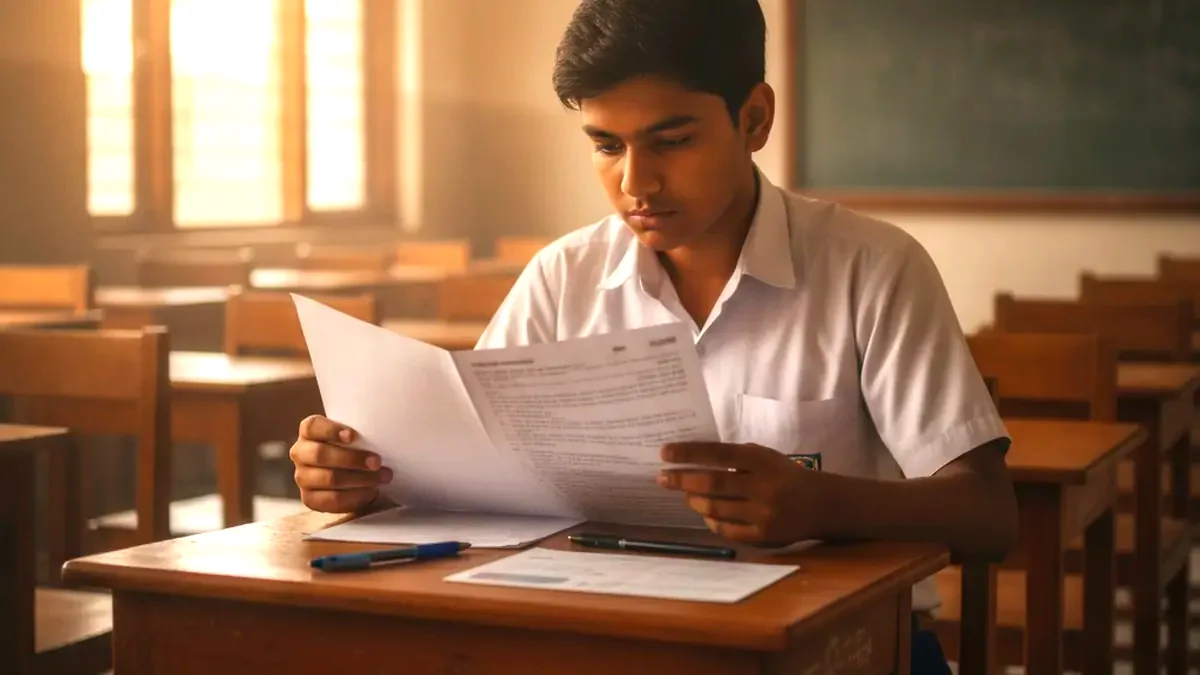
The CBSE 15-minute reading time strategy (10:15 AM to 10:30 AM) requires verifying question paper integrity, locking internal 'OR' choices, and mentally mapping competency-based case studies. Students must never write in the answer book or mark question papers during this period, using it strictly to eliminate anxiety and structure attempt order.
Key takeaways
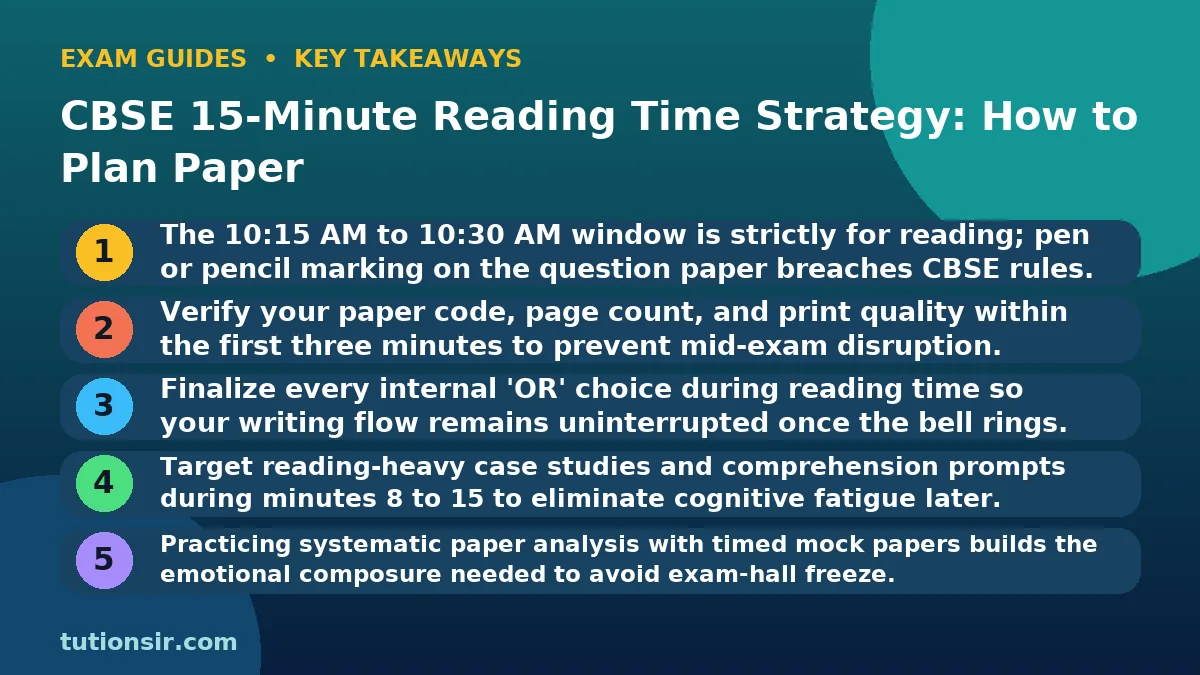
- The 10:15 AM to 10:30 AM window is strictly for reading; pen or pencil marking on the question paper breaches CBSE rules.
- Verify your paper code, page count, and print quality within the first three minutes to prevent mid-exam disruption.
- Finalize every internal 'OR' choice during reading time so your writing flow remains uninterrupted once the bell rings.
- Target reading-heavy case studies and comprehension prompts during minutes 8 to 15 to eliminate cognitive fatigue later.
- Practicing systematic paper analysis with timed mock papers builds the emotional composure needed to avoid exam-hall freeze.
CBSE Reading Time Rules and the Official 10:15 to 10:30 AM Schedule
The Central Board of Secondary Education (CBSE) mandates a standardized morning schedule across all affiliated examination centres in India and abroad. Under directives issued by the Controller of Examinations, Dr. Sanyam Bhardwaj, examination centre gates close strictly at 10:00 AM. Candidates who reach after this cutoff are denied entry to preserve a calm, distraction-free environment for examinees inside the halls.
Between 10:00 AM and 10:15 AM, invigilators distribute the main 32-page or 40-page answer booklets. Examinees utilize these fifteen minutes to fill in demographic details, roll numbers, subject codes, and shade the corresponding bubbles on the front OMR cover sheet. At exactly 10:15 AM, invigilators distribute the question papers for both the Class 10 AISSE and Class 12 AISSCE. From 10:15 AM to 10:30 AM, a mandatory 15-minute reading period takes effect, concluding when the long bell rings at 10:30 AM to mark the official commencement of writing.
What Can You Write on the Question Paper in CBSE Board Exams?
You are strictly permitted to write only your Roll Number in the designated blank box at the top of the question paper. Writing answers, solving equations, outlining steps, or ticking options with a pen or pencil is strictly forbidden under CBSE Unfair Means (UFM) Regulations.
Flying squads and centre superintendents inspect papers during rounds. If an examinee is caught with unauthorized pencil ticks, scribbled formulas, or solved rough work on their question paper, it can trigger an immediate UFM inquiry, leading to paper confiscation or cancellation. Keep your pens, pencils, and highlighters resting flat on the desk until the 10:30 AM bell rings.
Minute-by-Minute Strategy for the CBSE 15-Minute Reading Time
Navigating the reading window without a structured workflow often leads to scattered reading, heightened anxiety, and wasted time. Topper examinees approach the 15 minutes as an operational planning phase divided into three deliberate stages.
Minutes 0 to 3: Verification, Page Counting, and Instructions
Finally, spend sixty seconds scanning the general instructions. CBSE occasionally introduces modifications in section-wise weightage, word limits, or sub-part distribution. Confirm how many sections the paper contains and the exact number of compulsory internal choices.
Minutes 3 to 8: Internal Choice Selection and Question Filtering
Devote the middle five minutes exclusively to locking internal options ('OR' questions). CBSE papers offer roughly 33% internal choice across subjective sections. When students leave these decisions for the writing phase, they waste precious writing minutes hesitating between two alternatives.
Evaluate both choices in a pair based on concrete grading criteria rather than initial familiarity. Select the prompt where you know every sub-part and can cite precise diagrams, equations, or case examples. Once decided, commit mentally to that question and eliminate the other from your thoughts.
Minutes 8 to 15: Competency Questions and First-Hour Blueprint
In alignment with the National Education Policy (NEP 2020), CBSE papers now feature up to 50% Competency-Based Questions (CBQs), such as integrated case studies, source-based extracts, and assertion-reasoning sets. These items have lengthy contextual preambles that demand sustained focus.
Use your final seven minutes to read through the case study stems in Section E or the unseen passages in Section A. Read the accompanying questions first, then scan the case background to identify relevant data or concepts. When the 10:30 AM bell rings, you can begin writing answers immediately without re-reading extensive passages from scratch.
Subject-Specific Tactics: English, Mathematics, Science, and Social Science
A generic reading strategy cannot handle the distinct structural demands of every academic subject. Different disciplines require targeted adjustments during the 10:15 AM to 10:30 AM window.
CBSE English Exam: Unseen Passages and Writing Selection
In English Core and Communicative papers, Section A (Reading Skills) features dense factual and discursive passages. Use the 15 minutes exclusively for the unseen passages.
Read the comprehension questions first before reading the passage itself. By priming your mind with the specific inquiry, vocabulary words, and tone queries, your brain automatically tags key paragraphs and contextual clues as your eyes sweep the passage text. If time remains, read Section B's creative writing prompts and decide between the internal options for letters, notices, or analytical paragraphs.
CBSE Mathematics Exam: Isolating Pitfalls and Proofs
For Class 10 and 12 Mathematics, resist the urge to calculate arithmetic solutions mentally during the reading period. Mental arithmetic without scrap paper causes unnecessary cognitive strain.
Instead, inspect the 4-mark and 5-mark subjective questions in Sections C and D, along with the Section E case studies. Identify which theorems are being tested, which coordinate geometry formulas apply, and which internal choices offer straightforward algebraic manipulation versus complex trigonometry proofs. Mental formula verification ensures your computational roadmap is fully organized before you pick up your pen.
Science and Social Science: Competency Decoding and Map Scanning
In Science (Physics, Chemistry, Biology), use reading time to decipher multi-part application questions and assertion-reasoning pairs. Verify the conditions given in circuit diagrams, chemical reaction balancing constraints, or genetics crosses.
In Social Science, allocate two minutes to inspect the map-work items in Section F to pinpoint historical locations or geographical features instantly. Then, scan the source-based historical excerpts in Section E. Identifying whether a question asks for cause, consequence, or personal reflection prevents off-topic digressions during writing.
| Time Window | Strategic Priority | Core Actions & Focus | CBSE Compliance Rule |
|---|---|---|---|
| Minutes 0 to 3 | Integrity & Instruction Check | Verify QP code with OMR sheet, count printed pages, inspect print clarity, read general instructions. | No pen or pencil usage permitted on paper; verify Roll Number box only. |
| Minutes 3 to 8 | Internal Choice ('OR') Finalization | Evaluate subjective options across Sections B, C, and D using step-marking and sub-part certainty criteria. | Lock choices mentally; do not tick, mark, or cross options on the question paper. |
| Minutes 8 to 13 | Case Study & Passage Scanning | Read comprehension questions in English or context stems in Science/Social Science/Maths case studies. | Focus cognitive energy on decoding dense text; avoid mental arithmetic burnout. |
| Minutes 13 to 15 | Launch Sequence & Pacing Plan | Identify the first 3 questions to write at 10:30 AM; take steady breaths to settle heart rate. | Answer books remain closed for writing until the commencement bell rings at 10:30 AM. |
How to Choose Internal Choices in CBSE Board Exams
Once you select your choice, fix it firmly in your mind. Second-guessing yourself midway through writing wastes time and leaves messy strikethroughs across your answer script.
- Sub-part Completeness: Opt for the question where you know 100% of the sub-divisions. A question divided into (a) 2 marks, (b) 2 marks, and (c) 1 mark where you know all three will score higher than a single 5-mark question where your explanation becomes vague after the opening paragraph.
- Step-Marking Safety: In quantitative and scientific subjects, select numerical problems or structured derivation proofs over open-ended theoretical essays. CBSE marking schemes assign discrete marks for formulas, values substituted, and units, making scoring predictable.
- Word-Economy and Time Cost: Compare the writing time required. For instance, in Class 12 Business Studies or Political Science, choosing a direct process question with 4 clear steps saves 5 to 7 minutes compared to an open-ended evaluative critique of an economic policy.
Psychological Regulation: How to Avoid Panic and Exam Freeze
Opening a board exam paper and immediately noticing an unfamiliar diagram or unexpected question format often triggers an acute stress response. Heart rate climbs, palms sweat, and the mind blanks out—a condition commonly referred to as exam freeze.
Recognize that initial shock is a normal physiological reaction, not an indicator of your preparation. Remind yourself that a CBSE question paper is calibrated across varied difficulty levels: roughly 50% tests direct understanding, 30% evaluates application, and only 20% challenges higher-order thinking (HOTS). An unfamiliar 4-mark question leaves 76 accessible marks on the table.
The 4-4-4 Grounding Protocol in the Exam Hall
If anxiety spikes between 10:15 AM and 10:20 AM, temporarily lower the question paper face-down on your desk. Plant both feet flat against the floor, rest your hands on your knees, and inhale slowly through your nose for 4 counts, hold for 4 counts, and exhale smoothly through your mouth for 4 counts. Complete two cycles.
Next, look intentionally for three questions across Section A or B that you know thoroughly. Confirming your mastery over easy questions halts adrenaline surges and restores executive working memory. If you experience chronic, debilitating test anxiety throughout the academic session, speaking with your school counsellor or healthcare professional can provide structured coping mechanisms.
Five Mistakes to Avoid During the 15-Minute Reading Window
Structured preparation platforms like Tution Sir help students practice under authentic timed conditions with mock board papers, building the strategic discipline required to navigate these critical opening minutes smoothly.
- Using Pen or Pencil on the Paper: Do not underline keywords, solve MCQs, or put dots beside option bubbles. Invigilators can seize papers or issue official reprimands for unpermitted markings under CBSE examination rules.
- Mentally Solving Entire Multiple-Choice Questions: Trying to solve 20 Section A MCQs mentally exhausts working memory before writing begins. Use the window to skim question themes rather than doing heavy mental algebra.
- Flipping Pages Erratically: Shuffling aimlessly through the question booklet without a fixed sequence induces overwhelm. Follow a methodical page-by-page or section-by-section pass.
- Ignoring Multi-Page Sub-Questions: Skimming too quickly can cause students to overlook a sub-part tucked at the top of an adjacent page (e.g., missing question 'part (d)' on page 7). Verify all sub-parts during verification.
- Switching Attempt Orders Unplanned: Do not alter your practiced sectional order on a sudden impulse. If you trained all year doing Section A first, do not switch spontaneously to Section D simply because the first long question looked enticing.
Frequently asked questions
Is writing or ticking answers on the question paper allowed during CBSE reading time?
No, writing or ticking answers on the question paper is strictly prohibited under CBSE examination guidelines. Examinees are only permitted to write their official roll number in the earmarked space at the top of the paper. Making pencil marks, solving equations, or ticking MCQ options can be treated as Unfair Means (UFM).
What is the exact official timing for the 15-minute reading window in CBSE exams?
According to official CBSE examination circulars issued by the Controller of Examinations, question papers are distributed at 10:15 AM. The 15-minute reading window runs from 10:15 AM to 10:30 AM. Writing in the answer booklet begins promptly at 10:30 AM when the commencement bell rings.
Can students fill in OMR particulars or write formulas in the answer book during reading time?
Students fill in their roll number, subject code, and OMR details between 10:00 AM and 10:15 AM before the question paper is distributed. Once the 10:15 AM reading period begins, no writing of any kind—including jotting rough formulas or notes in the answer book—is permitted until 10:30 AM.
How should students evaluate and lock internal choice ('OR') questions during the 15 minutes?
Examinees should choose the internal option where they can fully answer every sub-part with complete certainty. Prioritize questions with structured step-marking, such as numerical problems, derivations, or distinct point-based prompts, over long theoretical essays where grading criteria are more subjective.
What is the best way to utilize the 15-minute reading window for lengthy English comprehension passages?
In English papers, immediately turn to Section A. Read the comprehension questions first to identify targeted keywords, tone markers, and vocabulary terms. Then, scan the passage paragraphs with those questions in mind. This allows you to pinpoint answers immediately once writing starts at 10:30 AM.
Should students solve MCQs mentally during the CBSE reading period or focus on long answers?
Students should avoid solving complex MCQs mentally during reading time, as doing mental arithmetic creates premature brain fatigue. Instead, focus reading time on assessing internal choices in high-mark subjective sections and reading dense case-study stems, leaving discrete objective questions for the writing phase.
What must a student do immediately if there is a misprint or missing page in the question paper?
If you discover missing pages, blank sheets, illegible print, or mismatched set codes, raise your hand immediately and alert the invigilator. Reporting misprints during the 10:15 AM to 10:30 AM window ensures you receive a verified replacement copy before writing time starts, without losing writing minutes.
Sources and official links
- Central Board of Secondary Education (CBSE) Official Portal
- CBSE Examination Circulars and Guidelines
- The Times of India - CBSE Board Exam Day Rules and Bell Schedule
Exam rules and notifications change. Confirm dates, fees and eligibility on the official website before acting. Spotted an error? Email support@tutionsir.com. See our editorial policy.
Keep learning
How to Increase Handwriting Speed in Board Exams: Top Tips
Every year, thousands of Indian board examinees lose 10 to 15 marks simply because their hands cannot keep up
Read →CBSE Sample Paper Analysis: Guide to PYQs & Marking Schemes
Solving sample papers without an analytical framework produces minimal score improvement for board candidates.
Read →How to Avoid Silly Mistakes in CBSE Class 10 Maths: Guide
Every year, thousands of Class 10 board students drop from a 95 to an 85 not from a lack of mathematical knowl
Read →Practise what you just read
Free plan, no card needed. Full mock tests and the complete question bank are on the Pro plan.