CBSE . Academic Competitions
CBSE Aryabhata Ganit Challenge 2026: Dates, Fees & Guide
The Central Board of Secondary Education has officially rolled out the Aryabhata Ganit Challenge 2026 for students of Classes 8, 9, and 10 under Circular No. Acad-74/2026. The national initiative aims to strengthen mathematical thinking and real-life problem-solving skills across all affiliated schools.
Quick answer
The CBSE Aryabhata Ganit Challenge 2026 is a nationwide, two-tier mathematics assessment launched under Circular Acad-74/2026 for students in Classes 8 through 10. School-level Stage 1 runs free from November 4 to 18, 2026, leading to a ₹900 institutional national Computer Based Test on December 2, 2026.
Key takeaways
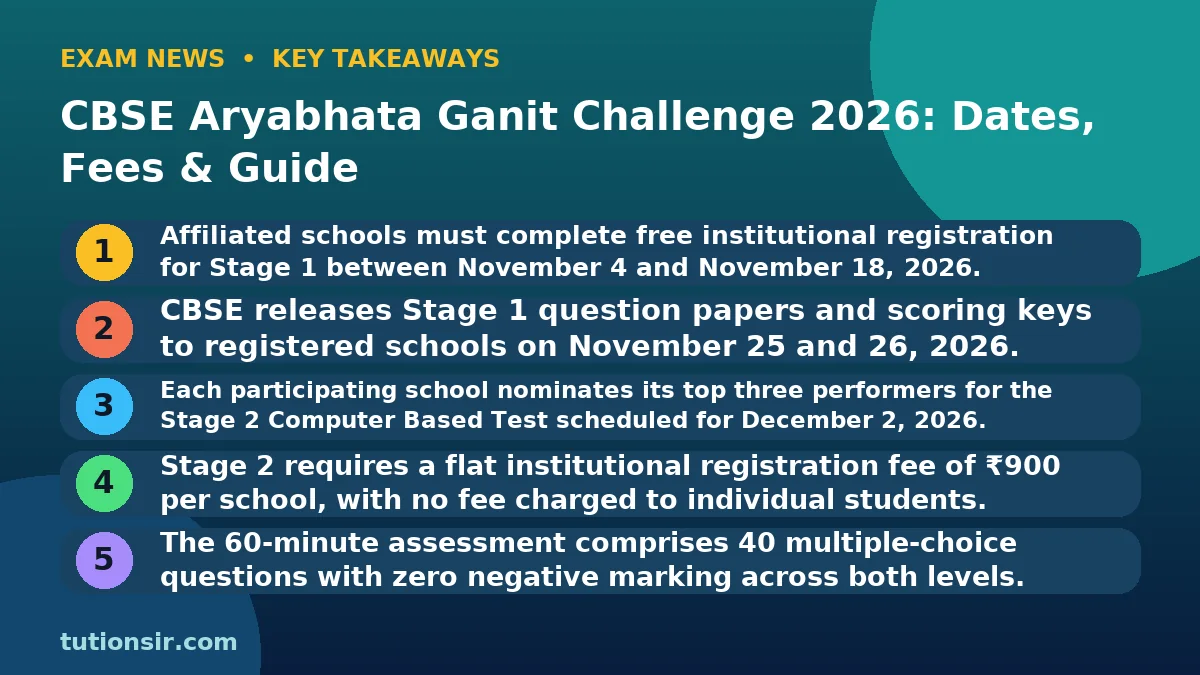
- Affiliated schools must complete free institutional registration for Stage 1 between November 4 and November 18, 2026.
- CBSE releases Stage 1 question papers and scoring keys to registered schools on November 25 and 26, 2026.
- Each participating school nominates its top three performers for the Stage 2 Computer Based Test scheduled for December 2, 2026.
- Stage 2 requires a flat institutional registration fee of ₹900 per school, with no fee charged to individual students.
- The 60-minute assessment comprises 40 multiple-choice questions with zero negative marking across both levels.
What is the CBSE Aryabhata Ganit Challenge 2026 Circular Acad-74/2026?
The Central Board of Secondary Education (CBSE) officially published Circular No. Acad-74/2026 on November 4, 2026, announcing the annual Aryabhata Ganit Challenge (AGC) 2026. Aligned with the experiential learning principles of the National Education Policy (NEP) 2020, this competition is crafted to transition school mathematics away from passive rote learning toward applied mathematical literacy and daily problem-solving.
The assessment evaluates how effectively students in secondary school can apply mathematical reasoning to unstructured, real-world contexts. Instead of testing standard mechanical calculations, the challenge asks students to model situations, interpret practical data, identify geometric patterns, and apply quantitative logic. Participation is organised entirely via CBSE-affiliated schools, providing an equitable benchmarking platform for learners across the country.
Who is eligible to participate and can individual students apply directly?
Eligible participants include all students currently enrolled in Classes 8, 9, and 10 within CBSE-affiliated institutions. The Board enforces an inclusive policy during the initial round, encouraging schools to permit broad student participation regardless of prior internal examination scores.
Individual students cannot register on their own via private candidate logins. All registrations must be routed through the student's respective school administration. Parents and learners seeking participation must contact their school mathematics department or exam coordinator, who will register the institution and administer the first round internally on campus.
How does the two-tier structure work: Stage 1 vs Stage 2?
The Aryabhata Ganit Challenge operates in two sequential phases: a school-level screening round followed by an online national challenge.
Stage 1 is conducted directly by participating schools on their own campuses. CBSE uploads the standardized question paper and evaluation key to its academic web portal on November 25 and 26, 2026. Teachers conduct the pen-and-paper test, mark the scripts using the official key, and identify their top three scoring students.
Stage 2 is an apex national-level Computer Based Test (CBT) scheduled for December 2, 2026. Only the three selected representatives from each registered school are permitted to sit for this digital assessment, administered under CBSE supervision.
| Activity / Event | Official Date / Timeline | Format & Platform | Fee Structure |
|---|---|---|---|
| Stage 1 School Registration | 04 Nov to 18 Nov 2026 | Online via cbseacademic.nic.in | Free (No fee) |
| Question Paper & Answer Key Release | 25 Nov & 26 Nov 2026 | School login download on portal | Included in Stage 1 |
| Stage 1 Test Administration | During school hours by 26 Nov 2026 | Offline pen-and-paper in school | Free |
| Stage 2 Nomination & Registration | 27 Nov to 30 Nov 2026 | School portal data entry (Top 3 students) | ₹900 per school |
| Stage 2 National Examination | 02 December 2026 | Online Computer Based Test (CBT) | Covered by institutional fee |
| Merit Certificate Allocation | Post-examination announcement | Top 100 students per CBSE region | Digital certificates |
What are the registration fees and cbseacademic.nic.in portal steps?
Participation in Stage 1 carries zero fees for schools and students alike. For Stage 2, CBSE mandates an institutional registration fee of ₹900 per school to nominate its three top performers. This fee is non-refundable and must be paid collectively by the school using debit card, credit card, or net banking; individual students are never required to remit fees directly to the Board.
School examination coordinators can complete institutional registration by following these practical steps:
- Visit the official academic portal at cbseacademic.nic.in and locate the Aryabhata Ganit Challenge 2026 link under the circular section.
- Log in using the school's existing CBSE affiliation credentials (LOC user ID and password).
- Fill in the basic institutional details to register for Stage 1 before the November 18, 2026 cut-off.
- Download the Stage 1 question paper and answer key when unlocked on November 25 and 26, 2026.
- Re-access the portal between November 27 and November 30, 2026, to submit the particulars of the top three students and make the ₹900 Stage 2 institutional payment.
What is the AGC 2026 exam pattern, marking scheme, and tie-breaker protocol?
Both Stage 1 and Stage 2 follow an identical testing format. The exam has a duration of 60 minutes and consists exclusively of 40 multiple-choice questions (MCQs), carrying one mark each for a total of 40 marks. There is no negative marking for incorrect answers or unanswered items.
A common administrative challenge during Stage 1 is managing tie scores when multiple students finish with identical top marks. CBSE guidelines require schools to nominate strictly three candidates. To resolve ties equitably, schools should adopt an objective tie-breaker mechanism: either administer a brief 15-minute speed-and-accuracy screening quiz, evaluate speed of submission in the initial test, or prioritize performance on high-difficulty reasoning items. Schools should document this criteria upfront to maintain complete transparency.
What syllabus topics and mathematical competencies are evaluated?
The AGC assessment does not adhere to standard textbook formula drills; instead, it tests functional application across the NCERT Class 8, 9, and 10 mathematics framework.
The curriculum spans five key content areas and six core competencies specified by the Board:
Core Content Domains
Content questions test: Number Sense and Number Systems; Algebra; Mensuration; Geometry and Spatial Sense; and Data Analysis, Statistics, and Probability. Questions frequently integrate contextual case studies, everyday consumer arithmetic, and India's historical mathematical heritage.
Key Evaluated Competencies
The exam is designed around six cognitive pillars: conceptual understanding, problem-solving ability, logical reasoning, strategic approach, visualization and mathematisation, and creative or abstract thinking. Practicing higher-order thinking problems on platforms like Tution Sir can help secondary school students develop the rapid pattern recognition and quantitative reasoning needed for this test.
How are merit certificates awarded across CBSE administrative regions?
CBSE recognizes top mathematical talent across all its administrative regions, ensuring fair representation nationwide. Following the completion of the Stage 2 Computer Based Test, the Board compiles regional merit rankings.
The top 100 qualifying students from each CBSE administrative region receive an official CBSE Merit Certificate. Furthermore, to incentivize broad participation at the grassroots level, CBSE awards an Appreciation Certificate to the top 10 schools in every region that record the highest percentage of student participation in Stage 1. Both student merit certificates and school awards are dispatched digitally via academic dashboards.
Frequently asked questions
What is the CBSE Aryabhata Ganit Challenge 2026?
The Aryabhata Ganit Challenge 2026 is an annual mathematical competence test organized by CBSE under Circular Acad-74/2026. It is designed for students in Classes 8 to 10 to evaluate practical reasoning, spatial sense, and real-life mathematical applications across two competitive stages.
Who is eligible to participate in the Aryabhata Ganit Challenge 2026?
All regular students studying in Classes 8, 9, and 10 in schools affiliated with the CBSE are eligible to participate in the Stage 1 school-level competition. Only the top three students identified by each school qualify to advance to the Stage 2 national test.
Can individual students apply directly for CBSE Aryabhata Ganit Challenge?
No, individual students cannot apply directly on the CBSE portal. Registrations for both Stage 1 and Stage 2 must be handled officially by affiliated schools using their institutional CBSE portal logins. Students must register through their school's mathematics department.
What is the registration fee for Aryabhata Ganit Challenge 2026?
Participation in Stage 1 is completely free for all students and schools. For Stage 2, affiliated schools must pay a fixed institutional registration fee of ₹900 when nominating their top three students. Students do not pay any individual fees.
What are the important dates for CBSE AGC 2026 Stage 1 and Stage 2?
Stage 1 institutional registration is open from November 4 to November 18, 2026. CBSE releases Stage 1 papers on November 25 and 26. Stage 2 registration takes place between November 27 and 30, and the national CBT will be conducted on December 2, 2026.
What is the exam pattern and duration for Aryabhata Ganit Challenge?
Both stages feature a 60-minute examination containing 40 multiple-choice questions for a maximum of 40 marks. The questions assess five content areas and six analytical competencies focusing on real-world applications rather than textbook memorization.
Is there any negative marking in the Aryabhata Ganit Challenge test?
No, there is no negative marking in either Stage 1 or Stage 2 of the challenge. Every correct answer earns one mark, and incorrect or unattempted responses carry zero penalties, encouraging students to attempt every question thoughtfully.
How are top performers awarded merit certificates in CBSE AGC 2026?
The top 100 scoring students from each CBSE administrative region in the Stage 2 Computer Based Test receive an official CBSE Merit Certificate. Additionally, the top 10 schools per region with the highest Stage 1 student turnout receive Appreciation Certificates.
Sources and official links
Exam rules and notifications change. Confirm dates, fees and eligibility on the official website before acting. Spotted an error? Email support@tutionsir.com. See our editorial policy.
Keep learning
NCERT New Class 10 Books: December 2026 Release Guide
The National Council of Educational Research and Training (NCERT) has confirmed that revised Class 10 textbook
Read →How to Solve Physics Numericals Easily: 5-Step Guide
Struggling to solve numerical problems even when you remember every formula is the single most common frustrat
Read →How to Avoid Silly Mistakes in CBSE Class 10 Maths: Guide
Every year, thousands of Class 10 board students drop from a 95 to an 85 not from a lack of mathematical knowl
Read →Practise what you just read
Free plan, no card needed. Full mock tests and the complete question bank are on the Pro plan.