CBSE Board Exams • Strategy & Presentation
CBSE Board Exam Answer Presentation: Top Formatting Guide
Scoring 95% or higher in CBSE board exams requires more than rote memorization; it demands clear, disciplined answer presentation. Formatting your responses to match official marking criteria ensures examiners instantly spot key points and award maximum step marks.
Quick answer
Effective CBSE board exam answer presentation relies on structured formatting aligned with official marking schemes. Write with a blue or royal blue pen, highlight NCERT keywords, preserve step-by-step working for numericals, present diagrams in pencil with boxes, and group all sub-questions together to secure every allotted step mark.

Key takeaways
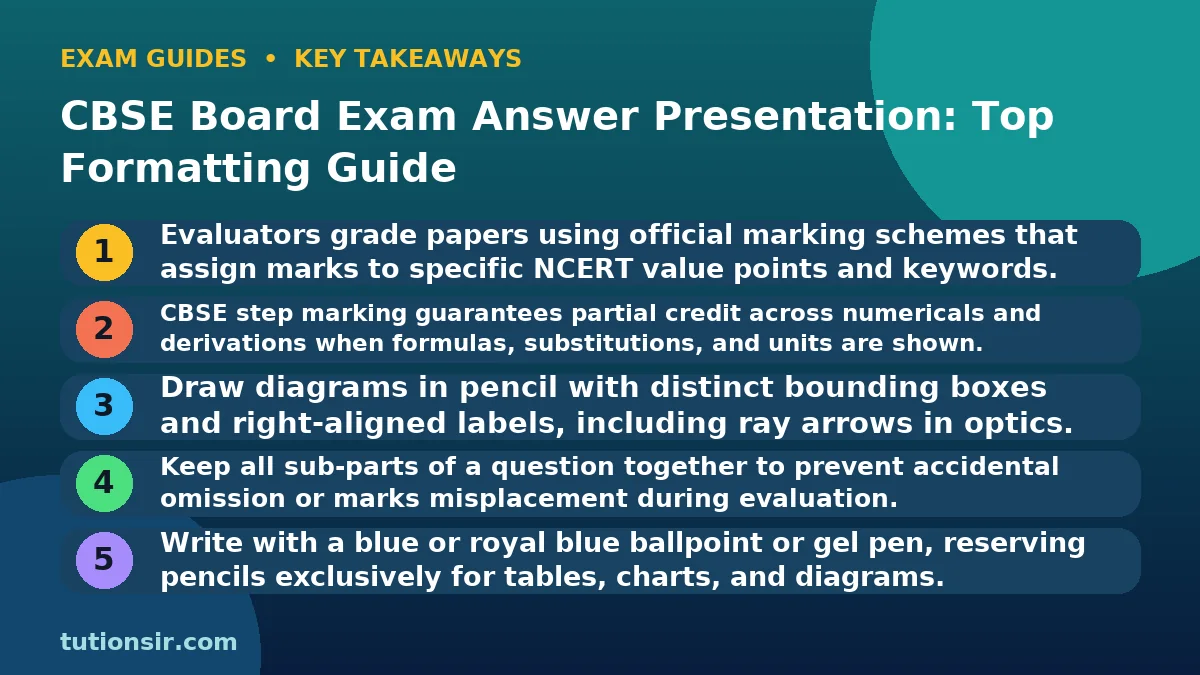
- Evaluators grade papers using official marking schemes that assign marks to specific NCERT value points and keywords.
- CBSE step marking guarantees partial credit across numericals and derivations when formulas, substitutions, and units are shown.
- Draw diagrams in pencil with distinct bounding boxes and right-aligned labels, including ray arrows in optics.
- Keep all sub-parts of a question together to prevent accidental omission or marks misplacement during evaluation.
- Write with a blue or royal blue ballpoint or gel pen, reserving pencils exclusively for tables, charts, and diagrams.
Try Tution Sir free for your class and subject.
No card. Registering takes about two minutes.
How do CBSE examiners evaluate and grade answer copies?
CBSE examiners do not assess your paper subjectively based on overall impressions; they evaluate strictly against the CBSE Official Marking Scheme issued by the Controller of Examinations, CBSE. Each subject question paper is accompanied by a standardized evaluation rubric that outlines exact 'value points', conceptual keywords, and fractional mark breakdowns. An examiner reviewing dozens of scripts every single day looks directly for these value points.
When an answer is presented in dense, unstructured paragraphs, essential terms often get lost in visual clutter. Conversely, an answer sheet featuring prominent subheadings, bullet points, underlined terms, and clear margins enables the evaluator to verify the presence of every required concept quickly. Understanding this evaluator-centric perspective forms the foundation of board exam paper presentation techniques.
- Value Points: Evaluators search specifically for core concepts derived from the NCERT syllabus.
- Step Mark Breakdowns: Marks are partitioned into half-mark (0.5) and one-mark (1.0) allocations across procedures, definitions, and reasoning.
- Time Constraints: Evaluators handle multiple scripts per session, meaning immediate legibility directly protects your marks from oversight.
Mastering the CBSE step marking scheme in numericals and science
The CBSE step marking scheme is designed to award partial credit at every milestone of an answer, meaning a computational slip at the final line will not cost you full marks if your methodology is intact. In both the Class 10 Secondary School Examination and Class 12 Senior School Certificate Examination, quantitative questions in Mathematics, Physics, Chemistry, and Accountancy follow a rigorous four-phase presentation rubric.
To maximize step credit, never write direct arithmetic calculations without setting up the contextual framework. Always organize numerical answers into four distinct stages: 'Given Data with standard symbols', 'Applicable Formula or Governing Law', 'Value Substitution with clear algebraic manipulation', and 'Final Magnitude accompanied by SI or standard Units enclosed in a box'. This methodology guarantees that even if a transcription mistake occurs during final calculation, the earlier milestones secure the bulk of the allotted credit.
Step-by-step layout for numerical solutions
Start by listing 'Given' variables on the left side of your answer space, converting all parameters into the SI system immediately (e.g., converting centimeters to meters or hours to seconds). State the formula explicitly in standard notation before substituting numbers. Avoid performing intermediate mental math; write each algebraic transformation on a new line. Finally, write the derived value clearly, state the units explicitly, and draw a neat box around the final answer.
Scientific derivations and chemical equations
For theoretical derivations in Physics, state the initial physical assumptions and label all vector signs or coordinate axes before writing equations. In Chemistry, write balanced chemical equations with state symbols (s, l, g, aq) and specify reaction conditions such as temperature, pressure, and catalysts above the reaction arrow. Balanced equations must stand on individual lines rather than running inside descriptive sentences.
How to structure 5 mark questions in CBSE board exam papers
Long-form five-mark questions determine the difference between an average score and an exceptional one, requiring a balanced blend of structure, depth, and spatial organization. In CBSE examinations, attempting a 5-mark question as a continuous block of text is the most common presentation mistake. Instead, successful candidates employ an architectural framework: a crisp 2-line introductory context, 4 to 5 thematic bullet points with bold subheadings, and a concluding evaluation or real-world application.
Word limit directives issued by CBSE recommend approximately 120 to 150 words for 5-mark theory questions. Writing far beyond this limit does not yield additional marks and robs you of time needed for revision. Each distinct point should start on a fresh line, supported by an underlined NCERT keyword to catch the examiner's eye immediately.
- Heading & Introduction: Begin with a brief definition or contextual summary highlighting the primary entity of the question.
- Categorized Subheadings: Group complex explanations into logical categories (e.g., 'Principle', 'Working', 'Limitations' or 'Causes', 'Impacts', 'Mitigation').
- Visual Anchors: Complement the explanation with a flow diagram, comparison table, or labeled sketch wherever applicable.
- Concluding Note: Close with a one-sentence inference that directly links back to the core question.
| Question Mark Tier | Recommended Word Limit | Structural Layout Pattern | Key Presentation Elements |
|---|---|---|---|
| 1-Mark Questions (MCQ / Objective) | Direct option / 1 to 20 words | Option letter with full corresponding text | State correct option alphabet (e.g., '(B)') along with explicit text |
| 2-Mark Questions (Short Answer I) | 30 to 50 words | 2 distinct bullet points or short definition | Underline primary technical term; 1 mark per valid value point |
| 3-Mark Questions (Short Answer II) | 50 to 80 words | 3 distinct points with mini-headings | Include relevant formula or small diagram; point-wise breakdown |
| 4-Mark Questions (Case-Based / Application) | 80 to 100 words (or sub-parts) | Sub-question answers labelled clearly (i, ii, iii) | Direct extraction of conceptual solution referencing the provided case |
| 5-Mark Questions (Long Answer) | 120 to 150 words | Introduction, 4-5 thematic bullet points, conclusion | Bold subheadings, pencil diagrams inside boxes, boxed final results |
Essential diagram, graph, and margin protocols
Visual presentations such as ray diagrams, biological sketches, electric circuits, and coordinate graphs require adherence to strict procedural guidelines. All diagrams and graphical plots in CBSE answer sheets must be executed strictly in sharp graphite pencil, never in ink. If a diagram drawn in ink contains an error, rectifying it creates unsightly blemishes that detract from overall presentation.
Enclose every standalone diagram within a clean rectangular bounding box drawn with a ruler. When labeling components, align all leader lines horizontally toward the right margin whenever possible, avoiding overlapping or crisscrossing lines. For Physics ray optics, direction arrowheads along incident and reflected or refracted rays are mandatory; CBSE evaluation rules stipulate that a ray lacking an arrow carries zero mark value even if geometrically accurate. In Class 10 Science, electric circuit schematics must indicate proper meter polarities (+ and -) and switch states.
- Left and Right Margins: Draw a neat margin on the left for question numbering and a narrow margin on the right side of the sheet for rough calculation notes.
- Bounding Boxes: Frame every diagram, flow chart, and key formula inside a neat pencil border.
- Label Alignment: Keep text horizontal and neatly aligned to the right, using uppercase or title-casing for readability.
- Graph Coordination: Label graph axes clearly with quantities and units, declare scale ratios on the top right, and mark coordinate intersections with circled dots.
Handling sub-questions, section demarcations, and error rectification
A critical area where candidates lose marks is improper handling of sub-questions and cross-sectional replies. When answering multi-part prompts, such as Question 24 featuring parts (a), (b), and (c), you must answer all sub-parts contiguously. Scattering sub-parts across different pages of the answer booklet forces evaluators to cross-reference multiple folios, significantly increasing the risk of an uncredited sub-part during spot evaluation. If you are momentarily unsure of part (b), leave adequate blank space and proceed to part (c), returning later to finish.
Furthermore, Central Board of Secondary Education guidelines mandate clear section management. In subjects like Class 10 Science (divided into Section A, B, and C) and Social Science (divided into Section A, B, C, and D), CBSE has explicitly instructed that answers must be written strictly within their designated section blocks. Mixing questions from different subject sections can lead to replies not being evaluated.
Clean error correction protocols
Mistakes happen under exam pressure, but how you correct them defines your paper's cleanliness. Liquid correction fluid, whiteners, and blade erasers are strictly barred by CBSE regulations. Never scribble heavily or draw zig-zag patterns over an incorrect sentence. To cancel an erroneous word, calculation, or entire paragraph, use a ruler to draw a single, clean horizontal strike-through line across it. Write the correct statement immediately below or beside it. Evaluators appreciate neat cancellations and ignore strikethrough material completely.
Supplementary sheet management
When exhausting the main CBSE answer booklet, request a supplementary sheet well before your current page ends so your writing flow remains uninterrupted. Record your roll number and the supplementary sheet number accurately on the main booklet cover page as instructed by invigilators. Securely thread the additional sheets inside the main booklet using the provided twine, ensuring the knots are tight and the pages are arranged in chronological numerical order.
Subject-wise answer presentation tips for CBSE board exams
Presentation demands vary substantially across Humanities, Commerce, and Science disciplines. Applying identical layouts across all subjects fails to meet the specific pedagogical criteria set out in respective NCERT marking schemes. Tailoring your stylistic choices to the subject discipline instantly establishes technical maturity.
In Humanities subjects (History, Political Science, Sociology), build answers around structured thematic headers. Incorporate historical dates, constitutional articles, and significant geopolitical treaties underlined in the text. In English and Hindi language papers, adhere strictly to the prescribed layout boxes for notices, formal letters, advertisements, and analytical reports, writing within designated word ceilings.
For Commerce subjects (Accountancy and Business Studies), Accountancy ledgers and journal entries must feature complete column formats: Date, Particulars, Ledger Folio (L.F.), Debit Amount, and Credit Amount, drawn cleanly with a scale. Working notes are an indispensable component of the marking scheme; label them systematically (e.g., 'Working Note 1: Calculation of Goodwill') and reference them in your primary ledger. In Business Studies, state the NCERT management principle or concept as a prominent header before discussing its analytical application.
Actionable routine: 15-minute reading window and self-auditing
The mandatory 15-minute question paper reading window prior to exam commencement is your most valuable strategic asset. Use this period exclusively to scan the paper, read internal choices carefully, select the questions you are best equipped to answer, and formulate structural outlines in your mind. Do not write on your answer booklet during this reading window.
Conclude your paper writing at least 15 minutes before the final bell to execute a thorough three-step self-audit. First, verify question numbering against the question paper to ensure zero discrepancies. Second, scan calculations to check that all mathematical answers carry correct units and boxed highlights. Third, confirm that all supplementary sheets and supplied map sheets are tied firmly to the booklet. Developing these presentation habits during pre-board revisions and through automated answer evaluation on learning platforms like Tution Sir allows candidates to rectify presentation weaknesses well ahead of the final CBSE board examination.
Frequently asked questions
Does handwriting affect marks in CBSE board exams?
Handwriting does not have a separate score allocation, but legibility is critical. If an examiner cannot decipher your words or numbers, they cannot award marks for missing value points. Neat, legible handwriting with clean spacing and underlined keywords ensures examiners read and evaluate your points without confusion.
How does CBSE step marking work for numerical and science questions?
CBSE step marking allocates partial credit across every phase of a solution. Evaluators assign marks for identifying given variables, stating correct formulas, substituting values, and arriving at the final numerical answer with appropriate SI units. Even if the final calculation is incorrect, complete steps retain majority marks.
Can we attempt questions in any order in CBSE board exams?
Yes, you can attempt questions in any order, provided question numbers are written accurately. However, maintain section-wise continuity, especially in Class 10 Science and Social Science where questions must stay inside their section groups. Crucially, keep all sub-parts of a specific question grouped together.
What is the ideal word limit for 2, 3, and 5-mark questions in CBSE?
CBSE prescribes roughly 30 to 50 words for 2-mark questions, 50 to 80 words for 3-mark questions, and 120 to 150 words for 5-mark questions. Writing excessively beyond these guidelines does not earn additional credit and risks running out of time.
Are gel pens or ballpoint pens allowed in CBSE board exam answer sheets?
CBSE allows blue or royal blue ballpoint and gel pens. Avoid fountain pens or watery inks that bleed through standard answer sheet paper. Black pens, red pens, and colored inks are strictly barred for candidates. Pencils must be used for diagrams and graphs.
Is rough work allowed on the main CBSE answer booklet?
Yes, rough work is permitted directly on your answer booklet. Draw a neat vertical margin on the right side of the relevant page, label it clearly as 'Rough Work', and perform calculations there. Strike it through with a single pencil line before submitting your booklet.
Is a watch allowed inside the CBSE board exam hall for Class 10 and 12?
CBSE permits only standard analogue wristwatches inside the examination hall. Digital watches, smartwatches, fitness tracking bands, and any wristwear with calculation or connectivity functions are strictly prohibited and classified under unfair means regulations.
Sources and official links
- Central Board of Secondary Education (CBSE)
- CBSE Examination Circulars & Permitted Items
- CBSE Academic Sample Question Papers & Marking Scheme
Exam rules and notifications change. Confirm dates, fees and eligibility on the official website before acting. Spotted an error? Email support@tutionsir.com. See our editorial policy.
Keep learning
How to Write Long Answers in Social Science Class 10 (2026)
Many Class 10 students know their history dates and economic terms thoroughly yet drop precious marks on 5-mar
Read →How to Avoid Silly Mistakes in CBSE Class 10 Maths: Guide
Every year, thousands of Class 10 board students drop from a 95 to an 85 not from a lack of mathematical knowl
Read →How to Solve Unseen Passage in English Class 10: 5 Steps
Scoring 20 out of 20 in the reading section is entirely possible when you stop reading passages like storybook
Read →Do not let another week go by without a plan
Reading about the exam does not raise marks. Practice does. Register free now and start with the one topic that worries you most. Small daily practice beats a last-minute rush.
- Free plan, no card needed
- Ask any doubt and get a step-by-step answer
- Practice questions with explanations
Free plan, no card needed. Your progress is saved to your account.