CBSE Class 10 · English
How to Solve Unseen Passage in English Class 10: 5 Steps
Scoring 20 out of 20 in the reading section is entirely possible when you stop reading passages like storybooks and start treating them like treasure hunts. Here is the exact time-saving blueprint high-scoring students use to finish both passages in under 38 minutes.
Quick answer
To solve an unseen passage in English Class 10 quickly, read the question stems first to highlight key keywords, then skim the text to locate those anchors. Synthesize answers in your own words within 30 to 40 words, allocating no more than 18 to 20 minutes per passage.

Key takeaways
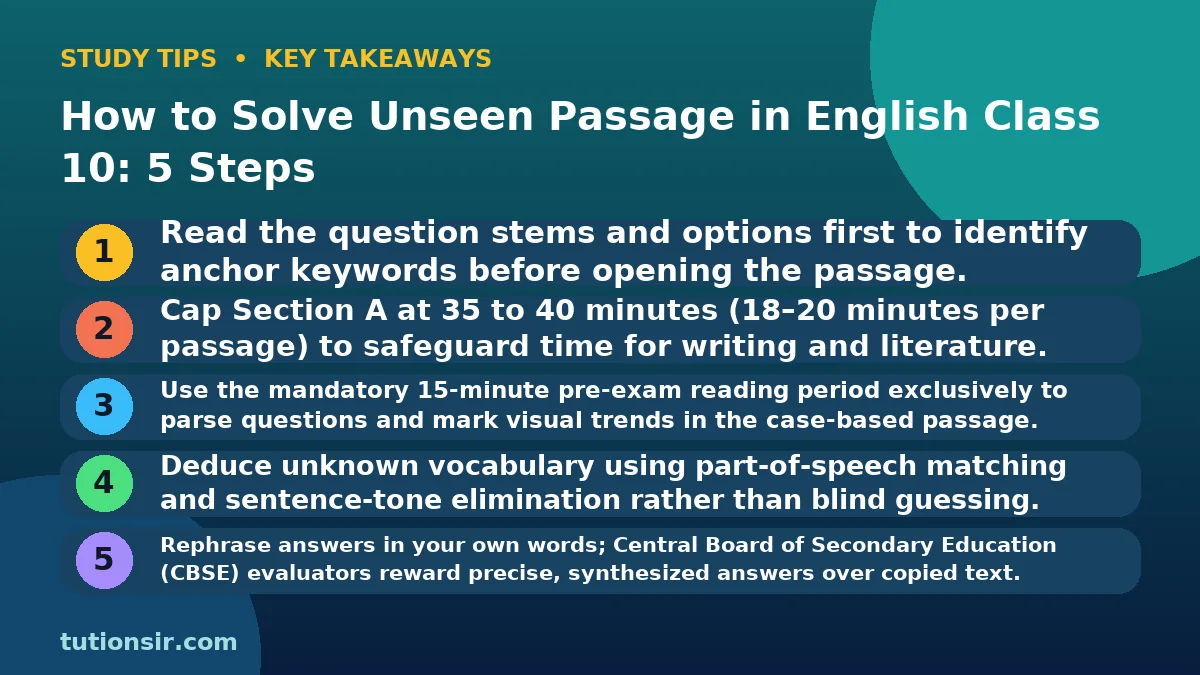
- Read the question stems and options first to identify anchor keywords before opening the passage.
- Cap Section A at 35 to 40 minutes (18–20 minutes per passage) to safeguard time for writing and literature.
- Use the mandatory 15-minute pre-exam reading period exclusively to parse questions and mark visual trends in the case-based passage.
- Deduce unknown vocabulary using part-of-speech matching and sentence-tone elimination rather than blind guessing.
- Rephrase answers in your own words; Central Board of Secondary Education (CBSE) evaluators reward precise, synthesized answers over copied text.
Try Tution Sir free for your class and subject.
No card. Registering takes about two minutes.
Should I Read Questions First or Passage First in Class 10 Unseen Passage?
You should always read the questions first before diving into the passage text. Most Class 10 students lose valuable time because they read the entire unseen passage line by line, reach the question section, and then find themselves compelled to re-read the passage all over again to search for answers. This passive approach duplicates your reading workload and burns upwards of 25 minutes on a single passage.
The question-first technique transforms your reading from aimless browsing into an active, targeted search. When you review the question stems, your brain registers specific keywords, names, dates, cause-and-effect relationships, and tone markers. As your eyes move across the paragraphs during your subsequent reading, those anchored terms trigger immediate recognition, allowing you to highlight candidate answers on your very first pass.
However, reading questions first requires deliberate discipline. Do not attempt to memorize all questions at once. Read the first three to four questions carefully, note their core demands, and then skim the initial paragraphs of the text. Because board exam questions generally follow the chronological flow of the passage, this phased approach ensures you locate answers in natural order without mental overload.
- Underline noun anchors (names, specific locations, scientific terms, statutory years).
- Circle relational triggers (such as 'why', 'how', 'consequence', 'contrast', 'primary factor').
- Pay attention to paragraph pointers (many questions specify 'In paragraph 2...' or 'According to paragraph 4...').
35-Minute Section A Blueprint: Time Management for Discursive and Case-Based Passages
A strict time-budgeting strategy is the single most important factor determining whether you complete your 80-mark English paper comfortably or panic during the literature section. In the CBSE Class 10 English Language and Literature examination (Code 184), Section A carries 20 marks split equally across two distinct texts: a Discursive Passage of 400 to 450 words (10 marks) and a Case-Based Factual Passage of 200 to 250 words with visual inputs (10 marks).
You must cap your total time for Section A at 38 minutes maximum—allocating 20 minutes to the discursive passage and 18 minutes to the case-based passage. Spending 50 or 60 minutes in the reading section leaves you rushed during the 20-mark Creative Writing section (Letter and Analytical Paragraph) and deprives you of time to construct nuanced answers for the 40-mark Literature section.
Treat each passage as an independent sprint divided into four distinct phases: two minutes for question preview, six to seven minutes for targeted skim-and-scan reading, eight minutes for writing concise answers, and two minutes for quick verification against question numbering.
Recommended Minute-by-Minute Breakdown per Passage
Minute 00 to 02: Read the question stems and highlight anchor words. Ignore distractors in Multiple Choice Questions (MCQs); read only the stem and question prompt to avoid false biases.
Minute 02 to 09: Skim the passage. Read the opening sentence and concluding line of every paragraph with extra focus, as authors state main ideas there. Underline answers matching your question anchors.
Minute 09 to 17: Draft your answers directly in your answer sheet. For MCQs, write both the chosen option letter and the text answer clearly. For short-answer questions, formulate two crisp sentences (30–40 words).
Minute 17 to 19: Review your answers against the prompt numbers. Verify that you have answered all sub-parts, especially where a two-mark question asks for an explanation along with an inference.
How to Utilize the 15-Minute Question Paper Reading Time for Unseen Passages
The mandatory 15-minute pre-exam reading period provided by boards like CBSE and ICSE is your greatest strategic advantage if used correctly. During this window, you are not permitted to write on the answer sheet, but you are allowed to read the question paper thoroughly. Most students waste these fifteen minutes flipping aimlessly through literature questions they already know how to approach.
Dedicate at least 10 of those 15 minutes exclusively to Section A. Start by reading the questions of Passage 1, followed by a swift skim through its text. Because your mind is fresh and unburdened by exam exhaustion, your comprehension speed and information retention are at their peak.
Next, move directly to Passage 2. Examine the accompanying bar graph, table, or infographic. Identify the axis labels, highest and lowest values, percentages, and headline trends. When the writing bell rings, you will already know where 60 to 70 percent of the answers reside, allowing you to begin writing immediately with confidence.
| Feature | Discursive Passage (Q1) | Case-Based Factual Passage (Q2) |
|---|---|---|
| Word Count | 400–450 words | 200–250 words (excluding visuals) |
| Marks Weightage | 10 Marks | 10 Marks |
| Core Focus | Opinion, argument, philosophical or socio-cultural discourse | Data analysis, statistical charts, reports, surveys, or factual inputs |
| Question Types | Inference, evaluation, vocabulary, central idea, authorial tone | Data interpretation, trend comparison, analytical deduction, fact-checking |
| Recommended Time | 18–20 Minutes | 16–18 Minutes |
| Key Solving Skill | Skimming paragraphs for tone and underlying reasoning | Scanning visual axes, correlation checks, and numerical verification |
How to Attempt Case-Based Factual Passage in Class 10 English
A case-based factual passage tests your ability to interpret statistical data, charts, survey reports, or visual diagrams alongside textual commentary. While discursive passages focus on opinions, philosophies, and arguments, case-based passages demand objective analysis and direct synthesis of numbers and statements.
The primary trap in factual passages is the misinterpretation of data trends. Board examiners frequently formulate questions where an option uses the word 'drastic decline' when the data reflects only a 'marginal dip', or uses 'majority' when the chart indicates a mere plurality (such as 42%). You must cross-reference descriptive words against actual statistical metrics.
Begin by reading the title and source of the visual graphic. Next, check the legend, horizontal and vertical axes, and percentage splits. Note anomalies—such as a sudden spike in a specific year or an unexpected outlier in a survey group. Once you grasp what the data measures, synthesize the written excerpt with the numbers to answer analytical prompts accurately.
- Differentiate correlation from causation: If two trends rise together in a chart, do not assume one caused the other unless the text explicitly confirms it.
- Watch for qualifier words: Pay extreme attention to qualifiers such as 'all', 'only', 'almost', 'projected', and 'stagnant' in both questions and options.
- Cite the data point in short answers: When asked to support a claim, mention the specific figure from the text or chart (e.g., 'as evidenced by the 34% drop between 2021 and 2024').
Unseen Passage Vocabulary Questions Solving Trick Class 10
Vocabulary-based questions—such as identifying synonyms, antonyms, or word meanings in context—often cause the greatest anxiety. However, CBSE does not test whether you possess a dictionary-sized vocabulary; it evaluates your contextual deduction skills. You can determine the meaning of an unfamiliar word by inspecting its grammatical environment.
First, determine the target word's part of speech. Look at how the word functions within its sentence in the specified paragraph. Is it an action verb, a descriptive adjective, or a noun naming an entity? Any valid synonym must match the exact part of speech and grammatical tense of the original word.
Second, apply the 'Positive/Negative Tone Scan'. Examine the surrounding sentence to see whether the idea expressed is favorable, harmful, or neutral. If the author is criticizing an unscientific practice, a descriptive term in that sentence almost certainly carries a critical or negative connotation. This immediately eliminates two to three unrelated positive options.
Third, use the 'Plug-In Substitution Test'. Replace the difficult word in the original sentence with each given option. Read the modified sentence silently. Does it maintain logical continuity with the preceding and following sentences? The option that preserves natural sense and authorial intent is your correct answer.
Do Examiners Deduct Marks for Copying Lines Directly from the Passage in Class 10?
Yes, examiners frequently deduct marks or award zero when students lift long, verbatim sentences directly from the passage. As explicitly stated in CBSE Marking Scheme guidelines, the value points provided to evaluators are benchmarks for expression, and students are expected to show genuine comprehension through their own phrasing.
Copying entire sentences—especially from the middle of a paragraph without tailoring them to the specific question prompt—signals to the evaluator that you do not understand the underlying concept. Furthermore, verbatim copying often introduces irrelevant details that exceed the recommended 30 to 40 word limit for short answers.
To secure full credit, adopt the 'Synthesize and State' formula: Identify the core fact from the passage, adopt the grammatical structure of the question stem, and rephrase the answer in one or two clear sentences using simple, grammatically sound language.
- Invert sentence patterns: If the passage says, 'The rapid depletion of groundwater stems from unregulated borewell usage,' write: 'Unregulated borewells cause rapid groundwater depletion.'
- Use precise synonyms for common words: Replace 'good outcome' with 'favorable impact' or 'helped people' with 'benefited local communities.'
- Answer the prompt directly in the very first word: Avoid starting with filler phrases like 'According to the author in this passage, it is said that...'
Step-by-Step Worked Example: From Question to Full-Mark Answer
To understand how this strategy works under real exam conditions, let us analyze a sample extract adapted from recent board exam patterns.
Sample Extract: 'The growing preference for indigenous craft items marks a pivotal shift against mass-produced homogeneity. Traditional earthenware, hand-spun fabrics, and bamboo utilities carry minimal ecological footprints because artisans utilize locally sourced biodegradable materials and waste-minimizing methods honed over generations. Consequently, supporting these craftspeople not only revitalizes cultural heritage but also builds economic resilience in rural clusters where alternate livelihoods remain scarce.'
Sample Question 1 (Short Answer, 2 Marks): 'How does purchasing indigenous crafts foster environmental sustainability and rural empowerment? Answer in about 30–40 words.'
The Common (Lifting) Mistake: A struggling student copies the text: 'Traditional earthenware, hand-spun fabrics, and bamboo utilities carry minimal ecological footprints because artisans utilize locally sourced biodegradable materials... and also builds economic resilience in rural clusters.' This exceeds the word count and reflects rote copying.
The Full-Mark Strategy Answer: 'Purchasing indigenous crafts protects the environment because artisans use natural, biodegradable materials with minimal waste. Simultaneously, it empowers rural communities by generating steady household income and sustaining alternate livelihoods where conventional employment options are limited.' (37 words). This answer covers both required dimensions, rephrases the source text, and demonstrates clear conceptual grasp.
The 5-Point Exam Day Checklist for Section A
Before you put pen to paper on exam day, run through this concise checklist to keep your execution disciplined and prevent unforced errors under time pressure.
Consistent daily practice using authentic sample papers helps cement these habits. Platforms like Tution Sir offer structured, timed reading comprehension assessments designed to help CBSE Class 10 learners refine their skim-and-scan execution and master competency-focused evaluation patterns.
- Section Order: Attempt Section A first while your concentration is sharp, or attempt it right after Section B if you prefer finishing writing formats early—never leave reading passages for the final 30 minutes.
- Word Limits: Restrict 1-mark objective answers to single phrases/options, and 2-mark short answers to 30–40 words.
- Numbering Accuracy: Match the sub-part Roman numerals (e.g., Q1(iii) or Q2(vi)) precisely to avoid confusion during grading.
- Handling Doubts: If an MCQ option seems ambiguous, eliminate the two definitely incorrect choices first, re-read the context sentence, and pick the best remaining fit.
- Legibility: Keep answers neatly spaced; leave a one-line gap between questions so the examiner can locate your value points at a glance.
Frequently asked questions
How can I solve unseen passage quickly in Class 10 English?
To solve unseen passages quickly, read the question stems first to identify anchor keywords, then skim the passage specifically to locate those terms. Write crisp answers in your own words rather than copying paragraphs. Cap your reading and writing time at 18 to 20 minutes per passage.
How much time should I spend on the reading section in Class 10 CBSE English?
You should spend a maximum of 35 to 40 minutes on Section A (Reading Skills). This allows approximately 20 minutes for the Discursive Passage and 18 minutes for the Case-Based Passage, preserving at least 140 minutes for the Writing, Grammar, and Literature sections.
How to answer vocabulary questions in unseen passage if I do not know the word meaning?
Locate the word in its assigned paragraph and identify its part of speech. Determine whether the sentence expresses a positive or negative idea. Then, substitute each option into the sentence to see which one preserves logical coherence without altering the author's message.
What is the difference between discursive and case-based factual passages in Class 10?
A discursive passage (400–450 words) presents perspectives, opinions, or arguments requiring inference and evaluation. A case-based factual passage (200–250 words) provides concrete data, survey findings, or visual illustrations like bar graphs, assessing your ability to extract and interpret statistical evidence.
Can we write answers in our own words for unseen passages in CBSE Class 10?
Yes, CBSE officially encourages students to write answers in their own words. Formulating concise, original sentences that accurately capture the required value points earns full marks, whereas blindly copying lengthy lines from the passage can lead to marks deduction.
Do examiners deduct marks for copying lines directly from the passage in Class 10?
Yes, copying complete sentences verbatim often leads to mark loss because it exceeds the prescribed word limit and fails to demonstrate comprehension. Evaluators look for direct, synthesized responses that address the prompt in 30 to 40 crisp words.
How should I handle multiple-choice questions with two confusing options?
Re-read the question stem to identify qualifier words like 'primary', 'not', or 'most likely'. Locate the exact sentence in the passage and evaluate both options against the author's direct assertion. Eliminate the option that introduces external assumptions not explicitly confirmed by the text.
Sources and official links
- CBSE Academic - Class X English Language and Literature Curriculum & Marking Scheme
- NCERT - National Council of Educational Research and Training
Exam rules and notifications change. Confirm dates, fees and eligibility on the official website before acting. Spotted an error? Email support@tutionsir.com. See our editorial policy.
Keep learning
How to Write Long Answers in Social Science Class 10 (2026)
Many Class 10 students know their history dates and economic terms thoroughly yet drop precious marks on 5-mar
Read →How to Solve Case Based Questions in CBSE Class 10
CBSE has raised competency-focused questions to 50 percent of the Class 10 board examination, turning Section
Read →CBSE Board Exam Answer Presentation: Top Formatting Guide
Scoring 95% or higher in CBSE board exams requires more than rote memorization; it demands clear, disciplined
Read →Do not let another week go by without a plan
Reading about the exam does not raise marks. Practice does. Register free now and start with the one topic that worries you most. Small daily practice beats a last-minute rush.
- Free plan, no card needed
- Ask any doubt and get a step-by-step answer
- Practice questions with explanations
Free plan, no card needed. Your progress is saved to your account.