CTET Strategy Guide
How to Choose Language 1 and Language 2 in CTET: 2026 Guide
Choosing between Language 1 and Language 2 is one of the most critical decisions in your CTET registration, directly determining whether you face complex unseen poetry or straightforward prose passages. Making the wrong selection can cost you 15 to 20 marks before you even enter the exam hall.
Quick answer
To choose Language 1 and Language 2 in CTET, select your most proficient language as Language 1 because it contains unseen poetry alongside prose comprehension. Choose your secondary language as Language 2 because it features two simpler prose passages without poetry, maximizing your overall reading comprehension accuracy and test scores.

Key takeaways
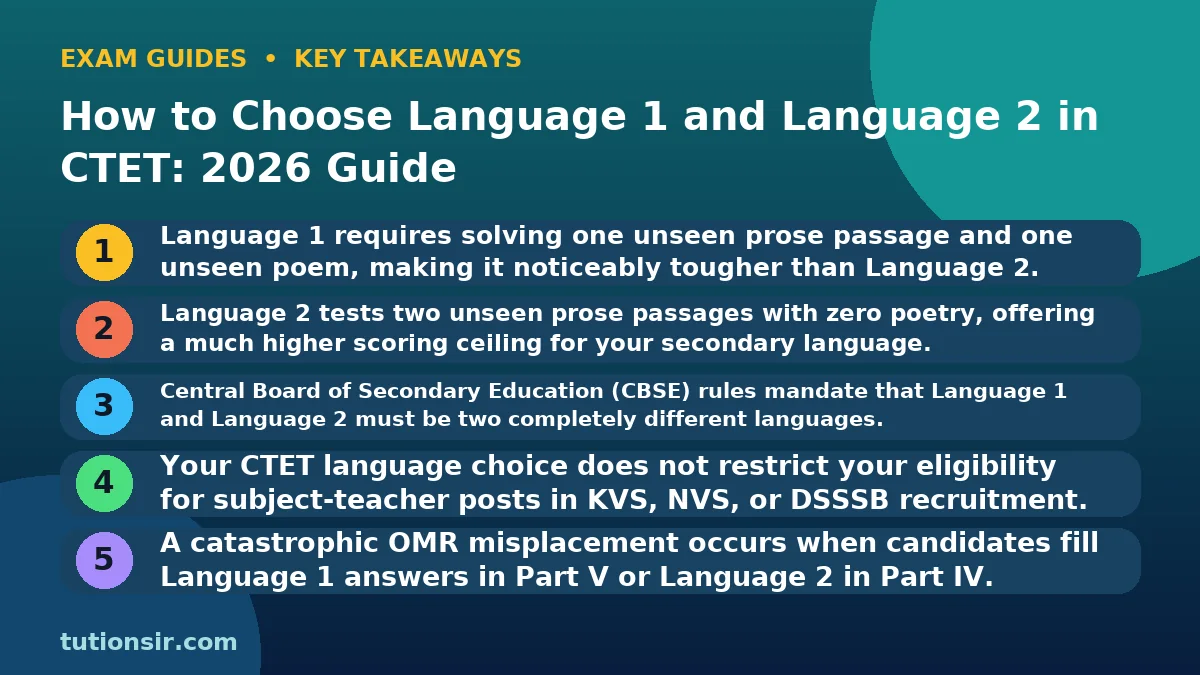
- Language 1 requires solving one unseen prose passage and one unseen poem, making it noticeably tougher than Language 2.
- Language 2 tests two unseen prose passages with zero poetry, offering a much higher scoring ceiling for your secondary language.
- Central Board of Secondary Education (CBSE) rules mandate that Language 1 and Language 2 must be two completely different languages.
- Your CTET language choice does not restrict your eligibility for subject-teacher posts in KVS, NVS, or DSSSB recruitment.
- A catastrophic OMR misplacement occurs when candidates fill Language 1 answers in Part V or Language 2 in Part IV.
Find yours this week with a free CTET mock test.
No card. Registering takes about two minutes.
What is Language 1 and Language 2 in CTET? Official CBSE Rules & Structure
The Central Teacher Eligibility Test conducted by the Central Board of Secondary Education features five distinct sections in CTET Paper 1 (Classes I–V) and four sections in CTET Paper 2 (Classes VI–VIII). Across both papers, language proficiency constitutes an enormous chunk of your total score: 60 marks out of 150. These 60 marks are equally divided into Language 1 (30 marks) and Language 2 (30 marks). Each language section is further broken down into two distinct components: 15 marks for Reading Comprehension and 15 marks for Pedagogy of Language Development.
According to the official CTET Information Bulletin issued by CBSE, Language 1 is designed to focus on proficiencies related to the medium of instruction, whereas Language 2 focuses on basic elements of language, communication, and comprehension abilities. Candidates must select two distinct languages from the 20 official language codes offered by CBSE, which include Hindi, English, Sanskrit, Urdu, Assamese, Bengali, Gujarati, Kannada, Malayalam, Marathi, Punjabi, Tamil, Telugu, and others.
The most rigid rule outlined in the CBSE guidelines is that candidates cannot select the same language for both options. If you choose English as Language 1, your Language 2 must be chosen from the remaining 19 languages. Selecting two different languages is compulsory, and attempting the wrong language booklet or swapping their sequences on the offline answer sheet can lead to immediate invalidation of your responses.
- Total Language Weightage: 60 marks out of 150 across both CTET Paper 1 and Paper 2.
- Sectional Breakdown: 15 marks for Reading Comprehension and 15 marks for Language Pedagogy per language.
- Strict Rule of Disparity: Language 1 and Language 2 must be two completely different language codes.
- Total Language Options: 20 recognized regional and national languages listed in the CTET Information Bulletin.
The Critical Structural Difference: Unseen Poetry vs Double Prose
The most consequential difference between Language 1 and Language 2 lies inside the reading comprehension segment. Many first-time aspirants assume that both sections are identical in format and simply represent your primary and secondary preferences. That assumption is false and leads to avoidable score penalties.
In Language 1, the 15-mark comprehension section comprises one unseen prose or drama passage (carrying approximately 8 to 9 questions) and one unseen poem (carrying approximately 6 to 7 questions). Unseen poetry tests literary devices, figures of speech, rhyme schemes, tone, and deep metaphorical interpretation. For candidates who do not possess native-level fluency or literary familiarity with a language, deciphering abstract poetic verses under strict exam timers results in severe inaccuracies and negative time expenditure.
In contrast, Language 2 contains zero poetry. The 15-mark comprehension component consists entirely of two unseen prose passages, which can be discursive, literary, narrative, or scientific in nature. Prose passages are factual, sequential, and direct. Answers to questions on main ideas, supporting arguments, synonyms, antonyms, and basic contextual grammar can be extracted directly from the paragraph lines without guessing allegorical meanings.
This architectural difference makes Language 2 structurally easier to score in than Language 1 for any given language. Consequently, the golden rule of CTET language selection is simple: assign your strongest, most natural mother tongue or first language to Language 1, where you can navigate poetry effortlessly, and keep your weaker or second language as Language 2 to enjoy the cushion of two straightforward prose passages.
Best Language Combination for CTET: Paper 1 and Paper 2 Scoring Strategies
Selecting the right combination can comfortably push your cumulative language score above 50 out of 60 marks. Depending on your academic background, mother tongue, and comfort level, three primary combinations dominate successful scorecards.
For bilingual candidates who completed their schooling in Hindi-medium or state-board schools with English as a subject, Hindi as Language 1 and English as Language 2 is universally the most effective pairing. Hindi poetry (Kavita) is generally transparent to native speakers who can effortlessly detect Ras, Chhand, and Alankar, or infer emotional themes. Meanwhile, taking English as Language 2 removes English poetry (which is notorious for archaic idioms and intricate syntax), leaving you with two readable English prose passages and 15 predictable pedagogy questions.
For candidates educated strictly in English-medium schools or graduates in English Literature, choosing English as Language 1 and Hindi as Language 2 yields outstanding results. If you are comfortable analyzing English sonnets and stanzas, English L1 rewards high verbal ability. You can then breeze through Hindi L2, which presents two straightforward prose comprehension passages (Gadyansh) without requiring you to dissect complex Hindi verses (Padyansh).
Another high-scoring combination in the northern and central belts is Hindi as Language 1 and Sanskrit as Language 2. Sanskrit grammar, sandhi, samas, and root vocabulary overlap heavily with Hindi. Because Sanskrit L2 features two prose passages rather than complex Vedic or classical shlokas, aspirants with basic Class 10 Sanskrit knowledge regularly score 25+ marks in Language 2.
Regional Language Combinations for Paper 1 and Paper 2
If your mother tongue is Bengali, Marathi, Tamil, Telugu, Urdu, or Gujarati, the identical rule applies. Keep your regional language as Language 1 so you can tackle mother-tongue poetry intuitively without stress. Keep English (or Hindi) as Language 2 to avoid second-language poetry and maximize prose comprehension accuracy.
| Feature / Parameter | Language 1 (Part IV) | Language 2 (Part V) |
|---|---|---|
| CBSE Bulleting Focus | Proficiency related to medium of instruction | Language elements, communication & comprehension |
| Reading Comprehension (15 M) | 1 Unseen Prose Passage + 1 Unseen Poem | 2 Unseen Prose Passages (Zero Poetry) |
| Passage Types | Literary, discursive, scientific prose + Verse | Discursive, literary, narrative, or factual prose |
| Pedagogy Questions (15 M) | Principles of language teaching, LSRW, errors | Identical pedagogical framework and syllabus |
| Question Numbers on OMR | Questions 91 to 120 | Questions 121 to 150 |
| Ideal Choice For Candidates | Your strongest native tongue / primary language | Your secondary language / school-learned language |
| Average Difficulty Level | Moderate to High (due to figurative poetry questions) | Easy to Moderate (direct factual passage answers) |
The OMR Sheet Trap: How Candidates Accidentally Lose 30 to 60 Marks
In the offline pen-and-paper mode of CTET, language mis-bubbling on the OMR answer sheet causes hundreds of candidate disqualifications every exam cycle. The physical CTET test booklet contains multiple language sections, and failing to understand the question numbering sequence is a catastrophic mistake.
The standard CTET Main Test Booklet contains questions numbered 1 through 150. Part I is Child Development and Pedagogy (Questions 1–30). In Paper 1, Part II is Mathematics (31–60) and Part III is Environmental Studies (61–90). In Paper 2, Parts II and III are replaced by your chosen subject: Mathematics & Science or Social Studies (Questions 31–90).
The trap begins at Question 91. Part IV of the test booklet contains Language 1 (Questions 91–120). Part V contains Language 2 (Questions 121–150). The main booklet prints both English and Hindi for both sections. If your chosen Language 1 is Hindi, you must solve Hindi from Part IV (Questions 91–120). If your chosen Language 2 is English, you must skip English in Part IV and solve English only from Part V (Questions 121–150).
Every year, anxious candidates mistakenly solve English from Part IV (Questions 91–120) because it appears first in the booklet, even though English was their registered Language 2. They then solve Hindi from Part V (Questions 121–150). This exact error inverts your answer sheet against your official admit card record, resulting in near-zero marks across both language sections and ruining an otherwise passing result.
- Rule 1: Always check your CTET Admit Card before breaking the booklet seal to confirm your registered Language 1 and Language 2 codes.
- Rule 2: Attempt Language 1 strictly on OMR bubble slots 91 to 120 (Part IV).
- Rule 3: Attempt Language 2 strictly on OMR bubble slots 121 to 150 (Part V).
- Rule 4: If you chose Sanskrit, Urdu, or a regional language, request the supplementary language booklet from your invigilator immediately and verify that its booklet code matches your main booklet code.
Debunking the Recruitment Myth: Do CTET Languages Restrict KVS, NVS, or DSSSB Hiring?
A persistent rumor circulating among teaching aspirants is that choosing Hindi as Language 1 and English as Language 2 will disqualify you from applying as a TGT English teacher in Kendriya Vidyalaya Sangathan (KVS), Navodaya Vidyalaya Samiti (NVS), or Delhi Subordinate Services Selection Board (DSSSB). This myth causes unnecessary anxiety during application registration.
The National Council for Teacher Education (NCTE) and recruitment boards clearly state that CTET is an essential qualifying test, not a post-specific subject certification. To be appointed as a Trained Graduate Teacher (TGT) in English, Hindi, or Sanskrit in central government schools, your eligibility is determined by your graduation degree subjects and B.Ed pedagogy subjects, not your CTET language combination.
For instance, KVS recruitment rules require a candidate applying for TGT English to have studied English as a subject in all three years of graduation, along with a recognized B.Ed degree and a valid CTET Paper 2 pass certificate. KVS does not mandate that English must have been your CTET Language 1. As long as you clear CTET Paper 2 with the minimum qualifying benchmark (60% for General, 55% for reserved categories), your CTET certificate remains 100% valid for all recruitment notifications.
The only strategic concern is scoring high. Because clearing the qualifying cutoff is your primary hurdle, you should choose whichever language pairing guarantees you the highest marks, without worrying about downstream recruitment eligibility.
Mastering Language Pedagogy: The 30-Mark Overlap Hack
While comprehension passages differ between Language 1 and Language 2, the 15-mark Pedagogy of Language Development syllabus is virtually identical for both. Whether you are solving English pedagogy, Hindi pedagogy, or Sanskrit pedagogy, CBSE bases the questions on the exact same core linguistic theories and educational frameworks.
Preparing language pedagogy once effectively covers 30 marks across both language sections, and it strongly reinforces another 5 to 8 questions in Child Development and Pedagogy (CDP). By understanding the theoretical foundations, you can secure near-perfect marks in pedagogy without doubling your study hours.
Focus your preparation on four foundational linguistic pillars. First, master Language Acquisition vs Language Learning: acquisition is natural, subconscious, and implicit (promoted by Noam Chomsky's Language Acquisition Device), whereas learning is formal, conscious, and rule-based. Second, study Stephen Krashen's Second Language Acquisition theory, specifically the Input Hypothesis (i+1), Affective Filter Hypothesis, and Natural Order.
Third, master the four core language skills: Listening, Speaking, Reading, and Writing (LSRW). Understand the difference between receptive skills (listening and reading) and productive skills (speaking and writing). Finally, align your answers with the National Curriculum Framework (NCF) and the National Education Policy (NEP 2020), which emphasize multilingualism as a rich classroom resource rather than an instructional handicap.
Step-by-Step Language Decision Framework & Final Revision Checklist
Before finalizing your CTET application form or stepping into the exam hall, run through this tactical decision framework to ensure your choices maximize your scoring potential.
First, audit your language fluency honestly. Pick up previous years' CTET question papers from the official portal (ctet.nic.in). Solve an unseen poem in your prospective Language 1. If you score below 4 out of 7 on the poem, that language should not be your Language 1. Reassign it as Language 2, where you will face two prose passages instead.
Second, double-check your application confirmation page. Verify that the language codes entered during registration match your intended strategy. If CBSE opens the correction window, use that single opportunity to correct any inadvertent swaps between Language 1 and Language 2 before admit cards are issued.
During your daily study schedule, practice reading speed. Since Language 2 features two long prose passages, you must practice scanning techniques to identify answers without re-reading entire paragraphs multiple times. Platforms like Tution Sir provide structured pedagogy question banks and targeted mock papers to help you master time allocation across both language sections before exam day.
Frequently asked questions
What is the difference between Language 1 and Language 2 in CTET?
Language 1 tests proficiency in your primary instructional language and features one prose passage and one unseen poem, alongside 15 pedagogy questions. Language 2 tests basic communication and features two prose passages with no poetry, alongside 15 pedagogy questions. Language 2 comprehension is structurally easier to score in.
Can I choose both Language 1 and Language 2 as the same language in CTET?
No. CBSE rules explicitly mandate that Language 1 and Language 2 must be two completely different languages. You must choose two separate language codes from the 20 available options in the official CTET Information Bulletin.
Is Language 1 harder than Language 2 in the CTET exam?
Yes, Language 1 is generally considered harder because it includes an unseen poem. Interpreting poetic devices, figurative language, tone, and central themes under time pressure is significantly more challenging than extracting factual answers from the two prose passages found in Language 2.
Which language should I choose as Language 1 in CTET to score higher?
Choose the language in which you have native fluency and literary comfort as Language 1. For most bilingual candidates in India, choosing Hindi or their regional mother tongue as Language 1 and English or Sanskrit as Language 2 maximizes their overall score.
Does Language 1 in CTET have a poem while Language 2 has only prose?
Yes, exactly. CBSE guidelines state that Language 1 comprehension consists of two passages: one prose or drama and one poem. Language 2 comprehension consists strictly of two prose passages (discursive, narrative, or factual) with zero poetry.
How do I mark Language 1 and Language 2 correctly on the CTET offline OMR sheet?
Mark Language 1 questions strictly in Part IV (Questions 91–120) and Language 2 questions in Part V (Questions 121–150). Never solve Language 2 questions in the 91–120 section, even if that language appears first in your booklet, as it invalidates your responses.
Does my CTET language choice affect my eligibility for KVS, NVS, or DSSSB recruitment?
No, it does not. KVS, NVS, and DSSSB determine your eligibility for TGT and PRT positions based on your graduation degree subjects and B.Ed qualifications, not your CTET language choices. CTET serves only as a qualifying credential.
Can I change my CTET Language 1 and Language 2 options after submitting the application?
You can only change your language choices during the official online application correction window opened by CBSE shortly after the registration period closes. Once the correction window closes, CBSE accepts no further modification requests under any circumstances.
Sources and official links
Exam rules and notifications change. Confirm dates, fees and eligibility on the official website before acting. Spotted an error? Email support@tutionsir.com. See our editorial policy.
Keep learning
WB Primary TET Preparation Strategy: Blueprint & Plan
Cracking the West Bengal Primary Teacher Eligibility Test demands more than standard textbook revision; it req
Read →Nagaland TET 2026 Postponed: SCERT Issues Hold Notice
The State Council of Educational Research and Training (SCERT) Nagaland has officially deferred the 6th editio
Read →TG TET 2026-II In-Service Hall Ticket Out; Exam on Nov 19
The Telangana School Education Department has made the TG TET 2026-II in-service hall ticket available on Nove
Read →CTET free practice and syllabus
Free practice and study help
Read →West Bengal TET practice
Free practice and study help
Read →Do not let another week go by without a plan
Most CTET aspirants only find their weak topics after the real exam. Register free now and start with the one topic that worries you most. Small daily practice beats a last-minute rush.
- Free CTET mock test, Paper 1 and Paper 2
- Instant score with topic-wise weak areas
- Explanations in simple language, in your preferred language
Free plan, no card needed. Your progress is saved to your account.