WB Primary TET · Exam Strategy
WB Primary TET Preparation Strategy: Blueprint & Plan
Cracking the West Bengal Primary Teacher Eligibility Test demands more than standard textbook revision; it requires a targeted pedagogical blueprint. With 90 out of 150 marks tied directly to teaching methodologies, strategic preparation is your surest path to qualifying.
Quick answer
A winning WB Primary TET preparation strategy focuses on the 90-mark pedagogical component across Child Development and Pedagogy, Mathematics, EVS, and Languages. Aspirants should thoroughly study WBBSE Class 1–5 textbooks ('Amar Boi', 'Amader Paribesh'), master Piaget, Vygotsky, and Kohlberg theories, and consistently practice CTET and WB TET previous year question papers.

Key takeaways
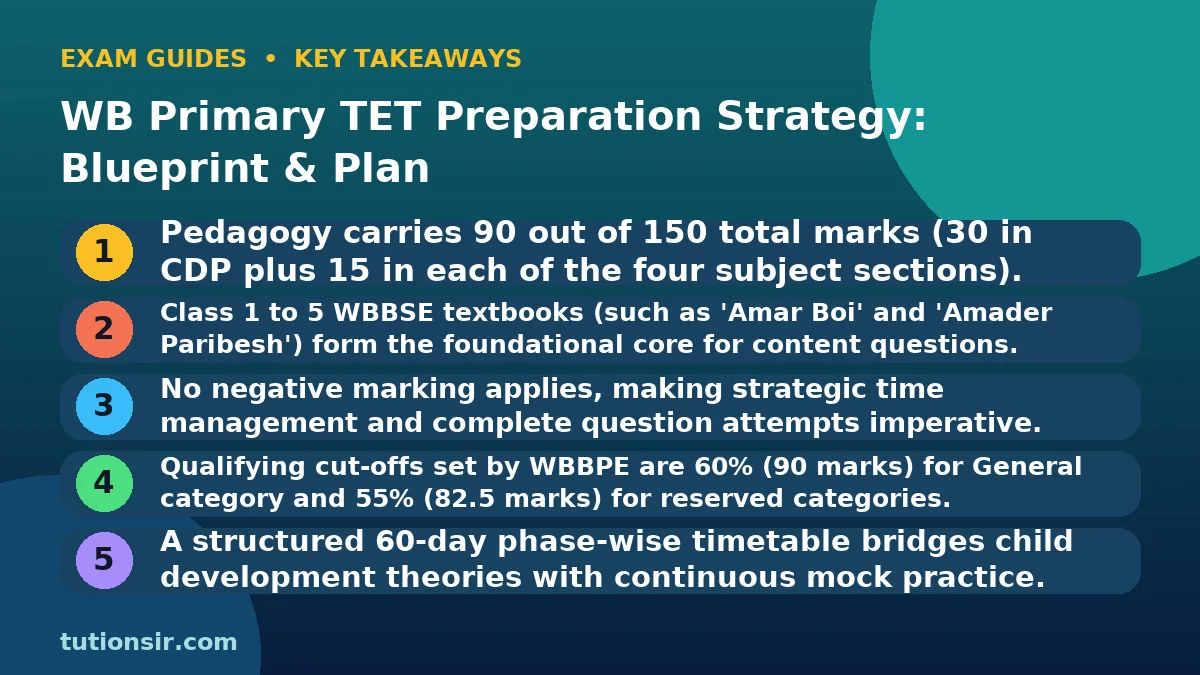
- Pedagogy carries 90 out of 150 total marks (30 in CDP plus 15 in each of the four subject sections).
- Class 1 to 5 WBBSE textbooks (such as 'Amar Boi' and 'Amader Paribesh') form the foundational core for content questions.
- No negative marking applies, making strategic time management and complete question attempts imperative.
- Qualifying cut-offs set by WBBPE are 60% (90 marks) for General category and 55% (82.5 marks) for reserved categories.
- A structured 60-day phase-wise timetable bridges child development theories with continuous mock practice.
Try a free West Bengal TET mock test now.
No card. Registering takes about two minutes.
What is the exam pattern and marks distribution for WB Primary TET?
The West Bengal Board of Primary Education (WBBPE) conducts the Primary Teacher Eligibility Test as a single offline, pen-and-paper examination consisting of 150 multiple-choice questions (MCQs) for 150 marks to be completed in 150 minutes (2.5 hours). There is strictly no negative marking for incorrect or unattempted responses.
Under guidelines aligned with the National Council for Teacher Education (NCTE), WBBPE tests five compulsory disciplines: Child Development and Pedagogy (CDP), Language I (Bengali, Hindi, Odia, Telugu, Nepali, Santali, or Urdu), Language II (English), Mathematics, and Environmental Studies (EVS). Each paper contains 30 questions carrying 1 mark each.
A critical structural shift introduced in recent WB Primary TET editions is the explicit 50-50 division in the four subject disciplines. While CDP contributes 30 pure pedagogical questions, each of the remaining four subjects (Language I, Language II, Mathematics, and EVS) dedicates 15 marks to core subject content and 15 marks to subject-specific pedagogy. Consequently, pedagogy alone governs 90 out of the total 150 marks (60% of the entire paper), making rote memorisation of static facts an ineffective route to qualification.
- Total Questions & Marks: 150 MCQs, 150 marks, 1 mark per question.
- Duration: 150 minutes (no sectional time limits).
- Marking Scheme: +1 for correct answers, 0 for incorrect responses (no negative deduction).
- WBBPE Minimum Qualifying Marks: 60% (90 out of 150 marks) for Unreserved/General candidates; 55% (82.5 marks, rounded to 82 marks) for SC, ST, OBC-A, OBC-B, Differently-Abled, Ex-Servicemen, and Exempted Category candidates.
How can I prepare for Child Development and Pedagogy (CDP) for WB TET?
Mastering Child Development and Pedagogy (CDP) requires building conceptual clarity around psychological constructs rather than memorising isolated terminology. The 30 marks in CDP focus on child growth principles, cognitive frameworks, inclusive education, and classroom dynamics relevant to the primary school bracket (ages 6 to 11).
Begin by dissecting the developmental theories of Jean Piaget, Lev Vygotsky, and Lawrence Kohlberg. Understand the four cognitive stages of Piaget (sensorimotor, preoperational, concrete operational, and formal operational), noting that primary school learners sit predominantly in the concrete operational stage where manipulative aids and practical examples solidify comprehension. Contrast this with Vygotsky's sociocultural lens, mastering concepts such as the Zone of Proximal Development (ZPD), More Knowledgeable Other (MKO), and instructional scaffolding. For Kohlberg, focus on pre-conventional and conventional stages of moral reasoning.
Devote focused revision to inclusive education and special needs (which routinely accounts for 5 to 7 questions). Study learning disabilities including dyslexia (reading), dysgraphia (writing), and dyscalculia (arithmetic), alongside gifted and creative learners. Familiarise yourself with the foundational legal mandates: the Right of Children to Free and Compulsory Education Act (RTE Act, 2009), the Rights of Persons with Disabilities Act (RPwD Act, 2016), and the child-centric foundational learning recommendations of the National Education Policy 2020 (NEP 2020).
High-Yield Micro-Topics in Child Development
Prioritise heredity versus environment debates, principles of growth and development (cephalocaudal and proximodistal trends), socialization agencies (primary vs secondary agents), and socialization theories. Revisit formative versus summative assessment paradigms, continuous and comprehensive evaluation (CCE), diagnostic testing, and remedial instruction techniques.
How to master Bengali and English pedagogy and content in WB Primary TET?
Language preparation requires a dual-track strategy addressing both comprehension skills and language-learning pedagogy. Language I (predominantly Bengali for most candidates in West Bengal) and Language II (English) each carry 30 marks, split evenly between 15 marks for reading comprehension and grammatical mechanics, and 15 marks for language pedagogy.
For Language I (Bengali), the 15-mark content section presents two unseen passages (one prose and one poetry). Questions evaluate contextual vocabulary (Samarthak Sabda, Biparit Sabda, Samochharita Bhinnarthak Sabda), sandhi, samas, karak-bibhakti, barna-bisleshon, and pad-poriborton. In the 15-mark Bengali pedagogy segment, focus on first-language acquisition principles, methods of teaching reading and writing (barna-anukromik vs bakya-anukromik paddhati), language errors, diagnostic measures, and language skills development (Srabon, Kathan, Pathon, Likhan).
For Language II (English), the 15-mark content component consists of two reading comprehension texts accompanied by fundamental grammar questions such as parts of speech, tense concordance, prepositions, voice change, narration, and idioms. The 15-mark English pedagogy module tests Second Language Acquisition (SLA) principles. Prioritise learning versus acquisition, Stephen Krashen's input hypothesis, Noam Chomsky's Language Acquisition Device (LAD), B.F. Skinner's behaviourist perspective, the Communicative Language Teaching (CLT) approach, multilingualism as a classroom resource, and strategies for teaching English in a non-native environment.
- Revisit Primary Bengali Curriculum: Examine West Bengal Board elementary texts like 'Amar Boi' (Classes 1 and 2) and 'Pata Bahar' (Classes 3, 4, and 5) to understand expected phonetic and lexical levels.
- English Pedagogical Models: Understand the functional differences between the Grammar-Translation Method, Direct Method, Structural Approach, and Task-Based Language Teaching.
- Continuous Evaluation in Languages: Practice questions on assessing listening and speaking in overcrowded classrooms, crafting diagnostic worksheets, and designing remedial teaching exercises.
| Exam Section | Total Marks | Content vs Pedagogy Division | High-Yield Focus Areas | Recommended Study Resources |
|---|---|---|---|---|
| Child Development & Pedagogy (CDP) | 30 | 30 Marks Pedagogy & Developmental Theories | Piaget, Vygotsky, Kohlberg; Inclusive Education; CCE; RTE 2009 & NEP 2020 | D.El.Ed CDP text modules; CTET & WB TET PYQ question banks |
| Language I (Bengali) | 30 | 15 Marks Content + 15 Marks Pedagogy | Unseen prose & poetry, sandhi, karak, vocabulary; L1 acquisition, reading methods | WBBSE 'Pata Bahar' (Classes 3–5), standard Bengali grammar texts |
| Language II (English) | 30 | 15 Marks Content + 15 Marks Pedagogy | Reading comprehension, grammar & vocabulary; SLA principles, CLT, Krashen, LAD | WBBSE 'Butterfly' (Classes 3–5), NCERT English pedagogy reference notes |
| Mathematics | 30 | 15 Marks Content + 15 Marks Pedagogy | Number systems, basic geometry, fractions, mensuration; Van Hiele levels, TLM, remedial math | WBBSE 'Amar Ganit' (Classes 3–5), elementary NCERT arithmetic |
| Environmental Studies (EVS) | 30 | 15 Marks Content + 15 Marks Pedagogy | NCTE core themes, WB local ecology & rivers, pollution; Integrated EVS, project evaluation | WBBSE 'Amader Paribesh' (Classes 3–5), state biodiversity board reports |
How to prepare Mathematics and EVS using WBBSE books and pedagogy principles?
Mathematics and Environmental Studies (EVS) in the WB Primary TET carry 60 marks combined, with 30 marks grounded in primary-level syllabus concepts and 30 marks allocated to pedagogical approaches.
For Mathematics content (15 marks), focus on basic number systems, prime and composite numbers, fractions, decimals, LCM and HCF, simple arithmetic, basic geometry (shapes, angles, perimeters, and areas of 2D figures), measurement units (time, mass, money, capacity), and patterns. For Mathematics pedagogy (15 marks), examine the nature of mathematical thinking, inductive versus deductive reasoning, Bloom's taxonomy applied to mathematics learning, Pierre van Hiele's levels of geometric thinking, diagnostic testing for mathematical anxieties, and the use of low-cost teaching-learning materials (TLMs) like geo-boards, abacus, and Napier's bones.
For Environmental Studies (15 marks content), the official syllabus aligns with both NCTE core themes and local Bengal geography. Study the core NCERT/WBBSE themes: Family and Friends, Food, Shelter, Water, Travel, and Things We Make and Do. Pay close attention to West Bengal-specific environmental realities: Sundarbans mangrove ecology, Darjeeling biodiversity, red laterite soils of the Rarh region, arsenic contamination in groundwater across Bengal districts, endemic flora and fauna, and national environmental laws. For EVS pedagogy (15 marks), master integrated EVS concepts, activities, experiments, discussions, primary-level science-social science integration, and environmental project evaluations.
- Class 1–5 Textbook Mapping: Study the West Bengal Board primary textbooks 'Amar Ganit' (Classes 3 to 5) and 'Amader Paribesh' (Classes 3 to 5) cover-to-cover to understand exact thematic examples used by WBBPE.
- Real-World Problem Solving: Practice quick calculation drills to solve primary arithmetic questions within 45 to 60 seconds each.
- EVS Curricular Connections: Connect theoretical ecology questions with current state environmental conservation initiatives and local bio-reserves.
What is the 60-day study plan to clear WB Primary TET at home without coaching?
Clearing the WB Primary TET on your first attempt without commercial coaching requires consistent time-blocking, disciplined coverage of the official syllabus, and regular self-evaluation. Dedicating 4 to 6 focused hours daily across 60 days provides ample bandwidth to master both content and pedagogical models.
Divide your 60-day schedule into three distinct operational phases: Foundation & Syllabus Mapping (Days 1–25), Pedagogy Integration & Cross-Subject PYQs (Days 26–45), and Intensive Mock Tests with Error Correction (Days 46–60). Balancing your study slots prevents cognitive fatigue and guarantees balanced coverage across all five papers.
Phase 1: Foundation and Concept Building (Days 1 to 25)
Devote 2 hours daily to CDP (growth theories, Piaget, Vygotsky, Kohlberg, inclusive education). Allocate 1.5 hours to Mathematics content and foundational geometry. Spend 1.5 hours alternating between Bengali grammar/unseen passages and English basic grammar. Dedicate 1 hour to reading 'Amader Paribesh' (WBBSE Classes 3–5) and reviewing primary environmental themes.
Phase 2: Pedagogy Integration and PYQ Drills (Days 26 to 45)
Shift focus directly toward pedagogical applications across Language I, Language II, Math, and EVS. Complete chapter-wise previous years' questions from WB Primary TET (2014, 2017, 2022, and 2023 papers) along with Central Teacher Eligibility Test (CTET Paper 1) archives. CTET question patterns offer benchmark practice for situational, classroom-based pedagogy items.
Phase 3: Full-Length OMR Simulations and Targeted Revision (Days 46 to 60)
Attempt one full-length 150-question mock test every two days within the strict 150-minute examination window (preferably 12:00 PM to 2:30 PM to align with typical exam timing). Mark your responses on printed physical OMR sheets to develop bubble-filling speed and eliminate transcription errors. Use alternate days exclusively to analyse incorrect questions and revise weak areas.
What are the common mistakes made by WB Primary TET aspirants and how to avoid them?
Thousands of capable candidates fail to achieve the qualifying score of 90 marks due to avoidable strategic errors rather than a lack of subject knowledge. The most pervasive mistake is ignoring subject pedagogy. Many candidates invest excessive hours memorising complex secondary-level mathematics or advanced grammar, completely ignoring the 15 marks of pedagogical methods embedded inside each paper.
A second critical pitfall is failing to practice on physical OMR sheets. In an offline examination comprising 150 questions, shading bubbles accurately under timed conditions takes approximately 15 to 20 minutes. Candidates who solve papers solely on digital screens often face time deficits or misalign serial numbers on exam day.
Thirdly, aspirants frequently overlook the West Bengal regional context in Environmental Studies. While central resources provide good coverage of generic EVS topics, WBBPE frequently includes questions concerning local rivers (Teesta, Torsa, Damodar, Bhagirathi), traditional handicrafts (Dokra, Terracotta), state animal and bird classifications (Fishing Cat, White-throated Kingfisher), and regional environmental movements. Ground your EVS reading in state-approved materials.
- Do not leave questions unattempted: With no negative marking, allocate the final 5 minutes to make informed educational guesses on remaining questions.
- Avoid reading multiple conflicting guidebooks: Stick to standard NCTE D.El.Ed textbooks, authentic WBBSE school books, and official past papers.
- Balance your daily schedule: If you are an in-service teacher or working candidate, adopt split study blocks—such as 2 hours before work focused on pedagogy and 2 hours in the evening focused on math and mock drills.
How to evaluate progress and practice with precision?
Continuous evaluation is vital to bridging the gap between passive reading and exam-day recall. Maintain an 'Error Log' notebook where you record every mistake made during mock tests and past-paper drills. Categorise each error into one of three buckets: conceptual misunderstanding, misreading the question stem (such as missing words like 'NOT' or 'EXCEPT'), or calculation/shading slips.
Aspiring candidates looking for topic-by-topic pedagogy drills, real-time question analysis, and structured practice tests can leverage platforms like Tution Sir to access adaptive learning modules aligned directly with the latest state board primary teacher syllabi.
Review your compiled error log every Sunday morning. Converting identified weak spots into immediate revision tasks ensures steady progress and builds the test-taking stamina needed to cross the qualifying threshold comfortably on examination day.
Frequently asked questions
What is the exam pattern and marks distribution for WB Primary TET?
The WB Primary TET consists of 150 objective multiple-choice questions carrying 150 marks, conducted in offline OMR mode over 150 minutes. The paper is split into five compulsory sections: Child Development and Pedagogy, Language I, Language II, Mathematics, and Environmental Studies, each carrying 30 marks.
How are the 30 marks divided between content and pedagogy in WB Primary TET?
In Child Development and Pedagogy, all 30 marks belong to developmental and educational psychology. For the remaining four sections—Language I, Language II, Mathematics, and EVS—each subject is divided equally into 15 marks of core content and 15 marks of subject-specific pedagogical issues.
What are the minimum qualifying marks for WB Primary TET for general and reserved categories?
As per WBBPE guidelines, General (Unreserved) candidates must score at least 60% (90 out of 150 marks) to qualify. Candidates belonging to SC, ST, OBC-A, OBC-B, Differently-Abled, Ex-Servicemen, and Exempted Categories receive a 5% relaxation and must secure 55% (82.5 marks, rounded off to 82 marks).
How can I prepare for Child Development and Pedagogy (CDP) for WB Primary TET?
Focus on the foundational theories of Jean Piaget, Lev Vygotsky, and Lawrence Kohlberg. Thoroughly study inclusive education, learning disabilities (dyslexia, dyscalculia), assessment frameworks (formative, summative, CCE), and statutory provisions including the RTE Act 2009 and NEP 2020 recommendations for primary schooling.
Which WBBSE books should I study for WB Primary TET Environmental Studies (EVS)?
Study the official West Bengal Board of Secondary Education primary textbooks, specifically 'Amader Paribesh' for Classes 3, 4, and 5, alongside 'Amar Boi' for Classes 1 and 2. Supplement these with regional West Bengal geography topics like local wildlife, river basins, and wetland conservation.
Is there any negative marking in the WB Primary TET examination?
No, there is no negative marking in the WB Primary TET examination. Candidates receive one mark for every correct answer, and zero marks for incorrect or skipped questions. Aspirants are strongly advised to answer all 150 questions on their OMR sheet.
How many hours should I study daily to clear WB Primary TET in 60 to 90 days?
A focused daily commitment of 4 to 6 hours is sufficient to prepare for WB Primary TET at home. Allocate 2 hours to Child Development and subject pedagogy, 2 hours to core subject content (Math, Languages, EVS), and 1 to 2 hours to mock drills and PYQs.
Can CTET syllabus and previous year questions help in WB Primary TET preparation?
Yes, CTET Paper 1 previous years' question papers are exceptionally beneficial because WBBPE has restructured the WB TET pattern to mirror the NCTE and CTET framework, particularly for conceptual child psychology and subject-specific pedagogical scenarios.
Sources and official links
- West Bengal Board of Primary Education (WBBPE) Official Portal
- National Council for Teacher Education (NCTE) Teacher Eligibility Guidelines
Exam rules and notifications change. Confirm dates, fees and eligibility on the official website before acting. Spotted an error? Email support@tutionsir.com. See our editorial policy.
Keep learning
CTET Paper 2 Preparation: Maths, Science & SST Plan
Passing CTET Paper 2 means balancing teaching ideas with strong subject knowledge. The exam covers NCERT sylla
Read →How to Choose Language 1 and Language 2 in CTET: 2026 Guide
Choosing between Language 1 and Language 2 is one of the most critical decisions in your CTET registration, di
Read →TG TET 2026-II In-Service Hall Ticket Out; Exam on Nov 19
The Telangana School Education Department has made the TG TET 2026-II in-service hall ticket available on Nove
Read →West Bengal TET practice
Free practice and study help
Read →Do not let another week go by without a plan
TET seats go to the aspirants who practise under exam conditions. Register free now and start with the one topic that worries you most. Small daily practice beats a last-minute rush.
- Free WB TET mock test
- See exactly which topics cost you marks
- Answer explanations after every question
Free plan, no card needed. Your progress is saved to your account.