CTET · Exam Preparation
CTET Child Development and Pedagogy Important Topics 2026
Scoring above 25 out of 30 in Child Development and Pedagogy is the fastest way to qualify both CTET Paper 1 and Paper 2. Here is the definitive, chapter-wise weightage blueprint dissecting recurring theorists, inclusive education, and situational classroom MCQs for the 2026 examination cycle.
Quick answer
CTET Child Development and Pedagogy important topics are organized into three CBSE modules: Child Development (15 marks), Inclusive Education (5 marks), and Learning & Pedagogy (10 marks). High-yield areas include Piaget, Vygotsky, and Kohlberg theories, developmental principles, learning disabilities, assessment for learning, and NEP 2020 constructivist classroom practices across Papers 1 and 2.

Key takeaways
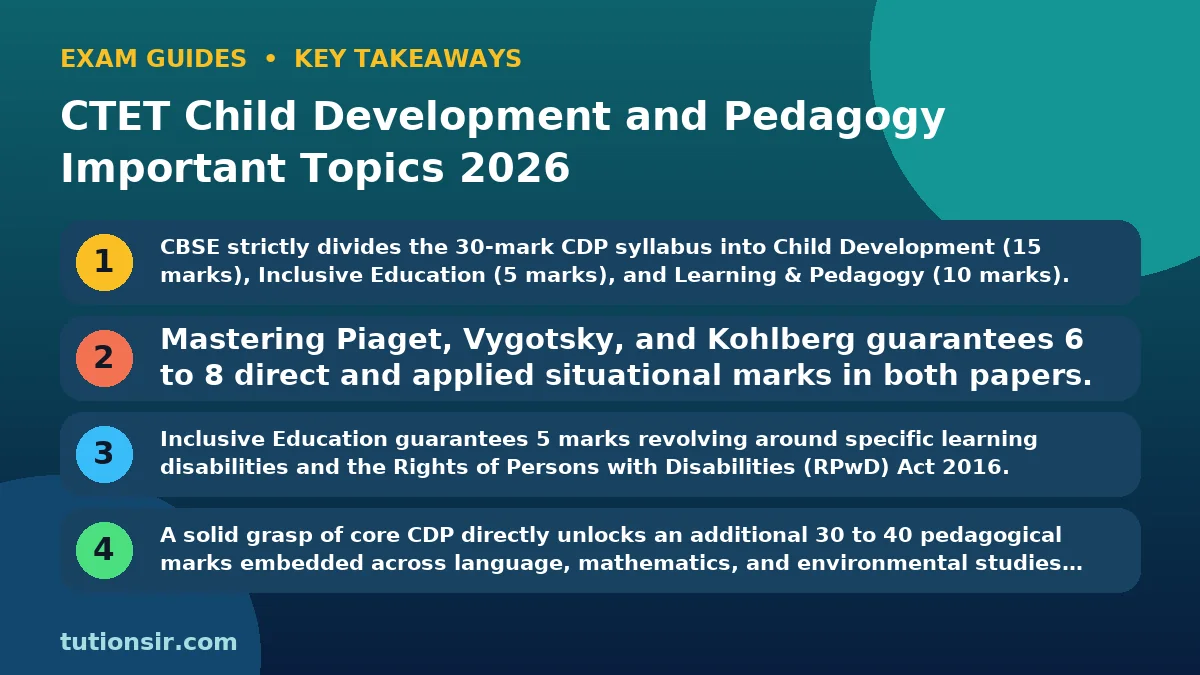
- CBSE strictly divides the 30-mark CDP syllabus into Child Development (15 marks), Inclusive Education (5 marks), and Learning & Pedagogy (10 marks).
- Mastering Piaget, Vygotsky, and Kohlberg guarantees 6 to 8 direct and applied situational marks in both papers.
- Inclusive Education guarantees 5 marks revolving around specific learning disabilities and the Rights of Persons with Disabilities (RPwD) Act 2016.
- A solid grasp of core CDP directly unlocks an additional 30 to 40 pedagogical marks embedded across language, mathematics, and environmental studies sections.
Find yours this week with a free CTET mock test.
No card. Registering takes about two minutes.
Which topics carry the highest weightage in CTET Child Development and Pedagogy?
The Child Development and Pedagogy (CDP) section carries 30 compulsory multiple-choice questions in both Paper 1 (Classes 1 to 5) and Paper 2 (Classes 6 to 8) of the Central Teacher Eligibility Test conducted by the Central Board of Secondary Education (CBSE). Rather than testing raw philosophical definitions, the official CBSE syllabus divides the 30 marks into three structured units: Child Development (15 questions), Concept of Inclusive Education and Understanding Children with Special Needs (5 questions), and Learning and Pedagogy (10 questions). Knowing this exact distribution allows aspirants to allocate their revision time efficiently rather than getting overwhelmed by academic psychology literature.
In recent CTET editions, CBSE has steadily moved away from rote recall questions toward vignette-based, competency-aligned classroom scenarios. An aspirant is no longer simply asked to state the age band of Piaget's pre-operational stage. Instead, questions describe an elementary classroom situation—such as a student struggling to conserve liquid volume when poured into a taller glass—and ask the candidate to deduce the underlying cognitive limitation. This shift makes applied conceptual understanding far more rewarding than passive textbook memorization.
Beyond securing a high score in the standalone 30-mark CDP module, mastering high scoring topics in CTET CDP yields an indispensable strategic advantage: the foundational pedagogical principles covered here replicate directly across the subject-specific pedagogical sections of Mathematics, Environmental Studies (EVS), Science, Social Studies, and both Language modules. Consequently, building command over these core topics effectively secures between 60 and 70 total marks out of the 150 marks required to clear the examination.
- Child Development Module (15 Marks): Principles of growth, heredity and environment, socialization agencies, Piaget, Vygotsky, Kohlberg, multiple intelligences, language and thought, and evaluation frameworks.
- Inclusive Education Module (5 Marks): Addressing disadvantaged learners, neurodevelopmental learning disorders (dyslexia, dyscalculia, dysgraphia, ADHD), and supporting gifted or creative students.
- Learning and Pedagogy Module (10 Marks): Constructivist teaching practices, children's alternative conceptions ('errors'), motivation dynamics, problem-solving, and cognition-emotion linkages.
The Hidden Multiplier Effect on Subject Pedagogy
Every subject paper in CTET allocates 10 to 15 questions strictly to subject pedagogy. Concepts such as formative assessment, constructivist diagnostic teaching, diagnostic remediation, and handling student misconceptions are identical whether tested in CTET CDP, Primary EVS, or Upper Primary Mathematics. Aspirants who master core CDP principles automatically build the competence needed to answer subject pedagogy vignettes accurately without separate preparation.
What are the core development theories asked in every CTET examination?
The theorist triad—comprising Jean Piaget, Lev Vygotsky, and Lawrence Kohlberg—forms the highest-yield thematic cluster in the entire CTET CDP syllabus, routinely accounting for 6 to 9 questions per examination paper. The Central Board of Secondary Education consistently designs comparative and situational items testing how each theorist interprets cognitive growth, language development, and moral decision-making inside primary and upper-primary classrooms. Grasping their philosophical premises and specific classroom terminology is non-negotiable for scoring above 25 marks.
Jean Piaget's cognitive constructivism views the child as an active 'little scientist' exploring their physical environment to build internal mental frameworks termed schemas. CTET questions repeatedly examine the twin mechanisms of schema adaptation: assimilation (interpreting new experiences using existing schemas without altering them) and accommodation (modifying existing schemas or creating new ones when faced with cognitive disequilibrium). Candidates must memorize the hallmark developmental milestones across Piaget's four stages: object permanence in the Sensorimotor stage (0–2 years); symbolic play, centration, egocentrism, and lack of conservation in the Pre-operational stage (2–7 years); reversibility, decentration, seriation, and conservation in the Concrete Operational stage (7–11 years); and abstract hypothetical-deductive reasoning in the Formal Operational stage (11–15+ years).
Lev Vygotsky's socio-cultural theory presents a fundamental philosophical divergence from Piaget. While Piaget posited that biological maturation and internal development precede learning, Vygotsky argued that social learning and cultural mediation precede and drive cognitive development. Vygotsky-centric questions focus heavily on three core constructs: the Zone of Proximal Development (ZPD)—the gap between what a learner can achieve independently and what they can accomplish with guided support; Scaffolding—temporary, adjustable pedagogical assistance provided by a teacher or peer to bridge that gap; and the More Knowledgeable Other (MKO). Furthermore, CTET frequently tests their differing stances on speech: Piaget termed young children's self-talk as immature 'egocentric speech,' whereas Vygotsky viewed 'private speech' as an essential cognitive tool used by children to regulate their thoughts and guide their actions.
Lawrence Kohlberg's theory of moral development rounds out the triad, assessing how children reason through ethical conflicts using his famous Heinz dilemma. CTET assesses Kohlberg across three levels and six distinct stages. At the Pre-conventional level (typical of early primary students), moral choices depend on direct physical consequences: Stage 1 focuses on punishment and obedience orientation, while Stage 2 centers on naive hedonistic reciprocity ('tit-for-tat' or instrumental purpose). At the Conventional level, reasoning shifts to societal expectations: Stage 3 reflects the 'good boy–nice girl' orientation seeking social approval, while Stage 4 demands strict maintenance of law and social order. At the Post-conventional level, morality is driven by broader philosophical principles: Stage 5 prioritizes social contracts and individual human rights, while Stage 6 is grounded in universal ethical principles. CTET examiners frequently introduce Carol Gilligan's feminist critique, which highlighted that Kohlberg's research was based on an exclusively male sample and undervalued an ethic of care and interpersonal connection.
What is the difference between growth and development according to the CTET syllabus?
Understanding the scientific distinction between growth and development forms the foundation of the 15-mark Child Development module. In educational psychology, 'growth' refers exclusively to quantitative, biological, and physical changes in the body—such as increases in height, weight, and bodily proportions—which can be directly measured in objective units and generally halt upon physical maturity. In contrast, 'development' is a multidimensional, qualitative, and lifelong process spanning physical, cognitive, socio-emotional, and linguistic domains from conception until death ('womb to tomb'). Development encompasses maturation, physiological growth, and learning experiences, making it progressive, orderly, and coherent.
CBSE routinely evaluates candidates on the overarching principles of child development. Foremost among these are the directional trends of physical and motor growth: the Cephalocaudal principle dictates that development proceeds from head to toe (e.g., an infant gains neck control before learning to sit or walk), while the Proximodistal principle dictates that development proceeds from the center of the body outward (e.g., control of the trunk and spinal axis precedes fine motor control of fingers). Another foundational concept is that development is the joint product of heredity and environment; development equals heredity multiplied by environment (D = H × E), meaning human traits cannot be attributed exclusively to biological genetics or external upbringing alone.
Socialization processes represent another recurring topic in this section, yielding 1 to 2 direct questions per paper. CTET categorizes socialization into two primary agencies: Primary Socialization, which occurs during infancy within the family and immediate caretakers who instill initial cultural values; and Secondary Socialization, which occurs when the child steps into broader society, mediated by formal institutions such as schools, peer groups, neighborhood communities, and digital media. Questions often ask candidates to classify which entity belongs to which tier, where CBSE consistently defines the family as the foremost primary agent and the school as the decisive secondary agent.
- Cephalocaudal Trend: Longitudinal developmental trajectory moving downward from head to extremities.
- Proximodistal Trend: Centrifugal trajectory moving from the core spinal column outward to peripheral extremities.
- Continuity vs Discontinuity: Debating whether development is a smooth, gradual accumulation of skills (continuous) or discrete, stage-bound transformations (discontinuous, as modeled by Piaget).
- Individual Differences: Learners progress at varying rates while adhering to an orderly, universal sequential pattern.
| Syllabus Unit | Core Chapters & Thematic Focus | Expected Weightage | Recommended Revision Priority |
|---|---|---|---|
| Unit 1: Child Development | Piaget, Vygotsky, & Kohlberg Theories | 6 – 8 Marks | Priority 1 (Mandatory Deep Study) |
| Unit 1: Child Development | Principles of Growth, Development, & Directional Trends | 2 – 3 Marks | Priority 2 (High Yield) |
| Unit 1: Child Development | Socialization Agencies, Heredity vs Environment | 2 – 3 Marks | Priority 2 (High Yield) |
| Unit 1: Child Development | Assessment FOR vs OF Learning, CCE, & Rubrics | 2 – 3 Marks | Priority 1 (Mandatory Deep Study) |
| Unit 2: Inclusive Education | Learning Disabilities (Dyslexia, Dyscalculia, ADHD) & RPwD Act | 3 – 4 Marks | Priority 1 (Mandatory Deep Study) |
| Unit 2: Inclusive Education | Gifted, Talented, & Creative Learners (Divergent Thinking) | 1 – 2 Marks | Priority 3 (Quick Review) |
| Unit 3: Learning & Pedagogy | Constructivism, Alternative Conceptions, & Role of Errors | 4 – 5 Marks | Priority 1 (Mandatory Deep Study) |
| Unit 3: Learning & Pedagogy | Motivation, Cognition, Emotions, & Facilitator Roles | 3 – 4 Marks | Priority 2 (High Yield) |
| Units 1, 2, & 3 Combined | NEP 2020, NCF Alignment, & Competency-Based Vignettes | 2 – 4 Marks | Priority 2 (High Yield) |
How many marks are dedicated to Inclusive Education in the CTET CDP syllabus?
Inclusive Education and Understanding Children with Special Needs (CWSN) is allocated exactly 5 marks in both CTET Paper 1 and Paper 2, making it the highest marks-per-page topic in the entire curriculum. The core tenet of inclusive education, as mandated by the National Education Policy 2020 (NEP 2020) and the National Curriculum Framework (NCF), is that the general school system must adapt to accommodate every learner, regardless of their physical, intellectual, social, linguistic, or cultural background. In CTET questions, the golden rule is always that the educational system, curriculum, and pedagogy must adjust to fit the child—the child must never be blamed or modified to fit an inflexible school system.
The most predictable marks in this section come from specific learning disabilities (SLDs) and neurodevelopmental conditions. Aspirants can reliably expect questions testing four core diagnostic classifications: Dyslexia (persistent difficulty with reading, decoding written words, and phonological processing); Dysgraphia (neurologically based impairment in fine motor coordination affecting handwriting, spatial letter spacing, and spelling); Dyscalculia (difficulty in comprehending arithmetic concepts, number operations, and mathematical symbols); and Dyspraxia (motor coordination disorder impacting gross physical movement, balance, and spatial awareness). Questions commonly present a student displaying symptom patterns—such as consistently confusing letters like 'b' and 'd' or transposing 'saw' and 'was'—and prompt the examinee to identify Dyslexia.
Furthermore, CBSE incorporates questions on the Rights of Persons with Disabilities (RPwD) Act 2016, which expanded recognized disability categories from 7 to 21 and mandated inclusive classroom adjustments. Classroom-based questions also regularly address Attention Deficit Hyperactivity Disorder (ADHD), characterized by chronic inattention, short attention spans, and impulsive physical restlessness, which teachers must manage by breaking lengthy tasks into short, manageable chunks. Finally, identifying and nurturing gifted, talented, and creative learners is covered under this unit: CTET tests creative thinking as divergent thinking (producing varied, original, and flexible solutions), contrasted with convergent thinking (identifying a single standardized solution).
Can an aspirant score 25+ in CTET CDP focusing only on high-scoring chapters?
Securing 25 or more marks out of 30 is entirely achievable by mastering high-yielding conceptual units rather than drowning in extraneous psychological history. The third official module—Learning and Pedagogy (10 marks)—is the final pillar required to cross the 25-mark threshold. This module inspects how children think, construct mental models, and sometimes encounter academic barriers in classroom settings. Scoring well here requires internalizing modern constructivist pedagogy, where teaching is seen as facilitating active inquiry rather than transmitting rote information.
A major recurring theme in this 10-mark unit is the constructive value of children's 'errors' and alternative conceptions. In traditional pedagogical models, mistakes were viewed as behavioral deficits requiring punitive correction or mechanical drills. In contrast, CTET adheres strictly to the constructivist paradigm: student errors are natural, invaluable cognitive windows providing teachers direct insight into how a child currently reasons through a concept. When an exam vignette presents a student calculating '24 + 18 = 312' or assuming that heavier objects fall faster in a vacuum, the correct pedagogical response is never admonishment or providing the solution immediately; it involves designing experiential problem-solving tasks that allow the child to examine their alternative logic and construct the correct conceptual schema autonomously.
Assessment methodology represents another high-scoring area within pedagogy. Questions systematically challenge aspirants to differentiate between three evaluation paradigms: Assessment OF Learning (summative, benchmark-oriented, conducted at the conclusion of an instructional cycle to grade performance); Assessment FOR Learning (formative, diagnostic, continuous evaluation integrated directly during instructional delivery to provide actionable, qualitative feedback); and Assessment AS Learning (metacognitive, self-directed reflection where learners independently monitor, assess, and adjust their own learning processes). Additionally, Continuous and Comprehensive Evaluation (CCE), alongside school-based assessment, emphasizes qualitative rubrics, portfolios, and anecdotal records over high-stakes, single-day standardized examinations.
- Cognition and Emotion: CTET treats emotion and cognition as intertwined and interdependent; positive emotional safety enhances cognitive processing, whereas severe anxiety impedes intellectual performance.
- Motivation Dynamics: Intrinsic motivation (learning driven by curiosity, personal interest, and mastery goals) is far superior to extrinsic motivation (learning driven by avoidance of punishment, physical rewards, or public grades).
- Facilitator Role: Under NEP 2020 and constructivism, the teacher is not a lecturer but a facilitator who structures safe exploratory learning environments.
- Metacognition: Encouraging students to 'think about their own thinking' and evaluate their problem-solving approaches fosters autonomous learning.
How does the CDP section differ between CTET Paper 1 and Paper 2?
While the official syllabus headings for Child Development and Pedagogy are nearly identical for both CTET Paper 1 and Paper 2, the pedagogical focus and cognitive difficulty diverge significantly based on the age group of the target learner. According to CBSE guidelines, Paper 1 CDP focuses primarily on the educational psychology of the primary school child, spanning ages 6 to 11 (Classes 1 through 5). Conversely, Paper 2 CDP centers on the elementary/middle stage child, spanning ages 11 to 14 (Classes 6 through 8). Recognizing this age distinction is critical when selecting the most appropriate pedagogical answer on exam day.
In Paper 1, situational questions predominantly reflect Piaget's Pre-operational and Concrete Operational stages. Classrooms are depicted as spaces where children rely on sensory manipulatives, concrete hands-on activities, picture cards, and foundational play-based approaches to understand numerical quantities, spatial patterns, and basic literacy. Primary children require concrete learning aids because their capacity for abstract symbolic thought is still developing. Questions on language development at this stage often highlight vocabulary acquisition, home-language bridging, and initial peer interactions during play.
In Paper 2, questions shift heavily into the transition between Concrete Operational and Formal Operational thought, alongside the socio-emotional complexities of early adolescence. Scenarios in Paper 2 feature adolescent dilemmas: coping with peer group pressure, developing personal identity versus role confusion (drawing on Erik Erikson's developmental framework), handling abstract scientific and mathematical hypotheses, and navigating egocentric adolescent phenomena such as the 'imaginary audience' (feeling constantly scrutinized by others) and the 'personal fable' (believing one's experiences are uniquely tragic or indestructible). Pedagogy questions at this level demand inquiry-based projects, peer collaboration, debate, critical media literacy, and complex problem-solving.
How are Piaget, Vygotsky, and Kohlberg theories tested in situational classroom questions?
To illustrate how CBSE operationalizes abstract theory into multiple-choice dilemmas, let us analyze a typical vignette-based CTET question. Consider the following real-world classroom scenario: 'During an upper-primary science session, a teacher observes that students are struggling to balance chemical reactions. Instead of directly writing the balanced equations on the board or scolding the class, the teacher provides molecular bead models, offers half-solved structural clues, and pairs struggling learners with peers who have grasped the logic. According to Lev Vygotsky, the teacher's intervention exemplifies which construct?' The four options provided are: (A) Conditioning, (B) Passive Assimilation, (C) Scaffolding within the Zone of Proximal Development, and (D) Metacognitive Punishment.
Applying pedagogical reasoning quickly eliminates incorrect choices. Conditioning is a behaviorist principle (associated with Pavlov and Skinner) focused on stimulus-response pairing, which directly conflicts with constructivist learning. Passive assimilation is an oxymoron in Piagetian constructivism, where schema acquisition is always an active process. Metacognitive punishment is conceptually invalid, as modern pedagogical frameworks strictly reject punitive measures. The correct option is undeniably (C): the structural hints, concrete bead models, and collaborative peer pairings represent temporary, adjustable support (Scaffolding) enabling learners to complete tasks they could not yet solve independently, firmly operating within their Zone of Proximal Development.
To build fluency in navigating these situational scenarios, aspirants must replace rote memorization with continuous diagnostic problem solving. Aspirants can leverage diagnostic assessment platforms like Tution Sir to practice real-time CTET mock sets, identify conceptual gaps across high-weightage chapters, and master situational question reasoning under timed conditions. Implementing a rigorous 4-week preparation plan guarantees mastery across every core competency tested by CBSE.
Frequently asked questions
Which topics carry the highest weightage in CTET Child Development and Pedagogy?
The highest weightage topics in CTET CDP are the developmental theories of Jean Piaget, Lev Vygotsky, and Lawrence Kohlberg (accounting for 6 to 8 marks combined), inclusive education and specific learning disabilities (5 marks), assessment for learning and CCE (2 to 3 marks), and constructivist learning processes with student error analysis (4 to 5 marks).
How does the CDP section differ between CTET Paper 1 and Paper 2?
CTET Paper 1 CDP focuses on the primary school learner aged 6 to 11 years, emphasizing concrete operational thought, sensory manipulatives, foundational play, and home-language integration. CTET Paper 2 CDP targets the elementary/middle stage child aged 11 to 14 years, highlighting transitions into formal operational reasoning, peer group dynamics, adolescent identity development, and abstract problem-solving.
How many marks are dedicated to Inclusive Education in the CTET CDP syllabus?
Inclusive Education and Understanding Children with Special Needs (CWSN) carries exactly 5 compulsory questions (5 marks) in both CTET Paper 1 and Paper 2. These questions evaluate learning disabilities (dyslexia, dysgraphia, dyscalculia, ADHD), provisions under the RPwD Act 2016, and pedagogical accommodations for gifted and deprived learners.
What are the core development theories asked in every CTET examination?
Every CTET examination features Jean Piaget's theory of cognitive development (schemas, stages, conservation), Lev Vygotsky's socio-cultural theory (ZPD, scaffolding, private speech), and Lawrence Kohlberg's theory of moral reasoning (pre-conventional, conventional, post-conventional levels). Howard Gardner's theory of Multiple Intelligences is also frequently tested.
Can an aspirant score 25+ in CTET CDP focusing only on high-scoring chapters?
Yes. Because the 30-mark section follows a strictly predictable distribution—15 marks for Child Development, 5 marks for Inclusive Education, and 10 marks for Learning & Pedagogy—mastering the top 5 high-scoring chapters (Theorists, Learning Disabilities, Assessment, Development Principles, and Constructivist Errors) guarantees over 25 marks.
How does NEP 2020 influence the latest CTET CDP questions?
NEP 2020 and the latest National Curriculum Framework shift CTET questions toward competency-based, experiential classroom scenarios. Questions penalize rote memorization and mechanical drills, rewarding student-centered facilitator strategies, multilingual classroom assets, formative portfolio-based assessment, and toy-based or inquiry-driven pedagogical interventions.
What is the difference between growth and development according to the CTET syllabus?
Growth refers to measurable, quantitative physical changes such as height and weight that conclude with physical maturity. Development is a broader, qualitative, and multidimensional process encompassing physical, cognitive, linguistic, and socio-emotional maturation that continues progressively throughout the individual's entire life span from conception to death.
Sources and official links
- Central Teacher Eligibility Test (CTET) Official Portal
- Central Board of Secondary Education (CBSE)
- National Council for Teacher Education (NCTE)
Exam rules and notifications change. Confirm dates, fees and eligibility on the official website before acting. Spotted an error? Email support@tutionsir.com. See our editorial policy.
Keep learning
CTET CDP: Topic-Wise Weightage and Prep Strategy
Child Development and Pedagogy (CDP) has 30 compulsory marks in both CTET Paper 1 and Paper 2. It forms the fo
Read →CTET Paper 1 Preparation Strategy: 60-Day Self-Study Plan
Qualifying CTET Paper 1 without expensive coaching is completely achievable with the right blueprint. This beg
Read →How to Write Long Answers in Social Science Class 10 (2026)
Many Class 10 students know their history dates and economic terms thoroughly yet drop precious marks on 5-mar
Read →CTET free practice and syllabus
Free practice and study help
Read →West Bengal TET practice
Free practice and study help
Read →Do not let another week go by without a plan
Most CTET aspirants only find their weak topics after the real exam. Register free now and start with the one topic that worries you most. Small daily practice beats a last-minute rush.
- Free CTET mock test, Paper 1 and Paper 2
- Instant score with topic-wise weak areas
- Explanations in simple language, in your preferred language
Free plan, no card needed. Your progress is saved to your account.