CTET Exam Preparation
Prepare for CTET Paper 2 Social Science Without Coaching
Cracking the 60-mark Social Science section in CTET Paper 2 does not require expensive coaching institutes or bulky commercial guides. With a disciplined NCERT study plan, mastery over pedagogy keywords, and authentic previous papers, you can comfortably cross the 50-mark threshold on your own.
Quick answer
To prepare for CTET Paper 2 Social Science without coaching, master NCERT History, Geography, and Civics textbooks for Classes 6 to 8 line-by-line for 40 content marks. For the 20 pedagogy marks, practice inquiry-based learning constructs and source evaluation. Solve CBSE previous year papers under timed conditions to secure 50+ marks.

Key takeaways
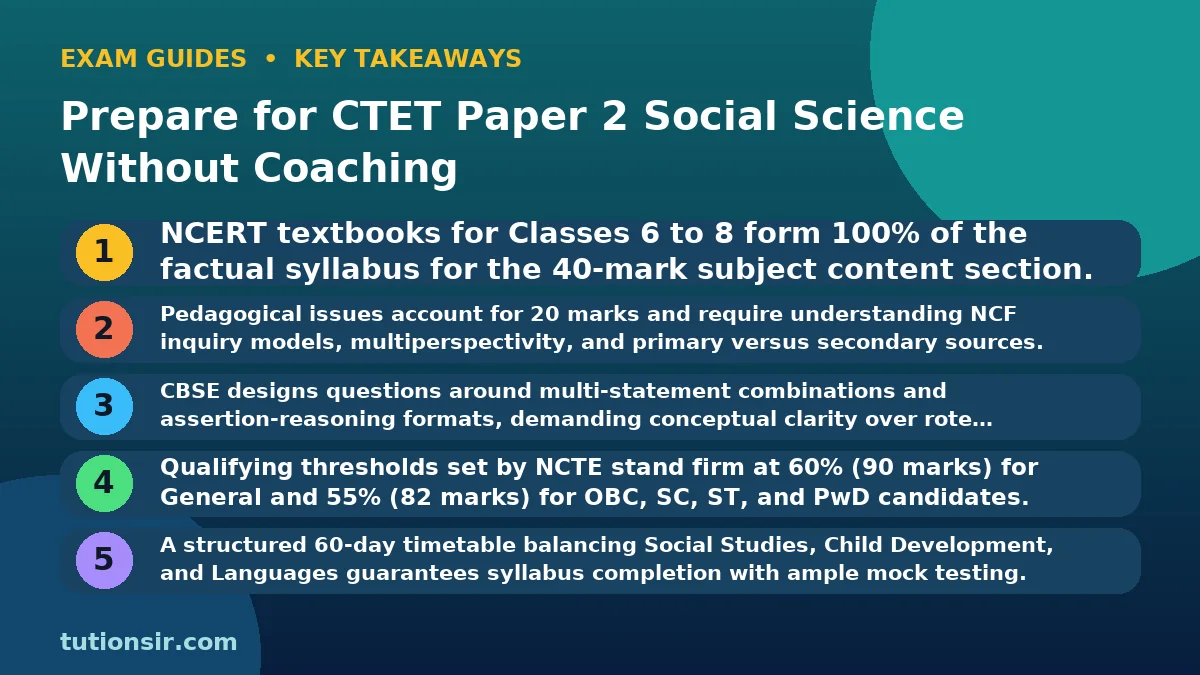
- NCERT textbooks for Classes 6 to 8 form 100% of the factual syllabus for the 40-mark subject content section.
- Pedagogical issues account for 20 marks and require understanding NCF inquiry models, multiperspectivity, and primary versus secondary sources.
- CBSE designs questions around multi-statement combinations and assertion-reasoning formats, demanding conceptual clarity over rote memorization.
- Qualifying thresholds set by NCTE stand firm at 60% (90 marks) for General and 55% (82 marks) for OBC, SC, ST, and PwD candidates.
- A structured 60-day timetable balancing Social Studies, Child Development, and Languages guarantees syllabus completion with ample mock testing.
Find yours this week with a free CTET mock test.
No card. Registering takes about two minutes.
What is the syllabus and mark distribution for CTET Paper 2 Social Studies?
The Central Teacher Eligibility Test (CTET), administered by the Central Board of Secondary Education (CBSE), is the essential benchmark for candidates aiming to teach upper primary grades (Classes 6 to 8) across central schools like Kendriya Vidyalaya Sangathan (KVS) and Navodaya Vidyalaya Samiti (NVS). The entire CTET Paper 2 comprises 150 multiple-choice questions carrying 150 marks, scheduled across a duration of 150 minutes without any negative marking. For candidates from humanities, commerce, and arts backgrounds, Social Studies/Social Science is the single largest component, carrying 60 marks.
Understanding the internal division of these 60 marks is the foundation of smart self-study. CBSE divides the paper into two strict segments: 40 marks dedicated to Subject Content (comprising History, Geography, and Social and Political Life) and 20 marks dedicated to Pedagogical Issues. The official syllabus published on ctet.nic.in directly maps the content to the curriculum formulated by the National Council of Educational Research and Training (NCERT) for Classes 6 through 8. Many candidates fail not because the syllabus is excessively hard, but because they invest disproportionate time in commercial guidebooks rather than mastering the official NCERT units.
- Total Exam Marks: 150 marks across four core sections (Child Development and Pedagogy: 30 marks; Language I: 30 marks; Language II: 30 marks; Social Science: 60 marks).
- Social Science Breakdown: 40 marks for NCERT subject concepts (History, Geography, Civics) + 20 marks for classroom pedagogy and evaluation methods.
- Examination Format: Offline pen-and-paper mode using OMR sheets with single-correct multiple-choice questions.
- Qualifying Standard: As mandated by the National Council for Teacher Education (NCTE), General category candidates must score at least 60% (90 out of 150 marks), while candidates belonging to OBC, SC, ST, and PwD categories require 55% (82 out of 150 marks).
Why Self-Study Outperforms Commercial Coaching for CTET SST
Commercial coaching centers often rely on abridged summaries, one-liner objective digests, and generic recorded lectures that overlook the nuanced narrative framing of NCERT textbooks. However, CBSE's recent question patterns emphasize textual comprehension, boxed case studies, and critical interpretation of sources. When you study independently, you engage directly with the primary text, observe how historical timelines connect with geographic landscapes, and reflect on democratic institutions, building the exact analytical depth needed to solve multi-statement questions.
Which NCERT books are essential for CTET Paper 2 Social Science?
To clear CTET Paper 2 Social Science without coaching, your primary bookshelf must consist solely of nine foundational NCERT textbooks across Classes 6, 7, and 8. The Central Board of Secondary Education frames content questions directly from lines, historical excerpts, maps, and illustrative sidebars contained within these specific volumes. Both English and Hindi medium editions are equally viable, as the official exam papers are bilingual.
The curriculum is organized systematically across three disciplines: History ('Our Pasts' series, Parts I, II, and III), Geography ('The Earth: Our Habitat', 'Our Environment', and 'Resources and Development'), and Social and Political Life (SPL Parts I, II, and III). Relying on condensed third-party notes before reading these textbooks is the most common pitfall. The following chapter mapping highlights high-yield areas where CBSE repeatedly concentrates questions.
- NCERT Class 6 Books: 'Our Pasts – I' (focus on Harappan civilization, Ashoka's edicts, early kingdoms, and hunter-gatherer transitions); 'The Earth: Our Habitat' (latitudes, longitudes, rotation, revolution, major domains, and landforms); 'Social and Political Life – I' (diversity, discrimination, Panchayati Raj, and rural/urban livelihoods).
- NCERT Class 7 Books: 'Our Pasts – II' (Delhi Sultanate administrative systems, Mughal revenue architecture, Mansabdari system, regional cultures, and tribal societies); 'Our Environment' (interior structure of the earth, rock cycle, atmospheric layers, ocean currents, and human-environment interactions); 'Social and Political Life – II' (equality in Indian democracy, state legislative processes, role of government in health, and gender roles).
- NCERT Class 8 Books: 'Our Pasts – III' (East India Company's expansion, Permanent Settlement, Mahalwari and Ryotwari systems, the 1857 Revolt, tribal rebellions, craft and industries, and the National Movement from 1870s to 1947); 'Resources and Development' (soil, water, mineral classification, agricultural farming systems, and human resource dynamics); 'Social and Political Life – III' (Indian Constitution, secularism, the parliamentary system, criminal justice mechanisms, judiciary hierarchy, and understanding marginalisation).
How to Read NCERT Textbooks for Conceptual Retention
Do not read NCERT textbooks like storybooks. Maintain an active study approach: read a chapter once to understand the broader narrative, then read it a second time while highlighting precise definitions, dates of significant reforms, and terminology. Pay careful attention to the small coloured sidebars, source boxes (such as excerpts from travellers like Ibn Battuta, Al-Biruni, or colonial official records), and illustrative captions. CBSE frequently builds conceptual statements directly from these overlooked margins.
How to prepare for CTET Paper 2 Social Science Pedagogy?
Pedagogical issues account for a massive 20 marks out of the 60-mark Social Science section. This section does not evaluate raw factual recall; instead, it tests your ability to translate historical, geographic, and civic concepts into engaging, inclusive, and inquiry-driven classroom interactions. The syllabus aligns closely with the principles of the National Curriculum Framework (NCF) and the National Education Policy (NEP 2020), prioritizing constructivist learning over passive lecture delivery.
To score 16 to 18 marks in this segment, you must understand the distinction between Social Science and Social Studies, the importance of developing critical thinking, methods of empirical inquiry, and the contextual selection of instructional aids. A strong pedagogical response in CTET consistently positions the student as an active knowledge-seeker rather than an empty vessel.
- Primary vs Secondary Sources: Learn to classify historical evidence. Primary sources include original artefacts, coins, inscriptions, diary entries, autobiographies, archival letters, and oral histories. Secondary sources comprise textbooks, modern biographies, encyclopaedias, and analytical articles written after the event.
- Inquiry-Based and Project Methods: Questions frequently present classroom scenarios where students investigate community water issues or local market dynamics. The preferred teacher action always encourages collaborative surveys, evidence collection, and reflective questioning rather than dictating notes.
- Handling Controversial and Sensitive Themes: When teaching sensitive themes such as caste discrimination, religious diversity, or gender stereotypes, CBSE expects teachers to rely on constitutional values, open discussions, and guided empathy, avoiding judgmental declarations or trivializing historical oppression.
- Continuous and Comprehensive Evaluation (CCE): Focus on formative diagnostic assessments, rubrics, portfolio evaluations, and open-ended conceptual assignments rather than rigid summative examinations.
Using Keyword Elimination in Pedagogy Questions
You can systematically eliminate wrong answer options by spotting pedagogical red flags. Negative keywords that almost always signal an incorrect choice include: 'rote memorization', 'rote learning', 'drilling', 'strictly textbook-centred', 'passive listening', 'punishing', 'rewarding marks only', and 'segregating slow learners'. Conversely, positive keywords that typically characterize the correct option include: 'multiperspectivity', 'critical inquiry', 'democratic dialogue', 'hands-on experience', 'contextualizing with real-life surroundings', and 'constructivist exploration'.
| Phase & Timeline | NCERT Subject Coverage (2 Hours/Day) | Pedagogy & Core Subjects (2 Hours/Day) | Daily Practice Target |
|---|---|---|---|
| Days 1–15 (Class 6 Foundation) | Class 6 History ('Our Pasts - I') & Class 6 Geography ('Earth: Our Habitat') | CDP: Growth, Development, Piaget & Vygotsky theories; Language I grammar/reading | 30 Topic-wise MCQs from NCERT Class 6 exercises |
| Days 16–30 (Class 7 Expansion) | Class 7 History ('Our Pasts - II'), Geography ('Our Environment'), & Class 6-7 SPL | CDP: Kohlberg, Inclusive Education, CCE; Language II reading comprehensions | 40 MCQs focusing on administrative systems & physical geography |
| Days 31–45 (Class 8 In-Depth) | Class 8 History ('Our Pasts - III'), Geography ('Resources'), & Class 8 SPL | Social Science Pedagogy: Primary/Secondary sources, inquiry models, controversial issues | 40 Mixed multi-statement and assertion-reasoning questions |
| Days 46–55 (Integration & PYQs) | Comprehensive revision of boxed case studies, maps, and constitutional articles | Pedagogy keyword drills, diagnostic review of CDP and language pedagogy | Full-length CTET Paper 2 PYQ (2021-2024 papers) on OMR sheet |
| Days 56–60 (Final Mock Simulations) | Review self-made summary sheets, error notebook, and tricky terminology | Quick revision of educational policies (NEP 2020, NCF guidelines) | Timed 150-minute full mock test daily with strict self-grading |
How to Tackle Multi-Statement and Assertion-Reasoning Questions
In recent editions of the offline CTET examination, CBSE has steadily phased out single-line memory questions in favor of complex multi-statement (Statements A, B, and C) and Assertion-Reasoning (A and R) questions. These formats are designed to test higher-order thinking skills and can be challenging if you have only prepared using superficial question banks.
Mastering these questions requires a rigorous, systematic evaluation technique. Treat each statement independently before deciding on their logical interconnectedness. This structured habit prevents candidates from rushing to an intuitive guess that traps them in deceptive wording.
- Step 1: Check Assertion (A) in isolation. Read the assertion statement carefully and determine whether it is historically, geographically, or constitutionally true or false according to NCERT.
- Step 2: Check Reason (R) in isolation. Disregard the assertion for a moment and evaluate whether statement (R) is factually accurate on its own merits.
- Step 3: Connect them with 'Because'. If both statements are independently true, insert the conjunction 'because' or 'due to the fact that' at the end of the assertion and read the combined sentence aloud. If statement (R) gives the genuine causal reason why (A) occurs, select the option stating 'Both (A) and (R) are true, and (R) is the correct explanation of (A)'. If not, choose 'Both are true, but (R) is NOT the correct explanation'.
Worked Example: Solving a Tricky History Question
Consider this typical CTET question pattern: Assertion (A): 'Under the Permanent Settlement introduced in 1793 by Lord Cornwallis, many zamindars failed to pay the revenue and lost their estates.' Reason (R): 'The revenue that had been fixed was very high, and agricultural prices were depressed in the initial decades.'
Solution Walkthrough: First, examine (A): Did zamindars lose estates under Permanent Settlement? Yes, NCERT Class 8 confirms that numerous zamindaris were auctioned off due to payment defaults. Assertion (A) is true. Second, examine (R): Was the fixed revenue excessively high during the 1790s amid depressed agricultural output? Yes, NCERT explicitly notes that the company set initial revenue targets steep, expecting them to remain constant forever. Reason (R) is true on its own. Third, connect them: Zamindars failed to pay their dues BECAUSE the fixed revenue was set exceptionally high while farm prices were depressed. The causal link is completely valid. Hence, the correct answer is: 'Both (A) and (R) are true, and (R) is the correct explanation of (A)'.
The 60-Day CTET Paper 2 Social Science Study Plan (Balancing All 150 Marks)
Preparing without coaching demands a disciplined, realistic daily routine. Remember that clearing CTET Paper 2 requires crossing the overall threshold of 90 marks (General) or 82 marks (OBC/SC/ST) across the complete 150-mark paper. Devoting all your daily study hours to Social Science while ignoring Child Development and Pedagogy (30 marks) or the two language sections (60 marks) is a critical strategic blunder.
Allocate approximately 4 to 5 hours of focused self-study each day. Split your study blocks so that you allocate 2 hours to NCERT Social Science content and pedagogy, 1 hour to Child Development and Pedagogy (CDP), 1 hour to Language I and Language II (unseen passages and language pedagogy), and the remaining 30 to 45 minutes to solving previous year questions under timed conditions.
- Phase 1 (Days 1–25: Foundation & Class 6–7 NCERTs): Complete NCERT Class 6 and 7 History, Geography, and Social and Political Life. Create one-page summary flowcharts of dynasties, rock types, latitudes, and local governance bodies. Dedicate CDP hours to foundational theorists: Jean Piaget, Lev Vygotsky, and Lawrence Kohlberg.
- Phase 2 (Days 26–45: Advanced Content & Pedagogy): Cover NCERT Class 8 across all three disciplines, paying particular attention to the British colonial economy, the Indian Constitution, and the judicial system. Study Social Science pedagogy units (sources, classroom projects, CCE, and Bloom's revised taxonomy). Solve language reading comprehensions daily.
- Phase 3 (Days 46–60: Mock Tests, PYQ Drills & OMR Practice): Stop reading new materials. Solve authentic CBSE CTET Paper 2 question papers from the past five years (2021 to 2026). Print blank OMR sheets and practice bubbling answers within the 150-minute deadline to build speed and accuracy.
Common Mistakes Aspirants Make in Self-Study and How to Avoid Them
Thousands of candidates take CTET Paper 2 multiple times without crossing the qualifying mark. In most instances, failure is not caused by a lack of effort, but by repetitive methodological missteps during self-study. Being conscious of these pitfalls early allows you to safeguard your time and energy.
The most pervasive mistake is treating the Social Science section as a pure test of dates and trivia. CBSE consistently designs items that test structural relationships: why town planning differed between Harappa and Mohenjo-Daro, how latitude affects seasonal climate belts, or how the separation of powers protects individual liberties. Memorizing lists of dates without contextual meaning yields poor results on statement-based questions.
- Mistake 1: Relying on generic multi-exam competitive guides. General knowledge digests designed for state police or clerk exams emphasize rote trivia and completely omit NCERT constructivist pedagogy.
- Mistake 2: Neglecting the 20-mark Pedagogy component. Treating pedagogy as an afterthought costs aspirants an easy 15+ marks. These questions follow predictable patterns based on NCF recommendations.
- Mistake 3: Practicing MCQs solely on smartphone screens. The CTET is an offline exam conducted with ballpoint pens on OMR sheets. Failure to practice bubbling leads to misaligned answer keys and time mismanagement on exam day.
- Mistake 4: Disregarding the Language and CDP sections. Scoring 45 in Social Science is futile if you fail to secure decent marks in Child Development and Pedagogy (30 marks) and the two chosen languages (60 marks combined). Maintain a balanced study timetable.
Self-Study Execution Checklist: Your Path to 50+ Marks
Before entering the examination hall, use this practical self-audit checklist to verify that your self-study has left no conceptual blind spots. Achieving a score above 50 marks in Social Science provides an invincible cushion that guarantees overall qualification, regardless of minor fluctuations in language paper difficulty.
To evaluate your progress objectively during the final month, practice full-length chapter tests and previous year sets. Integrating digital diagnostic resources like Tution Sir can streamline your self-evaluation workflow, offering targeted practice questions and instant feedback mapped directly to NCERT concepts so you can pinpoint weak chapters without spending money on conventional coaching.
- Textbook Check: Have you read all nine NCERT Class 6 to 8 books (History, Geography, SPL) including sideboxes and image captions?
- Pedagogy Tools: Can you distinguish between primary and secondary sources at a glance and apply positive/negative elimination keywords automatically?
- Assertion-Reasoning Mastery: Have you practiced the 3-step 'Because' evaluation technique on at least 50 multi-statement items?
- OMR Drills: Have you completed at least five full-length 150-question mock tests using an authentic pen-and-paper OMR sheet within 150 minutes?
- Official Papers: Have you analyzed previous years' official CBSE question papers from ctet.nic.in to verify question trends?
Frequently asked questions
Can I clear CTET Paper 2 Social Science without coaching?
Yes, absolutely. The entire 60-mark Social Science section is derived directly from NCERT Class 6 to 8 textbooks and standard constructivist pedagogical principles. By reading the nine prescribed NCERT textbooks thoroughly, understanding key pedagogy concepts, and practicing authentic CBSE previous year question papers on OMR sheets, you can comfortably clear the exam without paid coaching.
Which NCERT books are essential for CTET Paper 2 Social Science?
You need nine NCERT textbooks covering Classes 6, 7, and 8. For History, read 'Our Pasts' Parts I, II, and III. For Geography, read 'The Earth: Our Habitat' (Class 6), 'Our Environment' (Class 7), and 'Resources and Development' (Class 8). For Civics, read 'Social and Political Life' Parts I, II, and III.
What are the qualifying marks for CTET Paper 2 for General and OBC/SC/ST candidates?
According to official National Council for Teacher Education (NCTE) guidelines, General category candidates must score a minimum of 60% (90 marks out of 150). Candidates belonging to Scheduled Caste (SC), Scheduled Tribe (ST), Other Backward Classes (OBC), and Persons with Disabilities (PwD) must obtain 55% (82 marks out of 150) to qualify.
Is reading NCERT Class 6 to 8 enough for CTET Paper 2 Social Science?
Yes, NCERT Class 6 to 8 textbooks are completely sufficient for the 40-mark subject content section. However, you must also prepare for the remaining 20 marks of Social Science Pedagogy by studying concepts of inquiry-based learning, primary versus secondary sources, project methods, and National Curriculum Framework (NCF) guidelines.
What are the high-weightage topics in CTET Paper 2 SST?
High-weightage history topics include the Indus Valley Civilization, the Mughal administrative system, the Revolt of 1857, and the National Movement. In geography, focus on latitudes, Earth's atmospheric layers, rock cycles, and agricultural types. In civics, high-yield areas include the Indian Constitution, fundamental rights, the judiciary, and local governance.
How many months of self-study are needed to clear CTET Paper 2?
Two to three months of consistent, disciplined self-study (spending 3 to 4 hours daily) is typically sufficient. A 60-day plan divided into reading NCERTs, practicing pedagogy elimination techniques, and solving past five years' official question papers provides ample preparation to achieve 100+ total marks.
How should I prepare for CTET Paper 2 Social Science Pedagogy?
Focus on understanding constructivist classroom methodologies recommended by NCF and NEP. Learn to identify primary versus secondary historical sources, study community-based experiential learning, and master keyword elimination: choose answers fostering critical thinking, multiperspectivity, and democratic participation, while eliminating choices that promote rote memorization or strict textbook adherence.
Sources and official links
- Central Teacher Eligibility Test (CTET) Official Portal
- National Council of Educational Research and Training (NCERT)
- National Council for Teacher Education (NCTE)
Exam rules and notifications change. Confirm dates, fees and eligibility on the official website before acting. Spotted an error? Email support@tutionsir.com. See our editorial policy.
Keep learning
CTET Paper 1 Preparation Strategy: 60-Day Self-Study Plan
Qualifying CTET Paper 1 without expensive coaching is completely achievable with the right blueprint. This beg
Read →CTET Paper 2 Preparation: Maths, Science & SST Plan
Passing CTET Paper 2 means balancing teaching ideas with strong subject knowledge. The exam covers NCERT sylla
Read →How to Write Long Answers in Social Science Class 10 (2026)
Many Class 10 students know their history dates and economic terms thoroughly yet drop precious marks on 5-mar
Read →CTET free practice and syllabus
Free practice and study help
Read →West Bengal TET practice
Free practice and study help
Read →Do not let another week go by without a plan
Most CTET aspirants only find their weak topics after the real exam. Register free now and start with the one topic that worries you most. Small daily practice beats a last-minute rush.
- Free CTET mock test, Paper 1 and Paper 2
- Instant score with topic-wise weak areas
- Explanations in simple language, in your preferred language
Free plan, no card needed. Your progress is saved to your account.