CBSE Board Exams · Legal Update
Delhi High Court CBSE Calculator Class 12: Notice Issued
The Delhi High Court has sought answers from CBSE, NCERT, and the Centre on whether Class 12 students should be allowed to use basic calculators in board exams. While parents highlight an unnotified 2024 board proposal, the court has granted authorities six weeks to file formal replies.
Quick answer
The Delhi High Court has not permitted calculators for CBSE Class 12 board exams yet. On November 4, 2026, a division bench issued notices granting CBSE, NCERT, PARAKH, and the Centre six weeks to respond to a PIL seeking basic calculator use in Accountancy and Maths, listing the matter for January 27, 2027.
Key takeaways
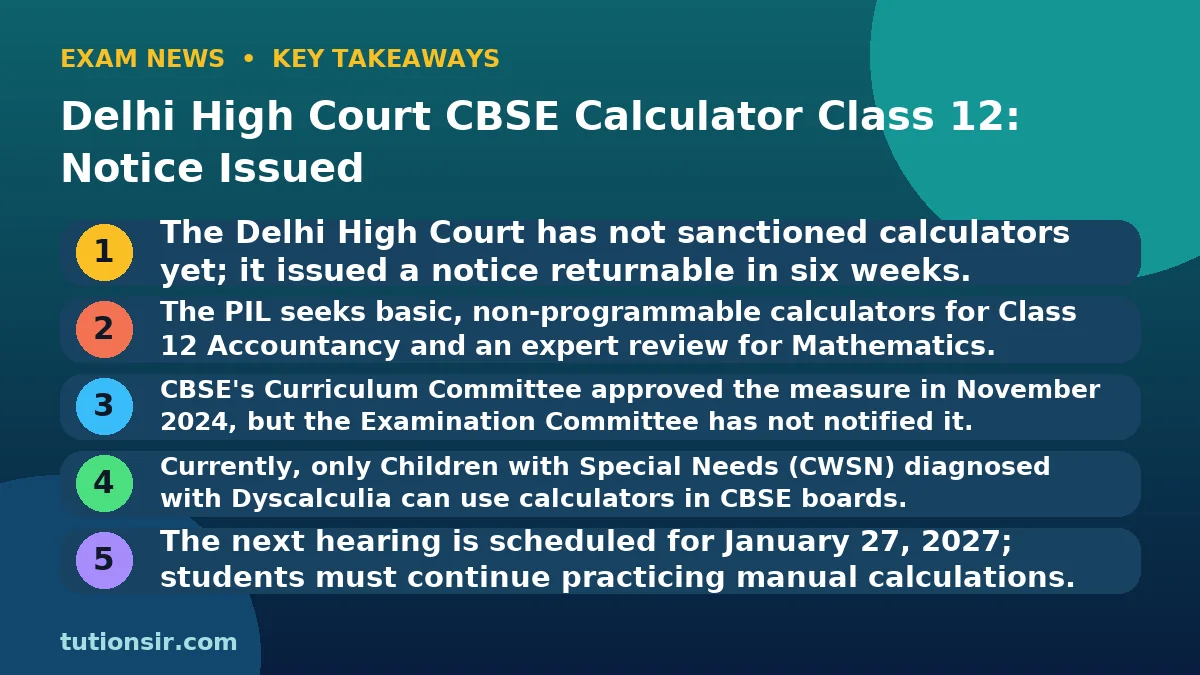
- The Delhi High Court has not sanctioned calculators yet; it issued a notice returnable in six weeks.
- The PIL seeks basic, non-programmable calculators for Class 12 Accountancy and an expert review for Mathematics.
- CBSE's Curriculum Committee approved the measure in November 2024, but the Examination Committee has not notified it.
- Currently, only Children with Special Needs (CWSN) diagnosed with Dyscalculia can use calculators in CBSE boards.
- The next hearing is scheduled for January 27, 2027; students must continue practicing manual calculations.
Did Delhi High Court order CBSE to allow calculators in Class 12 exams?
No, the Delhi High Court has not ordered the immediate introduction of calculators into examination halls. On November 4, 2026, a Division Bench comprising Acting Chief Justice Nitin Wasudeo Sambre and Justice Sanjay Sharma merely issued formal notices to the respondents, seeking their policy stand on the matter. The court made an oral observation that deciding whether to implement an internal recommendation lies within the policy domain of the Central Board of Secondary Education (CBSE).
The court gave six weeks to CBSE, the National Council of Educational Research and Training (NCERT), the Union Ministry of Education, and PARAKH (the National Assessment Centre) to file their counter-affidavits. Advocate Nitin Mangla appeared on behalf of petitioner Vishal Dua and ten other parents in the Public Interest Litigation titled Vishal Dua & Ors. v. Union of India & Ors. The bench has listed the case for its next hearing on January 27, 2027. Until the court delivers a binding order or CBSE issues a circular at cbse.gov.in, general candidates cannot carry any computing device into board exams.
Why has CBSE not yet implemented the recommendation to permit calculators?
The petition reveals that CBSE's own Curriculum Committee had formally approved allowing simple, non-programmable calculators during its 70th meeting held on November 25 and 26, 2024. That proposal moved to CBSE's Governing Body during its 140th meeting on December 26, 2024, under agenda Item No. 4.08. The minutes noted that permitting basic calculating tools in Class 12 Accountancy would relieve students of unnecessary cognitive strain, enabling deeper focus on financial analysis, partnership accounts, and balance sheet interpretations.
Despite that committee milestone, the policy stalled before implementation. In court, CBSE's legal counsel explained that the board manages 204 different subjects across thousands of affiliated schools. Numerical evaluations span numerous disciplines, from Physics to Applied Mathematics. Counsel stressed that changing examination hall regulations requires approval from the CBSE Examination Committee, rather than just the Curriculum Committee. The board must also define permissible non-programmable device specifications, establish uniform invigilation protocols, and address logistical equity across rural and urban test centres before notifying any change.
Is a basic calculator allowed in CBSE Class 12 Accountancy board exams?
At present, basic calculators are completely prohibited in CBSE Class 12 Accountancy for all general candidates. Invigilators treat any unauthorised calculator as unfair means (UFM) under existing CBSE examination bye-laws. The PIL argues that this ban forces Commerce students to spend up to 40% of their test duration executing routine arithmetic by hand. That manual arithmetic load leaves little room for comprehensive problem solving, despite National Education Policy (NEP) 2020 urging competency-based testing over mechanical drill.
The petitioners also asked the court to direct CBSE to form an expert panel for Class 12 Mathematics. In addition, the plea seeks wider accommodations for inclusive education, demanding that calculator relaxations extend to students across multiple neurodivergent and physical disability categories rather than remaining confined to Dyscalculia alone.
| Board / Authority | Class 12 Accountancy Policy | Class 12 Mathematics Policy | Permitted Device Category |
|---|---|---|---|
| CBSE (Current Rule) | Strictly Prohibited (Only Dyscalculia CWSN exempt) | Strictly Prohibited (Only Dyscalculia CWSN exempt) | None for general students; basic calculator for CWSN |
| CBSE (Proposed in PIL) | Under Judicial Scrutiny (Reply sought by Jan 2027) | Referred for subject expert review | Basic, non-programmable standalone calculator |
| CISCE (ISC Class 12) | Permitted for all candidates | Permitted for all candidates | Non-programmable calculator (up to 8 digits / basic) |
| Cambridge / IB | Permitted in specific applied papers | Permitted in designated calculator papers | Scientific / Graphing calculators (reset in hall) |
Who is currently permitted to use a calculator in CBSE board examinations?
CBSE currently reserves the use of a simple calculator exclusively for Children with Special Needs (CWSN) diagnosed with Dyscalculia. Dyscalculia is a specific learning disorder that impairs an individual's ability to process numerical data, learn arithmetic facts, and perform mathematical operations accurately.
Under existing board concessions, eligible CWSN students must submit medical verification to their school, which then registers the request on CBSE's online portal prior to admit card issuance. Qualifying candidates receive an explicit endorsement on their board admit card, allowing them to carry a standalone, non-programmable arithmetic calculator into the exam centre.
- Requirement 1: Valid medical certificate issued by a government hospital or competent medical board specifying Dyscalculia.
- Requirement 2: Formal application filed by the school during CBSE CWSN portal registration.
- Requirement 3: Explicit permission printed on the student's official board exam admit card.
- Requirement 4: Device limited to basic arithmetic (+, -, ×, ÷, %, √) without memory storage, graphing, or internet access.
How does CBSE compare with ISC, Cambridge, and IB calculator rules?
The PIL underlines that other major Indian and international educational boards have long modernised their calculation rules. For instance, the Council for the Indian School Certificate Examinations (CISCE) permits candidates to use basic, non-programmable calculators in ISC Class 12 Accountancy and Mathematics papers.
Similarly, International Baccalaureate (IB) Diploma and Cambridge International Assessment (A-Levels) frameworks integrate graphing and scientific calculators into structured examination sections, assessing higher-order logic instead of speed calculations. This contrast leaves CBSE commerce and science students at a procedural disadvantage when managing high-stakes papers within rigid three-hour limits.
What should students do while the Delhi High Court deliberates?
Because the next High Court hearing takes place on January 27, 2027—just weeks before practicals and theory examinations commence—students should avoid banking on a mid-session rule change. Adjusting your preparation based on speculative social media posts can severely hurt your pacing on exam day.
Treat your current study plan as strictly manual. To preserve time during Accountancy and Applied Mathematics tests, incorporate timed rough-work drills into your weekly timetable. When practising past years' question papers or evaluating conceptual steps through digital study tools like Tution Sir, solve ledger balancing and partnership goodwill allocations completely by pen and paper to build computational stamina.
Step-by-step strategy for manual calculation speed in Accountancy
1. Dedicate a neat right-hand column on every answer sheet for rough calculations to prevent ledger scribbling errors.
2. Practice Vedic math shortcuts for rounding off, cross-multiplications, and percentage shares (such as 3:2:1 profit ratios) under 45 seconds.
3. Cross-check balance sheet totals using the casting method (summing units columns first) instead of recalculating entire multi-digit sums from scratch.
Frequently asked questions
Did Delhi High Court order CBSE to allow calculators in Class 12 exams?
No. The Delhi High Court has not sanctioned calculators for the upcoming exams. On November 4, 2026, the court issued notice to CBSE, NCERT, the Centre, and PARAKH, seeking their response in six weeks. The court remarked that implementation is for CBSE to decide.
Is a basic calculator allowed in CBSE Class 12 Accountancy board exams?
No, general candidates cannot use calculators in CBSE Class 12 Accountancy. Carrying any computing machine into the examination hall without board sanction is treated as unfair means. Only registered CWSN candidates diagnosed with Dyscalculia hold valid exemptions under existing rules.
When will the Delhi High Court take up the CBSE calculator case next?
The Delhi High Court division bench of Acting Chief Justice Nitin Wasudeo Sambre and Justice Sanjay Sharma has listed the matter for further hearing on January 27, 2027, following CBSE's request for time to obtain instructions.
Why has CBSE delayed implementing its 2024 calculator recommendation?
While the Curriculum Committee approved basic calculators in November 2024, CBSE submitted in court that it offers 204 subjects and must assess logistical considerations. Formal exam regulations require sanction from the board's Examination Committee, not just curriculum bodies.
Who is currently permitted to use a calculator in CBSE board examinations?
Only students categorized under Children with Special Needs (CWSN) who are medically certified with Dyscalculia are permitted to use a basic, non-programmable calculator. This concession must be approved in advance through the school and printed on their admit card.
Does NEP 2020 support allowing calculators in senior secondary board exams?
Yes. The National Education Policy 2020 advocates competency-based education that prioritises analytical reasoning over mechanical memorisation and manual calculation drills. Petitioners argued that prohibiting basic calculating aids contradicts this reform objective.
Sources and official links
Exam rules and notifications change. Confirm dates, fees and eligibility on the official website before acting. Spotted an error? Email support@tutionsir.com. See our editorial policy.
Keep learning
How to Avoid Silly Mistakes in CBSE Class 10 Maths: Guide
Every year, thousands of Class 10 board students drop from a 95 to an 85 not from a lack of mathematical knowl
Read →CBSE LOC Correction Window: Schools Must Edit by Nov 7
The Central Board of Secondary Education has opened the List of Candidates correction window for Classes 10 an
Read →How to Increase Handwriting Speed in Board Exams: Top Tips
Every year, thousands of Indian board examinees lose 10 to 15 marks simply because their hands cannot keep up
Read →Practise what you just read
Free plan, no card needed. Full mock tests and the complete question bank are on the Pro plan.