CBSE & School Education · News
Delhi Schools Closed GRAP 4: Online Rules and Board Status
Following a sudden spike in toxic smog that pushed the regional Air Quality Index beyond the hazardous 450 mark, authorities have activated Stage 4 of the Graded Response Action Plan across Delhi-NCR. Physical classrooms for most grades are shut immediately, forcing thousands of schools to migrate back to online instruction.
Quick answer
Under GRAP Stage 4 curbs enforced across Delhi-NCR, all physical classes for students up to Class 9 and Class 11 are suspended and shifted online until further notice. However, offline classes continue for Class 10 and 12 board-exam students, as confirmed by Delhi's Directorate of Education.
Key takeaways
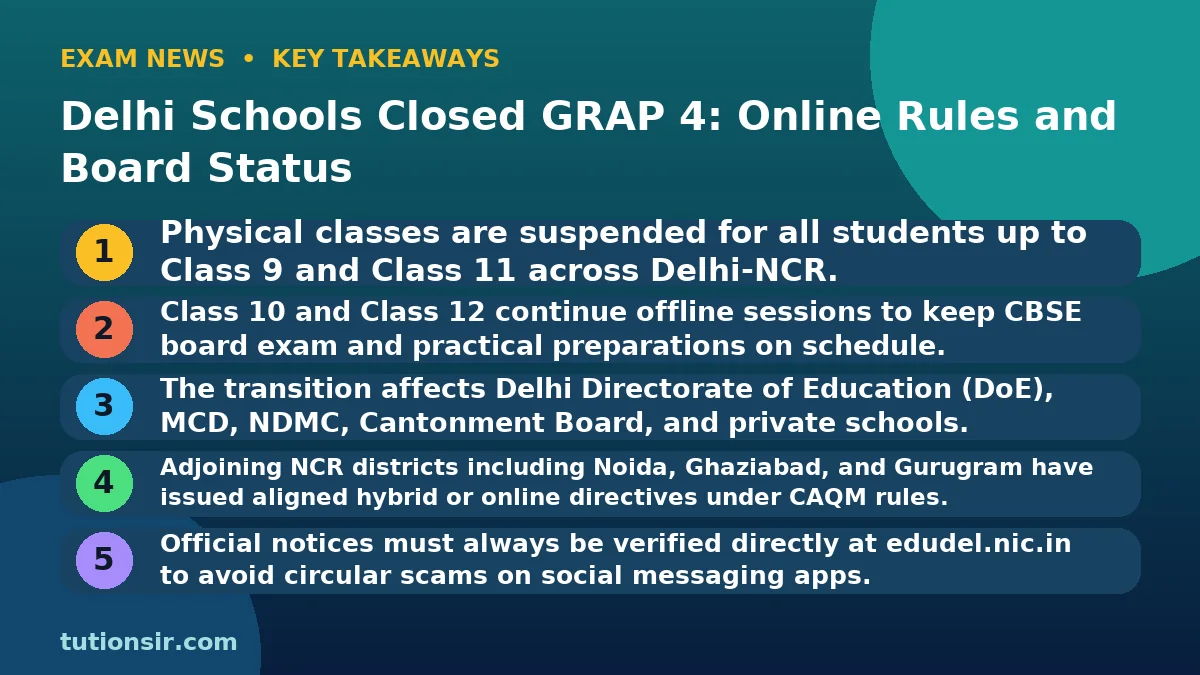
- Physical classes are suspended for all students up to Class 9 and Class 11 across Delhi-NCR.
- Class 10 and Class 12 continue offline sessions to keep CBSE board exam and practical preparations on schedule.
- The transition affects Delhi Directorate of Education (DoE), MCD, NDMC, Cantonment Board, and private schools.
- Adjoining NCR districts including Noida, Ghaziabad, and Gurugram have issued aligned hybrid or online directives under CAQM rules.
- Official notices must always be verified directly at edudel.nic.in to avoid circular scams on social messaging apps.
Try Tution Sir free for your class and subject.
No card. Registering takes about two minutes.
What Triggered the GRAP Stage 4 School Closure in Delhi?
The decision to invoke Stage 4 of the Graded Response Action Plan (GRAP) came after Delhi's 24-hour average Air Quality Index (AQI) surged into the 'Severe Plus' category, crossing 450 across multiple continuous monitoring stations. In response to this acute public health hazard, the Commission for Air Quality Management (CAQM) held an emergency review meeting and mandated stringent region-wide emergency curbs.
Following CAQM's statutory directions, Delhi Chief Minister Atishi announced the immediate suspension of in-person schooling. The Delhi Directorate of Education (DoE) promptly published a circular directing all government, government-aided, Municipal Corporation of Delhi (MCD), New Delhi Municipal Council (NDMC), Delhi Cantonment Board, and unaided private recognized schools to discontinue physical schooling for all grades up to Class 9 and Class 11 until further notice.
- AQI threshold: GRAP Stage 4 automatically activates when regional AQI breaches the 450 mark.
- Enforcing body: Commission for Air Quality Management (CAQM) in coordination with state education departments.
- Scope: Applies uniformly across state-run, municipal, aided, and private unaided institutions in Delhi-NCR.
Are Class 10 and 12 Students Required to Attend Offline Classes Under GRAP 4?
Yes, students enrolled in Class 10 and Class 12 are explicitly required to attend regular offline sessions despite the GRAP Stage 4 restrictions. The Directorate of Education made this conscious carve-out to safeguard academic momentum ahead of the upcoming Central Board of Secondary Education (CBSE) board examinations.
Because board examinees face mandatory internal practical assessments, laboratory submissions, and crucial pre-board examinations throughout November and December, education officials prioritized learning continuity for these benchmark batches. While younger children remain sheltered at home away from hazardous ambient PM2.5 concentrations, secondary and senior secondary schools are mandated to take protective indoor measures, including suspending all outdoor physical assemblies, sports periods, and field activities.
Noida, Ghaziabad, and Gurugram Schools: How Adjoining NCR Districts Are Responding
District magistrates and local education officers across Uttar Pradesh and Haryana have adopted corresponding measures under the overarching CAQM directives. In Gautam Buddha Nagar (Noida and Greater Noida) and Ghaziabad, the Department of Basic Education ordered schools to transition into remote learning or hybrid formats for junior and middle standards.
Similarly, in Haryana's Gurugram, Faridabad, and adjoining belts like Nuh, district elementary education authorities have curtailed physical schooling up to upper-primary or secondary levels depending on hyper-local air quality numbers. Because implementation orders are rolled out via district-level circulars, parents residing in satellite cities should cross-reference specific orders issued by their respective deputy commissioner offices alongside announcements from their individual school administrations.
| Class Category | Learning Mode | Mandatory Safety Curbs | Official Authority |
|---|---|---|---|
| Nursery to Class 5 (Primary) | Fully Online | No outdoor activities; home-based assignments | DoE Delhi / NCR District Collectors |
| Class 6 to Class 9 (Middle / Secondary) | Fully Online | Screen-time breaks; digital worksheet submissions | DoE Delhi / CAQM Guidelines |
| Class 10 (Board Exam Batch) | Physical / Offline | N95/pollution masks mandatory; zero outdoor sports | CBSE / DoE Delhi Exemption |
| Class 11 (Senior Secondary) | Fully Online | Virtual science labs and remote lecture modules | DoE Delhi / CAQM Guidelines |
| Class 12 (Board Exam Batch) | Physical / Offline | Strict indoor lab work; morning assemblies suspended | CBSE / DoE Delhi Exemption |
Addressing the Digital Divide, Attendance Gaps, and Practical Work
While private school students generally transition to digital meeting tools within hours, sudden closures expose persistent structural challenges in government and MCD institutions. The Supreme Court of India has repeatedly highlighted that protracted campus shutdowns impact midday meal distribution, restrict access to essential nutritional support, and widen academic inequalities for households lacking multi-device access or stable broadband connectivity.
To mitigate attendance drops during virtual instruction, school heads are deploying hybrid communication pipelines. Government school teachers are utilizing official WhatsApp study groups, state learning repository links, and periodic physical study-sheet distribution days for parents. For subjects requiring lab demonstrations in Class 9 and 11 science streams, teachers are advised to leverage open-source virtual science labs and simulate practical components until physical entry resumes.
How to Verify Authentic Education Department Notices and Avoid Rumours
During sudden pollution crises, fabricated circulars and doctored holiday notifications circulate rapidly across social media and parent messaging groups. Acting on unverified messages can lead to unexcused absences during crucial pre-board dates or unnecessary commute risks.
To confirm whether an educational directive is genuine, always check the source directly before sharing:
- Delhi Schools: Visit the official Directorate of Education portal at edudel.nic.in and review the 'Public Circulars' tab.
- Uttar Pradesh NCR Districts: Check the district administration portal (e.g., gbnagar.nic.in for Noida) or the official handle of the District Magistrate.
- Haryana NCR Districts: Consult the Directorate of School Education Haryana site at schooleducationharyana.gov.in or local DC press releases.
- Board Exam Guidelines: CBSE publishes every official schedule and circular exclusively at cbse.gov.in.
Daily Study Routine: Managing Screen Time and Smog Indoors
Switching abruptly from interactive school classrooms to isolated home desks often leads to digital fatigue and fragmented study hours. Students juggling six to seven hours of virtual lectures must establish clear boundaries to protect both their eyesight and academic retention.
Adhere to the 20-20-20 rule during screen sessions: every 20 minutes, gaze at an object 20 feet away for at least 20 seconds to ease ciliary muscle strain. Keep bedroom windows shut during early morning and late evening hours when ambient particulate concentrations peak. Complement live school lectures with concise, self-paced revision tools; platforms like Tution Sir offer structured question banks and bite-sized concept practices that allow students to master textbook topics independently without spending excessive passive hours glued to video streams.
Frequently asked questions
Are schools in Delhi completely closed due to GRAP Stage 4?
No, schools are not completely closed. Physical attendance is suspended for students up to Class 9 and Class 11, who have moved entirely to online classes. However, physical classes continue for students in Classes 10 and 12.
Are Class 10 and 12 students required to attend offline classes under GRAP 4?
Yes, Class 10 and 12 students must attend offline classes as scheduled by their schools. The Directorate of Education exempted these classes so students can complete mandatory CBSE practicals, science lab work, and pre-board revision without disruption.
Which areas of Delhi-NCR have shifted schools to online mode?
The online transition covers all districts across the National Capital Territory of Delhi, along with adjoining NCR zones including Noida, Greater Noida, Ghaziabad, Gurugram, and Faridabad under CAQM Stage 4 directions.
What AQI level triggers GRAP Stage 4 in Delhi?
GRAP Stage 4, designated as 'Severe Plus', is triggered when the regional Air Quality Index breaches 450. It enforces emergency measures such as truck entry bans, construction prohibitions, and school physical class suspensions.
How long will Delhi schools remain online due to pollution?
Schools will conduct classes online until further notice from the Directorate of Education and CAQM. The restrictions will be reviewed and revised only when meteorological conditions improve and AQI levels subside sustainably.
Are pre-board exams and practicals postponed due to school closures?
No, pre-board exams and CBSE practical assessments for Classes 10 and 12 remain on track because these grades continue to attend school offline. For other grades, schools are holding assessments online or rescheduling internally.
How can students manage screen time and maintain study routines during online classes?
Students should follow the 20-20-20 screen rule, use blue-light filters, and create dedicated offline study blocks for handwritten note-making. Breaking homework into focused 25-minute Pomodoro intervals helps prevent mental fatigue during extended virtual learning.
Sources and official links
- Delhi Directorate of Education (DoE)
- Central Pollution Control Board (CPCB)
- The Times of India
- Hindustan Times
Exam rules and notifications change. Confirm dates, fees and eligibility on the official website before acting. Spotted an error? Email support@tutionsir.com. See our editorial policy.
Keep learning
Delhi High Court CBSE Calculator Class 12: Notice Issued
The Delhi High Court has sought answers from CBSE, NCERT, and the Centre on whether Class 12 students should b
Read →CBSE IPS Portal Evaluation Data Verification 2026
The Central Board of Secondary Education has issued urgent operational instructions directing Chief Nodal Supe
Read →CBSE Winter Bound Schools Practical Exams: New SOP Rules
With severe winter weather set to trigger January closures across highland zones, the Central Board of Seconda
Read →Do not let another week go by without a plan
Reading about the exam does not raise marks. Practice does. Register free now and start with the one topic that worries you most. Small daily practice beats a last-minute rush.
- Free plan, no card needed
- Ask any doubt and get a step-by-step answer
- Practice questions with explanations
Free plan, no card needed. Your progress is saved to your account.