CISCE • Circular Update
ISC Modern English Question Paper Format: CISCE Notice
The Council for the Indian School Certificate Examinations (CISCE) has officially ended student confusion over ISC Modern English (Subject Code 891). In a recent notification, the board clarified that Paper 1 (Language) will feature a common question paper identical to English (Subject Code 801).
Quick answer
The Council for the Indian School Certificate Examinations (CISCE) clarified that ISC Modern English (891) and English (801) share a single, unified Paper 1 (Language) question paper. Because both syllabi are identical, candidates will sit for the 80-mark written examination simultaneously on the same date and time.

Key takeaways
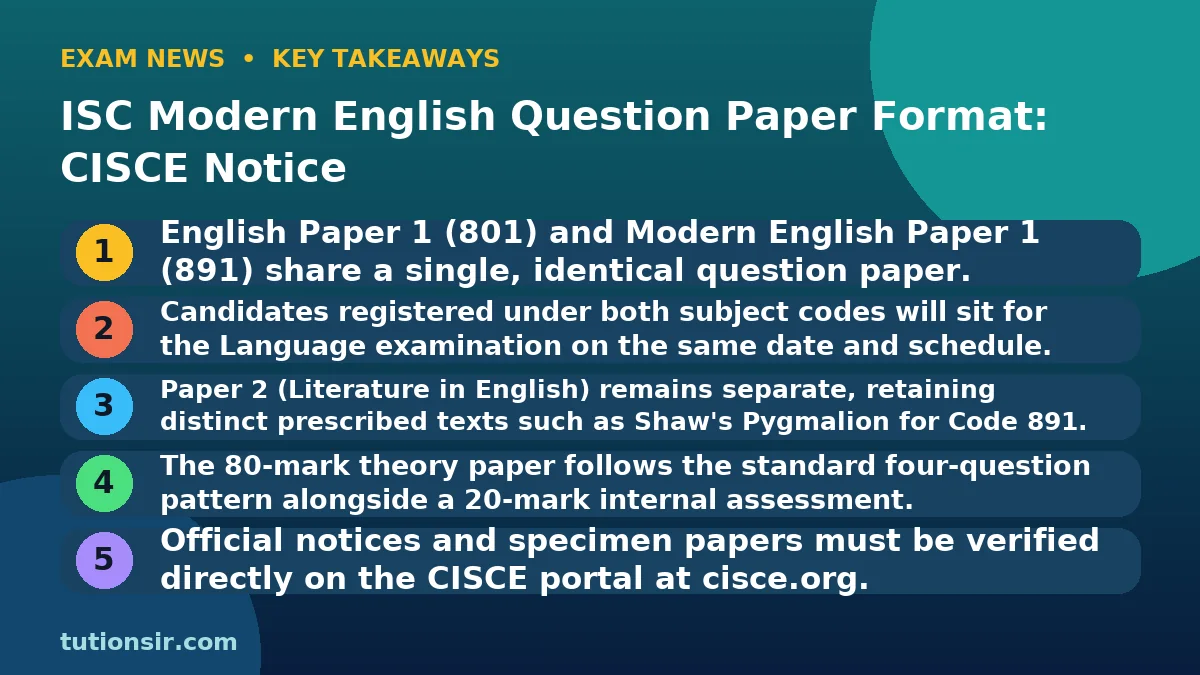
- English Paper 1 (801) and Modern English Paper 1 (891) share a single, identical question paper.
- Candidates registered under both subject codes will sit for the Language examination on the same date and schedule.
- Paper 2 (Literature in English) remains separate, retaining distinct prescribed texts such as Shaw's Pygmalion for Code 891.
- The 80-mark theory paper follows the standard four-question pattern alongside a 20-mark internal assessment.
- Official notices and specimen papers must be verified directly on the CISCE portal at cisce.org.
Get a free study plan and practice questions for your class.
No card. Registering takes about two minutes.
What Clarification Did CISCE Issue Regarding ISC Modern English?
The Council for the Indian School Certificate Examinations (CISCE) issued an official notification clarifying the structure of the ISC Class 12 Modern English examination. In response to persistent inquiries from affiliated school heads, subject educators, and students, the council made it clear that English Paper 1 (Language, Subject Code 801) and Modern English (Language, Subject Code 891) will share a common question paper. The council highlighted that because the prescribed curriculum for the language component is identical across both streams, no separate language paper will be designed for Modern English candidates.
CISCE also announced that both examinations will take place on the exact same date and time. Candidates registered under Code 801 or Code 891 will enter the examination hall together and write the identical 80-mark Language paper. This decision streamlines board operations while assuring candidates that standard evaluation benchmarks apply uniformly across the board.
ISC English Paper 1 vs Modern English: Why Are the Syllabi Identical?
When CISCE introduced Modern English (891) as an alternative to the traditional compulsory English (801) course, schools questioned whether the linguistic benchmarks would differ. CISCE's Regulations and Syllabuses for ISC Year 2027 Examination affirm that both subjects require identical communicative, analytical, and grammatical competencies.
A student enrolled in Modern English is expected to master precisely the same mechanics of English as a student taking traditional English. The functional skills—organizing essays coherently, writing formal proposals, interpreting complex unseen passages, summarizing with grammatical economy, and applying syntactic transformations—do not change. The council's common question paper ensures that neither cohort receives an uneven linguistic test.
Paper 1 vs Paper 2: Common Language Paper but Distinct Literature Syllabi
While Paper 1 (Language) is unified, CISCE emphasized that Paper 2 (Literature in English) remains completely distinct. A common misconception arose among students who assumed that Modern English was merging into English 801 entirely. This is incorrect. Paper 2 features separate syllabi, distinct prescribed textbooks, and independent question papers.
English Literature (801) centres on classical English drama—specifically William Shakespeare's Macbeth—along with the Prism collection of ISC short stories and the Rhapsody anthology of poems. In contrast, Modern English (891) was formulated to offer an accessible, contemporary alternative without sixteenth-century archaic idioms. Its Literature syllabus prescribes George Bernard Shaw's Pygmalion, alongside the Perspectives anthology for short stories and Reflections for poetry.
Candidates cannot choose both subjects simultaneously. Modern English satisfies the compulsory ISC English passing criterion, but test-takers must remember: prepare standard ISC English past papers for Language Paper 1, but study your specific 891 textbooks for Literature Paper 2.
| Feature / Component | English (Subject Code 801) | Modern English (Subject Code 891) |
|---|---|---|
| Paper 1 (Language) Question Paper | Common Unified Paper (80 Marks, 3 Hours) | Common Unified Paper (80 Marks, 3 Hours) |
| Language Exam Date & Timings | Same date, concurrent board schedule | Same date, concurrent board schedule |
| Paper 2 (Literature in English) | Distinct Paper: Macbeth, Prism, Rhapsody | Distinct Paper: Pygmalion, Perspectives, Reflections |
| Paper 1 Structure | Composition, Directed/Proposal, Grammar, Comprehension | Composition, Directed/Proposal, Grammar, Comprehension |
| Internal Project Assessment | 20 Marks (Listening: 5, Speaking: 5, Writing: 10) | 20 Marks (Listening: 5, Speaking: 5, Writing: 10) |
| Compulsory Status | Satisfies ISC Compulsory English requirement | Satisfies ISC Compulsory English requirement |
| Permitted Subject Combinations | Cannot be combined with Modern English (891) | Cannot be combined with English (801) |
ISC Class 12 English Language Question Paper Pattern and Marks Distribution
The common Paper 1 carries 80 marks for the written theory exam, administered over three hours with an additional 15 minutes of reading time. To score high marks, candidates must understand the granular four-question format set by CISCE:
Question 1 (Composition, 20 marks): Candidates select one topic out of six choices, writing 400 to 450 words. The options include descriptive, narrative, reflective, argumentative, and short story prompts. CISCE examiners look for fresh perspectives, strong structural transitions, and accurate grammar rather than convoluted vocabulary.
Question 2 (Directed Writing and Proposal Writing, 25 marks): This question is split into two mandatory parts. Part A (15 marks) tests directed writing (feature articles, book/film reviews, speech transcripts, or statements of purpose) in 250 to 300 words based on given amplifying guidelines. Part B (10 marks) requires a formal project proposal, structured with a clear Heading, Statement of Objective, List of Measures, and Budget/Conclusion.
Question 3 (Functional Grammar, 15 marks): This section evaluates precise command over syntax, prepositions, phrasal verbs, and structural transformations (e.g., active-passive, direct-indirect, inversion, degrees of comparison) without changing the original sentence meaning.
Question 4 (Comprehension and Summary Writing, 20 marks): Students read an unseen passage of approximately 700 words. It tests contextual vocabulary, literal understanding, and inferential analysis. A critical sub-question demands an 80-to-100-word precis or summary written strictly within a grid format. Exceeding word limits or omitting the grid results in heavy mark penalties.
Competency-Focused Questions and 20-Mark Internal Project Work
In alignment with National Education Policy (NEP) guidelines, CISCE has raised the proportion of competency-focused questions to 50% across secondary and higher secondary assessments. In the unified English Language Paper 1, this reform is evident in reading comprehension and directed writing prompts that test evaluative judgement, contextual tone, and situational problem-solving rather than rote memorization.
Beyond the 80-mark written paper, both English (801) and Modern English (891) include a 20-mark internal assessment. Schools must maintain auditable candidate portfolios across three components: Listening Skills (a comprehension test based on a recorded audio text, 5 marks), Speaking Skills (a 3-minute oral presentation, extempore speech, or debate, 5 marks), and Writing Skills (an investigative, reflective, or creative assignment of 500 words, 10 marks). Marks are awarded by an internal teacher and an external examiner appointed under CISCE guidelines.
Preparation Strategy: How Modern English Candidates Should Study
Because the Language paper is identical, candidates registered for Modern English (891) do not need to hunt for specialized Language guidebooks. Instead, follow these concrete preparation steps:
First, solve the last ten years of solved papers from standard ISC English Paper 1 (801). Every composition topic, grammar exercise, and comprehension passage in those archives directly reflects what will appear on your examination paper.
Second, practice proposal writing using the exact CISCE marking rubrics. Always draft your proposal with clear subheadings and bullet points, keeping the budget reasonable and actionable.
Third, time your mock tests strictly. Allocate 45 minutes for the composition, 40 minutes for directed and proposal writing, 20 minutes for grammar, 55 minutes for comprehension, and preserve 20 minutes for rigorous proofreading.
For students seeking systematic writing feedback, self-paced diagnostic assessments, and curated grammar drills, intelligent learning platforms like Tution Sir offer structured ISC-aligned question banks that reinforce core exam competencies.
How to Download the Official CISCE Circular on Modern English
Educators and candidates must verify circulars directly through CISCE's official channels rather than social media forums. Follow these steps to obtain genuine notices:
Step 1: Open your web browser and go to the official portal: cisce.org.
Step 2: Scroll to the 'Notice Board' or click the 'Examinations' tab on the homepage navigation bar.
Step 3: Select 'ISC Examination' and locate the link titled 'Clarification on Format of ISC Modern English Question Paper' or the updated 'Regulations and Syllabuses for ISC Year 2027 Examination'.
Step 4: Download the official PDF document, note the circular number and date, and file it for your school's examination record.
Frequently asked questions
What clarification did CISCE issue regarding ISC Modern English?
CISCE confirmed that English Paper 1 (Language, Subject Code 801) and Modern English (Language, Subject Code 891) will share a single common question paper in the ISC Class 12 board examinations. Because both syllabi are identical, candidates registered under either code will appear for the language examination on the exact same date and schedule.
Is the ISC Modern English Paper 1 identical to English Paper 1 (801)?
Yes, ISC Modern English Paper 1 is completely identical to English Paper 1 (801). Both papers follow the same 80-mark pattern encompassing essay composition, directed writing, proposal writing, functional grammar, and reading comprehension with summary writing. Students preparing for Modern English should practice standard ISC English Language past papers and specimen papers.
What is the difference between ISC English Literature and Modern English Literature?
While Paper 1 is common, Paper 2 (Literature in English) remains separate. English Literature (801) focuses on classical texts including Shakespeare's Macbeth alongside the Prism and Rhapsody anthologies. In contrast, Modern English Literature (891) studies George Bernard Shaw's Pygmalion alongside modern anthologies Perspectives (prose) and Reflections (poetry), offering more accessible, contemporary language.
What are the subject codes for ISC English and ISC Modern English?
The subject code for traditional ISC English is 801, whereas the subject code for Modern English is 891. Under CISCE regulations, students cannot register for both subjects simultaneously; candidates must select either 801 or 891. Both subjects satisfy the compulsory English qualification required for the award of the ISC Class 12 pass certificate.
What is the question paper format and marks breakup for ISC English Language Paper 1?
The 80-mark Paper 1 spans three hours with four compulsory sections: Question 1 is Composition (20 marks, 400-450 words), Question 2 covers Directed Writing (15 marks) and Proposal Writing (10 marks), Question 3 tests Functional Grammar (15 marks), and Question 4 features Comprehension with a 100-word grid summary (20 marks).
How does CISCE evaluate the 20-mark internal project work for Modern English?
The 20-mark internal assessment for Modern English (891) follows the identical framework as English (801). Schools assess candidates internally and through external moderation across three mandatory components: Listening Skills (comprehension test, 5 marks), Speaking Skills (oral presentation or debate, 5 marks), and Writing Skills or Project Portfolio (investigative or reflective project, 10 marks).
Where can students download the official CISCE circular on ISC Modern English?
Students and school administrators can access official notifications directly on the official CISCE website at cisce.org. Navigate to the "Notice Board" or "Circulars" tab under the Examinations menu to review and download the official PDF circular regarding the unified examination format and regulations for ISC Year 2027 Examinations.
Sources and official links
Exam rules and notifications change. Confirm dates, fees and eligibility on the official website before acting. Spotted an error? Email support@tutionsir.com. See our editorial policy.
Keep learning
ICSE Class 10 Exam Timing 2027: Start Time and Duration
The Council for the Indian School Certificate Examinations is advancing morning board exams by one hour starti
Read →Delhi High Court CBSE Calculator Class 12: Notice Issued
The Delhi High Court has sought answers from CBSE, NCERT, and the Centre on whether Class 12 students should b
Read →ICSE & ISC Date Sheet 2027: Class 10 and 12 Exam Dates
The Council for the Indian School Certificate Examinations (CISCE) will publish the ICSE and ISC board examina
Read →Do not let another week go by without a plan
Knowing the ISC dates is step one. Using the weeks before them well is what decides marks. Register free now and start with the one topic that worries you most. Small daily practice beats a last-minute rush.
- Free plan, no card needed
- Ask any doubt and get a step-by-step answer
- Practice questions with explanations, chapter by chapter
Free plan, no card needed. Your progress is saved to your account.