Class 10 SST Preparation
How to Memorize History Dates and Events for Class 10
Struggling to remember whether the Simon Commission arrived before or after the Chauri Chaura incident? You are not alone. Turning historical years into a story-driven visual timeline eliminates rote panic and helps you score full marks on board exam chronology questions.
Quick answer
To memorize history dates and events for Class 10, use horizontal visual timelines anchored by cause-and-effect milestones rather than isolated numbers. Group events into macro-decades, connect European developments with Indian national movements, and practice active recall using flashcards and chronological sorting questions to lock sequences into long-term memory.

Key takeaways
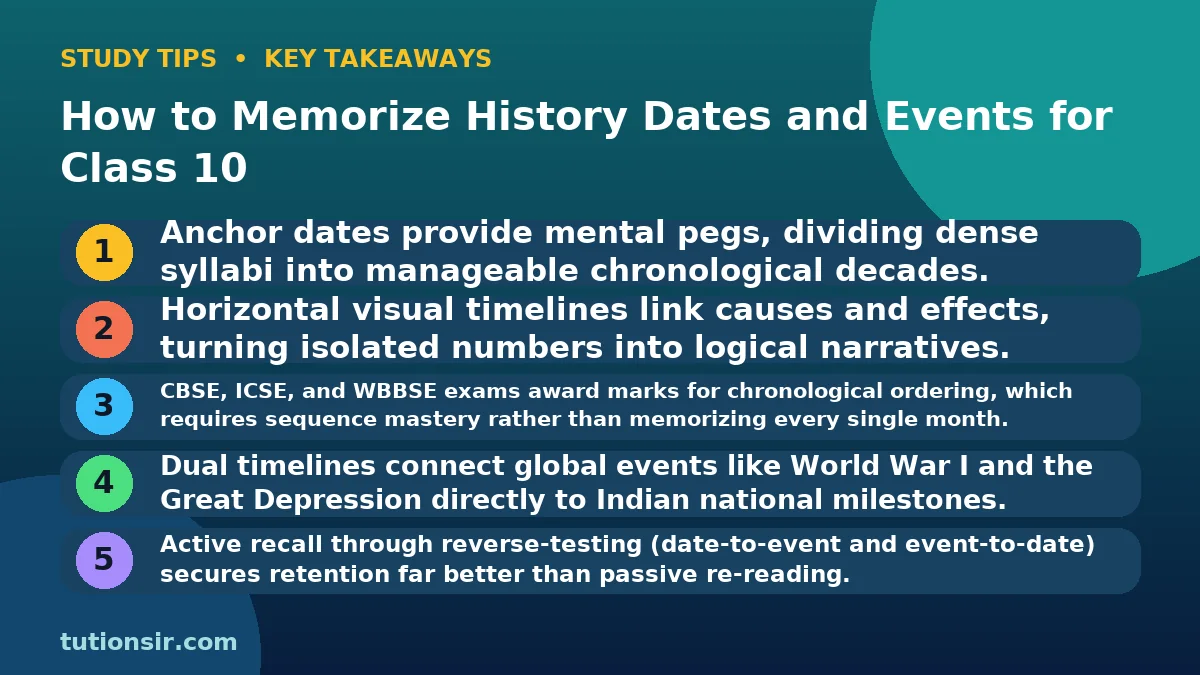
- Anchor dates provide mental pegs, dividing dense syllabi into manageable chronological decades.
- Horizontal visual timelines link causes and effects, turning isolated numbers into logical narratives.
- CBSE, ICSE, and WBBSE exams award marks for chronological ordering, which requires sequence mastery rather than memorizing every single month.
- Dual timelines connect global events like World War I and the Great Depression directly to Indian national milestones.
- Active recall through reverse-testing (date-to-event and event-to-date) secures retention far better than passive re-reading.
Try Tution Sir free for your class and subject.
No card. Registering takes about two minutes.
What Is the Timeline Method for Memorizing Historical Events?
The timeline method for history is an active visual learning strategy that organizes historical developments sequentially along a horizontal or vertical axis. Instead of treating years as random four-digit PIN numbers, the timeline technique converts them into milestones along a continuous journey. When your brain views an event as the direct consequence of a preceding action, chronological retention shifts from temporary cramming into genuine comprehension.
Cognitive overload is the single largest hurdle faced by Class 10 Social Science students. The NCERT textbook 'India and the Contemporary World - II' covers complex sociopolitical transitions spanning across continents. When students attempt to memorize isolated dates from 'The Rise of Nationalism in Europe' alongside 'Nationalism in India', memory interference occurs. A horizontal timeline method provides visual spatial cues, giving each decade a distinct physical territory on your study sheet.
Educational research consistently reveals that human memory is fundamentally associative. You do not remember where you placed your house keys by reciting a mathematical coordinate; you recall the narrative sequence of walking through the doorway and setting down your bag. In the same way, the timeline method to remember history dates class 10 cbse anchors critical turning points around human decisions, economic pressures, and political conflicts.
- Visual Spatial Association: Spacing milestones proportionately on paper shows the passage of time graphically.
- Cause-and-Effect Context: Every date answers 'Why did this happen right now?' rather than merely 'When did it occur?'
- Narrative Cohesion: Events function as plot points in a continuous historical story rather than disconnected flash items.
Anchor Dates vs. Macro-Epochs: What Do You Actually Need to Memorize?
One of the biggest mistakes board exam aspirants make is trying to memorize every calendar date printed in the margins of their textbook. Boards like CBSE (Central Board of Secondary Education), CISCE (Council for the Indian School Certificate Examinations), and state authorities such as WBBSE (West Bengal Board of Secondary Education) do not expect students to act like automated almanacs. Scoring full marks requires knowing the difference between an 'Anchor Date' and a 'Macro-Epoch Year'.
An Anchor Date represents a watershed moment where the exact calendar day, month, and year are mandatory for board scoring. For instance, in 'Nationalism in India', writing merely '1919' for the Jallianwala Bagh Massacre is insufficient in long-answer evidence; you must know it occurred on 13 April 1919 during Baisakhi. Similarly, Gandhi's breaking of the salt law at Dandi demands the precise date of 6 April 1930.
In contrast, Macro-Epoch Years refer to broader systemic transformations, regional treaties, or socioeconomic shifts where only the year matters. The establishment of the Zollverein customs union in 1834, the introduction of the Napoleonic Code in 1804, or the Vienna Peace Settlement of 1815 are macro-epochs. Grouping your syllabus into these two categories prevents cognitive burnout and clarifies your revision priorities.
High-Precision Anchor Dates (Day + Month + Year)
Reserve your daily flashcards for high-precision milestones. Key examples include: 13 April 1919 (Jallianwala Bagh Massacre), 5 February 1922 (Chauri Chaura incident leading to the withdrawal of Non-Cooperation), 12 March to 6 April 1930 (The Dandi March), and 5 March 1931 (Gandhi-Irwin Pact). Missing the month or day in these specific questions can cost half-mark deductions in precise marking schemes.
Macro-Epoch Benchmark Years (Year Only)
Benchmark years establish broad context across chapters. In European history, track 1789 (French Revolution), 1804 (Civil Code), 1815 (Treaty of Vienna and defeat of Napoleon), 1821 (Greek War of Independence begins), 1832 (Treaty of Constantinople), 1848 (Revolutions across Europe and Frankfurt Parliament), 1861 (Victor Emmanuel II proclaimed King of United Italy), and 1871 (Proclamation of the German Empire at Versailles).
How to Make a Timeline Chart for Class 10 History: Step-by-Step
Creating an effective timeline chart requires thoughtful design rather than simply copying lines from a textbook. Follow this systematic, four-step routine to craft horizontal timeline charts that fit neatly on your study desk or bedroom wall.
Step 1: Select an orientation and establish your decade brackets. Rotate an A3 or standard chart paper horizontally. Draw a solid central line across the middle. Divide this line into clear decade spans. For Indian nationalism, mark 1915 to 1920, 1921 to 1925, 1926 to 1930, and 1931 to 1935. Leaving proportionate physical space between years ensures your brain perceives the gap between events accurately.
Step 2: Assign distinct color codes to historical actors and event categories. Use green for peasant and tribal rebellions (such as Baba Ramchandra in Awadh or Alluri Sitaram Raju in the Gudem Hills), red for British legislative acts and repressions (Rowlatt Act, Martial Law), blue for formal Congress sessions and declarations (Nagpur 1920, Lahore 1929), and black for mass nationwide campaign launches. Color coding triggers visual memory during stressful exam hours.
Step 3: Annotate cause-and-effect arrows above and below the axis. Write the event name and date on top of the line, and place the immediate catalyst directly underneath. For example, above the line at 1919 write 'Rowlatt Act passed', and draw a downward arrow leading to 'Nationwide Rowlatt Satyagraha', which points directly forward to 'Jallianwala Bagh gathering'. This turns dates into logical dominoes.
Step 4: Incorporate active-recall reverse-testing flaps. Use sticky notes or folded paper tabs over the dates. During self-study sessions, test yourself in both directions: first, read the event and recite the year; second, lift the flap to read the year and explain the three core events that occurred during that twelve-month span.
| Chapter / Theme | Event / Milestone | Nature of Date | Precise Board Exam Timeline |
|---|---|---|---|
| Nationalism in Europe | Civil Code introduced (Napoleonic Code) | Macro-Epoch Year | 1804 |
| Nationalism in Europe | Treaty of Vienna (Defeat of Napoleon) | Macro-Epoch Year | 1815 |
| Nationalism in Europe | Treaty of Constantinople recognizes Greek independence | Macro-Epoch Year | 1832 |
| Nationalism in Europe | Zollverein customs union formed in Prussia | Macro-Epoch Year | 1834 |
| Nationalism in Europe | Proclamation of German Empire at Versailles | Macro-Epoch Year | January 1871 |
| Nationalism in India | Mahatma Gandhi returns to India from South Africa | Anchor Month/Year | January 1915 |
| Nationalism in India | Jallianwala Bagh Massacre in Amritsar | Anchor Date (Exact) | 13 April 1919 |
| Nationalism in India | Nagpur Congress Session (Non-Cooperation adopted) | Anchor Month/Year | December 1920 |
| Nationalism in India | Chauri Chaura violent clash (NCM withdrawn) | Anchor Date (Exact) | 5 February 1922 |
| Nationalism in India | Lahore Congress Session (Purna Swaraj adopted) | Anchor Month/Year | December 1929 |
| Nationalism in India | Dandi Salt March (Sabarmati to Dandi) | Anchor Date Range | 12 March – 6 April 1930 |
| Nationalism in India | Gandhi-Irwin Pact signed | Anchor Date (Exact) | 5 March 1931 |
| Nationalism in India | Poona Pact signed between Gandhi and Dr. Ambedkar | Anchor Month/Year | September 1932 |
Nationalism in India: Complete Chronological Master Timeline
The chapter 'Nationalism in India' carries the highest frequency of date-dependent questions in CBSE and state board assessments. Chronological ordering questions frequently pull four unrelated milestones from this chapter and ask students to arrange them. Below is the essential master chronology you must commit to memory using narrative sequence.
The narrative opens in January 1915 with Mahatma Gandhi's return from South Africa, introducing the novel technique of Satyagraha. The immediate testing ground was the local satyagrahas: Champaran in Bihar (1917, organizing peasants against oppressive indigo plantation systems), Kheda in Gujarat (1917, supporting peasants affected by crop failure and plague), and Ahmedabad (1918, intervening in a dispute between cotton mill workers and owners).
The nationwide phase erupted in 1919. The imperial government rushed the Rowlatt Act through the Imperial Legislative Council despite united Indian opposition. Gandhi initiated the Rowlatt Satyagraha, leading to countrywide hartals. General Dyer enforced martial law in Amritsar, culminating in the horrific Jallianwala Bagh Massacre on 13 April 1919. Shaken by the violence, Gandhi realized that any mass movement needed Hindu-Muslim unity, bringing him into alliance with Muhammad Ali and Shaukat Ali of the Khilafat Committee (formed in Bombay in March 1919).
The movement formalized across three historic sessions: the Calcutta Session of Congress (September 1920), where Gandhi convinced leaders to adopt Non-Cooperation in support of Khilafat as well as Swaraj; and the Nagpur Session (December 1920), where the Non-Cooperation program was formally ratified. The Non-Cooperation-Khilafat Movement began in January 1921. It spread from urban middle classes to the countryside, before the violent clash at Chauri Chaura in Gorakhpur on 5 February 1922 compelled Gandhi to halt the agitation abruptly.
The late 1920s set the stage for the second mass uprising. The British Tory government constituted the Statutory Commission under Sir John Simon in 1927 to look into the constitutional system. Arriving in India in 1928, it was greeted everywhere with black flags and the slogan 'Go Back Simon'. To defuse tension, Viceroy Lord Irwin offered a vague 'dominion status' proposal in October 1929. Dissatisfied, the Lahore Congress of December 1929 under Jawaharlal Nehru's presidency formalized the demand for 'Purna Swaraj' (Complete Independence) and declared 26 January 1930 as Independence Day.
The cycle reached its climax with the Salt Satyagraha. On 31 January 1930, Gandhi sent an eleven-demand ultimatum to Irwin. When ignored, he launched the Salt March from Sabarmati Ashram on 12 March 1930, covering 240 miles with 78 volunteers, and broke the salt monopoly at Dandi on 6 April 1930. The Civil Disobedience Movement spread nationwide, paused briefly with the Gandhi-Irwin Pact on 5 March 1931, resumed after the failed Second Round Table Conference in London, and gradually lost momentum by 1934.
Dual-Timeline Framework: Aligning European Nationalism and Indian Freedom Struggles
A common gap in Class 10 preparation is studying World History and Indian History in isolated mental silos. In reality, global shifts directly catalyzed political events in India. Creating a 'Dual Parallel Timeline'—placing European and Global events on the upper track and Indian developments on the lower track—cements your understanding of cause, effect, and international chronology.
Consider the First World War (1914–1918). On the global track, the war generated massive defense expenditures, forcing the British colonial administration to introduce income tax and increase customs duties in India. On the parallel Indian track (1915–1918), these economic burdens, combined with forced recruitment into colonial armies and widespread crop failures, bred intense resentment, creating the exact social tinderbox that welcomed Mahatma Gandhi's early satyagrahas.
Similarly, observe the late 1920s. On the European and American track, agricultural prices collapsed from 1926 and plummeted further after the 1929 Wall Street Crash, launching the Great Depression. Peasant exports collapsed worldwide. On the Indian track, agricultural prices cratered between 1928 and 1930, leaving farmers completely unable to pay colonial land revenues. This acute rural distress formed the economic backbone of the Civil Disobedience Movement launched in 1930.
This dual-track perspective is equally invaluable for ICSE History and Civics and West Bengal Board (WBBSE) Madhyamik students. Whether you are mapping the 1857 Great Uprising against Victorian colonial reforms or tracing 20th-century anti-colonialism alongside European totalitarianism, parallel timelines prevent dates from becoming disjointed memorization chores.
How to Score Full Marks in Class 10 History Chronology Questions
In modern CBSE and ICSE exam patterns, chronology questions appear in three primary formats: sequential ordering MCQs, match-the-column items, and assertion-reason questions based on cause-effect timing. Solving these does not require remembering all four exact years if you understand boundary events.
First, apply the 'Boundary Event Technique' for sequence-sorting questions. If an MCQ asks you to arrange: (1) Chauri Chaura incident, (2) Poona Pact, (3) Rowlatt Act, (4) Gandhi-Irwin Pact; do not panic if you forget the year of one item. Identify the absolute earliest event (Rowlatt Act, 1919) and the latest event (Poona Pact, September 1932). Scan the multiple-choice options immediately. In over 80% of board questions, identifying the first and last milestone eliminates three incorrect options instantly.
Second, watch out for 'Chronological Inversion' in Assertion-Reason questions. The assertion might state: 'Mahatma Gandhi withdrew the Non-Cooperation Movement.' The reason might read: 'The Simon Commission faced massive black flag demonstrations across India.' Both individual statements are historically true facts. However, the reason cannot explain the assertion because the Simon Commission arrived in 1928, six years after the withdrawal of Non-Cooperation in 1922. Without timeline awareness, students often wrongly mark option (A) instead of recognizing the chronological mismatch.
A 7-Day Spaced Repetition Revision Plan for History Milestones
Rote memorization fades within 48 hours unless reinforced through spaced intervals. To permanently retain Class 10 history dates ahead of pre-boards and board exams, use this structured 7-day cyclical schedule.
Day 1: Build the visual timeline. Select one chapter (e.g., The Rise of Nationalism in Europe). Draw the horizontal axis, plot the primary anchor dates, color-code political actors, and write one-line causes beneath each milestone.
Day 2: Forward Recall Testing. Cover the right half of your timeline. Look at the date and verify if you can narrate the milestone, key leaders involved, and its immediate outcome aloud without checking notes.
Day 3: Reverse Recall Testing. Now cover the dates. Read the event descriptions and write down the exact year or date on a rough sheet. Check your accuracy. Circle any date that took longer than five seconds to recall.
Day 4: Gap and Parallel Connection. Compare your chapter timeline with contemporary global events. Connect economic trends (like the 1929 Great Depression) to Indian political decisions (the 11 Demands to Irwin in 1930).
Day 5: Solve Past-Year Board Questions. Work through the last ten years of CBSE or ICSE Social Science papers focusing exclusively on 1-mark objective questions, chronological order items, and source-based passages.
Day 6: Flashcard Sprint and Timed Mock Testing. Shuffle physical index cards or utilize online topic-wise practice sets on Tution Sir to drill high-yield history milestones against the clock.
Day 7: The Blind Sheet Draw. Take a completely blank sheet of paper. Without opening any book, sketch the entire timeline from memory, plotting all major anchor dates in sequence. If you can replicate the sequence on a blank page, you are 100% prepared for board exam day.
Frequently asked questions
How can I easily remember dates in History Class 10?
Draw horizontal visual timelines that connect dates through cause-and-effect storytelling rather than memorizing isolated numbers. Focus on anchor dates first, use color codes for different types of events, and practice active recall using flashcards with spaced repetition intervals.
Is it necessary to memorize every single date in Class 10 History?
No. Board exam marking schemes do not penalize students for omitting minor dates in descriptive answers. You only need exact day-month-year precision for key anchor events like the Jallianwala Bagh Massacre (13 April 1919) and the Dandi March (6 April 1930).
What is the timeline method for memorizing historical events?
The timeline method is a visual study technique where historical events are plotted chronologically along a continuous line. It highlights the sequence, causes, and consequences of developments, helping students understand the historical narrative instead of relying on rote memorization.
Which chapter has the most important dates in CBSE Class 10 History?
'Nationalism in India' contains the highest volume of date-sensitive exam questions. Milestones from Gandhi's return in 1915 to the Poona Pact in 1932 frequently appear in chronological ordering MCQs, match-the-column questions, and multi-mark analytical answers.
How do I prepare for chronology-based questions in the Class 10 SST board exam?
Use the boundary event strategy. Identify the absolute earliest and latest events in the given list to eliminate incorrect MCQ options quickly. Also, practice linking movements with their immediate triggers to avoid chronological errors in assertion-reason questions.
What are anchor dates and how do they help in Class 10 History?
Anchor dates are major historical milestones that serve as mental checkpoints. By anchoring your memory around central years like 1915, 1920, 1930, and 1942, you can easily position intermediate events before or after those reference markers.
How many times should I revise History dates before board exams?
Revise using a 1-3-7 spaced repetition rhythm: review your timeline one day after making it, re-test on day three, and practice a blank-sheet recall on day seven. Monthly re-tests before board exams will keep dates stored in your long-term memory.
How do toppers remember dates and events in Social Science?
Toppers avoid rote cramming. They read chapters like novels, translate text into visual timeline charts, link global events to national uprisings, and test themselves regularly using reverse-recall methods and past board examination papers.
Sources and official links
- CBSE Academic Curriculum & Sample Papers
- NCERT Class 10 Social Science Textbooks
- CISCE ICSE History and Civics Regulations
Exam rules and notifications change. Confirm dates, fees and eligibility on the official website before acting. Spotted an error? Email support@tutionsir.com. See our editorial policy.
Keep learning
How to Write Long Answers in Social Science Class 10
Struggling to convert bulky Social Science chapters into crisp, high-scoring answers? Master the exact point-w
Read →How to Write Long Answers in Social Science Class 10 (2026)
Many Class 10 students know their history dates and economic terms thoroughly yet drop precious marks on 5-mar
Read →What to Do When Your Mind Goes Blank During an Exam: 5 Steps
You turn the page, read the first question, and your brain suddenly feels like a wiped hard drive. Before pani
Read →Do not let another week go by without a plan
Reading about the exam does not raise marks. Practice does. Register free now and start with the one topic that worries you most. Small daily practice beats a last-minute rush.
- Free plan, no card needed
- Ask any doubt and get a step-by-step answer
- Practice questions with explanations
Free plan, no card needed. Your progress is saved to your account.