Exam Strategy & Wellbeing
What to Do When Your Mind Goes Blank During an Exam: 5 Steps
You turn the page, read the first question, and your brain suddenly feels like a wiped hard drive. Before panic sets in, understand that this freeze is purely physiological, completely reversible, and manageable within ninety seconds.
Quick answer
When your mind goes blank during an exam, immediately drop your pen, lean back, and take four slow box breaths (inhale 4 seconds, hold 4, exhale 4, hold 4). Skip the blocked question, answer an easy question first to rebuild confidence, and jot down keyword fragments in your rough margin.

Key takeaways
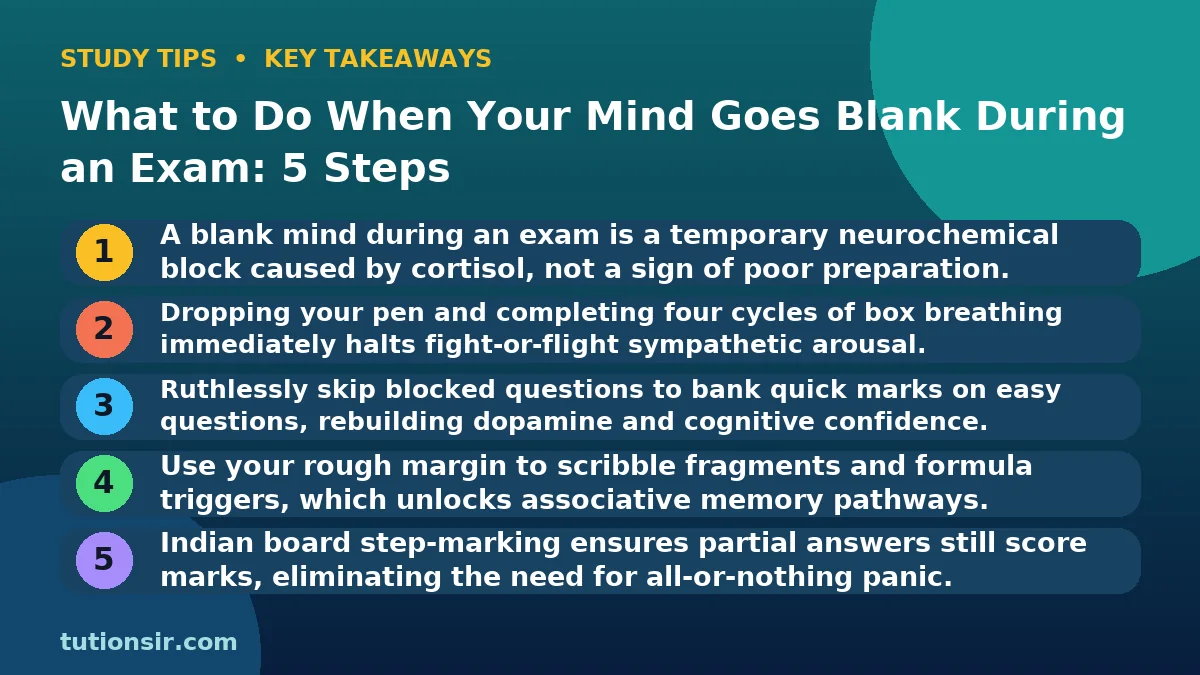
- A blank mind during an exam is a temporary neurochemical block caused by cortisol, not a sign of poor preparation.
- Dropping your pen and completing four cycles of box breathing immediately halts fight-or-flight sympathetic arousal.
- Ruthlessly skip blocked questions to bank quick marks on easy questions, rebuilding dopamine and cognitive confidence.
- Use your rough margin to scribble fragments and formula triggers, which unlocks associative memory pathways.
- Indian board step-marking ensures partial answers still score marks, eliminating the need for all-or-nothing panic.
Try Tution Sir free for your class and subject.
No card. Registering takes about two minutes.
Why does my mind go blank during an exam even if I studied?
Your mind goes blank because acute stress triggers an evolutionary survival response that temporarily cuts off access to rational memory retrieval. When you sit in the examination hall and confront an unexpected problem or watch the countdown clock, your brain's threat-detection center—the amygdala—senses imminent danger. It does not distinguish between a charging predator and a difficult five-mark calculus question. In response, it floods your bloodstream with stress hormones, primarily cortisol and adrenaline.
Under moderate arousal, cortisol heightens alertness. However, when stress crosses your personal cognitive threshold, excessive cortisol and norepinephrine disrupt communication between your prefrontal cortex (PFC) and the hippocampus. The prefrontal cortex manages executive functions like working memory, logical sequencing, and decision-making. The hippocampus acts as the indexing gateway where studied concepts and formulas reside. High cortisol binds to synaptic receptors in both regions, effectively jamming the retrieval gateway shut.
The critical insight every student must internalize is this: the information has not vanished. You did not suffer permanent amnesia, and your weeks of revision were not in vain. The neural traces of those definitions, diagrams, and historical dates remain intact inside your long-term storage. The door is simply locked by physiological panic. Once you lower your physiological arousal back below the critical threshold, your parasympathetic nervous system engages, blood flow returns to your frontal lobes, and memory access reopens.
- Amygdala activation triggers a survival-first hormonal surge that prioritizes physical escape over academic reasoning.
- Excessive cortisol physically suppresses working memory circuits connecting the hippocampus to the prefrontal cortex.
- A mental block during exam conditions is an access failure, not a storage failure.
5 calm down steps when mind goes blank in exam: The emergency reset protocol
Knowing what to do when your mind goes blank during an exam requires a practiced, systematic routine. You cannot force a jammed drawer open through sheer willpower; pulling harder only bends the frame. Instead, follow this five-step physiological and cognitive reset to break the freeze response within ninety seconds.
Step 1: Execute a physical interrupt and tactical box breathing
The moment you detect mental paralysis, physically disengage from the paper. Put your pen flat on the desk, uncross your ankles, and lean your back firmly against your chair. Staring aggressively at blank margins while clutching a pen white-knuckled sends continuous stress feedback to your central nervous system.
Close your eyes or fix your gaze on an inanimate point on your wooden desk. Inhale quietly through your nose for a count of four seconds. Hold that air gently in your lungs for four seconds. Exhale slowly through your mouth for four seconds, letting your shoulders drop. Hold empty lungs for four seconds. Repeat this box-breathing cycle three to four times. This rhythmic pacing stimulates the vagus nerve, which immediately downregulates your heart rate, halts adrenaline release, and signals to your brain stem that there is no physical mortal danger. Uncap your water bottle and take two slow sips of room-temperature or cool water; swallowing engages the esophageal reflex that further halts hyperventilation.
Step 2: Apply the silent 5-4-3-2-1 desk-safe grounding scan
When exam panic attack symptoms strike, your thoughts spin into catastrophic future projections: failing the paper, disappointing your family, or losing admission seats. Sensory grounding drags your awareness out of toxic mental loops and anchors it in the physical present room.
Perform a subtle, desk-safe version of the 5-4-3-2-1 technique without looking suspicious to the invigilator. Silently acknowledge five distinct visual textures (the wood grain of your desk, the blue ink of your rollerball clip, the ruler's centimeter markings, the hem of your sleeve, the grain of the answer booklet). Next, identify four tactile sensations (the firm floor beneath your soles, the smooth plastic of your identity card, the pressure of the chair against your lumbar spine, the coolness of the paper beneath your wrists). Then, identify three quiet sounds (the whir of the overhead ceiling fan, the distant scrape of a bench, the invigilator's rhythmic footsteps). Notice two distinct scents (the faint scent of fresh paper, the clean scent of your cotton shirt). Finally, identify one physical taste (the lingering freshness of the water you just sipped). This 30-second sensory inventory interrupts panic loops and reactivates executive sensory processing.
Step 3: Enforce strategic triage and ruthless question-skipping
The most fatal tactical error students commit is battling a frozen question for ten straight minutes. Do not stay on a question that produced a blank. Immediately take your pencil, draw a light asterisk beside the question number on your question paper, and turn the page.
Begin a deliberate search for the easiest, most straightforward question on the entire paper. In CBSE Class 10 or 12 examinations, this might be a direct one-mark multiple-choice question, an uncomplicated chemical formula, a familiar textbook definition, or a standard grammatical correction. Write that answer immediately. Solving even a modest one-mark question successfully triggers a micro-release of dopamine in the brain. Dopamine directly counteracts cortisol, restores confidence, and signals to the prefrontal cortex that productive cognitive work is underway.
Step 4: Execute a rough-margin keyword brain-dump
Human memory does not operate in linear paragraphs; it functions via associative neural networks known as semantic webs. When you experience a mental block during exam writing, direct recall of an entire answer is blocked, but related associative nodes remain accessible.
Turn to the designated rough work margin on your answer sheet—or the last page of your answer booklet marked 'ROUGH WORK'. Do not attempt to write cohesive sentences. Instead, begin jotting down scattered fragments: single words, diagram fragments, units, scientist names, dates, or relevant abbreviations (such as BODMAS, OIL RIG, or VIBGYOR). For example, if you froze on a biology question regarding photosynthesis pathways, scribble 'chloroplast', 'stroma', 'light', 'ATP', 'thylakoid', and 'water splitting'. As your hand writes these peripheral fragments, the brain's spreading-activation mechanism begins firing connected neural circuits, systematically uncovering the exact core answer that was blocked moments earlier.
Step 5: Leverage subconscious incubation and diffuse-mode processing
Once you have dumped fragments into your rough margin, intentionally leave the question behind and proceed through other comfortable sections of the paper. Human cognition relies on two primary states: focused mode and diffuse mode.
While your focused mode concentrates on solving subsequent sections—such as writing long-answer descriptions or calculating numericals—your subconscious brain continues running background searches across memory stores via the diffuse mode. You will frequently find that forty minutes later, while writing an entirely unrelated answer in Section C, the exact formula or forgotten terminology from Section A spontaneously surfaces in your mind. Because you preserved your momentum rather than freezing, you can simply flip back to the flagged question and write the solution calmly.
Indian board exam realities: Navigating reading time, bell schedules, and step-marking
Managing exam hall freeze requires understanding the specific administrative rules of Indian examination boards like the Central Board of Secondary Education (CBSE), Council for the Indian School Certificate Examinations (CISCE - ICSE/ISC), and state boards like West Bengal Board of Secondary Education (WBBSE/WBCHSE).
CBSE and CISCE board examinations provide a mandatory 15-minute question paper reading window prior to the writing bell (typically 10:15 AM to 10:30 AM in morning sessions). This period is when the majority of acute anxiety spikes occur. Students scan the entire paper hurriedly, encounter a convoluted application-based question in Section D, and conclude their entire preparation has failed. Use reading time tactically: read internal choices carefully, select your preferred options in Sections B, C, and D, and pick the exact three questions you will write first when the starting bell rings at 10:30 AM. Never calculate complex arithmetic in your head during reading time; reserve that energy for the writing window.
Furthermore, dismantle the psychological pressure of 'all-or-nothing' grading. CBSE, CISCE, and state boards mandate step-marking across quantitative, scientific, and humanities subjects. In a 5-mark physics derivation or accountancy numerical, full credit is broken into distinct components: writing the initial formula yields half a mark, listing given parameters with correct SI units yields another half mark, substituting values earns a mark, and intermediate steps earn sequential credits. Even if your mind goes blank on the final algebraic simplification, writing down the core formula, given data, and basic diagrams secures 60% of the allocated marks. Remembering step-marking neutralizes catastrophic thinking.
| Symptom / Instinctive Panic | Underlying Neurobiology | Immediate Grounded Action | Expected Time to Reset |
|---|---|---|---|
| Staring blankly, white knuckles, frozen fingers | Acute sympathetic fight-or-flight freeze; adrenaline surge | Put pen down, lean back, release grip, sip water | 15–20 seconds |
| Racing heartbeat and shallow, rapid chest breathing | Hyperventilation altering blood CO2; amygdala alarm loop | Box breathing (4s inhale, 4s hold, 4s exhale, 4s hold) | 30–45 seconds |
| Spiraling catastrophic thoughts ('I will fail the paper') | Working memory hijacked by emotional limbic processing | 5-4-3-2-1 desk-safe grounding scan; focus on physical senses | 30–60 seconds |
| Persistent mental block on a complex 4- or 5-mark question | Hippocampal retrieval gateway temporarily blocked by cortisol | Skip question; solve a guaranteed 1-mark question to trigger dopamine | 60–90 seconds |
| Vague, partial recollection of formulas or diagrams | Partial activation in semantic associative memory network | Margin rough work brain-dump (keywords, units, abbreviations) | 60–120 seconds |
Worked scenario: How to recover from a 5-mark question freeze under real exam conditions
To understand how memory recall techniques in exams function in real time, examine this timeline of a student who experiences sudden paralysis during a Class 12 CBSE Board Examination in Chemistry or Physics.
- Minute 0:00 (The Freeze): The student reaches a 5-mark question on electromagnetic induction or chemical equilibrium. Heart rate spikes to 125 beats per minute, vision narrows, and the student's mind feels completely void of the governing equation. The instinct is to reread the prompt six times in terror.
- Minute 0:30 (The Somatic Halt): Recognizing the freeze, the student caps their blue ballpoint pen, lays it horizontal, leans back against the wooden chair, and closes their eyes. They execute three box-breathing cycles (inhale 4s, hold 4s, exhale 4s, hold 4s) and swallow a sip of water. Heart rate declines.
- Minute 1:45 (The Tactical Bypass): The student places a neat pencil dot beside Question 28, turns the page, and locates Question 14—a standard 2-mark question on Lenz's law or Le Chatelier's principle that they know thoroughly. They write the two-line answer cleanly. The sensation of progress restores cognitive agency.
- Minute 3:00 (Rough Page Priming): The student opens the back rough work page. They write loose associations: 'flux', 'Faraday', 'negative sign', 'Weber', 'dB/dt'. The visual presence of these symbols stimulates the hippocampus to recall the full differential equation.
- Minute 4:30 (Calm Execution): The student returns to Question 28. Even if the entire final step is unremembered, they state the law, draw the circuit diagram with directional arrows, write the governing formula, substitute values, and collect 4 out of 5 marks under standard board step-marking criteria.
Four damaging exam hall mistakes that turn a 60-second blank into a full panic attack
When students experience a brief mental block, their instinctive reactions often exacerbate the hormonal spiral. Avoiding these four common errors prevents a momentary blank from degenerating into prolonged academic distress.
- Fixating and rereading the question continuously: Staring at the same complex paragraph fifteen times while panicking simply embeds the stress trigger deeper into working memory. If you cannot formulate a response plan within 45 seconds, step away immediately.
- Looking around at other candidates: Watching classmates scribbling furiously creates a false social comparison. You do not know which question they are attempting, whether they are writing correct concepts, or if they are simply drafting rough sketches. Focusing on peers instantly spikes external anxiety.
- Engaging in rapid, shallow hyperventilation: Clenching teeth, tapping feet vigorously, and breathing short, rapid breaths through the mouth triggers carbon dioxide depletion in the bloodstream, accelerating dizziness, trembling hands, and cognitive fog.
- Catastrophizing the overall score: Jumping from 'I cannot recall this 3-mark organic mechanism' to 'I will fail my Class 12 boards and ruin my entrance chances' triggers an acute panic response. Remind yourself: a 3-mark loss out of an 80-mark paper leaves 77 marks completely within reach.
Building mental immunity: Retrieval practice habits to prevent future memory freeze
Preventing exam room memory freeze begins weeks before you enter the hall. The most common root cause of exam hall blanks is an over-reliance on passive revision. Re-reading textbooks, reviewing neat summaries, and highlighting notes create the 'illusion of competence'—a psychological state where information feels familiar, yet cannot be independently retrieved from long-term memory under stress.
To insulate your nervous system against exam day freeze, replace passive revision with active recall and spaced retrieval. Close your books and recreate chapter mind maps, derive formulas on blank whiteboards, or explain tough concepts aloud without referencing notes. Crucially, condition your brain to retrieve knowledge under authentic time pressure. Sitting for strictly timed, full-length sample papers desensitizes the amygdala to the ticking clock, training your prefrontal cortex to remain operational even when adrenaline rises.
Consistent prep using structured platforms like Tution Sir provides learners with calibrated mock exams, instant diagnostic feedback, and timed practice tests aligned with CBSE, CISCE, and state curricula, training students to navigate difficult questions calmly.
Finally, protect your neurochemistry on the night preceding the exam. Severe sleep deprivation impairs hippocampus-to-cortex consolidation by up to 40% and elevates baseline cortisol levels before you even set foot in the center. Aim for at least seven hours of uninterrupted sleep, avoid excessive energy drinks or sudden caffeine spikes on exam morning, and hydrate adequately to ensure optimal cerebral blood flow.
Frequently asked questions
Why does my mind go blank during an exam even if I studied?
Your mind goes blank due to high cortisol and adrenaline triggered by the amygdala during acute exam stress. These stress hormones disrupt neural communication between the prefrontal cortex and hippocampus, temporarily locking working memory retrieval even though the studied concepts remain stored in your long-term memory.
What should I do immediately when my mind goes blank in the exam hall?
Immediately put your pen down, uncross your legs, lean back against your chair, and take four slow box breaths (inhale 4 seconds, hold 4, exhale 4, hold 4). Drink two sips of water, skip the difficult question, and locate an easy question to solve first.
How do I unfreeze my brain during a board exam?
Unfreeze your brain by switching tasks. Skip the blocked problem and find a straightforward one-mark question you know well. Solving an easy problem releases dopamine, which lowers cortisol and reactivates executive functioning in your prefrontal cortex. Use your rough sheet to scribble related keyword fragments.
Is it normal to forget everything as soon as you see the question paper?
Yes, experiencing temporary mental blanks upon opening a question paper is an extremely common physiological reaction known as exam freeze. It is an acute fight-or-flight response caused by sudden situational arousal, not an indication of low intelligence or inadequate preparation.
How can I calm down exam anxiety in 30 seconds?
You can calm down in thirty seconds by performing two cycles of physiological sighing (two quick inhales through the nose followed by a long, slow exhale through the mouth) or box breathing. Ground yourself by pressing both feet firmly into the floor and feeling the physical coolness of your desk.
Why do I remember answers immediately after leaving the exam hall?
You remember answers after the exam because the moment you step outside, the perceived threat vanishes. Cortisol and adrenaline levels drop rapidly, restoring normal prefrontal cortex blood flow and opening the hippocampal pathways that were jammed while the timer was running.
Should I skip a question if my mind goes completely blank?
Yes, always skip a question that produces an acute mental block. Mark it with a light pencil dot, proceed to questions you can answer smoothly, and return later. While you work on other sections, your brain's diffuse mode continues retrieving the blocked concept subconsciously.
How does deep breathing help restore memory during a test?
Deep, paced breathing stimulates the vagus nerve and activates the parasympathetic nervous system. This decreases heart rate and blood pressure, suppresses cortisol release, and restores metabolic energy to the prefrontal cortex, reopening access to long-term memory retrieval circuits.
Sources and official links
- Digital Promise - What Causes Mind Blanks During Exams?
- Central Board of Secondary Education (CBSE Official)
- Hope Therapy and Counselling Services - How Stress Impacts Your Brain During Exams
- National Institutes of Health (PMC) - Neural Correlates of Mind Blanking
Exam rules and notifications change. Confirm dates, fees and eligibility on the official website before acting. Spotted an error? Email support@tutionsir.com. See our editorial policy.
Keep learning
How Parents Can Reduce Board Exam Stress: 6 Grounded Ways
When high-stakes Class 10 and 12 board exams approach, emotional tension often grips the entire household. Par
Read →Pomodoro Study Method for Students: Practical Daily Guide
Juggling daily school classes, private tuitions, heavy homework, and digital distractions leaves most students
Read →Feynman Technique for School Students: 4 Steps to Learn
Struggling to memorize dense Science and Social Science chapters before board exams? The Feynman Technique tra
Read →Do not let another week go by without a plan
Reading about the exam does not raise marks. Practice does. Register free now and start with the one topic that worries you most. Small daily practice beats a last-minute rush.
- Free plan, no card needed
- Ask any doubt and get a step-by-step answer
- Practice questions with explanations
Free plan, no card needed. Your progress is saved to your account.