School Education • Policy Update
West Bengal Schools AI Facial Recognition Attendance Pilot
The West Bengal School Education Department is launching a smart attendance trial using camera-based facial recognition across 100 state-aided schools. The initiative aims to eliminate manual roll calls, stop proxy entries, and transmit real-time attendance figures directly to state administrators.
Quick answer
The West Bengal schools AI facial recognition attendance pilot is a state initiative launching across 100 government and aided schools following the Puja break. Teachers capture a single classroom photograph via a mobile app, where artificial intelligence identifies student faces against Banglar Shiksha records, targeting a statewide rollout by January.
Key takeaways
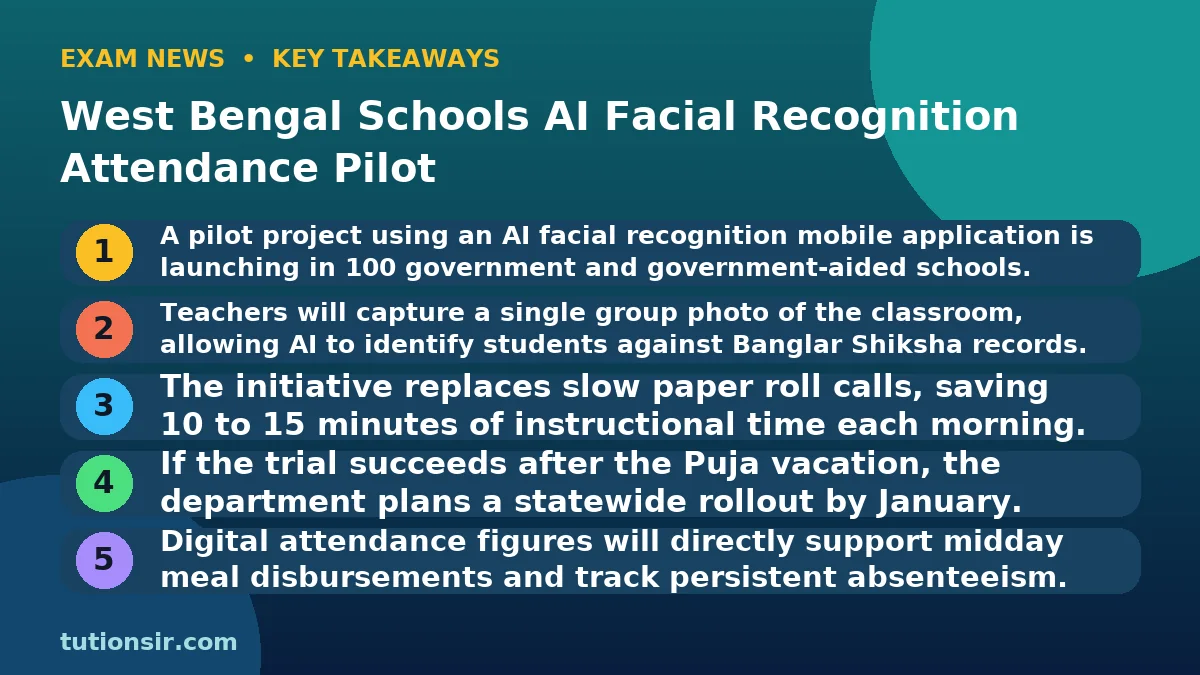
- A pilot project using an AI facial recognition mobile application is launching in 100 government and government-aided schools.
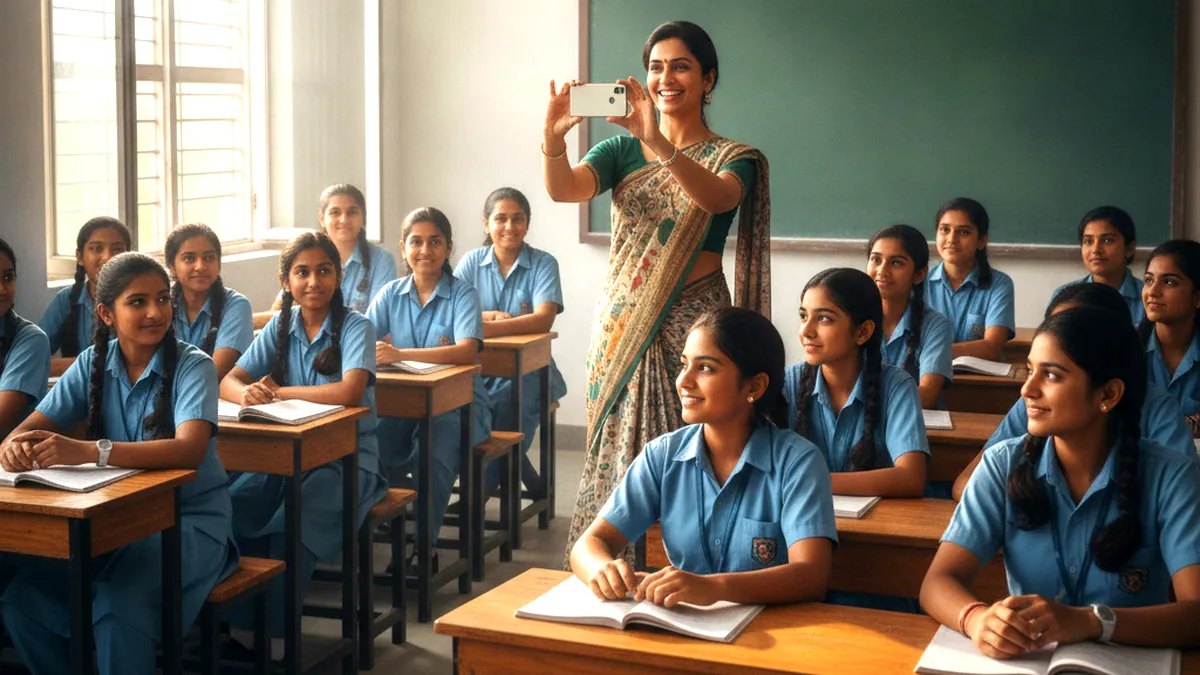
- Teachers will capture a single group photo of the classroom, allowing AI to identify students against Banglar Shiksha records.
- The initiative replaces slow paper roll calls, saving 10 to 15 minutes of instructional time each morning.
- If the trial succeeds after the Puja vacation, the department plans a statewide rollout by January.
- Digital attendance figures will directly support midday meal disbursements and track persistent absenteeism.
Start free: doubts answered in English, Bengali or Hindi.
No card. Registering takes about two minutes.
How does West Bengal AI facial recognition attendance work?
The West Bengal School Education Department is adopting a classroom-wide photographic identification model rather than forcing students to queue at stationary turnstiles or biometric tablets. Under this process, the class teacher launches an official state-designed mobile application on an authorized smartphone immediately after the opening bell. The teacher points the mobile camera toward the classroom and snaps one or two wide-angle group pictures encompassing all seated pupils.
Behind the scenes, the West Bengal school AI attendance app processes the captured frame using facial detection and neural network matching algorithms. The system identifies each face, extracts mathematical biometric facial vectors, and compares them against the pre-enrolled student image repository maintained within the Banglar Shiksha portal. In seconds, the application automatically populates an attendance roster, flagging students present, late, or absent without calling out roll numbers.
Once verified by the class teacher, the attendance record synchronizes directly with administrative servers at Bikash Bhavan in Salt Lake, Kolkata. This automated workflow eliminates the routine 10 to 15 minutes previously lost to paper-based roll calls in crowded state classrooms, redirecting that precious time back into direct academic instruction.
West Bengal 100 schools selected for AI attendance pilot project: Key details
According to reporting by Mathrubhumi and state media, the West Bengal School Education Department has selected a sample of 100 government and government-aided secondary and higher secondary schools across diverse districts for the initial phase. The trial is scheduled to begin as schools resume sessions following the festive Puja break, allowing technical teams to observe real-world performance under standard operating conditions.
The selection of institutions represents a cross-section of academic environments, spanning urban municipal schools in Kolkata and Howrah, semi-urban setups in North and South 24 Parganas, and rural institutions across Paschim Medinipur, Purulia, and Malda. This varied testing ground will test the application's responsiveness across varied lighting environments, high student-to-teacher ratios, and shifting classroom layouts.
School heads and designated teachers in these 100 pilot institutions will receive technical walkthroughs on capturing clear classroom frames, handling new admissions, and reviewing automated rosters. If the trial demonstrates consistent accuracy and high user reliability, education officials intend to initiate a full statewide rollout by January.
- 100 selected state-run and state-aided institutions participate in the initial pilot.
- Testing begins post-Puja vacation across urban, suburban, and rural district clusters.
- Statewide rollout across all WBBSE and WBCHSE schools is targeted for January pending trial outcomes.
- The system replaces physical roll call registers while preserving teacher audit capabilities.
Data privacy and DPDP Act compliance for minor students
Capturing biometric identifiers of minor children in public educational environments demands rigorous adherence to India's Digital Personal Data Protection (DPDP) Act, 2023. State officials emphasize that the classroom photo attendance AI Bengal initiative prioritizes student privacy by avoiding the storage of raw, unencrypted facial images on teachers' personal handsets.
When a teacher captures a classroom image, the application immediately converts facial landmarks into encrypted mathematical hashes before initiating matching against the Banglar Shiksha database. These algorithmic hash strings cannot be reverse-engineered into visible photographs by third parties. Raw classroom pictures are purged from local device memory once processing and verification complete.
Furthermore, student profile records remain housed within secure government data centres under the supervision of the Department of School Education. Parents and school management committees will be informed about digital attendance usage, ensuring lawful processing solely for educational administration, safety verification, and attendance audit requirements.
| Evaluation Parameter | Manual Register System | AI Facial Recognition App |
|---|---|---|
| Time Taken per Period | 10 to 15 minutes of teacher call-outs | Under 30 seconds for wide classroom photo |
| Data Synchronization | Monthly manual data entry into registers | Real-time transmission to Banglar Shiksha |
| Proxy Risk | High (verbal proxy or post-dated entries) | Virtually eliminated via biometric verification |
| Mid-Day Meal Linkage | Approximate estimates submitted manually | Precise headcount tied to daily meal prep |
| Rural Connectivity Need | None required (entirely paper) | Works offline with auto-sync on connection |
| Dispute Resolution | Subjective manual register scrutiny | Teacher-assisted manual override in app |
Offline functionality and rural connectivity challenges
A major operational concern across rural West Bengal schools is patchy cellular connectivity and occasional power fluctuations. To prevent system paralysis during broadband blackouts, software architects engineered an offline-first workflow into the mobile platform.
In offline mode, the application locally stores registered facial feature templates for that specific school's enrolled cohorts. A teacher can snap the morning classroom photograph and permit the on-device AI model to perform identification without requiring an active internet connection. The app securely time-stamps and caches the marked attendance roster locally.
The moment the device reconnects to a mobile data signal or school Wi-Fi network, the cached ledger automatically uploads to the central Banglar Shiksha portal. This design ensures that rural schools in coastal Sundarbans or forested Jangalmahal encounter zero downtime during routine morning check-ins.
Impact of AI attendance on midday meal monitoring in Bengal schools
Beyond punctuality tracking, the integration of facial recognition attendance carries immediate fiscal and logistical advantages for the PM POSHAN (Mid-Day Meal Scheme). In the traditional setup, meal calculations frequently relied on morning roll call headcounts that could overestimate real classroom presence or suffer administrative inflation.
With instant, tamper-resistant digital headcounts available by 11:00 AM, midday meal cooks and headmasters obtain an exact tally of students physically sitting in class. This prevents over-requisitioning of rice, pulses, and cooking ingredients, curbs resource wastage, and guarantees that state subsidies accurately reflect meal beneficiaries.
Moreover, verified attendance data helps state authorities monitor chronic absenteeism early. If a student enrolled under welfare schemes stops appearing in classroom photos for consecutive weeks, automated alerts can prompt local welfare officers and school counsellors to carry out home visits before the student permanently drops out.
Resolving image mismatches and technical glitches
No optical recognition engine achieves 100% precision every day, especially when handling dynamic classroom environments with shifting shadows, seasonal changes in hairstyle, spectacles, or facial swelling due to health issues. The School Education Department has therefore embedded human oversight directly into the software workflow.
Whenever the AI engine detects ambiguity—such as a student turned away from the camera lens or obscured by a classmate—the app displays the missing student's name on a 'Pending Verification' screen. The class teacher maintains authority to manually tap and mark the pupil present after confirming visual sight in the room. This dual check prevents false absences from corrupting student records.
For students preparing for Madhyamik and Higher Secondary examinations, maintaining the mandatory 75% attendance threshold remains a crucial board prerequisite. As schools transition into automated systems, learners can reinforce their daily academic routines using educational resources on Tution Sir to ensure their study schedules match their disciplined classroom attendance.
Frequently asked questions
How does the AI facial recognition attendance app work in West Bengal classrooms?
Teachers open an official mobile application and photograph the seated class. The artificial intelligence engine scans the picture, identifies facial landmarks, and compares them with registered records from the Banglar Shiksha database. The app automatically compiles an accurate attendance roster within seconds, eliminating verbal roll calls.
Which schools are included in the West Bengal AI attendance pilot project?
The pilot encompasses 100 state-run and state-aided secondary and higher secondary schools across West Bengal. Participating institutions were selected across diverse geographies—including urban, suburban, and remote rural districts—to evaluate optical performance and data synchronization across varied infrastructure conditions before wider implementation.
When will the facial recognition attendance system be rolled out statewide across West Bengal?
The trial commences after schools reopen following the Puja vacation. State education authorities will review pilot results, app stability, and teacher feedback over the subsequent weeks. If the system performs reliably, the department targets a statewide rollout across all government schools beginning in January.
Will the AI attendance app completely replace physical roll call registers in Bengal schools?
During the 100-school pilot phase, physical attendance registers will continue alongside the mobile application to serve as a verification baseline. Once the digital platform is certified for high accuracy and statewide coverage, manual registers will gradually be phased out in favour of digital Banglar Shiksha records.
How does the West Bengal education department address student biometric and facial data privacy?
The system adheres to the Digital Personal Data Protection (DPDP) Act, 2023. Photographs captured by teachers are converted into encrypted mathematical hashes rather than storing raw biometric files on personal phones. All identification records reside inside secured government data centres and are restricted solely to academic administration.
Can the AI attendance app function in rural Bengal schools with limited internet connectivity?
Yes. The application features an offline-first architecture. It stores local student facial templates directly on the device, allowing teachers to record classroom presence without internet access. When the mobile phone detects a network connection or school Wi-Fi later in the day, attendance data synchronizes automatically.
What happens if the AI fails to recognize a student or records a false absence?
Teachers retain manual override authority inside the app. If poor lighting, an obscured angle, or a physical change prevents facial identification, the application flags the student on an unverified list. The teacher can manually verify visual presence and mark the pupil present before submitting the final roster.
Sources and official links
Exam rules and notifications change. Confirm dates, fees and eligibility on the official website before acting. Spotted an error? Email support@tutionsir.com. See our editorial policy.
Keep learning
West Bengal School Curriculum Overhaul: Key Changes
West Bengal has finalized sweeping revisions to its school education syllabus, reshaping middle and secondary
Read →CISCE SHINE 2026 Registration: Fast-Track Notice Out
The Council for the Indian School Certificate Examinations (CISCE) has directed all affiliated institutions to
Read →West Bengal Teachers Political Curbs: Cabinet Clears Rules
The West Bengal Cabinet approved new conduct rules for future school recruits. They bar recruits from active p
Read →Do not let another week go by without a plan
Students who start revising early rarely panic in the last week. Register free now and start with the one topic that worries you most. Small daily practice beats a last-minute rush.
- Free plan, no card needed
- Chapter-wise explanations and practice
- Ask in the language you think in
Free plan, no card needed. Your progress is saved to your account.