WB Education . Governance
West Bengal 7th Pay Commission WBBSE WBCHSE Scope Expanded
The West Bengal Finance Department has formally extended the jurisdiction of the state's 7th Pay Commission to cover board employees and university non-teaching staff. Issued from Nabanna, the resolution sets the stage for revising salary frameworks across key education authorities.
Quick answer
The West Bengal Finance Department has officially brought regular administrative staff of WBBSE, WBCHSE, and the Madrasah Board, alongside non-teaching employees across 25 state-aided universities, under the 7th Pay Commission. Led by Atanu Chakraborty, the panel will review existing pay structures and service conditions before recommending revised compensation under new ROPA guidelines.
Key takeaways
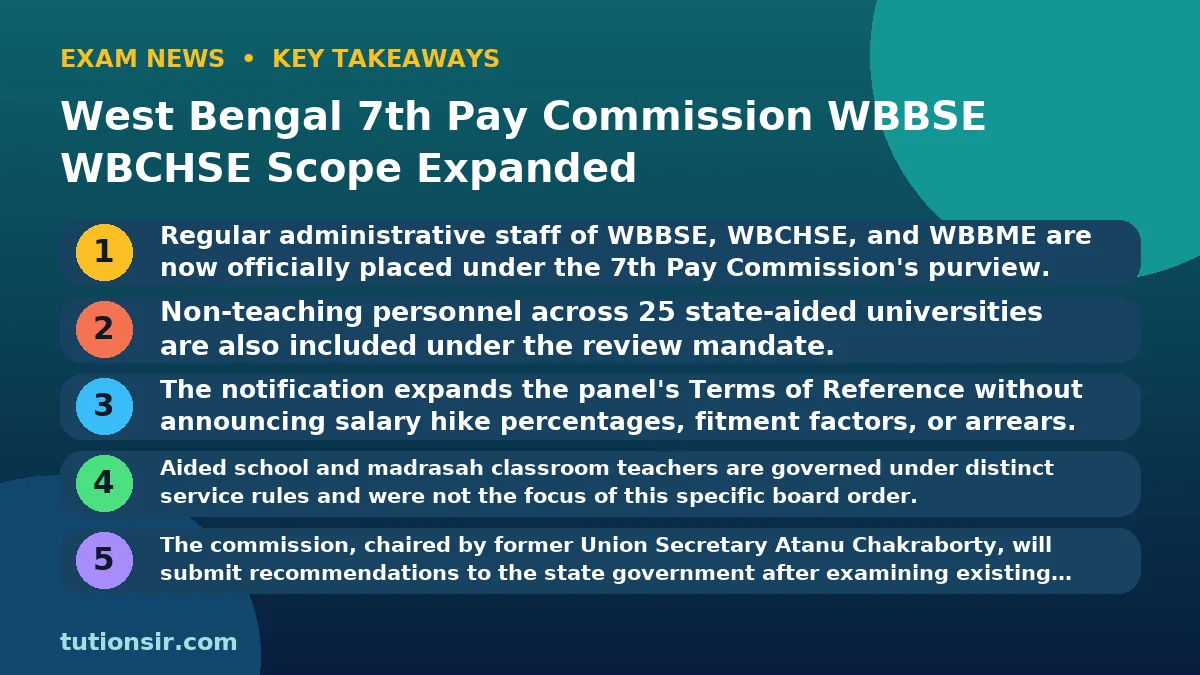
- Regular administrative staff of WBBSE, WBCHSE, and WBBME are now officially placed under the 7th Pay Commission's purview.
- Non-teaching personnel across 25 state-aided universities are also included under the review mandate.
- The notification expands the panel's Terms of Reference without announcing salary hike percentages, fitment factors, or arrears.
- Aided school and madrasah classroom teachers are governed under distinct service rules and were not the focus of this specific board order.
- The commission, chaired by former Union Secretary Atanu Chakraborty, will submit recommendations to the state government after examining existing pay scales.
Start free: doubts answered in English, Bengali or Hindi.
No card. Registering takes about two minutes.
What did the West Bengal Finance Department notify regarding education boards?
The Finance (Audit) Department of the Government of West Bengal issued an official resolution confirming an expanded mandate for the state's 7th Pay Commission. Under this order, regular sanctioned employees serving within the central secretariats and regional offices of the West Bengal Board of Secondary Education (WBBSE), the West Bengal Council of Higher Secondary Education (WBCHSE), and the West Bengal Board of Madrasah Education (WBBME) are brought within the panel's review.
The notification instructs the expert committee to examine the existing compensation frameworks, allowances, age of retirement, and promotion mechanisms of these statutory educational boards. Rather than declaring an instant monetary revision, the order formally establishes the committee's legal remit to audit these employee segments alongside mainstream state government departments.
- Formal inclusion of regular employees of WBBSE, WBCHSE, and WBBME.
- Inclusion of non-teaching staff across 25 state-aided universities in West Bengal.
- Mandate to review pay structures, special allowances, and conditions of service.
- Resolution issued via the state administrative headquarters at Nabanna.
Are school teachers included in the latest West Bengal 7th Pay Commission order?
No, classroom teachers in government-aided secondary, higher secondary, and madrasah institutions are not directly covered by this specific notification. The latest directive addresses administrative, clerical, and operational employees directly on the rolls of the statutory examining boards, rather than teaching cadres in affiliated schools across districts.
Teacher welfare groups, such as the Bangiya Shikshak O Shiksha Karmi Samiti, have frequently voiced concerns about the separate procedural tracks used for board staff and school educators. Classroom teachers in West Bengal are traditionally compensated under separate school-education ROPA rules. While overall pay principles drafted by the 7th Pay Commission will eventually inform wider educational revisions, this particular administrative resolution applies strictly to board personnel and university non-teaching ranks.
Clarifying administrative board staff versus school educators
Board employees manage secondary and higher secondary curriculum administration, examination logistics, tabulations, and regional council hubs. They maintain a service structure analogous to departmental directorates, which separates their pay assessment from aided school teachers whose salaries pass through district inspectorates.
Which university non-teaching employees are covered under the panel's review?
Alongside statutory school boards, the Finance Department order extends the commission's terms of reference to non-teaching personnel across 25 state-aided universities. Major tertiary institutions included under this framework comprise Calcutta University, Jadavpur University, Kalyani University, Burdwan University, North Bengal University, and Aliah University, among others.
This step addresses long-pending appeals from university staff unions regarding parity in pay scale reviews. Clerical employees, library attendants, technical laboratory assistants, and administrative support personnel across these higher education campuses will have their existing pay grades evaluated against standard state government matrices.
- University office superintendents, assistants, and clerical staff.
- Laboratory attendants, workshop helpers, and field assistants.
- Library support cadres and record managers across 25 participating universities.
| Authority / Category | Scope of Coverage | Current Status under 7th Pay Panel | Key Subject of Review |
|---|---|---|---|
| WBBSE | Regular board administrative, regional, and clerical staff | Formally brought under terms of reference | Basic pay bands, promotion schemes, medical allowances |
| WBCHSE | Permanent council secretariat and regional staff | Formally brought under terms of reference | Grade rationalisation, operational allowances, CAS |
| WBBME | Sanctioned regular madrasah board personnel | Formally brought under terms of reference | Parity with secondary education boards, service security |
| 25 State-Aided Universities | All permanent non-teaching staff (Clerical, Group D, Tech) | Formally brought under terms of reference | Campus pay scales, career progression, allowance caps |
| Classroom Teachers (Aided) | School and madrasah teachers across districts | Not included under this specific board order | Separate school education administrative framework |
Difference between 6th Pay Commission and 7th Pay Commission for board employees
Understanding the current review requires looking back at the Revision of Pay and Allowances (ROPA) 2019 framework enacted under the 6th Pay Commission. Under ROPA 2019, the state government implemented revised pay structures with a fitment factor of 2.57, taking effect from 1 January 2020 with notional computation from 1 January 2016. However, board staff transitioned through designated annexures that aligned autonomous board roles with core secretariat pay bands.
The 7th Pay panel, established under the chairmanship of former Union Economic Affairs Secretary Atanu Chakraborty, faces distinctive operational issues. Board staff associations have presented submissions concerning pending dearness allowance (DA) differences relative to central rates, career advancement scheme (CAS) stagnations, and modified promotional avenues. The new panel will evaluate whether to continue the 2019 pay-band model or shift toward an integrated level-based matrix aligned with national standards.
Key comparison points across pay revisions
Under ROPA 2019, autonomous board personnel received basic pay revisions alongside updated house rent allowance (HRA) caps. The 7th Pay Commission is tasked with addressing structural pay anomalies, rationalising variable allowances, and assessing pension commitments under current economic circumstances.
What follows next: Pay revision roadmap and official process
With the terms of reference officially broadened, the Atanu Chakraborty committee is expected to complete stakeholder hearings and present its comprehensive report to the state government within its designated six-month operating window. Representatives from recognized board unions and university employee federations will submit written representations and departmental data regarding their work profiles.
Following submission, the report will be evaluated by the Finance Department and placed before the State Cabinet. If approved, the government will draft and notify the formal ROPA rules, which will detail the definitive pay matrix, fitment factors, and implementation timelines. Readers and employees should rely on notifications hosted on the Finance Department portal (wbfin.wb.gov.in) rather than unverified social media circulars.
For competitive aspirants preparing for clerical, Group D, and administrative openings within WBBSE, WBCHSE, and state universities, understanding evolving service regulations provides clarity on long-term career benefits. Structured platforms like Tution Sir help candidates stay grounded on authentic syllabus updates, government service requirements, and foundational test preparations.
Frequently asked questions
Has the West Bengal government brought WBBSE and WBCHSE staff under the 7th Pay Commission?
Yes. The West Bengal Finance Department has issued a formal resolution bringing the regular administrative personnel of both the West Bengal Board of Secondary Education (WBBSE) and the West Bengal Council of Higher Secondary Education (WBCHSE) under the review scope of the 7th Pay Commission.
Which education boards are included in the West Bengal 7th Pay Commission notification?
The notification explicitly covers regular employees across three statutory examining bodies: the West Bengal Board of Secondary Education (WBBSE), the West Bengal Council of Higher Secondary Education (WBCHSE), and the West Bengal Board of Madrasah Education (WBBME).
Are school teachers included in the latest West Bengal 7th Pay Commission order?
No. This directive specifically applies to the regular administrative, clerical, and support staff of the examining boards and 25 state-aided universities. Aided school and madrasah teachers operate under separate administrative cadres governed by distinct department resolutions.
What did the West Bengal Finance Department notify regarding Madrasah Board employees?
The Finance Department notified that regular sanctioned staff of the West Bengal Board of Madrasah Education (WBBME) are brought under the 7th Pay panel, ensuring their pay structures and service conditions are reviewed in tandem with secondary and higher secondary board employees.
Who is the Chairperson of the West Bengal 7th Pay Commission?
The commission is chaired by Atanu Chakraborty, a retired Indian Administrative Service (IAS) officer and former Union Economic Affairs Secretary, who was appointed by the state government to oversee the pay evaluation process.
When will the 7th Pay Commission in West Bengal submit its recommendations?
The commission has been directed to submit its recommendations to the West Bengal government within a six-month period following the completion of its departmental consultations and stakeholder hearings.
Does the recent notification confirm the salary hike percentage, fitment factor, or arrears?
No. The notification only expands the commission's terms of reference to include board and university staff. Fitment factors, salary hike percentages, and potential arrears will only be determined after the commission submits its final report and the Cabinet approves new ROPA rules.
Which university non-teaching employees are covered under the 7th Pay Commission review?
The order covers permanent non-teaching employees—including clerical, technical, laboratory, and library support staff—across 25 state-aided universities in West Bengal, including Calcutta University, Jadavpur University, Burdwan University, and Aliah University.
Sources and official links
Exam rules and notifications change. Confirm dates, fees and eligibility on the official website before acting. Spotted an error? Email support@tutionsir.com. See our editorial policy.
Keep learning
West Bengal School Curriculum Overhaul: Key Changes
West Bengal has finalized sweeping revisions to its school education syllabus, reshaping middle and secondary
Read →WBBSE Madhyamik Answer Script Evaluation: 2026 Rules
The West Bengal School Education Department is overhauling secondary examination paper checking to publish Cla
Read →Madhyamik 2027 Routine: Dates + Study Plan
The date sheet tells you when. This guide tells you how to use the 13 weeks before the first paper, so that ea
Read →Do not let another week go by without a plan
Students who start revising early rarely panic in the last week. Register free now and start with the one topic that worries you most. Small daily practice beats a last-minute rush.
- Free plan, no card needed
- Chapter-wise explanations and practice
- Ask in the language you think in
Free plan, no card needed. Your progress is saved to your account.