Student Productivity Guide
How to Balance School Tuition and Self Study: Class 9-12
Juggling seven hours of school, evening tuition classes, and towering piles of homework leaves many secondary students exhausted. Discover a sustainable daily study routine that protects your self-study time and prevents academic burnout.
Quick answer
To balance school, tuition, and self-study, divide your day into non-overlapping cognitive blocks: use school for initial conceptual exposure and syllabus milestones, tuition for guided clarification, and a dedicated 3-to-4-hour evening window for active recall, homework, and question practice while safeguarding a mandatory seven hours of sleep.

Key takeaways
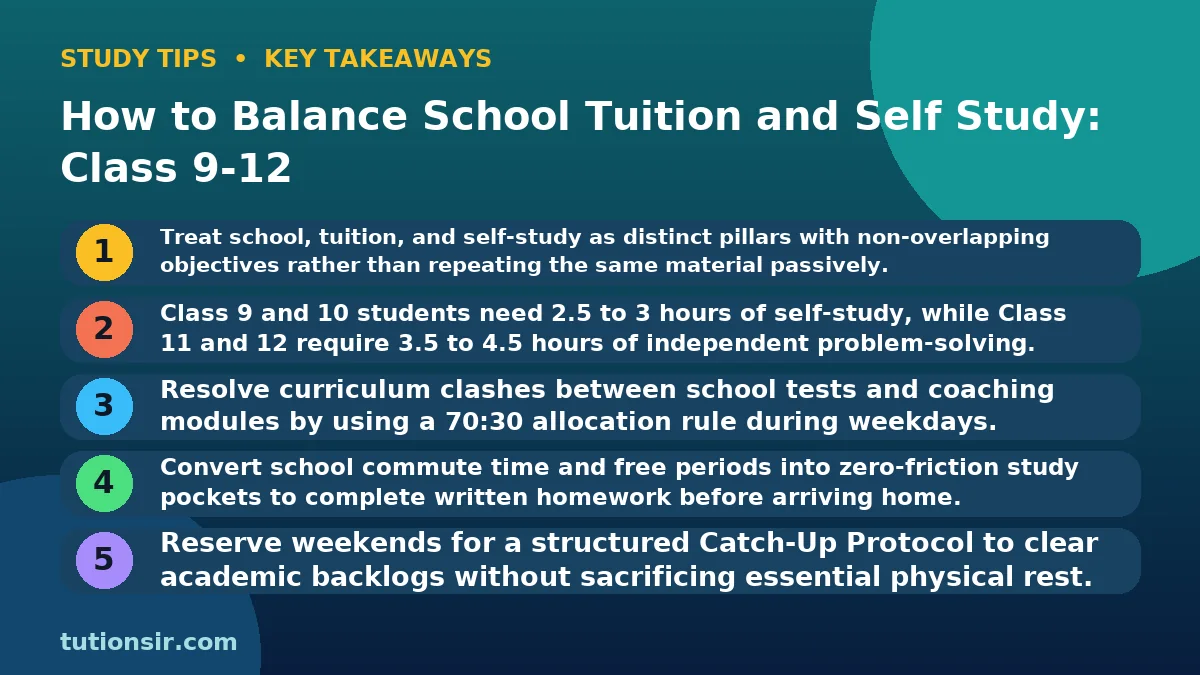
- Treat school, tuition, and self-study as distinct pillars with non-overlapping objectives rather than repeating the same material passively.
- Class 9 and 10 students need 2.5 to 3 hours of self-study, while Class 11 and 12 require 3.5 to 4.5 hours of independent problem-solving.
- Resolve curriculum clashes between school tests and coaching modules by using a 70:30 allocation rule during weekdays.
- Convert school commute time and free periods into zero-friction study pockets to complete written homework before arriving home.
- Reserve weekends for a structured Catch-Up Protocol to clear academic backlogs without sacrificing essential physical rest.
The Three-Pillar Framework: Why Most Daily Study Schedules Collapse
Every academic year, millions of Indian students enrolled under CBSE, ICSE, and state boards such as WBBSE or WBCHSE draft idealistic timetables. These schedules typically plan for wake-up alarms at 5:00 AM, six hours of school, three hours of tuition, four hours of intense evening self-study, and immediate assignment completion. Within a week, exhaustion sets in, alarms are snoozed, school homework remains half-done, and coaching sheets pile up into intimidating backlogs. The root cause is not a lack of willpower; it is a structural flaw in treating all study hours as identical.
To build a realistic daily study schedule for school students, you must implement the Three-Pillar Framework. This framework assigns a distinct, non-negotiable purpose to each environment: school is for syllabus completion and NCERT textbook clarity; coaching or private tuition is for rigorous doubt clarification and advanced problem-solving; self-study is exclusively for cognitive retention, active recall, and independent problem-solving. When you sit passively in school and tuition, you consume information. True academic mastery happens only during uninterrupted self-study when your brain struggles to retrieve, formulate, and write out answers independently.
According to the National Council of Educational Research and Training (NCERT) School Bag Policy (2020), high school and higher secondary students should not be loaded with more than two hours of daily written homework. However, when school assignments collide with external coaching problem sheets, the combined pressure pushes students into chronic sleep deprivation. Balancing these commitments requires acknowledging biological limits: cognitive function drops sharply after 45 minutes of unbroken strain, and memory consolidation depends strictly on getting seven to eight hours of regular sleep.
- Pillar 1 (School): Broad conceptual base, NCERT/prescribed textbook coverage, board-specific answer presentation, and internal assessment submissions.
- Pillar 2 (Tuition/Coaching): Clearing stubborn conceptual doubts, tackling high-order thinking skills (HOTS), and targeting competitive patterns like JEE Main, NEET, or CUET.
- Pillar 3 (Self-Study): Independent question solving, flashcard-based spaced repetition, and previous years questions (PYQs) analysis without external teacher guidance.
Daily Routine for Class 9 and Class 10: Building Board Foundations
Secondary students in Class 9 and Class 10 require a balanced rhythm that prevents early exhaustion while instilling exam stamina. If you are preparing for your Class 10 board exam under CBSE or ICSE, your daily academic load generally involves six hours of school and 90 to 120 minutes of evening tuition. The critical question students ask is: how many hours of self study for class 10 is truly necessary? The answer is 2.5 to 3 focused hours per day, provided this time excludes passive textbook re-reading.
Students following a daily timetable for class 9 student with school and tuition should prioritize building mathematical fundamentals and language writing habits. At this stage, cramming late into the night does more harm than good. Instead, a consistent late-afternoon reset followed by two distinct evening study blocks produces the best retention.
Below is an actionable weekday hourly breakdown designed specifically for secondary students who return home from school by 3:00 PM and attend evening coaching or private tuition between 4:30 PM and 6:30 PM.
Optimized Timetable for Class 9 and 10 (CBSE/ICSE/State Boards)
06:30 AM – 07:15 AM: Wake up, light stretching, breakfast, and a 15-minute formula or vocabulary review while your mind is completely fresh.
07:30 AM – 02:45 PM: School hours. Pay close attention during core theory periods, note down difficult points, and utilize the lunch break or free periods to finish daily diary homework.
03:00 PM – 04:15 PM: Return home, eat a nutritious meal, take a warm shower, and rest. Avoid social media screens to let your sensory system recharge.
04:30 PM – 06:30 PM: Evening tuition class. Keep your school doubts list ready and ensure active participation rather than silent note-copying.
06:30 PM – 07:00 PM: Outdoor walk, physical play, or tea with family to release physical tension.
07:00 PM – 08:30 PM (Self-Study Block 1): High-cognitive subject (Mathematics or Science). Solve textbook exercise problems and ICSE/CBSE exemplar questions independently.
08:30 PM – 09:15 PM: Dinner break and family conversation.
09:15 PM – 10:30 PM (Self-Study Block 2): Low-to-medium cognitive subject (Social Science, English, or Hindi/Regional Language). Focus on active recall, making point-wise bullet summaries, and checking school project files.
10:30 PM – 11:00 PM: Organize school and tuition bags for tomorrow, read light non-academic material, and sleep by 11:00 PM to secure 7.5 hours of rest.
Class 11 and 12 Routines: Science, Commerce, and Humanities Streamlined
The transition to senior secondary is notoriously steep. When students enter Class 11, the syllabus expands threefold, causing immediate friction between regular school attendance and demanding coaching modules. A Class 12 Science student preparing for JEE Main or NEET faces an entirely different set of pressures compared to a Commerce student studying Accountancy for CA Foundation or a Humanities student preparing elaborate board essays and General Test modules for CUET.
If you are figuring out how to manage school and coaching class 11, the primary rule is to avoid the illusion that coaching lectures equate to personal learning. A study timetable for class 12 science with coaching must dedicate at least 3.5 to 4 hours to raw numerical practice, reaction mechanisms, and biological diagrams every single evening.
For Commerce and Humanities students, time management for board exams and coaching centers heavily on answer-writing endurance and continuous case study analysis. Instead of spending five hours memorizing facts, allocate designated time intervals to solve timed Accountancy ledgers, Economics data-interpretation graphs, and long-format History essays.
Best Daily Routine for Class 11 and 12 Science (PCM/PCB with Coaching)
06:00 AM – 07:00 AM: Deep focus morning review. Read NCERT Biology lines or solve five Physics numericals from the previous day's coaching topic.
07:30 AM – 02:00 PM: School hours. Protect lab practical periods to finish practical records inside the laboratory itself, avoiding pending weekend records.
02:30 PM – 03:30 PM: Lunch and power nap (30 minutes) to reset mental fatigue.
04:00 PM – 07:00 PM: Coaching institute / tuition session (Physics/Chemistry/Maths or Biology).
07:15 PM – 07:45 PM: Light snack, fresh air, and complete digital disconnection.
07:45 PM – 09:30 PM (Self-Study Block 1): Entrance problem sheets and DPPs (Daily Practice Problems). Test yourself without checking solution keys midway.
09:30 PM – 10:15 PM: Dinner and casual downtime.
10:15 PM – 11:45 PM (Self-Study Block 2): School board syllabus alignment. Write NCERT theory answers, memorize chemical equations, and finish required school submissions.
11:45 PM – 12:00 AM: Plan tomorrow's top 3 tasks; lights out by midnight (6.5 to 7 hours of continuous sleep).
Class 11 and 12 Commerce and Humanities Daily Schedule
Commerce and Humanities students typically have fewer late-evening coaching hours, giving them an advantage if structured properly. After returning from school and completing 90 minutes of specialized tuition (for Accountancy, Applied Mathematics, or Economics), organize two evening blocks. Dedicate 6:30 PM to 8:30 PM to numerical subjects (Accountancy practical problems or Micro/Macroeconomics calculations). After dinner, reserve 9:15 PM to 11:00 PM for writing-intensive subjects: Business Studies case studies, Political Science analytical questions, or CUET verbal aptitude drills.
| Academic Stage | Recommended Self-Study | Maximum Daily Tuition | Primary Study Focus | Backlog Recovery Window |
|---|---|---|---|---|
| Class 9 (CBSE / ICSE / State) | 2 to 2.5 hours | 1.5 hours | NCERT/Textbook exercises, conceptual clarity, language writing | Saturday morning (2 hours) |
| Class 10 (Board Exam Preparation) | 2.5 to 3.5 hours | 2 hours | PYQs (last 10 years), sample papers, formula recall, diagram precision | Saturday afternoon & Sunday (3 hours) |
| Class 11 (Science / JEE / NEET) | 3.5 to 4.5 hours | 2.5 to 3 hours | Concept derivations, entrance DPPs, continuous formula application | Sunday deep-work session (4 to 5 hours) |
| Class 11 & 12 (Commerce / Humanities) | 3 to 4 hours | 1.5 to 2 hours | Accountancy ledgers, case study writing, CUET domain MCQs, essay structuring | Saturday afternoon & Sunday (3 to 4 hours) |
| Class 12 (Science Board + Entrances) | 4 to 5 hours | 2.5 to 3 hours | NCERT line-by-line reading, mock test papers, entrance test series analysis | Sunday full-day simulated exam drill |
How to Manage School Homework, Coaching, and Self-Study Clashes
A common point of friction for secondary students is curriculum misalignment: school teachers are conducting unit tests on Chapter 4 (such as Chemical Bonding or Thermodynamics), while coaching mentors are speeding through Chapter 8 (such as Equilibrium or Rotational Motion), and private tutors are revising Chapter 2 for an upcoming pre-board assessment. When every educator demands immediate priority, students freeze and end up accomplishing nothing.
To break this deadlock, deploy the Eisenhower Priority Matrix adapted for school-coaching balance. Categorize your academic tasks into four quadrants: Urgent & Important (school pre-board exams, internal practical submissions tomorrow); Important but Not Urgent (JEE/NEET foundation questions, completing long-term syllabus notes); Urgent but Low Impact (routine handwriting homework, school notebook decoration); and Neither (aimless digital scrolling or passive highlighting).
Adopt the 70:30 Daily Focus Rule during conflicting weeks. Dedicate 70 percent of your self-study time (approximately two to two-and-a-half hours) to the immediate urgent milestone—such as the upcoming school terminal exam or project submission. Allocate the remaining 30 percent (approximately one hour) strictly to maintaining coaching homework continuity. This preserves your school standing and attendance marks without triggering massive coaching backlogs.
In-School Efficiency Hacks and Travel Fatigue Management
Most students overlook the fact that their school day contains between 45 and 90 minutes of hidden, usable time. By treating the school campus exclusively as a place of lecture listening and social banter, you surrender precious evening minutes. Reclaiming this hidden time is the secret weapon used by high-performing board toppers across CBSE, CISCE, and state boards.
Identify 'zero periods,' substitution classes when a teacher is absent, library sessions, and the final 15 minutes of lunch break. Use this time exclusively for mechanical, low-cognitive tasks. Copying lab procedures into practical record books, writing out homework definitions, and solving direct textbook arithmetic do not require deep solitary silence. If you complete these tasks during school gaps, your evening remains entirely free for high-value self-study.
Commuting across crowded Indian cities consumes an hour or more each day in buses, auto-rickshaws, or local trains. Combat commute fatigue by keeping low-energy study formats ready on your mobile phone or a small pocket notebook. Listen to English literature chapter audiobooks, review organic chemistry reaction cheat-sheets, or test yourself on historical dates using flashcard applications. When you step inside your house in the evening, your written homework is already finished, allowing you to begin your core revision with clear mental energy.
The Weekend Catch-Up Protocol: How to Clear Backlogs in Class 11 and 12
Academic backlogs are inevitable. A seasonal fever, a mandatory school annual sports rehearsal, or a particularly difficult chapter can instantly derail your weekday study timetable. The mistake most students make is trying to wedge four weeks of backlogs into exhausted weekday nights. This creates a vicious cycle of tiredness, missed school lectures, and mounting anxiety.
Instead, protect your weekdays for the current chapter being taught in class and shift all backlog management to a dedicated Weekend Catch-Up Protocol on Saturday afternoons and Sundays. The Central Board of Secondary Education (CBSE) and state authorities frequently reiterate that consistent revision over distributed periods produces superior conceptual retention compared to emergency cramming.
Divide your weekend into three distinct 2-hour blocks: one block for clearing pending tuition question sheets, one block for completing mandatory school lab files or project assignments (especially critical for ICSE/ISC internal assessments), and one block strictly for testing yourself using Previous Years Questions (PYQs). Stop adding new study materials until you have closed out the pending chapters.
Step-by-Step Implementation Checklist for Students and Parents
Transforming an overwhelming schedule into a peaceful, high-yield routine requires systematic small changes rather than overnight overhauls. Use this practical implementation checklist to audit your study setup this week.
When studying complex chapters at home, students can use Tution Sir to access AI-driven practice questions, instant doubt resolution, and tailored test papers aligned with their specific board syllabus, helping them cut down hours of unguided confusion.
Remember that productivity routines should serve your life, not make you feel trapped. If persistent exhaustion, sleep difficulties, or intense exam anxiety disrupt your daily routine for weeks, speak candidly with a qualified counselor, doctor, or trusted family elder to adjust your workload safely.
- Audit Tuition Value: If a tuition teacher merely re-reads textbook paragraphs without adding problem-solving depth, discuss consolidating or eliminating that class to reclaim two hours of self-study.
- Enforce a Phone-Free Zone: Keep smartphones in another room during your 90-minute evening study blocks; use physical textbooks, paper notebooks, and a simple wristwatch timer.
- Execute the 24-Hour Review Rule: Spend just 10 minutes reviewing school class notes on the same evening they are written to slash long-term revision time by half.
- Synchronize Project Work: Complete ICSE/ISC environmental, science, and computer project files during weekend mornings rather than postponing them to pre-board week.
- Protect 7 Hours of Sleep: Never sacrifice sleep below 6.5 hours consistently; an alert brain solves problems twice as fast as a sleep-deprived mind.
Frequently asked questions
How many hours should a Class 10 student study daily after school and tuition?
A Class 10 student should ideally complete 2.5 to 3 hours of focused self-study daily after school and tuition. This time should be split into two 75-to-90-minute blocks dedicated to solving textbook exercises, practicing previous years' board questions, and revising formulas rather than passively re-reading school notes.
Is 3 to 4 hours of self-study enough for Class 11 and 12?
Yes, 3.5 to 4 hours of genuine self-study is sufficient for Class 11 and 12, even for competitive exams like JEE Main, NEET, or CUET, provided the hours are free of mobile distractions and emphasize active problem-solving, formula recall, and error analysis rather than passive lecture watching.
How do I balance school, coaching, and self-study without feeling exhausted?
Prevent exhaustion by enforcing a strict 30-to-45-minute buffer between arriving home from school and going to tuition. Complete repetitive school homework during school free periods, follow a 45-minute Pomodoro study pattern at night, and ensure at least 7 hours of unbroken night sleep.
How can I finish school homework when I have coaching till late evening?
Utilize in-school pockets such as lunch breaks, zero periods, and substitution classes to finish mechanical handwriting homework and lab records. When homework is finished inside school, your entire late-evening schedule remains open for deep conceptual self-study and coaching problem sheets.
How do toppers manage both school syllabus and competitive coaching?
Toppers avoid compartmentalizing syllabi; they link common chapters together. When coaching covers a topic like Thermodynamics, they simultaneously finish the corresponding NCERT chapter questions for school. They also utilize weekends to write timed board-format subjective answers to maintain high school assessment scores.
How do I cover study backlogs when daily school and tuition consume all my time?
Never attempt to clear extensive backlogs on weekday nights; this causes fatigue and creates fresh backlogs. Keep up with current classroom lectures from Monday to Friday, and reserve a dedicated 3-hour Catch-Up block every Saturday and Sunday solely to complete older chapters and problem sets.
Is daily tuition necessary if I have a disciplined self-study routine?
No, daily tuition is not mandatory if you understand classroom teaching and maintain disciplined self-study. Many top scorers rely on school lessons, standard textbooks, and selective online doubt-solving tools, saving travel hours and tailoring their daily timetable entirely around personal learning speeds.
Sources and official links
- National Council of Educational Research and Training (NCERT) - School Bag Policy Guidelines
- Central Board of Secondary Education (CBSE) Academic Portal
- The Hindu Education Bureau - NCERT Curriculum and Homework Recommendations
Exam rules and notifications change. Confirm dates, fees and eligibility on the official website before acting. Spotted an error? Email support@tutionsir.com. See our editorial policy.
Keep learning
How to Increase Handwriting Speed in Board Exams: Top Tips
Every year, thousands of Indian board examinees lose 10 to 15 marks simply because their hands cannot keep up
Read →CBSE 15-Minute Reading Time Strategy: How to Plan Paper
The mandatory 15 minutes before writing begins can determine your entire CBSE board exam score. Rather than fl
Read →ICSE ISC Date Sheet 2027: CISCE Routine Expected Soon
The Council for the Indian School Certificate Examinations (CISCE) will publish the ICSE and ISC board examina
Read →Practise what you just read
Free plan, no card needed. Full mock tests and the complete question bank are on the Pro plan.