Class 11 . Study Routine & Strategy
How to Balance School Coaching and Self Study Class 11 Plan
Transitioning to Class 11 often feels like hitting an academic wall when a six-hour school day collides with exhausting evening coaching batches. With the right energy-based routine and smart syllabus alignment, you can ace board exams and competitive goals without sacrificing sleep.
Quick answer
To balance school, coaching, and self-study in Class 11, commit to 3.5 to 4 focused self-study hours on weekdays and 7 to 8 hours on weekends. Eliminate homework backlog by finishing school assignments during free periods, sync overlapping coaching and board topics, and reserve evenings strictly for active problem-solving rather than passive re-reading.

Key takeaways
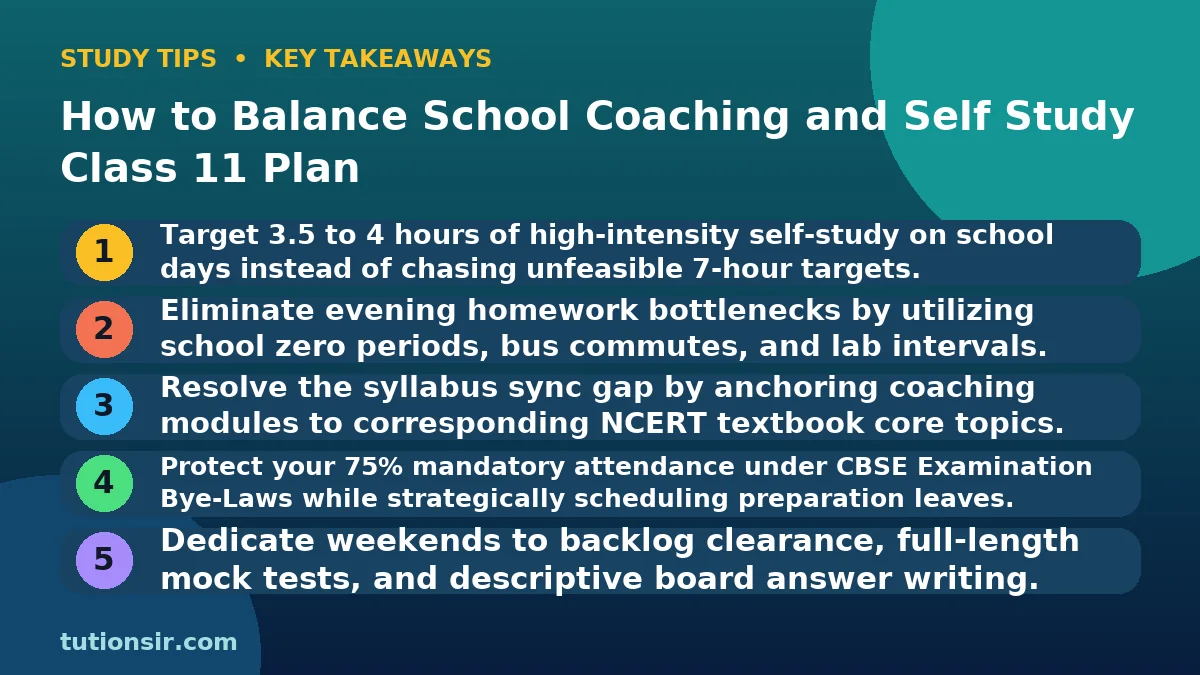
- Target 3.5 to 4 hours of high-intensity self-study on school days instead of chasing unfeasible 7-hour targets.
- Eliminate evening homework bottlenecks by utilizing school zero periods, bus commutes, and lab intervals.
- Resolve the syllabus sync gap by anchoring coaching modules to corresponding NCERT textbook core topics.
- Protect your 75% mandatory attendance under CBSE Examination Bye-Laws while strategically scheduling preparation leaves.
- Dedicate weekends to backlog clearance, full-length mock tests, and descriptive board answer writing.
Try Tution Sir free for your class and subject.
No card. Registering takes about two minutes.
The Class 11 Transition Shock: Why Traditional Timetables Fail
The leap from Class 10 to Class 11 represents one of the steepest academic gradients in the Indian education system. In Class 10, concise textbooks and predictable board patterns allowed students to score above ninety percent through two or three months of focused revision. Class 11 abruptly multiplies the syllabus volume fourfold. A single Physics chapter like Rotational Motion or a Chemistry unit like Chemical Bonding contains more conceptual depth and numerical variety than an entire term of secondary-grade science.
Most students react by creating rigid, idealized timetables: waking up at 5:00 AM, spending six hours at school, sitting through four hours of offline coaching, and attempting to force five hours of nocturnal self-study. Within three weeks, chronic sleep deprivation, cognitive fatigue, and mounting homework backlogs trigger severe burnout. The issue is rarely a lack of willpower; it is an unsustainable system that tracks hours spent sitting at a desk rather than biological energy levels and focus quality.
Recognizing that school and coaching are physical drains is the foundational step in learning how to balance school coaching and self study class 11. Success requires managing cognitive bandwidth across distinct daily phases: school hours, coaching instruction, transit buffer zones, and independent problem-solving sessions.
- Syllabus Expansion: Higher secondary subjects require mathematical rigor, multi-step derivation, and deep conceptual application.
- The Double-Pace Problem: Schools move quickly to wrap up mid-term portions, whereas competitive coaching institutes deconstruct microscopic details over several weeks.
- Physical Transit Drain: Commuting between regular school, home, and tuition centers robs students of 90 to 120 minutes of daily physical recovery.
- Passive Fatigue Trap: Spending eight hours listening to lectures creates the dangerous illusion of productivity while zero self-directed problem-solving has occurred.
How Many Hours of Self Study is Needed in Class 11?
A regular school-going Class 11 student requires 3.5 to 4 hours of focused daily self-study on weekdays, complemented by 7 to 8 hours on non-school days and weekends. Chasing six or seven hours of nightly self-study alongside six hours of formal schooling and three hours of coaching is mathematically unviable and medically hazardous.
Self-study hours must be categorized strictly as active independent work. Listening to coaching teachers, watching recorded online lectures, copying class notes, or casually flipping through NCERT textbooks do not count as self-study. Independent study begins when you pick up a pen and solve unassisted Daily Practice Problems (DPP), work through numerical exercises, write subjective derivations, or test yourself on active recall flashcards.
Dividing self-study time systematically prevents subject neglect. For a PCM student preparing for JEE Main, a 3.5-hour weekday study block should typically allocate 75 minutes to high-difficulty numerical practice in Physics or Mathematics, 75 minutes to Chemistry theory and reaction mechanisms, and 30 minutes to school homework or formula revision. Medical aspirants should rotate Physics problem-solving with targeted memorization of Botany and Zoology diagrams and NCERT line-by-line analyses.
- Weekday Target: 3.5 to 4 hours of uninterrupted, device-free active practice.
- Weekend Target: 7 to 8 hours broken into two 3-hour morning blocks and one 2-hour evening evaluation session.
- Core Rule: Maintain a 2:1 ratio between solving practice problems and reviewing theoretical notes.
- Revision Minimum: Reserve the final 20 minutes of every night strictly for reviewing formulas and short notes recorded earlier in the week.
Realistic Daily Timetable for Class 11 Science and Commerce Students
Balancing school and coaching demands an energy-aligned schedule that pairs demanding cognitive tasks with peak alertness windows, leaving low-energy intervals for repetitive administrative work. Below is a tested daily routine for a Class 11 student attending regular school and evening coaching batches.
Notice that this routine builds in buffer slots for travel decompression and guarantees a non-negotiable seven-hour sleep cycle, which neurological research confirms is vital for long-term memory consolidation and analytical retention.
Science Stream Daily Schedule (PCM / PCB with JEE or NEET Coaching)
06:00 AM – 06:45 AM: Wake up, light physical stretching, and rapid active recall (reviewing yesterday's formula sheets or Biology terminology). Avoid opening social media.
07:00 AM – 02:00 PM: School hours. Pay close attention during lab experiments and core science lectures. Convert zero periods, substitution periods, and lunch breaks into a board homework clearance zone.
02:00 PM – 03:30 PM: Return home, lunch, and a 30-minute restorative power nap or screen-free relaxation to reset cognitive fatigue.
03:30 PM – 04:00 PM: Travel to coaching center or set up for live online coaching.
04:00 PM – 07:30 PM: Coaching classes (Physics, Chemistry, Mathematics/Biology). Maintain neat running notes and star-mark questions that expose conceptual gaps.
07:30 PM – 08:15 PM: Commute home, light healthy snack, and evening walk to refresh the mind.
08:15 PM – 10:00 PM: Self-Study Block 1 (105 minutes). Peak focus slot: Tackle challenging Daily Practice Problems (DPP), coaching module exercises, or complex numericals in Physics/Maths.
10:00 PM – 10:30 PM: Dinner with family (no mobile phones or study materials at the dining table).
10:30 PM – 11:45 PM: Self-Study Block 2 (75 minutes). Medium focus slot: NCERT Chemistry reading, organic reaction mapping, or Biology line-by-line memorization.
11:45 PM – 12:00 AM: Day wrap-up: Organize desk, review tomorrow's school bag, and log completed tasks.
12:00 AM – 06:00 AM: Deep, uninterrupted sleep (minimum 6 to 7 hours).
Commerce Stream Daily Schedule (With CA Foundation / Applied Math Tuition)
Commerce students balancing Accountancy, Economics, Business Studies, and Applied Mathematics face heavy calculation workloads and extensive legal terminology. A balanced routine shifts analytical problem-solving to the fresh evening block.
06:30 AM – 07:15 AM: Formula revision for Applied Mathematics or memorization of Business Studies definitions and principles.
07:30 AM – 02:00 PM: Regular school. Utilize library periods to complete Accountancy ledger formatting and comprehensive project files.
02:30 PM – 04:00 PM: Lunch, transit, and downtime.
04:30 PM – 07:00 PM: Commerce coaching / Accountancy tuition / CA Foundation preparatory batches.
07:30 PM – 09:30 PM: Self-Study Block 1 (120 minutes): Rigorous Accountancy practical numericals, journal entries, and reconciliation problems.
09:30 PM – 10:15 PM: Dinner and family break.
10:15 PM – 11:30 PM: Self-Study Block 2 (75 minutes): Microeconomics graphs, market structures, and legal mercantile provisions for CA Foundation.
11:30 PM – 06:30 AM: Restful sleep.
| Time Block | School Day Routine (Mon–Fri) | Weekend / Holiday Routine (Sat–Sun) | Primary Academic Objective |
|---|---|---|---|
| 06:00 AM – 08:00 AM | Wake up, active recall, school prep | Self-Study Block 1 (High difficulty numericals) | Fresh cognitive window for complex problem-solving |
| 08:00 AM – 02:00 PM | Regular School (Complete board homework in dead time) | Self-Study Block 2 (Coaching modules & DPPs) | Fulfill 75% attendance rule / Intensive self-study |
| 02:00 PM – 04:00 PM | Lunch, transit, 30-min power nap | Lunch, light revision, mental downtime | Physical recovery and nervous system reset |
| 04:00 PM – 07:30 PM | Coaching classes (Theory & problem discussion) | Full-length mock exam / Backlog clearance sprint | Concept acquisition and timed exam simulation |
| 07:30 PM – 10:00 PM | Self-Study Block 1 (Coaching DPPs & numerical practice) | Mock test error analysis & weak spot review | Active output: solving unassisted problems |
| 10:00 PM – 11:45 PM | Self-Study Block 2 (NCERT theory, chemistry/bio reading) | Weekly planning, formula sheets, school prep | Subjective board prep and memory consolidation |
| 11:45 PM – 06:00 AM | Uninterrupted sleep (6.5 to 7 hours) | Uninterrupted sleep (7 to 8 hours) | Cognitive consolidation and physical rejuvenation |
How to Manage School Homework and Coaching Without Burning Out
The single biggest source of daily friction for Class 11 students is conflicting academic demands: school teachers demand lengthy practical record books and descriptive homework questions, while coaching faculties mandate the completion of fifty multiple-choice questions per chapter. When students attempt to complete both at night, self-study collapses completely.
The secret to managing school homework lies in reclaiming school 'dead time'. A standard school day contains between 45 and 90 minutes of unmonitored or low-engagement intervals: morning assembly buffers, zero periods, library sessions, sports periods where you are not actively playing, lab gaps while waiting for apparatus, and substitution periods when teachers are on leave.
Adopt the 'School Work Stays in School' principle. Carry your school notebooks, practical manuals, and assignment sheets to school daily. The moment a free interval opens up, work on completing repetitive written work, lab conclusions, or English literature essays. By treating school hours as the sole workshop for school assignments, your evening hours remain exclusively protected for competitive test preparation and coaching DPPs.
- Audit Free School Time: Keep a dedicated homework folder in your school bag at all times to capitalize on unexpected 20-minute teacher absences.
- Form a Cooperative Study Pod: Coordinate with trusted, disciplined classmates to divide practical write-ups and share verified experimental observations.
- Commute Optimization: Use bus or metro transit to read English chapters, review flashcards on your phone, or mentally test chemical formulas.
- De-escalate Perfectionism on Routine Tasks: For internal school assignments that do not impact final assessments, aim for accurate, neat completion rather than spending hours on decorative presentation.
Bridging the Sync Gap: When School and Coaching Teach Different Chapters
Class 11 students constantly confront the frustrating 'sync gap': your school may be conducting term exams on Thermodynamics and Gravitation, while your coaching institute is deep into Waves and Oscillations. Attempting to master both topics at the exact same depth during the same evening creates mental paralysis.
To reconcile this divergence, establish an explicit 70-30 split. Dedicate seventy percent of your weekday self-study time to your coaching institute's running curriculum. Coaching syllabus moves sequentially; falling behind by even two lectures makes subsequent advanced topics incomprehensible because competitive science and math concepts are deeply interdependent.
Reserve the remaining thirty percent of your study time for school syllabus alignment. Rather than re-reading the entire school chapter from scratch, anchor your school prep to the NCERT textbook. Solve the NCERT end-of-chapter exercises and read key theory boxes. NCERT questions cover board exam standards comprehensively. If you are enrolled in ISC or state boards like WBCHSE, dedicate two hours every Sunday to practicing descriptive board-pattern answers, derivations, and state board format questions.
- Priority Rule: Never abandon your running coaching lectures to cram for an ordinary weekly school unit test.
- NCERT as the Common Bridge: NCERT textbooks serve as the conceptual core for CBSE, NEET, and JEE Main. Mastering NCERT exercises satisfies both school testing and baseline competitive requirements.
- Weekend Board Sprints: Use Sunday mornings to write out five-mark descriptive derivations (such as Bernoulli's Theorem or Projectile Trajectory) that schools test heavily but coaching tests skip in favor of MCQs.
- State Board Adaptation: Students under WBCHSE or CISCE should practice board-specific question banks for 90 minutes weekly to ensure precise descriptive terminology is maintained.
Is 75% Attendance Mandatory in CBSE Class 11? Managing Board Rules vs Dummy Schools
A common dilemma for Class 11 students preparing for competitive exams like JEE and NEET is whether to switch to a 'dummy' or non-attending school. Before making this choice, students and parents must understand the legal and academic ground realities established by the Central Board of Secondary Education (CBSE).
Under Rules 13 and 14 of the CBSE Examination Bye-Laws, a minimum of 75% attendance is strictly mandatory for students to be eligible to appear in the Class 10 and Class 12 Board Examinations. CBSE circulars have repeatedly instructed affiliated schools to calculate attendance rigorously up to January 1 of the academic session. The Board has conducted surprise physical inspections across schools nationwide, de-affiliating institutions that facilitate non-attending dummy enrolments and barring ineligible candidates. Condonation up to 15% is granted only under strict, documented conditions like prolonged illness or authorized national sports participation.
Moreover, dummy schools carry severe psychological drawbacks: social isolation, lack of a daily operational routine, and unchecked procrastination. A regular school provides structured peer interaction, mandatory physical activity, and formal laboratory exposure essential for practical exams. The optimal strategy is to maintain clean attendance at a cooperative, standard regular school by tracking your working days mathematically: attending four out of five days every week keeps your attendance securely above 80%, leaving safe room for exam leaves.
- Understand the Math: In an average academic session of 220 working days, you must attend at least 165 days to meet the 75% threshold.
- Strategic Absences: Save your permissible 25% absences for pre-exam preparatory sprints, coaching revision camps in December, and recovery days before major national mock tests.
- Documentation Discipline: Always submit timely medical certificates and formal leave applications signed by parents for any genuine absence so your school record remains condonation-ready.
- Practical Examinations: Regular laboratory sessions in Physics, Chemistry, and Biology are compulsory; missing practicals directly jeopardizes internal assessment scores mandated by NEP guidelines.
How to Clear Class 11 Backlogs While Attending School and Coaching Daily
Almost every Class 11 student accumulates backlogs by October or November. Unsolved coaching sheets, skipped chapters, and missed concepts create intense anxiety. The most damaging mistake students make is halting their current classes to clear past chapters. This guarantees that your current topics will become next month's fresh backlogs.
To eliminate backlogs systematically, use the 'Parallel Micro-Dosing' strategy. Lock your current running topics into your primary weekday self-study block. Then, carve out exactly 45 minutes on weekday mornings or late evenings dedicated solely to your backlog list. On Sundays, dedicate a focused four-hour block to a single high-yield backlog chapter.
Prioritize backlogs by prerequisites rather than chronological order. For instance, in Class 11 Physics, you cannot afford a backlog in Vectors, Basic Calculus, or Newton’s Laws of Motion, because these are essential tools for every subsequent chapter. Conversely, an isolated topic like Properties of Solids can wait for winter break. For rapid concept recovery and targeted practice questions, platforms like Tution Sir provide immediate, board-aligned topic breakdowns and step-by-step problem sets that help you clear targeted doubts without losing travel time.
- The Iron Law: Never sacrifice running class syllabus for old backlog recovery.
- The High-Yield Hit List: Categorize backlogs into 'Foundational' (must clear immediately: Chemical Bonding, Functions, Mechanics) and 'Standalone' (can clear during term breaks: Environmental Chemistry, Statistics).
- One-Shot Video Caution: Avoid spending six hours watching marathon lecture videos passively. Instead, spend 45 minutes skimming NCERT or concise notes, then spend three hours solving basic level-1 questions.
- Micro-Milestones: Set a tangible goal of finishing 25 backlogged numerical problems per weekend rather than vaguely intending to 'revise Physics'.
Frequently asked questions
How many hours should a Class 11 student self-study daily?
A Class 11 student attending regular school and coaching should aim for 3.5 to 4 hours of focused, active self-study on weekdays. On weekends and school holidays, this should expand to 7 to 8 hours divided into structured morning and evening blocks dedicated to problem-solving and backlog clearance.
How do toppers manage both school and coaching in Class 11?
Toppers avoid duplicating effort. They finish school homework during zero periods, lab gaps, and bus rides. In the evening, they focus entirely on solving problems rather than passively re-reading notes. They also align school exams with competitive preparation by using NCERT as a unified foundation for both.
Is 75% attendance strictly mandatory in CBSE Class 11?
Yes. Under CBSE Examination Bye-Laws Rules 13 and 14, maintaining a minimum of 75% attendance is mandatory. CBSE circulars enforce strict tracking up to January 1, with surprise inspections penalizing non-attending dummy schools. Condonation up to 15% is granted only for documented medical emergencies or recognized sports participation.
How do I cover Class 11 backlogs while attending school and coaching daily?
Never stop your running coaching classes to study old chapters. Maintain your current syllabus during regular hours, and dedicate an extra 45 minutes on weekday mornings or late evenings exclusively to backlogs. Use a 4-hour window on Sundays to resolve foundational prerequisite chapters one by one.
Should I switch to a dummy school for JEE or NEET preparation in Class 11?
Enrolling in dummy schools carries heavy risks due to CBSE surprise inspections and deregistrations. Furthermore, dummy schooling often leads to social isolation and poor daily discipline. Attending a supportive regular school provides laboratory experience, keeps your routine grounded, and ensures compliance with board attendance mandates.
How to manage school homework without sacrificing coaching test preparation?
Enforce the rule of finishing school homework exclusively within school hours. Use substitution periods, library hours, and lunch breaks to finish written records and assignments. This keeps your home hours completely free for solving coaching modules, Daily Practice Problems (DPP), and competitive test series.
How do I divide daily self-study time between Physics, Chemistry, and Maths?
Do not study all three subjects superficially every night. Instead, rotate two core subjects per weekday: study Physics and Chemistry on Monday, Mathematics and Chemistry on Tuesday, and alternating thereafter. Spend 75 to 90 minutes on problem-solving per subject, and reserve 20 minutes for daily formula revision.
Can a student crack JEE or NEET in Class 11 without offline coaching?
Yes. Many students crack competitive exams using structured online resources, NCERT textbooks, and self-study test series. Online learning eliminates commuting exhaustion, granting two additional hours daily for problem practice. However, it demands strict self-discipline, consistent mock testing, and timely doubt clearance to prevent backlogs.
Sources and official links
- Central Board of Secondary Education - Examination Bye-Laws & Attendance SOP
- Council for the Indian School Certificate Examinations (CISCE)
- National Council of Educational Research and Training (NCERT)
Exam rules and notifications change. Confirm dates, fees and eligibility on the official website before acting. Spotted an error? Email support@tutionsir.com. See our editorial policy.
Keep learning
How to Balance School Tuition and Self Study: Class 9-12
Juggling seven hours of school, evening tuition classes, and towering piles of homework leaves many secondary
Read →Pomodoro Study Method for Students: Practical Daily Guide
Juggling daily school classes, private tuitions, heavy homework, and digital distractions leaves most students
Read →Madhyamik Study Timetable: 3-Month Class 10 Routine
As the November school test examinations conclude, Class 10 WBBSE candidates enter the decisive 90-day countdo
Read →Do not let another week go by without a plan
Reading about the exam does not raise marks. Practice does. Register free now and start with the one topic that worries you most. Small daily practice beats a last-minute rush.
- Free plan, no card needed
- Ask any doubt and get a step-by-step answer
- Practice questions with explanations
Free plan, no card needed. Your progress is saved to your account.