Study Habits & Productivity
Pomodoro Study Method for Students: Practical Daily Guide
Juggling daily school classes, private tuitions, heavy homework, and digital distractions leaves most students mentally drained before self-study even begins. A structured Pomodoro routine restores deep concentration and keeps study sessions productive without causing mental exhaustion.
Quick answer
The Pomodoro study method for students breaks revision into focused 25-minute study intervals separated by structured 5-minute offline rests. After completing four cycles, students take an extended 20-to-30-minute break. This rhythm curbs mental fatigue, prevents smartphone distraction, and enhances memory retention across theoretical and numerical school subjects.

Key takeaways
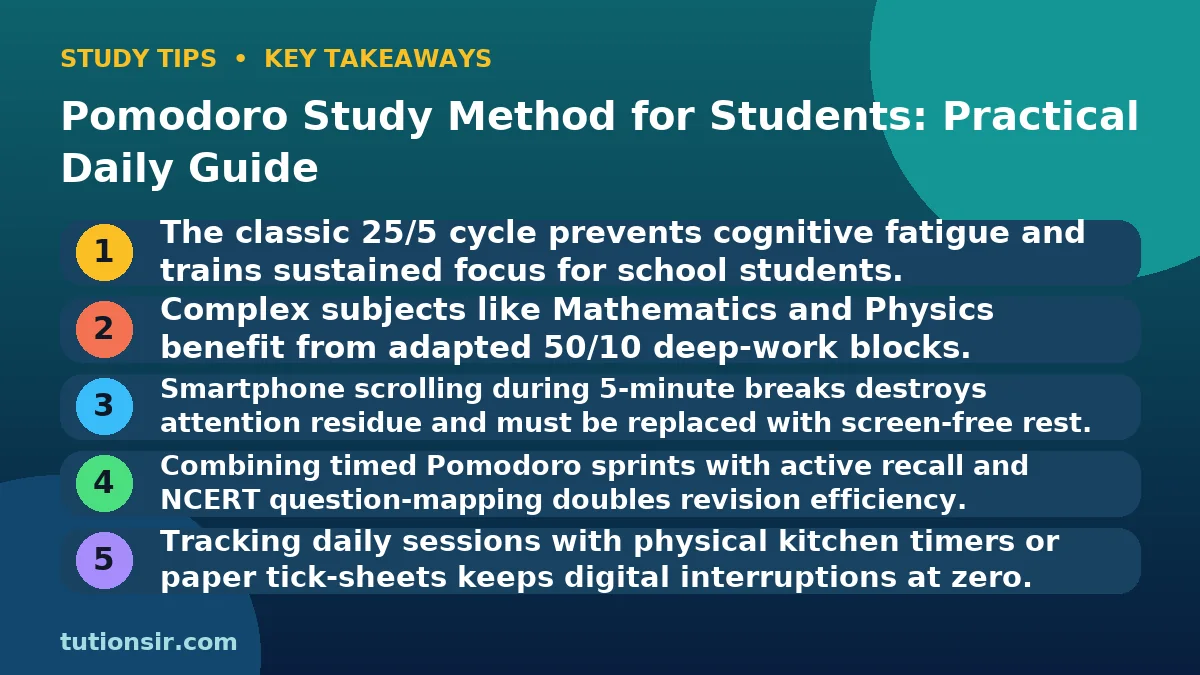
- The classic 25/5 cycle prevents cognitive fatigue and trains sustained focus for school students.
- Complex subjects like Mathematics and Physics benefit from adapted 50/10 deep-work blocks.
- Smartphone scrolling during 5-minute breaks destroys attention residue and must be replaced with screen-free rest.
- Combining timed Pomodoro sprints with active recall and NCERT question-mapping doubles revision efficiency.
- Tracking daily sessions with physical kitchen timers or paper tick-sheets keeps digital interruptions at zero.
Try Tution Sir free for your class and subject.
No card. Registering takes about two minutes.
What Is the Pomodoro Technique for Studying and How Does It Work?
The Pomodoro technique for studying is a structured time-management framework developed by university student Francesco Cirillo in the late 1980s. Cirillo used a tomato-shaped kitchen timer (from the Italian word 'pomodoro') to bind his academic focus to indivisible 25-minute intervals, each followed by a short recovery window. Rather than treating time as an open-ended enemy that slips away while you stare blankly at an open textbook, this methodology turns time into an ally by dividing syllabus targets into manageable mental sprints.
At its foundation, the system works through five core steps. First, you choose an unambiguous academic task, such as solving ten trigonometry problems or reading five pages of a history chapter. Second, you set a countdown timer for exactly 25 minutes. Third, you work exclusively on that single task until the bell rings, ignoring any internal urge to check notifications or tidy your desk. Fourth, when the timer rings, you immediately step away from the study desk for a 5-minute rest. Finally, after completing four consecutive work intervals—totalling 100 minutes of pure focus—you reward your mind with a longer break of 20 to 30 minutes.
Cognitive psychologists explain that human attention is governed by natural physiological patterns known as ultradian rhythms. During prolonged, unstructured study hours, your prefrontal cortex gradually loses the capacity to filter out irrelevant stimuli, leading to daydreaming and frequent smartphone checking. The 25 5 study rule aligns your revision with these natural attention thresholds. By reassuring your brain that a guaranteed rest is always less than half an hour away, the technique dramatically lowers the emotional friction of sitting down to revise daunting chapters.
- Decide on a single, well-defined syllabus task before starting the timer.
- Commit to zero multitasking: no secondary tabs, messaging apps, or background video streams.
- Treat each 25-minute interval as an indivisible unit of effort; if interrupted, reset the block.
- Enforce strict 5-minute pauses to let working memory consolidate learned concepts.
- Take an earned 20 to 30-minute restorative reset after every four completed intervals.
25/5 vs 50/10 Pomodoro Rule for Maths Practice and Complex Theory
While the classic 25/5 interval remains the gold standard for school children, it is not a rigid rule carved in stone. Academic subjects make fundamentally different cognitive demands on the brain. Reading an English literature prose piece or memorising botanical classifications for NCERT Biology requires quick bursts of active recall, for which a 25-minute sprint is ideal. However, attempting to solve multi-step calculus problems, physics derivations, or accountancy balance sheets in 25 minutes often interrupts deep analytical momentum just as you enter a state of flow.
For students in Classes 10, 11, and 12 under the Central Board of Secondary Education (CBSE), ICSE/ISC, or state boards like WBBSE and WBCHSE, switching between the 25/5 and 50/10 intervals based on the syllabus domain is essential. When practicing mathematics or physical sciences, complex problem solving requires sustained scratchpad work, conceptual bridging, and checking calculations. An abrupt bell at the 25-minute mark can fragment your problem-solving train of thought and create needless frustration.
The 50/10 model provides a prolonged 50-minute deep-work session followed by a restorative 10-minute pause. It mirrors the exact length of a standard school period or an intensive coaching lecture, making it an intuitive adjustment for older high school students. Conversely, use the lighter 25/5 rule for language grammar, vocabulary building, history timelines, formula flashcards, and rapid-fire multiple-choice question sets where mental stamina drops quickly after twenty minutes of pure rote recall.
When to Choose the 25/5 Interval
Use the standard 25/5 rule whenever your study goal involves factual memorisation, vocabulary lists, reading textbook theory, or reviewing short question banks. It works best for Class 6 to 9 students whose baseline sustained attention spans are still developing, as well as high schoolers tackling dense humanities and descriptive biology.
When to Upgrade to the 50/10 Deep-Work Block
Deploy the 50/10 rule for continuous computational work: quadratic equations, coordinate geometry, organic chemistry reaction mechanisms, electrostatics derivations, and long answer drafting for board examinations. Two 50-minute cycles deliver 100 minutes of uninterrupted analytical immersion without cognitive fragmentation.
Practical Pomodoro Study Routine for School Students Balancing Tuitions
A major reason Indian school students fail with generic study advice found online is that overseas schedules assume a relaxed 3:00 PM school finish followed by open evenings. In reality, a student preparing for board exams or competitive foundation tests often attends school until 3:30 PM, travels home, attends offline or online tuitions from 5:00 PM to 7:00 PM, and is left with only two to three usable hours for independent self-study. Trying to force eight or ten Pomodoros into such an evening guarantees burnout.
A realistic pomodoro study routine for school students prioritises consistency over sheer volume. On typical school weekdays, completing four to five high-intensity Pomodoro blocks (between 100 and 150 minutes of actual, distraction-free work) is vastly superior to spending four unfocused hours sitting with a phone beside an open notebook. By locking specific slots into an evening time-blocking calendar, you eliminate the daily fatigue of deciding what to study and when.
Consider this sustainable weekday self-study template designed for high school students returning from evening coaching classes. It respects dinner timing, protects adequate sleep, and provides sufficient room for both mandatory school homework and forward syllabus revision.
| Time Window | Study Block | Focus Subject & Academic Activity | Interval Protocol |
|---|---|---|---|
| 6:00 PM – 6:55 PM | Pomodoro 1 & 2 | NCERT Science / Social Science (Theory & Note Extraction) | Two 25/5 Classic Sprints (50 min study + 10 min break) |
| 7:05 PM – 8:00 PM | Pomodoro 3 | Mathematics / Physics Numerical Practice & Calculations | One 50/10 Deep-Work Sprint (50 min study + 10 min break) |
| 8:00 PM – 8:45 PM | Long Break | Family Dinner, Light Walk, and Screen-Free Decompression | 45-minute restorative meal & family conversation |
| 8:45 PM – 9:40 PM | Pomodoro 4 & 5 | School Homework, Language Revision, or Flashcard Self-Testing | Two 25/5 Sprints (50 min study + 5 min break) |
| 9:45 PM – 10:00 PM | Daily Review | Pack school bag, update Pomodoro tick-sheet, plan tomorrow | 15-minute organization and wind-down routine |
How to Effectively Use the Pomodoro Technique for Studying with Active Recall
The biggest pitfall of the Pomodoro method for students is mistaking mere attendance for actual learning. Sitting passively with a textbook highlighter for 25 minutes while your mind drifts to weekend plans will not produce academic marks. To turn timed intervals into outstanding grades, you must integrate evidence-based cognitive strategies: active recall and spaced repetition inside each Pomodoro block.
Begin every Pomodoro session by converting your textbook headings into test questions. For example, if you are studying NCERT Class 10 Science, turn 'Refraction through a Glass Prism' into the prompt: 'Can I sketch the ray diagram and label the angle of deviation from memory?' Spend the first 15 minutes reading the section with intense focus, and devote the remaining 10 minutes to the 'blurting' technique—closing the book entirely and scribbling down every formula, definition, and diagram you can remember on a blank rough sheet.
During subsequent Pomodoro intervals, compare your blurted notes against the textbook to identify factual gaps. This active retrieval forces your synaptic pathways to strengthen far more effectively than reading the same page four times over. Use your long 25-minute post-cycle breaks to file flashcards into review boxes for spaced repetition, ensuring that what you revise on Monday evening is systematically tested again on Thursday.
What Should Students Do During a 5-Minute Pomodoro Break?
What you do during your 5-minute break determines whether your next Pomodoro succeeds or collapses. The single most destructive mistake students make is unlocking their smartphone to check WhatsApp messages, Instagram Reels, or YouTube shorts. Digital media triggers rapid dopamine spikes and loads your working memory with unrelated social data—a cognitive phenomenon researchers call 'attention residue'. When your timer rings five minutes later, your brain is still processing what you saw on screen, destroying your ability to focus on chemistry or geography.
Your short break must be entirely analog and physically restorative. The goal is to give your optic nerves, neck muscles, and prefrontal cortex a complete break from near-distance processing and analytical thinking. Treat these five minutes as deliberate mental decompression so you return to the desk mentally recharged.
Adopt the ophthalmologist-endorsed 20-20-20 rule: look away from your books and screens at an object at least 20 feet away for 20 seconds to ease ciliary muscle tension in your eyes. Drink a full glass of water, walk around the room or balcony, do shoulder rolls to relieve cervical tension caused by leaning over notebooks, and practice slow diaphragmatic breathing. By keeping the break strictly offline, you protect your concentration reservoir throughout the entire evening.
- Leave your study chair immediately when the timer sounds to reset posture.
- Hydrate with plain water to combat dehydration-induced cognitive sluggishness.
- Practice eye relaxation by gazing out of an open window into the distance.
- Perform light physical stretching: neck rolls, hamstring stretches, and wrist flexes.
- Strict rule: Never unlock a mobile phone, tablet, or video game during short breaks.
How to Track Pomodoro Sessions Without Mobile Phone Distractions
While app stores host hundreds of beautifully designed Pomodoro apps, using a smartphone as a study timer is equivalent to placing a box of chocolates in front of someone trying to fast. Every time you touch your phone to check how many minutes remain, your lock screen displays app alerts, group chat badges, and news notifications that derail your self-control.
The best way to track Pomodoro sessions without distraction is to return to Francesco Cirillo’s original analog methodology. Purchase an inexpensive mechanical wind-up kitchen timer, a basic standalone digital countdown stop-clock, or an inexpensive digital wristwatch with a recurring countdown alarm. Placing a physical timer across the room produces two immediate benefits: it creates a tactile boundary that signals study time, and its ticking or visible countdown creates a gentle psychological urgency without exposing you to internet notifications.
Complement your physical timer with a paper-based 'Pomodoro Tally Sheet'. Draw a grid of small squares in your study diary. Every time you successfully complete a 25-minute sprint without breaking focus, draw an 'X' inside a square. If an unavoidable internal distraction pops into your head—such as remembering you need to submit an art project tomorrow—scribble it down on an adjacent 'distraction notepad' in three words, and immediately redirect your attention back to your textbook. When preparing for high-stakes board assessments, pairing this disciplined tally tracking with regular chapter-wise mock tests on educational platforms like Tution Sir gives students clear visibility over their real revision pace.
Why Do Students Fail to Stick to the Pomodoro Routine? Common Pitfalls
Many students adopt the Pomodoro technique with great enthusiasm on Sunday evening, only to abandon it completely by Wednesday night. Understanding why students fail helps you build preventative habits that ensure long-term consistency across the academic year.
The first major error is over-scheduling. Ambitious board candidates often draw up rigid timetables demanding eight to ten Pomodoro blocks immediately after six hours of school and two hours of tuition. When natural physical fatigue inevitably interferes, they fall behind, experience guilt, and abandon the method. Start modestly: commit to just three daily Pomodoros for your first week, and increase your quota only when you can hit that baseline comfortably five days in a row.
The second error is treating Pomodoro intervals as divisible. If a family member interrupts you ten minutes into a session, or if you answer a three-minute phone call, you cannot simply pause the timer and resume. A Pomodoro is an atomic unit of effort: if it is broken, that cycle is cancelled, and you must start fresh after a short breather. Upholding this strict rule conditions your subconscious mind to protect your study boundaries against casual domestic distractions.
Frequently asked questions
How does the Pomodoro technique work for school students?
School students pick a single syllabus topic, set a countdown timer for 25 minutes, and work with undivided focus until it rings. They take a strictly offline 5-minute break to rest their eyes and mind. Repeating this sequence four times completes one full set, earning a rewarding 20 to 30-minute rest.
Is a 25-minute Pomodoro session enough for complex subjects like Maths or Physics?
For multi-step numericals, geometry constructions, and complex derivations in Mathematics and Physics, 25 minutes can sometimes cut off analytical flow. Students in Classes 9 to 12 should adapt the framework to a 50/10 schedule: 50 minutes of continuous problem-solving followed by a 10-minute restorative break.
What should students do during a 5-minute Pomodoro break?
Students should stand up from their desk, hydrate with water, stretch their shoulders and neck, and look at distant greenery through an open window using the 20-20-20 rule. They must avoid smartphones, social media, and gaming, as digital inputs create attention residue that sabotages subsequent focus.
How many Pomodoros should a school student complete in a day?
On regular school days with evening tuitions, 4 to 6 focused 25-minute Pomodoros (around two to two-and-a-half hours of pure self-study) are ideal. On weekends or study holidays during board exam preparation, students can comfortably scale up to 8 to 10 Pomodoros divided into morning and evening clusters.
Can the Pomodoro method be used for board exam revision?
Yes. It is exceptionally effective for board exam revision when combined with active recall. Students can dedicate one Pomodoro to chapter mapping and formula memorisation, a second to solving previous years' question papers, and a third to checking errors and writing summary flashcards.
What is the difference between the 25/5 rule and the 50/10 rule?
The 25/5 rule prescribes 25 minutes of study followed by a 5-minute break, making it ideal for theory, languages, and younger students. The 50/10 rule doubles both periods, providing 50 minutes of deep, uninterrupted focus and a 10-minute rest for intensive numerical problem-solving.
Why do students fail to stick to the Pomodoro study routine?
Students usually fail because they set unrealistic targets (aiming for 10 sessions on busy school days), check social media during breaks, or pause the timer when interrupted instead of treating each interval as an unbroken, sacred unit of academic work.
What is the best way to track Pomodoro sessions without getting distracted by a phone?
Use a standalone mechanical kitchen timer, an inexpensive digital stop-clock, or a simple wristwatch. Keep your mobile phone in another room or on airplane mode, and log completed sessions manually with a pen on a paper tally tracker.
Sources and official links
- Francesco Cirillo Official - The Pomodoro Technique
- American Psychological Association - Multitasking and Concentration
- National Center for Biotechnology Information - Ultradian Rhythms and Cognitive Performance
Exam rules and notifications change. Confirm dates, fees and eligibility on the official website before acting. Spotted an error? Email support@tutionsir.com. See our editorial policy.
Keep learning
How to Make an Error Notebook for Exams: 3-Column Method
Solving test papers without analyzing your blunders guarantees you will repeat them in the final exam. The 3-c
Read →Feynman Technique for School Students: 4 Steps to Learn
Struggling to memorize dense Science and Social Science chapters before board exams? The Feynman Technique tra
Read →What to Do When Your Mind Goes Blank During an Exam: 5 Steps
You turn the page, read the first question, and your brain suddenly feels like a wiped hard drive. Before pani
Read →Do not let another week go by without a plan
Reading about the exam does not raise marks. Practice does. Register free now and start with the one topic that worries you most. Small daily practice beats a last-minute rush.
- Free plan, no card needed
- Ask any doubt and get a step-by-step answer
- Practice questions with explanations
Free plan, no card needed. Your progress is saved to your account.