Study Strategy • Academic Guides
How to Make Short Notes from NCERT: Class 9 to 12
NCERT textbooks pack immense academic depth into every paragraph, tempting students to transcribe entire pages into bulky notebooks. Creating true short notes requires systematic information extraction, preserving board-mandated keywords while compressing lengthy chapters into rapid-revision frameworks.
Quick answer
To make short notes from NCERT, read the chapter once without writing, highlight core concepts on a second pass, and extract only essential keywords, formulas, and diagrams on the third pass. Use a two-column format, strictly cap notes at one to two pages per chapter, and test recall with closed books.

Key takeaways
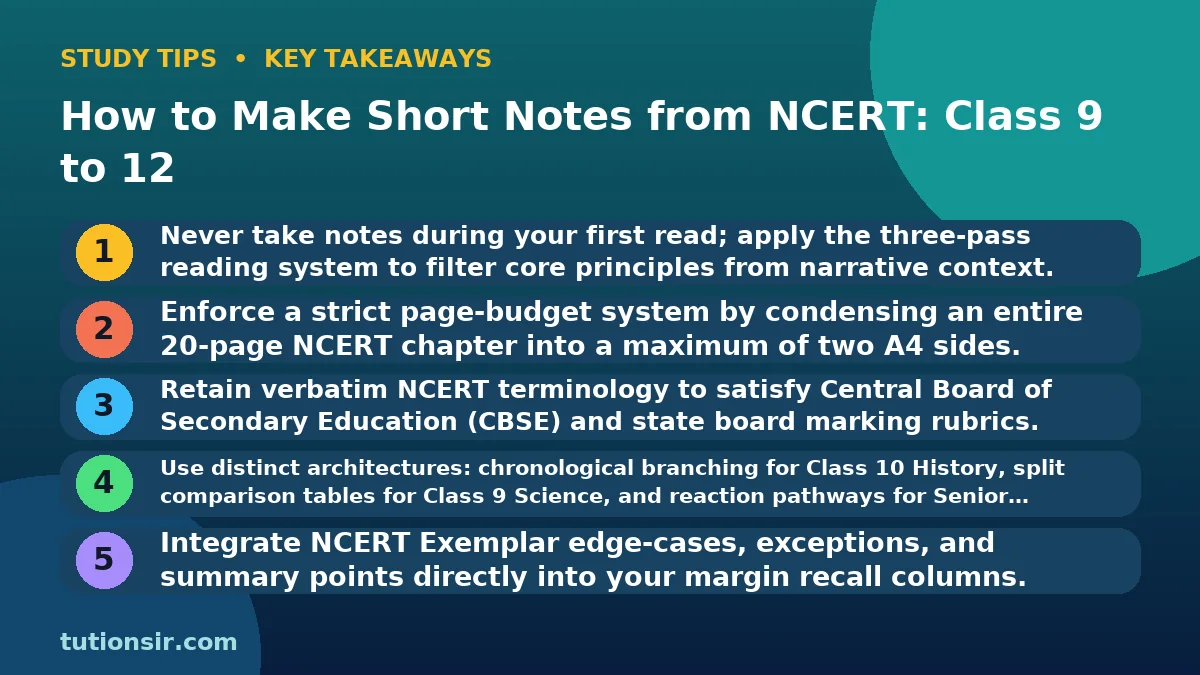
- Never take notes during your first read; apply the three-pass reading system to filter core principles from narrative context.
- Enforce a strict page-budget system by condensing an entire 20-page NCERT chapter into a maximum of two A4 sides.
- Retain verbatim NCERT terminology to satisfy Central Board of Secondary Education (CBSE) and state board marking rubrics.
- Use distinct architectures: chronological branching for Class 10 History, split comparison tables for Class 9 Science, and reaction pathways for Senior Secondary Chemistry.
- Integrate NCERT Exemplar edge-cases, exceptions, and summary points directly into your margin recall columns.
Try Tution Sir free for your class and subject.
No card. Registering takes about two minutes.
Should I make notes during my first reading of an NCERT chapter?
You must never write notes during your first reading of an NCERT textbook because unfamiliarity makes every single sentence appear equally critical. When students encounter a fresh chapter—whether in Class 9 Science or Class 12 Biology—their working memory is occupied with understanding basic terminology. Jotting down notes at this initial stage inevitably degenerates into passive mechanical copying, resulting in a handwritten duplicate of the published book that wastes hours without aiding comprehension.
A rigorous NCERT note making strategy relies on the multi-pass rule. National Council of Educational Research and Training (NCERT) volumes are edited by academic panels to deliver dense, concise explanations. A preliminary read should feel like reading a narrative: glide through headings, illustrations, captions, and the 'Points to Ponder' or end-of-chapter summaries without holding a pen. This builds a mental blueprint of the chapter's conceptual architecture and narrative flow.
During the second read, shift to active interrogation. Grasp the logical links between sub-topics, circle unfamiliar technical terms, and solve basic in-text questions. Only during the third pass should you begin the extraction phase. Because you now clearly distinguish foundational context from high-yield principles, your notes will capture only the distilled essence needed for rapid pre-exam retrieval.
- First Pass (The Bird's-Eye Scan): Read the chapter continuously from start to finish at a moderate pace to understand scope, structure, and chapter objectives.
- Second Pass (Analytical Understanding): Scrutinise diagrams, clarify ambiguous definitions, connect examples to theories, and lightly pencil-mark crucial junctures.
- Third Pass (Selective Extraction): Close the book periodically to test your recall, translating the verified core points into your dedicated revision binder.
Step by step guide to make short notes from ncert textbooks
To make crisp revision notes without copying whole paragraphs, adopt a systematic information extraction framework built on active recall. Traditional outlining fails because it invites passive transcription of linear prose. By converting text into structured data cards, comparison grids, and flowcharts, you force your brain to process information before laying ink to paper.
The most effective structure for secondary and senior secondary students is an adapted Cornell Note-Taking System. Divide an unruled A4 sheet into three distinct zones: a narrow 2.5-inch left margin (the Cue and Question Column), a broad 5.5-inch right section (the Core Synthesis Area), and a 2-inch bottom horizontal block (the Chapter Anchor Summary).
Maintain a strict 'page-budget' system to preserve brevity. Standardise on condensing a 15-to-20-page NCERT chapter into no more than two sides of an A4 page. Imposing a spatial limit forces ruthless prioritisation, preventing descriptive fluff and ensuring your sheets remain an ultra-fast revision tool during high-stakes board and competitive exam weeks.
- Step 1: The Topic Demarcation: Divide your A4 page into standard zones. Write the chapter name, weightage, and core themes across the top margin.
- Step 2: The High-Yield Filter: Read a subsection, close the book, identify the core mechanism, law, or condition, and draft it in five to eight bullet fragments.
- Step 3: Cue Generation: In the left margin, convert every note fragment into an active query (e.g., 'Factors altering equilibrium position?') rather than a passive title.
- Step 4: Formula and Exception Isolation: Draw dedicated callout boxes for mathematical expressions, SI units, and chemical exceptions flagged in the NCERT text.
- Step 5: Bottom Synthesis: Write a two-sentence takeaway in the bottom anchor space explaining the real-world significance or recurring exam focus of the topic.
Subject-specific blueprints: How to make notes from NCERT for Class 9 to 12
Note-taking techniques cannot be one-size-fits-all because subjects organise knowledge in fundamentally different ways. Class 9 and 10 students handle integrated science and social sciences, while Class 11 and 12 learners manage specialized streams involving rigorous physical derivations, reaction mechanisms, and extensive taxonomic classifications.
Applying a single narrative style across these varied domains creates disorganized, bloated sheets that fail to highlight subject-specific exam patterns. Tailor your structural approach directly to the nature of the syllabus.
Class 9 and 10 Science: Definition-Condition-Application Triads
For foundational topics like Laws of Motion, Tissues, or Metals and Non-Metals, build notes around a triad: the NCERT definition, the operating conditions or mathematical constraints, and the real-world application. Class 9 foundational mechanics require isolating variables and SI units. Class 10 Chemistry requires balancing equations with accompanying state symbols ((s), (l), (g), (aq)) and recording color transformations explicitly mentioned in experimental activity boxes.
Social Science and History Class 10 Short Notes: Chronological Branching
History chapters such as 'The Rise of Nationalism in Europe' or 'Nationalism in India' frequently overwhelm students with dense historical paragraphs. Never copy the narrative history. Instead, construct horizontal chronological timelines marked with pivotal treaties, dates, leader profiles, and civic consequences. For Geography and Economics, use paired comparison tables (such as Khadar vs. Bangar soils, or formal vs. informal credit sectors) matching the exact evaluation criteria used in board exam marking schemes.
Senior Secondary Chemistry and Physics: Reaction Webs and Master Formula Sheets
When tackling Class 11 and 12 Chemistry, convert descriptive organic chapters into branched reaction pathways. Center a target functional group (e.g., Alkyl Halides) on the page and project arrows radiating outwards detailing electrophilic and nucleophilic substitutions, reagents, catalyst parameters, and named reactions (e.g., Wurtz, Finkelstein, Swarts). For Physics, separate conceptual laws from mathematical equations. Document derivations solely by their primary starting postulates, diagrammatic geometry, and final expressions, leaving basic algebraic rearranging to mental recall.
NCERT Short Notes for NEET Biology: Comparative Matrices and Morphological Grids
Biology in Classes 11 and 12 contains dense data points across taxonomy, structural morphology, and human physiology. Build comparative matrices that pit plant and animal phyla against clear diagnostic features (symmetry, coelom, germ layers, excretory organs). Extract numerical ranges (e.g., erythrocyte lifespans, nephron populations) into a single margin column for flash revision.
| Subject & Class Level | High-Yield NCERT Focus Areas | Optimal Layout Architecture | Target Compression Ratio |
|---|---|---|---|
| Class 9-10 Science | Activity boxes, balanced equations, color changes, SI units, basic ray diagrams | Three-part grids: Law/Definition, Chemical Equation/Formula, Visual Change | 15-18 pages down to 2 A4 pages |
| Class 9-10 Social Science | Dates, treaties, peasant movements, soil classifications, economic parameters | Horizontal milestone timelines, cause-and-effect flowcharts, feature comparison tables | 20-25 pages down to 2-3 A4 pages |
| Class 11-12 Physics | Core derivations, fundamental postulates, vector equations, dimensional formulas, graph trends | Formula sheets with boundary conditions, schematic circuit diagrams, derivation checkpoints | 30 pages down to 2-3 A4 pages |
| Class 11-12 Chemistry | Named reactions, oxidation numbers, reagents, mechanism intermediates, periodic anomalies | Radial reaction trees for Organic; comparative trend columns with anomaly callouts for Inorganic | 25 pages down to 2 A4 pages |
| Class 11-12 Biology | Diagnostic phylum traits, enzyme cascades, anatomical labels, numerical parameters | Comparative taxonomy matrices, cyclical physiological loops, two-column recall cards | 20-24 pages down to 1.5-2 A4 pages |
How do toppers make short notes from NCERT for board exams and NEET?
Top-performing students build their notes to mirror board exam marking schemes and competitive examination patterns rather than writing personal summaries. The Central Board of Secondary Education (CBSE) and state boards like WBBSE and WBCHSE mandate mark distribution based on precise technical keywords. If an examiner seeks the term 'photolysis of water' or 'semi-conservative replication,' substituting loose explanations often leads to lost marks.
High-achieving candidates annotate their short notes with insights extracted from NCERT Exemplar problems and previous years' question papers. When an Exemplar question tests an edge case—such as anomalous behavior in periodic trends or exceptions to Mendel's laws—they write this detail directly alongside the main topic in red or green ink.
Furthermore, top students transcribe simplified, unlabelled schematic sketches of complex NCERT diagrams. For school boards, clean, labeled line diagrams (such as the human nephron, blastocyst formation, or electric motor setups) carry independent marks. Memorising simplified schematic skeletons ensures you can reproduce accurate figures quickly during examinations.
How to compress NCERT chapters into one page short notes: Worked example
To understand how radical compression works in practice, consider Class 10 Science, Chapter 1: 'Chemical Reactions and Equations.' In the original textbook, this fundamental chapter spans roughly sixteen pages packed with narrative setups, laboratory activity descriptions, and sample discussions.
A focused one-page summary does not reproduce the step-by-step descriptions of magnesium ribbons burning or lead nitrate heating. Instead, it extracts the underlying chemical taxonomy, visual flags, and reaction parameters into a tight visual dashboard.
- Header Band: Chapter 01: Chemical Reactions | Weightage: ~5-7 Marks | Central Theme: Law of Conservation of Mass.
- Block 1: Reaction Typology Grid: Five two-row columns detailing Combination, Decomposition (Thermal, Electrolytic, Photolytic), Displacement, Double Displacement (Precipitation), and Redox (Oxidising vs Reducing agents). Each entry contains only the general formula and one balanced landmark equation.
- Block 2: Observation & Color Change Matrix: Tabulate distinct indicators: FeSO4·7H2O (Green crystals -> Reddish-brown Fe2O3 + choking SO2/SO3 gases); Pb(NO3)2 (White powder -> Yellow PbO + Brown NO2 fumes); Cu + O2 (Reddish-brown -> Black CuO layer).
- Block 3: Corrosion & Rancidity Box: Definitions stripped to bare keywords: Oxidation of metals by moisture/acid vs oxidation of fats/oils causing altered taste/odor. Prevention points: Galvanisation, electroplating, nitrogen flushing, BHA/BHT antioxidants.
- Margin Prompts: 'Why is respiration exothermic?', 'Identify oxidant in CuO + H2 -> Cu + H2O', 'Conditions for silver chloride turning grey?'
Common note-making mistakes that waste students' study hours
The most pervasive mistake among secondary and senior secondary students is transforming note-taking into decorative artwork. Spending hours switching between multiple pastel highlighters, drawing elaborate borders, and drafting artistic calligraphy provides a false sense of productivity while delivering almost zero cognitive retention. Notes are revision utilities, not creative displays.
Another critical error is recording universally understood facts. If you already intuitively know that plants require sunlight for photosynthesis or that speed equals distance divided by time, writing it down merely consumes precious page space. High-yield short notes should capture what you tend to forget: edge-case exceptions, confusing units, counter-intuitive trends, and precise technical definitions.
Finally, many students produce their notes once and file them away without review. A note system delivers value only when integrated with active recall and spaced repetition. If a summary sheet sits unopened for two months following its creation, your memory of the underlying material decays significantly.
- Over-Highlighting: Coating whole textbook pages in neon ink without condensing the ideas into your own words.
- Verbatim Paraphrasing: Rearranging sentence syntax slightly while keeping the overall length and descriptive fluff intact.
- Neglecting Margin Space: Filling paper sheets entirely from edge to edge, leaving no room to incorporate later test corrections or teacher insights.
- Ignoring NCERT Footnotes & Summary Points: Bypassing the summary section at the end of each chapter, which frequently hides concise board-ready definitions.
Managing physical binders, digital apps, and a weekly spaced repetition schedule
Whether you use physical paper or digital tools, organise your materials consistently. For physical writing, use loose-leaf A4 sheets kept in a dedicated ring binder divided by subject, rather than bound notebooks. Loose-leaf binders let you insert fresh single-page updates, syllabus revisions, or test mistakes into the relevant chapter sequence without tearing pages or disrupting order.
Digital note-taking on tablets provides flexibility, effortless reorganization, and searchable hand-drawn reaction charts. However, digital note-takers must resist the temptation to copy and paste textbook PDF screenshots into their documents. Digitally cutting and pasting graphics bypasses the active neural encoding that occurs when you hand-draw a diagram or hand-write a formula.
Combine your notes with a structured spaced repetition timeline. Review a newly created chapter sheet 24 hours after drafting it, again on day 7, and once more on day 30. During each revision session, conceal the right-hand synthesis column and use the left-hand margin cues to test your memory aloud. For students seeking systematic validation of their conceptual retention across diverse board curricula, platforms like Tution Sir offer structured question sets aligned with official textbook concepts to verify active recall.
Frequently asked questions
How do I make short notes from NCERT without rewriting the textbook?
To avoid rewriting the textbook, enforce the multi-pass rule: never write while reading a chapter for the first time. On your final pass, close the book and write down only definitions, equations, and exceptions from memory. Then, verify against the textbook, recording only the specific keywords you missed.
Is it better to highlight NCERT directly or create separate short notes?
Highlighting directly in the textbook helps during initial and secondary reads, but it cannot replace separate short notes. Separate handwritten sheets force active cognitive synthesis, allow cross-topic comparisons, and enable rapid pre-exam review in minutes without leafing through hundreds of printed textbook pages.
How many pages should short notes be per NCERT chapter?
A standard NCERT chapter of 15 to 25 pages should ideally be condensed into one to two double-sided A4 sheets (two to four total sides). Dense senior secondary chapters, such as Class 12 Electrochemistry or Genetics, should never exceed three A4 sheets under this page-budget system.
Should NCERT short notes be handwritten or digital?
Handwritten notes are generally superior for board exams because physical writing builds muscle memory and improves long-term recall under timed, paper-based testing conditions. Digital notes on tablets work well if you handwrite with a stylus, but you must avoid passively copy-pasting textbook text or screenshots.
What is the best note-making method for Class 10 History NCERT chapters?
The best framework for Class 10 History is chronological branching combined with cause-and-effect flowcharts. Organize chapters by distinct historical phases, tabulate events beside their calendar dates, record participating leaders and social groups, and summarize the political fallout in bullet fragments rather than long descriptive paragraphs.
How do I include NCERT diagrams, formulas, and exceptions in short notes?
Dedicate distinct visual zones on your page for these elements. Use framed boxes for formulas with SI units, draw simplified single-line labeled skeletons for complex biology and physics diagrams, and highlight chemistry and biological exceptions in a contrasting ink color directly adjacent to the relevant general rule.
How often should I revise my NCERT short notes?
Revise your short notes using a spaced repetition cycle: review your sheets within 24 hours of writing, re-test yourself after seven days, and conduct a rapid run-through every three to four weeks. During revisions, test recall by covering the explanations and answering your margin cue questions.
Sources and official links
- National Council of Educational Research and Training (NCERT)
- Central Board of Secondary Education (CBSE) Academic Unit
Exam rules and notifications change. Confirm dates, fees and eligibility on the official website before acting. Spotted an error? Email support@tutionsir.com. See our editorial policy.
Keep learning
How to Make an Error Notebook for Exams: 3-Column Method
Solving test papers without analyzing your blunders guarantees you will repeat them in the final exam. The 3-c
Read →How to Write Long Answers in Social Science Class 10 (2026)
Many Class 10 students know their history dates and economic terms thoroughly yet drop precious marks on 5-mar
Read →How to Solve Case Based Questions in CBSE Class 10
CBSE has raised competency-focused questions to 50 percent of the Class 10 board examination, turning Section
Read →NCERT chapter-wise study help
Free practice and study help
Read →Do not let another week go by without a plan
Reading about the exam does not raise marks. Practice does. Register free now and start with the one topic that worries you most. Small daily practice beats a last-minute rush.
- Free plan, no card needed
- Ask any doubt and get a step-by-step answer
- Practice questions with explanations
Free plan, no card needed. Your progress is saved to your account.