CBSE Class 10 • Exam Strategy
How to Solve Case Based Questions in CBSE Class 10
CBSE has raised competency-focused questions to 50 percent of the Class 10 board examination, turning Section E case studies into major score-deciding components. Master this five-step strategy to decode lengthy narrative stems, filter background noise, and secure all 12 marks across subjects.
Quick answer
To solve case based questions in CBSE Class 10, read the sub-questions first before reading the narrative passage. Next, filter background story text, extract numerical data or scientific observations, and map them to standard NCERT concepts. Finally, answer sub-parts systematically, showing formulas, units, and clear justifications for full step marks.

Key takeaways
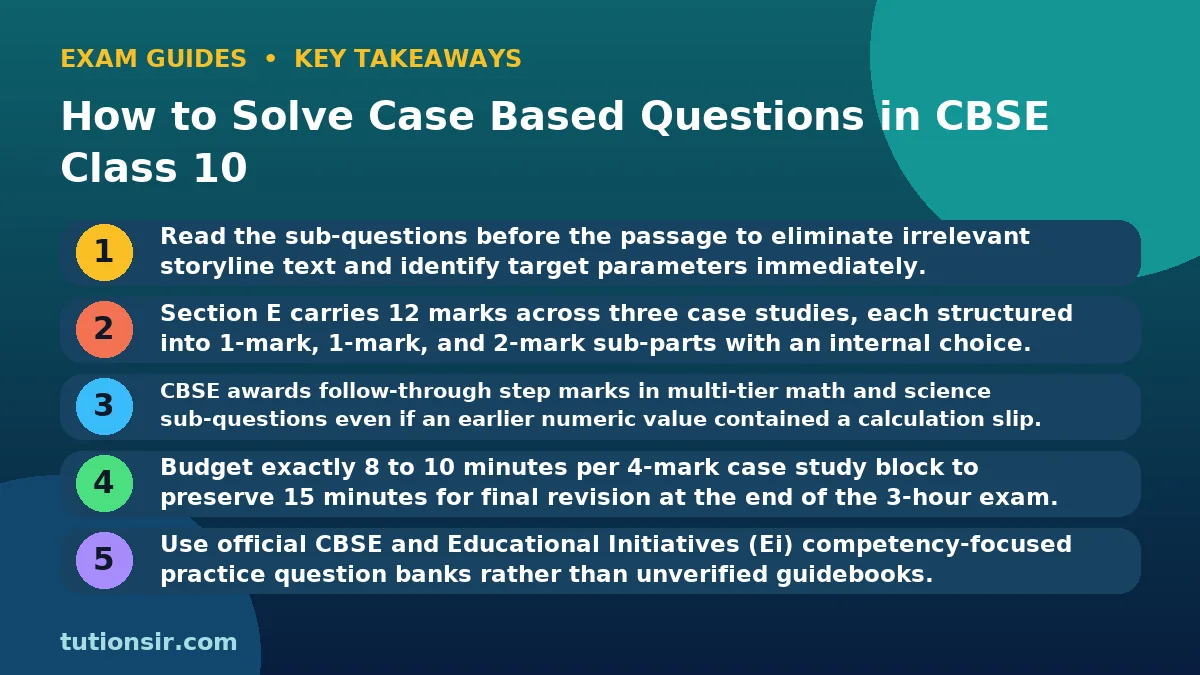
- Read the sub-questions before the passage to eliminate irrelevant storyline text and identify target parameters immediately.
- Section E carries 12 marks across three case studies, each structured into 1-mark, 1-mark, and 2-mark sub-parts with an internal choice.
- CBSE awards follow-through step marks in multi-tier math and science sub-questions even if an earlier numeric value contained a calculation slip.
- Budget exactly 8 to 10 minutes per 4-mark case study block to preserve 15 minutes for final revision at the end of the 3-hour exam.
- Use official CBSE and Educational Initiatives (Ei) competency-focused practice question banks rather than unverified guidebooks.
Try Tution Sir free for your class and subject.
No card. Registering takes about two minutes.
What are case-based questions in CBSE board exams?
Case-based questions in CBSE board exams are contextual assessment items designed to test higher-order thinking skills, application, and conceptual synthesis rather than rote memorization. In line with the National Education Policy (NEP 2020) and assessment benchmarks formulated by PARAKH, the Central Board of Secondary Education (CBSE) mandates that 50 percent of the total question paper weightage consists of competency-focused items. These items appear prominently as structured case studies, source-based extracts, and data-interpretation units.
A standard CBSE Class 10 case study provides a stimulus—which can be a real-world scenario, an experimental setup, a diagnostic data table, a schematic diagram, or an excerpt from a historical or economic report. Following the stimulus, students encounter three distinct sub-questions that test whether they can transfer textbook concepts to unfamiliar situations. These units are not meant to test general knowledge; every single question connects directly to standard NCERT learning outcomes.
- Primary location: Section E in Mathematics (Standard and Basic) and integrated units across Science and Social Science papers.
- Total weightage in Section E: Three case studies carrying 4 marks each, totaling 12 marks out of the 80-mark theory paper.
- Sub-question design: Sub-part (i) carries 1 mark, sub-part (ii) carries 1 mark, and sub-part (iii) carries 2 marks.
- Internal choice: CBSE rules mandate that an internal choice ('OR' option) must be provided in the 2-mark sub-part of every case study.
The 5-step method to solve CBSE case based questions
Navigating a lengthy passage without a systematic approach leads to cognitive overload and wasted exam minutes. Examiners intentionally embed descriptive narrative details to create an authentic context, but this extra context often distracts students from the mathematical equations or scientific principles at stake. By following this five-step sequence, you turn long prompts into predictable problem-solving templates.
This methodology trains your brain to treat the narrative stimulus as a database where you only retrieve the exact values or conditions needed to solve each numbered sub-part.
Step 1: Execute the reverse-reading technique
Never start by reading the narrative passage from beginning to end. Instead, begin by jumping straight to sub-questions (i), (ii), and (iii). Reading the sub-questions first activates your targeted recall and primes your mind with the exact parameters you need to locate.
For instance, if sub-question (i) asks for the common difference of an arithmetic progression or the type of chemical reaction taking place, you know precisely what variables or color changes to scan for when you return to the text. This single habit prevents re-reading the passage three or four times.
Step 2: Filter background noise and extract active data
Case study stems often begin with introductory storytelling: a farmer planting trees in a orchard, an engineer inspecting a parabolic suspension bridge, or an industrialist monitoring an electrolytic tank. Most of this background story is inert context.
Take your pencil and underline only 'active data'—numerical values, coordinate positions, angles of elevation, chemical formulas, temperature conditions, or statistical frequencies. Strike a mental line through descriptive fluff like names, company titles, or historical dates that are unrelated to the core question.
Step 3: Map real-world data to the underlying NCERT topic
Every CBSE case study is an NCERT problem in disguise. Once you have isolated the active data, identify the specific chapter and theorem being tested. If a story discusses consecutive rows of seats in an auditorium where each row has two more seats than the preceding one, immediately write down 'Chapter 5: Arithmetic Progressions' in your rough margin.
Identify the standard algebraic symbols: let the first row be a, the common difference be d = 2, and the total seats be Sn. Translating the real-world story into canonical mathematical or scientific notation demystifies the problem.
Step 4: Tackle sub-parts sequentially and show complete steps
Begin solving the sub-questions in chronological order. Sub-part (i) is usually direct recall or a single-step calculation designed to award a quick confidence-building mark. Sub-part (ii) often requires a minor extension of the first answer.
When approaching sub-part (iii), which carries 2 marks, write down the applicable formula, the substitution of values, intermediate algebraic simplifications, and the final evaluated answer. Never write down an isolated numeric answer without accompanying work, as CBSE marking schemes award partial credit for formulas and process steps.
Step 5: Scrutinize the internal choice and add units
In sub-part (iii), take 30 seconds to evaluate both options provided across the 'OR' divider. Choose the question that involves cleaner numerical computation, fewer fraction operations, or a concept you can defend with a textbook definition. Avoid switching between options midway.
Before closing the case study, double-check that every numerical quantity carries its appropriate SI or customary unit (such as cm², m/s, ohms, or Joules). Missing units are among the most frequent reasons students drop half a mark on an otherwise correct solution.
Subject-wise case study answering tricks: Maths, Science, and SST
While the 4-mark structural architecture remains uniform across subjects, the cognitive skills required to solve case studies differ significantly between Mathematics, Science, and Social Science. Applying a uniform approach across all three subjects is a common mistake that costs valuable marks.
Here is how you must tailor your answering approach depending on whether the stimulus is numerical, experimental, or source-textual.
Case study questions class 10 maths: Eliminating narrative decoys
In Mathematics (Standard and Basic), the most frequent chapters selected for Section E are Arithmetic Progressions, Some Applications of Trigonometry (Heights and Distances), Coordinate Geometry, Quadratic Equations, and Surface Areas and Volumes.
Worked Example: A narrative stem describes a radio transmission tower standing vertically on a hill, with two observation posts, A and B, situated on ground level at distances from the base, recording angles of elevation of 30° and 60°.
Trick: Draw your own simplified geometric right-triangle sketch in the answer booklet right away. Discard the narrative about radio waves or city architecture. Label the right angles, assign h for the tower height, identify the adjacent side lengths, and formulate your tan(theta) equations. Solving the geometric diagram takes less than three minutes once you discard the prose.
Case based questions class 10 science: Decoding experimental setups
In Science, case-based questions rarely ask for simple definitions. Instead, they present laboratory experiments, ray diagrams, chemical titration tables, or pedigree charts. Chapters like Chemical Reactions and Equations, Acids, Bases and Salts, Light (Reflection and Refraction), Electricity, and Heredity are prime candidates.
Worked Example: A student adds dilute hydrochloric acid to an unknown solid 'X' taken in a test tube. A colorless, odorless gas 'Y' evolves, which turns lime water milky. Sub-question (i) asks to identify X and Y. Sub-question (ii) asks for the balanced chemical equation. Sub-question (iii) asks what happens if excess gas Y is passed through the solution.
Trick: Science case studies require strict keyword compliance. Always write balanced molecular equations including physical states ((s), (aq), (g)). Identify the salt 'X' as Calcium Carbonate (CaCO3) and gas 'Y' as Carbon Dioxide (CO2). For the 2-mark sub-part, highlight the formation of soluble Calcium Hydrogen Carbonate (Ca(HCO3)2) to explain why the milkiness disappears. Examiners look for exact chemical names and formulas.
How to decode SST case based questions class 10: Sourcing direct evidence
Social Science (History, Geography, Political Science, Economics) presents source-based textual extracts directly adapted from speeches, colonial administrative records, newspaper editorials, or statistical survey reports.
Unlike Maths or Science, where the passage merely sets up the problem, Social Science extracts frequently contain direct answers within the text. However, 2-mark sub-questions often require you to connect the source extract to a broader textbook concept—such as Non-Cooperation movement phases, resource conservation policies, federal power-sharing mechanisms, or formal credit barriers.
Trick: For 1-mark sub-parts, quote or rephrase the factual evidence provided in the passage. For the 2-mark sub-part, synthesize: quote one sentence from the extract, and then corroborate it with two relevant conceptual points from the NCERT syllabus.
| Subject | Typical Case Stimulus | NCERT High-Yield Chapters | Sub-Part Structure | Evaluation Focus |
|---|---|---|---|---|
| Mathematics (Standard & Basic) | Real-life architectural scenarios, coordinate grids, commercial charts, parabolic arcs | Arithmetic Progressions, Applications of Trigonometry, Coordinate Geometry, Surface Areas & Volumes | (i) 1 Mark (ii) 1 Mark (iii) 2 Marks (with internal OR choice) | Formulas, step-by-step arithmetic simplification, correct final units |
| Science (PCB Disciplines) | Experimental lab diagrams, chemical titration data, circuit schematics, ecological webs | Chemical Reactions & Equations, Acids & Bases, Light, Electricity, Heredity | (i) 1 Mark (ii) 1 Mark (iii) 2 Marks (with internal OR choice) | Balanced chemical equations, scientific keywords, physical states, law citations |
| Social Science | Historical speeches, colonial reports, newspaper extracts, demographic/census tables | Nationalism in India, Manufacturing Industries, Federalism, Money and Credit | (i) 1 Mark (ii) 1 Mark (iii) 2 Marks (with internal OR choice) | Direct extraction of factual evidence combined with conceptual textbook synthesis |
How CBSE step-marking works for 4-mark case studies
A widespread misconception among board candidates is that getting the wrong numerical answer in sub-part (i) guarantees a zero across all following sub-parts. According to official CBSE evaluation criteria, this is not true. CBSE examiners utilize clear, step-wise marking schemes designed to reward correct methodology, intermediate formulations, and mathematical logic.
Understanding how an examiner grades the 1 + 1 + 2 mark matrix allows you to salvage high scores even when facing an unfamiliar or computationally challenging scenario.
- Grading 1-mark sub-parts: These items are strictly evaluated based on the final expression, value, or identified keyword. Half-mark deductions are typically not applied here; the candidate receives either 1 full mark for the correct answer or 0.
- Grading 2-mark sub-parts: The 2-mark question is split into half-mark increments: 0.5 mark for writing the standard formula or principle, 0.5 mark for correct substitution of extracted values, 0.5 mark for simplification steps, and 0.5 mark for the final result with appropriate units.
- Error Carried Forward (Follow-Through Rule): If you commit an arithmetic error in sub-part (i) and calculate a = 5 instead of a = 4, but subsequently use your value of a = 5 correctly inside the formula required for sub-part (iii), examiners are instructed to award full method and process marks for sub-part (iii). Never abandon later sub-parts just because you are unsure about an earlier answer.
- Internal choice parity: Both options under the 'OR' choice in sub-part (iii) carry identical marking weightage. You are never penalized for choosing the shorter question over the longer descriptive one, provided your steps are mathematically sound.
Common mistakes students make in Class 10 case study questions
Even academically prepared students frequently drop between 4 to 8 marks across Section E due to predictable tactical errors. Reviewing these recurring mistakes helps you avoid them during high-pressure board sittings.
Awareness of these pitfalls allows you to maintain clean presentation and rigorous focus throughout your paper.
- Reading the entire narrative stem passively: Spending 5 to 7 minutes slowly absorbing introductory story text before even looking at the questions, which drains time needed for Section D long-answer problems.
- Over-answering 1-mark sub-parts: Writing an entire descriptive paragraph for a 1-mark question that only requires a single formula, name, or numerical value. Keep 1-mark responses under one or two crisp lines.
- Ignoring the 'OR' option: Forgetting that an internal choice exists in sub-part (iii) and attempting the first prompt blindly, even when the alternative question is far simpler to compute.
- Omitting physical units: Presenting answers as bare numbers (e.g., 'Area = 450') without appending square meters (m²) or centimeters (cm), resulting in automatic 0.5-mark deductions under CBSE evaluation guidelines.
- Attempting both options of an internal choice: Writing solutions for both 'OR' choices in hopes that the examiner picks the higher mark. Examiners evaluate only the first attempted solution and cross out the second, wasting valuable time.
- Mixing section answers: For Science and Social Science, writing Section E case answers in designated disciplinary spaces intended for other subjects. CBSE circulars strictly warn that responses entered in incorrect sections may not be evaluated.
Time-budgeting blueprint: Allocating minutes during the 3-hour exam
The standard CBSE Class 10 theory paper carries 80 marks and lasts exactly 180 minutes. A disciplined time management plan prevents last-minute panics and ensures all three case studies receive thorough analysis.
Section E contains 3 case-based questions carrying a collective 12 marks. You must allocate a strict ceiling of 8 to 10 minutes per case study, capping the entire section at 25 to 30 minutes total.
- Reading Time (First 15 Minutes): Use this pre-exam reading period to glance through Section E. Identify the underlying NCERT chapters for all three cases and mentally select which 'OR' option you will attempt in sub-part (iii).
- Minute 0 to 45 (Section A - MCQs & Assertion-Reason): Complete the 20 one-mark objective questions efficiently (roughly 2 minutes per question).
- Minute 45 to 80 (Section B & Section C): Complete the Very Short Answer (2 marks) and Short Answer (3 marks) questions.
- Minute 80 to 135 (Section D - Long Answers): Dedicate 55 minutes to the demanding 5-mark long-form questions, ensuring full proofs, geometric constructions, and derivations are neatly presented.
- Minute 135 to 165 (Section E - Case Studies): Spend exactly 10 minutes on Case 1, 10 minutes on Case 2, and 10 minutes on Case 3.
- Minute 165 to 180 (Final Revision): Reserve the final 15 minutes to verify units, recalculate basic additions and subtractions, verify question numbering, and confirm that all sub-parts ((i), (ii), (iii)) are clearly labeled.
Official practice resources and self-assessment checklist
To score full marks on case-based units, practicing with authentic, board-aligned question stems is critical. Avoid third-party question banks that feature arbitrary college-level passages or non-standard question designs. CBSE, in collaboration with Educational Initiatives (Ei) and PARAKH, publishes dedicated Competency-Focused Practice Questions (CFPQ) booklets for Class 10 Mathematics, Science, and Social Science.
You can download these free question banks directly from the official CBSE Academic portal (cbseacademic.nic.in). Solve at least 15 to 20 case studies per subject under timed conditions to develop instinctive pattern recognition. For students seeking interactive, instant-feedback practice, digital learning platforms like Tution Sir provide structured competency-based modules aligned with the latest CBSE board exam frameworks.
Before your pre-board and final board examinations, review your case study preparation against the following operational checklist.
- Have I completed all case study problems from the official CBSE Sample Question Papers (SQP) and Additional Practice Questions (APQ)?
- Do I consistently read sub-questions prior to reading the case stem?
- Am I writing standard algebraic or scientific formulas explicitly before substituting values?
- Do I always write appropriate physical and mathematical units beside final numerical solutions?
- Have I timed my case study solving speed to remain strictly under 10 minutes per 4-mark question?
Frequently asked questions
How do you solve case-based questions in CBSE Class 10?
Read the sub-questions first before reading the case stem to identify the required values or concepts. Next, skim the narrative passage to extract active numerical data or scientific facts while ignoring irrelevant descriptive prose. Finally, map the scenario to standard NCERT formulas or concepts and present step-by-step solutions with appropriate units.
How many marks are case study questions in CBSE Class 10 Maths?
Case study questions in CBSE Class 10 Mathematics carry a total of 12 marks. Located in Section E of the paper, there are 3 distinct case study questions carrying 4 marks each. Each question is split into sub-parts worth 1 mark, 1 mark, and 2 marks, with an internal choice in the 2-mark part.
Should I read the case passage first or the sub-questions first?
Always read the sub-questions first. Scanning the sub-questions takes only 30 seconds and reveals exactly what data points, definitions, or equations are being tested. When you subsequently read the narrative passage, you can immediately locate and highlight the relevant figures, saving two to four minutes per question.
Are CBSE case-based questions direct from the NCERT textbook?
The contextual stories or real-world backgrounds in case studies are usually new and unfamiliar, but the underlying core concepts, formulas, and principles come strictly from the prescribed NCERT textbooks. If you understand standard NCERT derivations and exemplar problems, you can solve any case study scenario with ease.
How to avoid losing marks in Class 10 Science case-based questions?
To avoid losing marks in Science case studies, write precise scientific keywords and balanced chemical equations complete with state symbols. In numerical physics cases, write the governing formula, substitute values with correct sign conventions, and ensure the final answer includes the correct SI unit, such as Joules, Ohms, or Watts.
Is there internal choice in CBSE Class 10 case study questions?
Yes, CBSE provides internal choice within the case study questions. While there is no overall choice across the three case studies in Section E, an internal 'OR' choice is mandatory in every 2-mark sub-question, giving students two problem options to choose from within that specific sub-part.
What is the difference between case study questions and competency-based questions?
Competency-based questions are an umbrella category established under NEP 2020 that includes assertion-reason items, application-oriented MCQs, and analytical questions. Case study questions are a specific subset of competency questions structured around a multi-tier narrative, experimental, or data-driven stem carrying 4 marks.
Sources and official links
- Central Board of Secondary Education - Academic
- CBSE Question Bank and Assessment Resources
- National Education Policy 2020 - Ministry of Education
Exam rules and notifications change. Confirm dates, fees and eligibility on the official website before acting. Spotted an error? Email support@tutionsir.com. See our editorial policy.
Keep learning
How to Solve Assertion Reason Questions: CBSE Class 10
Assertion-reason questions in CBSE Class 10 Science can make or break your perfect score in Section A. Masteri
Read →How to Solve Unseen Passage in English Class 10: 5 Steps
Scoring 20 out of 20 in the reading section is entirely possible when you stop reading passages like storybook
Read →How to Make Short Notes from NCERT: Class 9 to 12
NCERT textbooks pack immense academic depth into every paragraph, tempting students to transcribe entire pages
Read →Do not let another week go by without a plan
Reading about the exam does not raise marks. Practice does. Register free now and start with the one topic that worries you most. Small daily practice beats a last-minute rush.
- Free plan, no card needed
- Ask any doubt and get a step-by-step answer
- Practice questions with explanations
Free plan, no card needed. Your progress is saved to your account.