Study Strategies · Mock Analysis
How to Make an Error Notebook for Exams: 3-Column Method
Solving test papers without analyzing your blunders guarantees you will repeat them in the final exam. The 3-column error notebook turns every missed mark, silly slip, and misread question into an active revision blueprint that systematically elevates your scores.
Quick answer
To make an error notebook for exams using the 3-column method, divide a fresh page into three sections: Problem Trigger and Source, Root-Cause Diagnosis, and Prevention Rule with Core Concept. Log only recurring slips or conceptual gaps, review them on a spaced schedule, and graduate entries after two consecutive clean re-solves.

Key takeaways
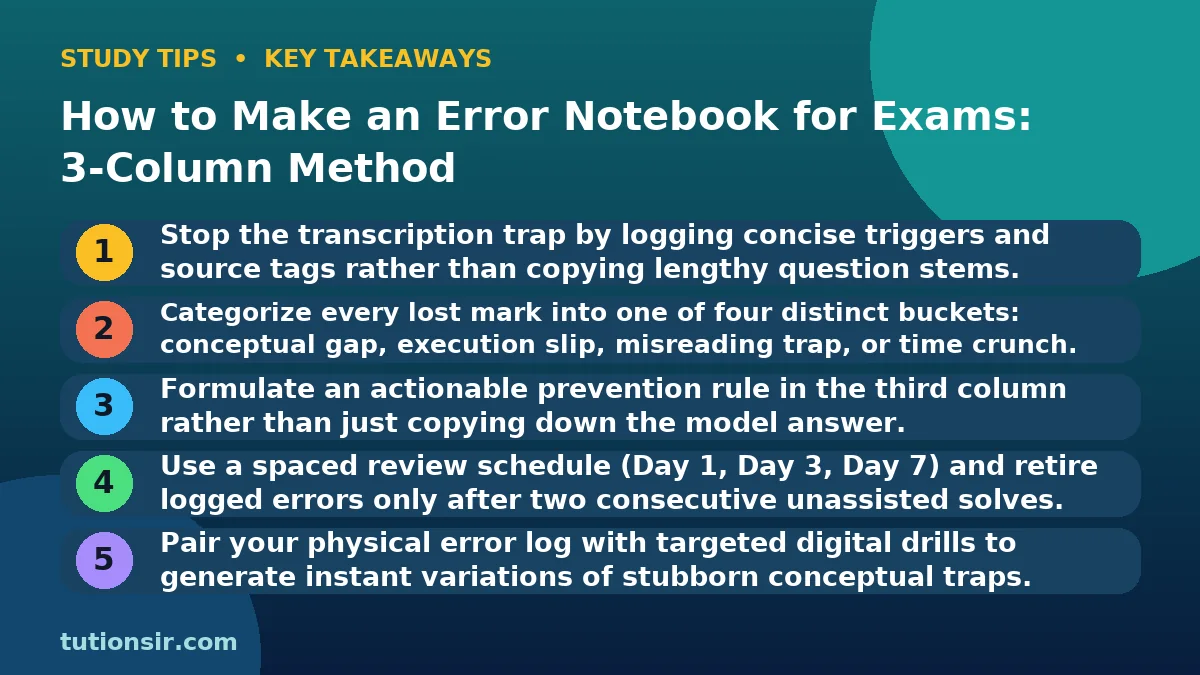
- Stop the transcription trap by logging concise triggers and source tags rather than copying lengthy question stems.
- Categorize every lost mark into one of four distinct buckets: conceptual gap, execution slip, misreading trap, or time crunch.
- Formulate an actionable prevention rule in the third column rather than just copying down the model answer.
- Use a spaced review schedule (Day 1, Day 3, Day 7) and retire logged errors only after two consecutive unassisted solves.
- Pair your physical error log with targeted digital drills to generate instant variations of stubborn conceptual traps.
Get a free study plan and practice questions for your class.
No card. Registering takes about two minutes.
Why Re-Solving Whole Papers Yields Diminishing Returns
Most secondary students preparing for school terminals, pre-boards, or national entrance exams fall into a predictable volume trap. They finish a three-hour mock test, tally their raw marks, feel a brief pang of disappointment over a few careless deductions, and immediately pick up the next mock paper. Educational psychology research on retrieval practice shows that re-taking tests without targeted diagnosis produces plateauing test scores. Working through 500 fresh questions while preserving unexamined blind spots merely reinforces your default habits, including your flawed thinking patterns.
Your errors are the single most valuable dataset you generate throughout your academic year. A student scoring 72 out of 100 does not need to re-read all 15 chapters of their textbook. They need an forensic breakdown of the specific 28 marks they forfeited. When you treat all errors as homogeneous bad luck or brush them aside with phrases like 'I knew that, it was just a silly slip,' you surrender the opportunity to build cognitive guardrails.
A dedicated mistake log transforms your passive regrets into metacognitive insight. By externalizing the moment your reasoning went off course, you remove emotional frustration from the equation. Instead of viewing mock tests as an assessment of innate intelligence, you begin treating every practice test as an diagnostic scan designed to expose hidden vulnerabilities before the official board or entrance hall invigilators hand you the final question paper.
What Is the 3-Column Method for an Error Notebook?
The 3-column method for an error notebook is a streamlined review framework that splits your journal page into three vertical zones: Problem Trigger & Source, Root-Cause Diagnosis, and Prevention Rule & Core Concept. Unlike standard class notebooks that focus on summarizing information, this layout isolates why an error happened and what concrete behavioral habit will prevent it in future tests.
Traditional notebook formats collapse because students exhaust themselves copying out five-line word problems, chemical equations, and exhaustive step-by-step textbook solutions. This is known as the 'transcription trap.' It consumes two hours of tedious handwriting without requiring any active recall. The 3-column layout prevents burnout by enforcing brevity. You record only the minimum trigger needed to identify the trap, define the exact cognitive failure, and state the corrective rule in your own voice.
- Column 1 (Left 25%): The Problem Trigger & Reference. Include the source code (e.g., 'Pre-Board 1, Q14' or 'NEET 2023 PYQ, Chem'), the central formula or diagram snippet, and the specific constraint you overlooked.
- Column 2 (Middle 35%): The Root-Cause Diagnosis. Write down your incorrect thought step. Did you rush arithmetic? Did you confuse concave mirror conventions with convex lenses? Did you misread a double-negative in the question stem?
- Column 3 (Right 40%): The Prevention Rule & Concept Anchor. State the proactive mental checklist, physical test habit, or foundational NCERT fact that guarantees you never fall into the same trap again.
Setting Up Your Notebook: Sectioning and Spreads
Use a durable A4-size spiral notebook or an unruled journal rather than loose sheets that can be easily misplaced. Divide the notebook into clear subject blocks using adhesive index tabs. For board exams, allocate distinct sections for Physics, Chemistry, Mathematics, and Biology (or Social Sciences and Languages). For competitive tests like JEE, NEET, or state teacher eligibility tests (CTET and WB TET), divide sections by subject domain and core pedagogical themes.
Always draw the three columns across a two-page spread if you solve complex multi-step numericals. This gives you ample horizontal breathing room to sketch circuit diagrams, balance ionic equations, or write side-by-side comparative steps without cramping your handwriting.
How Do You Categorize Mistakes in an Error Analysis Book?
To diagnose errors accurately, you must classify each lost mark into one of four unambiguous categories rather than writing vague tags like 'careless mistake.' A precise taxonomy enables you to spot recurring patterns across successive mock papers.
Every incorrect response on an exam paper stems from one of four psychological or academic mechanisms. Identifying which mechanism failed is half the battle toward eliminating it.
- Category A: Conceptual Gaps (The 'I Didn't Know' Error). You encountered an unfamiliar reaction mechanism, misapplied Faraday's Law, or forgot the conditions under which Rolle's Theorem applies. This requires targeted re-reading of your primary syllabus textbook or NCERT theory.
- Category B: Execution & Calculation Slips (The 'Rough Sheet Chaos' Error). You understood the underlying theory and selected the correct formula, but dropped a negative sign during cross-multiplication, added fractions incorrectly, or made an arithmetic error while rushing under the clock.
- Category C: Semantic & Reading Traps (The 'Question Blindness' Error). The question asked for 'incorrect statement,' 'rate of decay,' or 'radius instead of diameter,' but your eyes skimmed past the qualifiers. You solved for what you assumed the question asked rather than what was printed.
- Category D: Strategy & Time Traps (The 'Ego Fight' Error). You spent nine minutes wrestling with a 2-mark trigonometry identity or an intricate seating arrangement puzzle, inducing intense time anxiety that degraded your accuracy across the remaining ten straightforward questions.
| Feature | Traditional Mistake Copy | 3-Column Metacognitive Method |
|---|---|---|
| Setup Time | 1.5 to 2.5 hours per test (copying full stems) | 20 to 35 minutes per test (concise triggers only) |
| Primary Content | Question statement and model answer | Cognitive root cause and personal prevention rule |
| Error Categorization | Rarely categorized; mixed haphazardly | Classified into Concept, Slip, Misread, or Time trap |
| Revision Mechanism | Passive re-reading of long textbook-style solutions | Active cover-and-solve recall with spaced repetition |
| Long-Term Maintenance | Becomes bloated (200-400 pages) and abandoned | Lean entries with graduation criteria after 2 clean solves |
| Impact on Marks | Marginal boost; repeats identical calculation slips | Directly curtails negative marking and recurring slips |
Subject-Wise Worked Examples for Board and Competitive Exams
Implementing the 3-column system requires seeing how genuine exam mistakes translate into concise, actionable notebook entries across different academic curricula.
The entries below illustrate how students sitting for CBSE, ICSE, ISC, WBBSE, WBCHSE, NEET UG, JEE Main, or CTET can log subject-specific blunders without copying complete questions.
Class 10 & 12 Physics: Optics and Sign Convention (CBSE / ICSE / WBCHSE)
Column 1 (Trigger): CBSE Sample Paper 2026, Q21 (Ray Optics). Concave mirror, real inverted image at twice focal distance. Focal length f = 15 cm.
Column 2 (Diagnosis): Category B (Sign slip). Wrote mirror formula 1/f = 1/v + 1/u correctly, but plugged in f = +15 cm instead of f = -15 cm. Confused convex lens focal sign with concave mirror.
Column 3 (Prevention Rule): 'Cartesian Rule of Thumb: Concave is ALWAYS negative (both mirror and lens focal lengths). Before writing any numerical line, draw a tiny 2-second axis sketch at the margin and list signs explicitly: u = -, f = -, v = ?'.
Chemistry: NCERT Exception Traps (NEET / JEE Main)
Column 1 (Trigger): Periodic Properties Mock Test, Q42. Trend of Electron Gain Enthalpy for Group 17 (Halogens).
Column 2 (Diagnosis): Category A (Conceptual memory gap). Selected Fluorine > Chlorine > Bromine based on general electronegativity trends. Overlooked inter-electronic repulsions in the compact 2p subshell of Fluorine.
Column 3 (Prevention Rule): 'NCERT Exception Reminder: Cl > F > Br > I for electron gain enthalpy (-349 kJ/mol vs -328 kJ/mol). High electron density in Fluorine's small 2p orbital creates strong repulsion for the incoming electron. Create an active flash-tag for Group 16/17 size-anomalies.'
Secondary Mathematics: Quadratic Equations & Mensuration (Class 10)
Column 1 (Trigger): Pre-Board Mock 2, Section C, Q28. Cylinder melted into spheres. Asked for: Number of spheres and surface area comparison.
Column 2 (Diagnosis): Category C (Misreading). Equated volumes accurately and found n = 12, but forgot to calculate the second sub-question asking for the ratio of total surface areas. Lost 2 out of 4 marks.
Column 3 (Prevention Rule): 'Pen-Underline Protocol: During the 15-minute question reading period, place an underline under multi-part stems: (1) Find number, (2) Find surface area ratio. Never draw a terminal box around your final answer until checking that every underlined item has been answered.'
Teaching Eligibility & Pedagogy: Distractor Traps (CTET / WB TET)
Column 1 (Trigger): CTET Paper 1 CDP, Mock Set 4, Q19. Constructivist classroom environment assessment.
Column 2 (Diagnosis): Category C (Negative stem trap). Picked option 2 ('Encouraging peer dialogue') because it sounded pedagogically progressive. Missed the word 'EXCEPT' embedded in the third line of the question stem.
Column 3 (Prevention Rule): 'Reverse-Inversion Scan: Whenever words like EXCEPT, NOT, LEAST, or FALSE appear, circle them in your question booklet immediately. Re-frame the question mentally: Which of these four options is bad/unsuitable teaching practice?'
How Often Should You Revise Your Error Notebook Before Exams?
A mistake notebook is completely useless if it functions as a one-way archival dump. The true cognitive value emerges from spaced retrieval practice—re-testing your brain against old failure points at calibrated time intervals to consolidate neural pathways.
Establish an unshakeable review cadence following the 1-3-7 Spaced Revision rule. Review newly logged errors 24 hours after your mock test (Day 1). Re-solve the trigger questions with the solution column covered on Day 3. Re-attempt them a third time on Day 7.
Crucially, schedule a dedicated 'Pre-Mock Warm-up' session. Thirty minutes before sitting for your next full-length mock exam, do not read textbook chapters. Instead, read through the third column (Prevention Rules) of your error notebook. Priming your working memory with your specific error tendencies significantly reduces silly slips during the opening minutes of an exam paper.
The Graduation Criteria: Preventing Notebook Bloat
If you record every error without ever retiring entries, your error notebook will swell to an unmanageable 300 pages by January or February, inducing cognitive overwhelm. You must enforce a strict graduation protocol to maintain a lean, high-impact review file.
When you re-attempt a logged problem during your weekly review cycle and solve it cleanly without hesitation, mark a small pencil tick beside Column 1. When that problem achieves two consecutive ticks across separate review sessions spaced at least one week apart, draw a clean horizontal strike through the entry. That error has successfully 'graduated' from your active vulnerability list to your permanent knowledge base.
Digital Mistake Notebook vs Physical Error Copy: Which Is Better?
Students frequently ask whether they should log errors in physical notebooks or maintain digital logs using tools like Notion, OneNote, or tablet apps. While digital tools make it effortless to paste screenshots and tag questions, they come with significant hidden drawbacks for school and competitive exam aspirants.
Physical handwriting stimulates deeper motor-cognitive memory encoding. More importantly, nearly all major school board exams (CBSE, ICSE, ISC, WBBSE, WBCHSE) as well as offline pen-and-paper entrance examinations (such as NEET UG and offline state TET tests) require physical paper-and-pen endurance. Writing out your correction rules builds the exact physical rhythm and spatial rough-sheet discipline you need on exam day.
However, digital tools excel in searching, tagging, and archiving. If you are preparing for computer-based tests like JEE Main or want quick cloud access, consider a hybrid workflow. Maintain a physical spiral notebook for your daily rough work and core 3-column logging, but take quick photo snapshots of complex graphic problems to avoid manual tracing. Never let the aesthetic pursuit of perfect digital notes substitute for the cognitive work of solving problems unassisted.
Step-by-Step Implementation Plan and Mock Test Checklist
For students who need immediate practice variations after logging an error, leveraging modern AI study assistants can dramatically accelerate concept mastery. Platforms like Tution Sir (tutionsir.com) provide interactive problem variants and step-by-step guidance tailored to Indian board and competitive syllabi, helping you instantly re-test the exact conceptual weak point identified in your third column.
- Step 1: Cool-down Buffer (30-60 mins). Never analyze a mock test while mentally exhausted or emotionally upset. Take a short walk, drink water, and clear your head before evaluating your scorecard.
- Step 2: Raw Accounting. Group all incorrect and unattempted questions together. Calculate your net mark loss and identify which section accounted for the majority of the leak.
- Step 3: The 3-Column Filtering. Filter out one-off bizarre questions that sit far beyond syllabus boundaries. Focus 90% of your entries on standard syllabus questions where your execution failed.
- Step 4: Draft Concise Prevention Rules. Write Column 3 in assertive, second-person imperative language (e.g., 'Check units of mass before substituting into E = mc^2').
- Step 5: Variant Practice. Simply reading the correct solution is insufficient. You must solve at least one variant problem testing the identical concept under untimed conditions.
- Step 6: Pre-Exam Flash Re-read. Keep your graduated and active logs organized by subject so you can review your complete personal trap sheet in under 45 minutes on the eve of the final exam.
Frequently asked questions
What is the 3-column method for an error notebook?
The 3-column method divides your review notebook page into three functional sections: Problem Trigger and Source (Left), Root-Cause Diagnosis (Middle), and Prevention Rule with Core Concept (Right). It focuses on why you committed a mistake and what behavioral habit avoids it, rather than wasting hours transcribing lengthy textbook solutions.
How is a mistake notebook different from short revision notes?
Short revision notes summarize formulas, definitions, and theory that you must remember from the syllabus. An error notebook records your personal points of failure—careless arithmetic slips, misread words, sign confusion, and conceptual traps exposed during practice tests. It is an active diagnostic log of your unique cognitive blind spots.
Should I make a physical error notebook or maintain a digital error log?
A physical notebook is strongly recommended for school boards (CBSE, ICSE, WBBSE, WBCHSE) and pen-and-paper exams like NEET. Handwriting develops motor memory and reinforces rough-sheet discipline. Digital tools like Notion or tablet apps work well for online test series like JEE Main, provided you avoid spending excessive time on decorative formatting.
What should you write in an exam error notebook for silly calculation mistakes?
Do not write 'silly mistake.' Record the exact arithmetic failure in Column 2 (e.g., 'subtracted 17 from 32 and wrote 25; failed to carry over'). In Column 3, write an actionable operational rule (e.g., 'Keep rough margin calculations in neat two-inch vertical columns; never scratch rough math diagonally across page blanks').
How often should I review and revise my error notebook?
Review your error notebook using a spaced repetition rhythm: 24 hours after your test (Day 1), three days later (Day 3), and one week later (Day 7). Additionally, dedicate 30 minutes directly before every new mock test to review only your third-column prevention rules to prime your focus.
Can maintaining an error notebook prevent negative marking in exams?
Yes. In competitive tests like NEET UG, JEE Main, and CTET, negative marking usually stems from impulsive guessing or misreading negative qualifiers like 'NOT' or 'INCORRECT.' Tracking these habits in Column 2 makes you hyper-aware of high-risk question formats, eliminating unforced penalty deductions.
How do you categorize mistakes in an error analysis book?
Classify every missed mark into one of four distinct buckets: Category A (Conceptual Gap: unlearned or misunderstood theory), Category B (Execution Slip: arithmetic or formula substitution blunder), Category C (Semantic Trap: misreading the stem or units), or Category D (Time Trap: getting bogged down in low-yield questions).
Sources and official links
- Knowledge Gate Study Guides
- ReviewNotes Exam Preparation Protocols
- Passed JP Cognitive Study Frameworks
Exam rules and notifications change. Confirm dates, fees and eligibility on the official website before acting. Spotted an error? Email support@tutionsir.com. See our editorial policy.
Keep learning
Pomodoro Study Method for Students: Practical Daily Guide
Juggling daily school classes, private tuitions, heavy homework, and digital distractions leaves most students
Read →How to Make Short Notes from NCERT: Class 9 to 12
NCERT textbooks pack immense academic depth into every paragraph, tempting students to transcribe entire pages
Read →Feynman Technique for School Students: 4 Steps to Learn
Struggling to memorize dense Science and Social Science chapters before board exams? The Feynman Technique tra
Read →Do not let another week go by without a plan
Knowing the ICSE dates is step one. Using the weeks before them well is what decides marks. Register free now and start with the one topic that worries you most. Small daily practice beats a last-minute rush.
- Free plan, no card needed
- Ask any doubt and get a step-by-step answer
- Practice questions with explanations, chapter by chapter
Free plan, no card needed. Your progress is saved to your account.