Class 10 Chemistry Guide
How to Remember Chemical Reactions Class 10: Mnemonics
Struggling to memorize dozens of chemical equations, precipitate colours, and balancing steps for your board exams? You do not need brute-force memorisation; learning reaction archetypes, reactivity catchphrases, and algebraic balancing gives you complete command over Class 10 chemistry.
Quick answer
To remember chemical reactions in Class 10, group equations into five core reaction types, apply predictive patterns like acid-carbonate neutralisation, and memorise the metal reactivity series using catchphrase mnemonics. Combine these patterns with the algebraic balancing method and colour-coded flashcards for observations to eliminate rote memorisation entirely for board exams.

Key takeaways
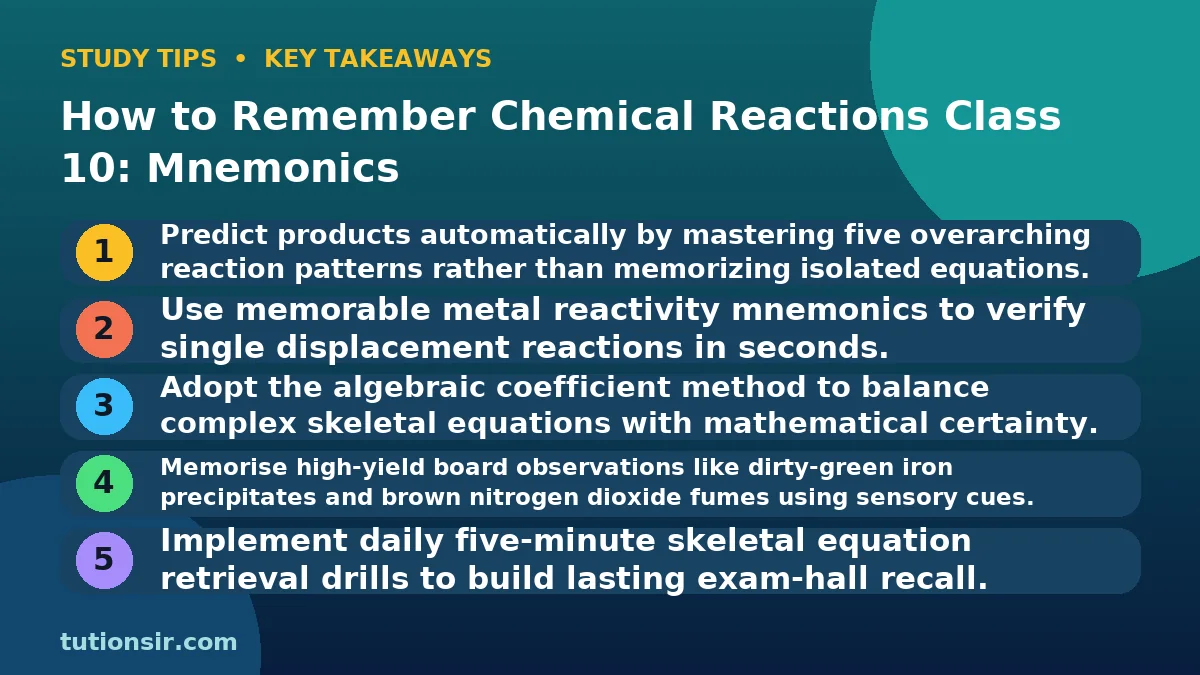
- Predict products automatically by mastering five overarching reaction patterns rather than memorizing isolated equations.
- Use memorable metal reactivity mnemonics to verify single displacement reactions in seconds.
- Adopt the algebraic coefficient method to balance complex skeletal equations with mathematical certainty.
- Memorise high-yield board observations like dirty-green iron precipitates and brown nitrogen dioxide fumes using sensory cues.
- Implement daily five-minute skeletal equation retrieval drills to build lasting exam-hall recall.
What are the 5 Main Types of Chemical Reactions in Class 10?
In the National Council of Educational Research and Training (NCERT) Class 10 Science syllabus, chemical reactions are categorised into five fundamental archetypes: combination, decomposition, displacement, double displacement, and redox. Rather than trying to commit hundreds of isolated formulas to memory, understanding the architectural template of these five categories allows you to deduce products logically whenever reactants are placed before you.
A combination reaction follows the structural formula A + B -> AB, where two or more elementary substances unite into a single compound. For instance, burning magnesium ribbon in oxygen forms magnesium oxide (2Mg + O2 -> 2MgO), and slaking quicklime with water yields slaked lime (CaO + H2O -> Ca(OH)2 + Heat). Both release thermal energy, highlighting how combination reactions frequently double as exothermic reactions in board questions.
Decomposition reactions act as the exact reverse: AB -> A + B + ... Here, a single reactant fractures into multiple products when supplied with external energy. NCERT highlights three energetic drivers that every student across CBSE, ICSE, and state boards like WBBSE must distinguish clearly: thermal decomposition driven by heat (such as limestone converting to quicklime and carbon dioxide: CaCO3 -> CaO + CO2), electrolytic decomposition powered by electrical currents (such as splitting water into hydrogen and oxygen: 2H2O -> 2H2 + O2), and photolytic decomposition triggered by ambient light (such as silver chloride silvering under sunlight: 2AgCl -> 2Ag + Cl2).
- Displacement reactions (A + BC -> AC + B): A more chemically reactive element ejects a less reactive element from its aqueous salt solution.
- Double displacement reactions (AB + CD -> AD + CB): Two ionic reactants swap partner ions, commonly producing an insoluble precipitate or neutral water.
- Redox reactions (Reduction-Oxidation): Coupled processes involving concurrent loss and gain of oxygen, hydrogen, or electrons between participating species.
Predictive Word Equations: Stop Memorising Isolated Products
You can derive roughly 60 percent of all secondary reactions across Class 10 chemistry chapters—including Acids, Bases and Salts, and Metals and Non-metals—by committing general functional formulas to memory. Instead of cramming individual salts, memorise the overarching outcome formulas: 'Metal + Dilute Acid -> Metal Salt + Hydrogen Gas', 'Metal Carbonate + Acid -> Salt + Carbon Dioxide + Water', and 'Metal Hydroxide + Acid -> Salt + Water'. Once you know the ionic valencies from your Class 9 foundations, these three formulas automatically generate balanced product pairs.
What is the Mnemonic for the Metal Reactivity Series in Class 10?
The reactivity series of metals is an empirical ranking that orders elements from greatest chemical electropositivity to least. It forms the backbone of predicting whether a single displacement reaction will proceed or result in 'No Reaction' on your board exam sheet. If an incoming free metal sits lower than the cation in the dissolved compound, no displacement can occur.
To recall the reactivity hierarchy effortlessly during high-pressure examinations, employ an engaging narrative mnemonic. The sequence—Potassium (K), Sodium (Na), Calcium (Ca), Magnesium (Mg), Aluminium (Al), Zinc (Zn), Iron (Fe), Lead (Pb), Hydrogen (H), Copper (Cu), Mercury (Hg), Silver (Ag), and Gold (Au)—can be remembered through the popular schoolroom catchphrase: 'Please Stop Calling Me A Zebra, Instead Learn How Copper Merits Silver Gold.'
Notice that hydrogen, despite being a non-metal, is deliberately positioned between lead and copper. Metals positioned above hydrogen actively displace hydrogen gas from dilute hydrochloric acid and dilute sulphuric acid; metals situated below hydrogen (copper, mercury, silver, gold) cannot displace hydrogen from dilute non-oxidising acids.
- K (Please) -> Potassium: Violently reactive, reacts with cold water.
- Na (Stop) -> Sodium: Stored under kerosene to prevent atmospheric ignition.
- Ca (Calling) -> Calcium: Reacts with cold water, floats due to hydrogen bubbles.
- Mg (Me) -> Magnesium: Reacts with boiling water or steam.
- Al (A) -> Aluminium: Protected by a self-healing amphoteric oxide coat.
- Zn (Zebra) -> Zinc: Reacts readily with steam, amphoteric in nature.
- Fe (Instead) -> Iron: Reacts slowly with steam to form Fe3O4.
- Pb (Learn) -> Lead: Appears passive due to insoluble surface coatings.
- H (How) -> Hydrogen: Non-metal baseline for acid-displacement potential.
- Cu (Copper) -> Copper: Does not react with dilute non-oxidising acids.
- Hg (Merits) -> Mercury: Low reactivity noble metal.
- Ag (Silver) -> Silver: Unreactive, prized for jewellery and electrical plating.
- Au (Gold) -> Gold: Native noble metal, inert under normal atmospheric exposure.
How to Balance Chemical Equations Easily: Step-by-Step Methods
Under the Law of Conservation of Mass formulated by Antoine Lavoisier, matter can neither be created nor destroyed in a chemical reaction. Therefore, the absolute number of atoms of each individual element must remain identical on both the reactant side (left-hand side) and the product side (right-hand side). An equation reflecting unmatched atomic counts is merely a skeletal chemical equation, which boards penalise heavily if left unadjusted.
Most Class 10 chemistry notes explain the hit-and-trial method: tabulating atom counts for each element and inserting integer coefficients sequentially, typically starting with the compound containing the maximum number of atoms. While hit-and-trial functions smoothly for simple binary interactions, it frequently leads to frustration and round-robin guessing when balancing multi-element reactions like the thermal decomposition of lead nitrate or copper reacting with nitric acid.
For challenging or complex equations, the algebraic coefficient method (also known as the undetermined coefficients method) provides an infallible, systematic trick that solves any equation mathematically without guesswork.
Step-by-Step Algebraic Method to Balance Complex Equations
Let us balance the thermal decomposition of lead nitrate using the algebraic method: a Pb(NO3)2 -> b PbO + c NO2 + d O2. First, assign algebraic variable coefficients (a, b, c, d) in front of each formula. Next, write an individual balance equation for every element present.
For Lead (Pb): Reactants have 1a = a; Products have 1b = b. Hence, a = b. For Nitrogen (N): Reactants have 2a = 2a; Products have 1c = c. Hence, c = 2a. For Oxygen (O): Reactants have 6a = 6a; Products have 1b + 2c + 2d. Hence, 6a = b + 2c + 2d.
Now assume the simplest integer for your primary variable: let a = 1. Consequently, b = 1, and c = 2(1) = 2. Substitute b and c into the oxygen equation: 6(1) = 1 + 2(2) + 2d, simplifying to 6 = 1 + 4 + 2d, or 6 = 5 + 2d, which yields 2d = 1, meaning d = 1/2. Because coefficients in a chemical equation must be whole integers, multiply all variables (a=1, b=1, c=2, d=1/2) by the denominator 2. This produces: a = 2, b = 2, c = 4, and d = 1. The perfectly balanced equation emerges: 2Pb(NO3)2(s) -> 2PbO(s) + 4NO2(g) + O2(g).
| Reaction Equation | Reaction Type | Visual Observation / Sensory Marker | Exam Key Concept |
|---|---|---|---|
| 2Mg(s) + O2(g) -> 2MgO(s) | Combination / Exothermic | Dazzling white flame; white powder residue | Magnesium ribbon must be sandpapered to strip passivation layer |
| CaO(s) + H2O(l) -> Ca(OH)2(aq) + Heat | Combination / Exothermic | Vigorous hissing; container gets hot; slaked lime forms | Base reaction for whitewashing walls; reacts with CO2 to form shiny CaCO3 |
| 2FeSO4(s) -> Fe2O3(s) + SO2(g) + SO3(g) | Thermal Decomposition | Pale green crystals turn reddish-brown; burning sulphur odour | Water of crystallisation lost first; twin acidic gases evolved |
| 2Pb(NO3)2(s) -> 2PbO(s) + 4NO2(g) + O2(g) | Thermal Decomposition | Colourless salt produces yellow residue (PbO) and dense brown fumes (NO2) | Crucial board MCQ identification for nitrogen dioxide gas |
| 2AgCl(s) -> 2Ag(s) + Cl2(g) | Photolytic Decomposition | White silver chloride turns grey in sunlight | Application in black-and-white photography; driven by light energy |
| Fe(s) + CuSO4(aq) -> FeSO4(aq) + Cu(s) | Displacement | Blue solution fades to light green; brown-red copper deposits on iron nail | Iron is positioned higher than copper in the reactivity series |
| Na2SO4(aq) + BaCl2(aq) -> BaSO4(s)v + 2NaCl(aq) | Double Displacement / Precipitation | Formation of a dense white precipitate of barium sulphate | Insoluble salt generated through mutual exchange of ions |
| CuO(s) + H2(g) -> Cu(s) + H2O(l) | Redox Reaction | Black copper oxide powder turns shiny pinkish-brown | CuO acts as oxidising agent; H2 acts as reducing agent |
Board Exam Observation Markers: Mnemonics for Colours, Odours, and Fumes
In board exams conducted by CBSE, ICSE, and state boards, over 40 percent of marks linked to Chapter 1 do not test pure balancing; they test qualitative physical observations. Examiners frequently present questions such as: 'A green salt on heating leaves a reddish-brown residue and emits gases smelling of burning sulphur. Identify the salt and write the equation.' If you have not connected chemical formulas with their real-world colours and emissions, balancing alone will not secure full marks.
Thermal decomposition of ferrous sulphate crystals is a perennial favourite. Hydrated ferrous sulphate crystals (FeSO4.7H2O) are pale green. When heated gently, they lose seven molecules of water of crystallisation to turn white (anhydrous FeSO4). Upon stronger heating, the solid decomposes: 2FeSO4(s) -> Fe2O3(s) + SO2(g) + SO3(g). The solid turns reddish-brown due to ferric oxide (Fe2O3), while the twin gases sulphur dioxide (SO2) and sulphur trioxide (SO3) emit the characteristic suffocating odour of burning sulphur. Remember the acronym 'B-S-O'—Burning Sulphur Odour—to immediately identify sulphur-containing gas emissions.
Similarly, lead nitrate crystals (Pb(NO3)2) are colourless. When heated, the test tube cracks with decrepitation, yielding lead monoxide (PbO), which is buff-yellow when cold, while evolving dense brown fumes of nitrogen dioxide (NO2). A reliable mnemonic to remember this is 'Brown Nitrate': whenever brown fumes arise in Class 10 inorganic chemistry, nitrogen dioxide (NO2) is the inevitable culprit.
How Do You Remember Oxidation and Reduction Reactions Easily?
Redox questions frequently confuse students in assertion-reasoning and multiple-choice sections because oxidation and reduction operate as simultaneous mirror images. Remembering the classic electron-transfer mnemonic 'OIL RIG' instantly clarifies these transformations: Oxidation Is Loss of electrons (or gain of oxygen / loss of hydrogen), while Reduction Is Gain of electrons (or loss of oxygen / gain of hydrogen).
Consider the landmark NCERT reaction between copper(II) oxide and hydrogen gas: CuO(s) + H2(g) -> Cu(s) + H2O(l). CuO loses oxygen to become elemental copper; therefore, CuO undergoes reduction. Conversely, H2 acquires oxygen to form water; therefore, H2 undergoes oxidation.
The crucial board trap involves identifying the agents. The rule is strictly inverted: the substance that gets reduced acts as the oxidising agent (because it supplies oxygen or withdraws electrons), and the substance that gets oxidised acts as the reducing agent (because it removes oxygen or donates electrons). In the reaction above, CuO is the oxidising agent, while H2 is the reducing agent. Note that oxidising and reducing agents are always chosen exclusively from the reactant side of the equation.
Important Chemical Reactions for Class 10 Board Exams: Pitfalls to Avoid
Examiners scrutinising Class 10 board scripts identify recurrent mistakes that cost high-scoring students unnecessary half and full marks. The most common slip is failing to record physical state symbols—solid (s), liquid (l), gas (g), and aqueous solution (aq)—whenever the question specifies a complete balanced chemical equation. An arrow pointing upwards (^) indicates an evolved gas, while a downward arrow (v) signifies an insoluble precipitate.
Another classic error occurs when students write incorrect molecular formulas due to rushed valency calculation. For example, writing zinc chloride as ZnCl rather than ZnCl2 instantly invalidates all balancing efforts downstream. Always construct neutral binary formulas using the criss-cross valency method prior to adjusting integer coefficients.
A practical inquiry often asked in board papers is: Why should a magnesium ribbon be cleaned before burning in air? Magnesium is an electropositive metal that reacts slowly with ambient atmospheric oxygen during storage to form an unreactive, protective surface film of basic magnesium oxide. Rubbing the ribbon with sandpaper strips away this protective passivation layer, allowing direct thermal contact between metallic magnesium and atmospheric oxygen for smooth ignition with a dazzling white flame.
The 7-Day Active Recall and Equation Mastery Revision Plan
Passive re-reading of textbooks gives a false illusion of competence. To cement these reactions in your long-term memory ahead of pre-boards and final board examinations, implement an active retrieval timetable across seven consecutive days.
Construct two-sided revision flashcards. On the front, write only the skeletal reactants and required reaction conditions (e.g., 'FeSO4 + Heat -> ?'). On the reverse, write the balanced equation, state symbols, and colour or odour observations. Self-test by writing the products and balancing coefficients on a blank pad before flipping the card. Platforms like Tution Sir provide targeted chapter tests and automated feedback to help Class 10 students practice these skeletal equation balancing drills under realistic timed board conditions.
- Day 1: Master the 5 reaction types and practice algebraic balancing on 10 skeletal equations.
- Day 2: Memorise the reactivity series mnemonic and write all single displacement reactions from Chapter 1 and Chapter 3.
- Day 3: Practice double displacement and precipitation reactions, memorising the precipitate colour chart.
- Day 4: Focus entirely on thermal, electrolytic, and photolytic decomposition equations alongside their observation markers.
- Day 5: Drill redox problems: identify oxidised substances, reduced substances, and respective agents across 15 previous-year questions.
- Day 6: Complete an all-chapter reaction marathon including acid-base neutralisations and esterification from Carbon and its Compounds.
- Day 7: Timed mock test: Write and balance 20 random equations purely from memory within 30 minutes.
Frequently asked questions
How can I easily memorize chemical reactions for Class 10?
Avoid memorizing every reaction from scratch. Categorize equations into the five primary types, learn the reactivity series mnemonic to forecast single displacements, and rely on general functional patterns such as metal carbonate plus acid yielding salt, water, and carbon dioxide. Combine these patterns with active recall flashcards.
Why do we need to balance chemical equations in Class 10?
Balancing chemical equations is mandatory to satisfy the Law of Conservation of Mass. This fundamental law states that matter cannot be created or destroyed during a chemical transformation. Therefore, the exact number of atoms for every constituent element must remain equal on both sides of the reaction arrow.
What is the easiest trick to balance a skeletal chemical equation?
For straightforward reactions, balance metals first, non-metals second, hydrogen third, and oxygen last using hit-and-trial. For complex equations with multiple compounds, use the algebraic coefficient method by assigning letter variables (a, b, c, d), creating simultaneous equations for each element, and solving mathematically.
Why should a magnesium ribbon be cleaned before burning in air?
Magnesium readily reacts with atmospheric oxygen at room temperature to form an inert, protective coat of basic magnesium oxide. This passive layer prevents oxygen from contacting the metal. Rubbing the ribbon with sandpaper removes this oxide film so the metal can ignite smoothly with a dazzling white flame.
How many chemical reactions are there in NCERT Class 10 Science Chapter 1?
NCERT Class 10 Science Chapter 1 contains approximately 15 to 18 distinct core chemical equations spanning laboratory activities, in-text examples, and chapter-end exercises. Understanding the 5 foundational categories allows you to write all of them without rote memorisation.
What is the difference between displacement and double displacement reactions?
In a displacement reaction, a single more reactive free element kicks out a less reactive metal or hydrogen from its salt solution. In a double displacement reaction, two separate ionic compounds exchange cations and anions, typically resulting in the formation of an insoluble precipitate or neutral water.
How do you identify oxidising and reducing agents in board exams?
First, identify which substance gained oxygen or lost electrons (oxidised) and which lost oxygen or gained electrons (reduced). The substance that underwent reduction is your oxidising agent, and the substance that underwent oxidation is your reducing agent. Both agents must always be reactants.
Keep learning
How to Solve Physics Numericals Easily: 5-Step Guide
Struggling to solve numerical problems even when you remember every formula is the single most common frustrat
Read →How to Increase Handwriting Speed in Board Exams: Top Tips
Every year, thousands of Indian board examinees lose 10 to 15 marks simply because their hands cannot keep up
Read →How to Write Long Answers in Social Science Class 10
Struggling to convert bulky Social Science chapters into crisp, high-scoring answers? Master the exact point-w
Read →Practise what you just read
Free plan, no card needed. Full mock tests and the complete question bank are on the Pro plan.