Class 10 Science Study Guide
How to Remember Chemical Reactions Class 10: 4 Easy Steps
Memorizing dozens of chemical equations across NCERT Class 10 Science chapters often feels overwhelming when approached by rote cramming. By shifting from blind repetition to logical pattern recognition, valency bridges, and sensory memory hooks, you can recall and balance any reaction effortlessly during board exams.
Quick answer
To remember chemical reactions easily in Class 10, group equations by reaction type, use ion valencies to predict products instead of rote memorization, attach sensory hooks like precipitate colors or gas releases to each equation, and practice active recall by writing balanced equations from word prompts using spaced repetition.

Key takeaways
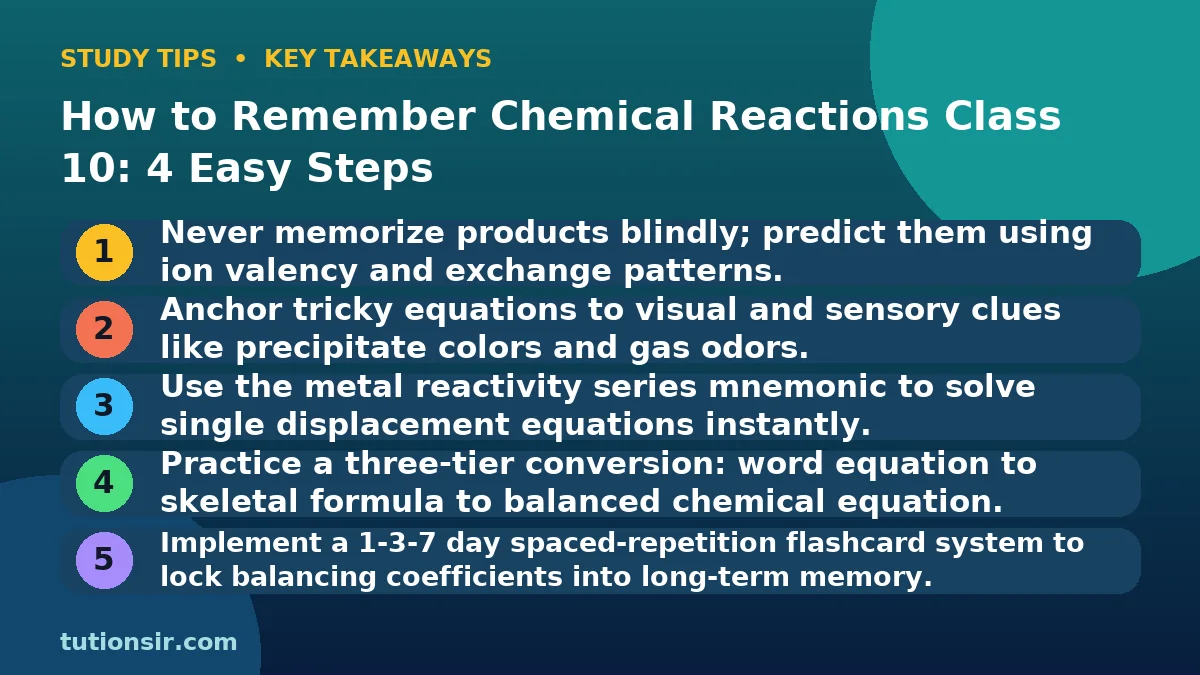
- Never memorize products blindly; predict them using ion valency and exchange patterns.
- Anchor tricky equations to visual and sensory clues like precipitate colors and gas odors.
- Use the metal reactivity series mnemonic to solve single displacement equations instantly.
- Practice a three-tier conversion: word equation to skeletal formula to balanced chemical equation.
- Implement a 1-3-7 day spaced-repetition flashcard system to lock balancing coefficients into long-term memory.
Try Tution Sir free for your class and subject.
No card. Registering takes about two minutes.
Why Do Students Struggle with Chemical Reactions in Class 10?
Every year, Class 10 students appearing for CBSE, ICSE, and State Board examinations lose critical marks in the Chemistry section not because they do not study, but because they treat chemical equations like random strings of letters and numbers. Trying to memorize that copper sulfate reacts with iron without understanding why copper is displaced leaves students vulnerable to memory lapses during exam stress. Chemical reactions represent real, physical transformations governed by fixed chemical laws, atomic valencies, and energetic principles.
The Class 10 NCERT Science syllabus contains over 45 distinct chemical reactions distributed across four foundational chapters: Chapter 1 (Chemical Reactions and Equations), Chapter 2 (Acids, Bases and Salts), Chapter 3 (Metals and Non-metals), and Chapter 4 (Carbon and its Compounds). Attempting to cram these equations through raw repetition requires hundreds of hours and yields poor retention. When a board exam question presents an unfamiliar reactant pair or asks for an observation-based deduction, rote memorization fails completely.
The secret adopted by board toppers is straightforward: replace rote memorization with structural pattern recognition. When you understand the underlying mechanism—whether it is an exchange of ions, a competition for oxygen, or a displacement driven by metal reactivity—you only need to remember the reactants. The products, the physical states, and even the balanced coefficients can be derived logically on your answer sheet.
- Rote memorization ignores polyatomic ion charges, leading to incorrect molecular formulas like writing FeCl instead of FeCl2.
- Students frequently forget the balancing numbers because coefficients are memorized as telephone numbers rather than balanced by atom counts.
- Board examiners deduct marks for missing reaction conditions such as catalysts, temperature thresholds, and state symbols (s, l, g, aq).
Technique 1: Master the Valency and Criss-Cross Product Prediction Engine
The most powerful trick to remember chemical reactions easily in Class 10 is learning how to predict products rather than memorizing them. Over 70% of the reactions in Chapters 1, 2, and 3 are ionic double displacement, single displacement, or acid-base neutralizations. If you know the charges of common cations and anions, you will never write an incorrect product formula again.
Consider the classic double displacement reaction between barium chloride and sodium sulfate. Instead of memorizing 'BaCl2 + Na2SO4 gives BaSO4 + 2NaCl', break both compounds into their constituent ions. Barium carries a +2 charge (Ba2+) and chloride carries a -1 charge (Cl-). Sodium carries a +1 charge (Na+) and sulfate carries a -2 charge (SO4 2-). During a double displacement reaction, the cations simply trade their partner anions.
The positive barium ion pairs with the negative sulfate ion: Ba2+ and SO4 2- have equal and opposite charges, forming neutral BaSO4. The positive sodium ion pairs with the negative chloride ion: Na+ and Cl- combine in a 1:1 ratio to form NaCl. By applying the criss-cross valency method taught in Class 9, you derive the correct products in five seconds without consulting a textbook.
- Cations to memorize: Na+ (+1), K+ (+1), Ag+ (+1), Ca2+ (+2), Mg2+ (+2), Zn2+ (+2), Ba2+ (+2), Fe2+ (Ferrous, +2), Fe3+ (Ferric, +3), Cu2+ (+2), Pb2+ (+2), Al3+ (+3).
- Anions to memorize: Cl- (-1), OH- (-1), NO3- (Nitrate, -1), HCO3- (Bicarbonate, -1), O2- (-2), S2- (-2), SO4 2- (Sulfate, -2), CO3 2- (Carbonate, -2), PO4 3- (Phosphate, -3).
- Acid-Base Neutralization Rule: Acid + Base always produces Salt + Water. When hydrochloric acid (HCl) meets sodium hydroxide (NaOH), H+ and OH- form H2O, leaving Na+ and Cl- to form NaCl.
- Metal Carbonate Rule: Acid + Metal Carbonate always produces Salt + Water + Carbon Dioxide (CO2). For example, Na2CO3 + 2HCl gives 2NaCl + H2O + CO2.
The Three-Step Word-to-Balanced Conversion Blueprint
Whenever you face a question in your board examination, never write the final balanced equation directly. Follow this disciplined three-step protocol on your rough sheet: First, write the clear word equation (e.g., Calcium Hydroxide + Carbon Dioxide -> Calcium Carbonate + Water). Second, apply ion valencies to construct the correct skeletal formula equation without coefficients (Ca(OH)2 + CO2 -> CaCO3 + H2O). Third, balance the elements systematically, starting with metals, then non-metals, and leaving hydrogen and oxygen for the final step. This eliminates arithmetic errors and ensures both mass conservation and chemical accuracy.
Technique 2: Anchor Reactions to Sensory and Color Observation Hooks
CBSE and state board question papers frequently frame questions around observations: 'A green salt on heating leaves a brown residue and releases choking fumes. Identify the salt and write the balanced equation.' If you only memorized the symbols, this question leaves you blank. If you memorized the reaction through sensory hooks—colors, smells, temperatures, and states—the answer becomes immediate.
Human memory retains visual, olfactory, and tactile associations far more effectively than abstract chemical formulas. In Class 10 NCERT Science, only a dozen reactions exhibit distinct physical characteristics. Associating these distinct sensory hooks with the equations turns dry symbols into vivid mental pictures.
The thermal decomposition of ferrous sulfate (FeSO4.7H2O) is an ideal example. The reactant crystals are light green. Upon gentle heating, they lose water of crystallization to become white anhydrous FeSO4. Strong heating decomposes it into ferric oxide (Fe2O3), which is reddish-brown, accompanied by two colorless gases: sulfur dioxide (SO2) and sulfur trioxide (SO3). The unmistakable observation is the pungent odor of burning sulfur. When you link the equation 2FeSO4(s) --Heat--> Fe2O3(s) + SO2(g) + SO3(g) to the sensory phrase 'Green to Reddish-Brown with Choking Sulfur Fumes', you will never forget it.
- Lead Nitrate Thermal Decomposition: White solid Pb(NO3)2 decomposes to yield a buff-yellow solid Lead Monoxide (PbO), brown fumes of Nitrogen Dioxide gas (NO2), and colorless Oxygen gas (O2). Hook: 'White powder yields Yellow residue + Dense Brown Fumes'.
- Potassium Iodide and Lead Nitrate: Lead Nitrate solution mixed with Potassium Iodide solution precipitates Lead Iodide (PbI2). Hook: 'Bright Canary Yellow Precipitate'.
- Iron in Copper Sulfate Solution: Blue CuSO4 solution fades to pale green FeSO4, while the silvery-grey iron nail becomes coated with a reddish-brown layer of copper. Hook: 'Blue to Pale Green swap'.
- Quicklime Slaking: Calcium Oxide reacts vigorously with water to form Slaked Lime (Ca(OH)2), accompanied by a boiling hissing sound and massive release of heat (exothermic reaction). Hook: 'Hissing boil and intense heat'.
| Chapter & Reaction Name | Word Equation Prompt | Balanced Chemical Equation with States | Crucial Sensory Observation / Rule |
|---|---|---|---|
| Ch 1: Combination | Quicklime + Water | CaO(s) + H2O(l) → Ca(OH)2(aq) + Heat | Vigorous reaction, hissing sound, beaker becomes extremely hot |
| Ch 1: Decomposition | Ferrous Sulphate Heating | 2FeSO4(s) --Δ--> Fe2O3(s) + SO2(g) + SO3(g) | Light green crystals turn reddish-brown; choking odor of burning sulfur |
| Ch 1: Decomposition | Lead Nitrate Heating | 2Pb(NO3)2(s) --Δ--> 2PbO(s) + 4NO2(g) + O2(g) | White powder yields yellow residue and dense reddish-brown fumes |
| Ch 1: Displacement | Iron + Copper Sulphate | Fe(s) + CuSO4(aq) → FeSO4(aq) + Cu(s) | Blue solution turns pale green; reddish-brown coating on iron nail |
| Ch 1: Precipitation | Sodium Sulphate + Barium Chloride | Na2SO4(aq) + BaCl2(aq) → BaSO4(s)↓ + 2NaCl(aq) | Formation of a thick, insoluble white precipitate of BaSO4 |
| Ch 2: Metal + Acid | Zinc + Dilute Sulphuric Acid | Zn(s) + H2SO4(aq) → ZnSO4(aq) + H2(g)↑ | Brisk effervescence; gas burns with a distinct 'pop' sound |
| Ch 2: Carbonate + Acid | Sodium Carbonate + Hydrochloric Acid | Na2CO3(s) + 2HCl(aq) → 2NaCl(aq) + H2O(l) + CO2(g)↑ | Brisk effervescence; gas turns clear lime water milky due to CaCO3 |
| Ch 3: Thermit Reaction | Iron(III) Oxide + Aluminium Powder | Fe2O3(s) + 2Al(s) --Ignition--> 2Fe(l) + Al2O3(s) + Heat | Highly exothermic; iron is produced in molten state; used to weld rails |
| Ch 4: Esterification | Ethanoic Acid + Ethanol | CH3COOH(l) + C2H5OH(l) --conc. H2SO4--> CH3COOC2H5(l) + H2O(l) | Formation of ethyl ethanoate, characterized by a sweet, fruity aroma |
| Ch 4: Saponification | Ethyl Ethanoate + Sodium Hydroxide | CH3COOC2H5(l) + NaOH(aq) → CH3COONa(aq) + C2H5OH(aq) | Alkaline hydrolysis of ester producing soap (sodium salt of carboxylic acid) |
Technique 3: Master the Reactivity Series Mnemonic to Predict Displacement
Single displacement reactions in NCERT Chapter 1 and Chapter 3 are entirely dictated by the Activity Series of Metals. A more reactive metal displaces a less reactive metal from its aqueous salt solution. Students who try to memorize every single combination of displacement reactions get tangled up. Instead, memorizing one 14-word mnemonic phrase unlocks dozens of equations instantly.
Use this standard board-tested mnemonic to memorize the reactivity series from most reactive to least reactive: 'Please Stop Calling Me A Careless Zebra, Instead Truly Learn How Copper Saves Gold' (Potassium, Sodium, Calcium, Magnesium, Aluminium, Carbon, Zinc, Iron, Tin, Lead, Hydrogen, Copper, Silver, Gold).
With this sequence embedded in your memory, you can answer displacement queries instantly. If an exam question asks: 'What happens when copper wire is placed in a zinc sulfate solution (Cu + ZnSO4)?', look at your mnemonic. Zinc ('Zebra') sits well above Copper ('Copper'). Therefore, copper lacks the chemical reducing power to displace zinc from its sulfate bond. Your answer is immediate: 'No reaction takes place.' Conversely, if zinc is placed in copper sulfate (Zn + CuSO4), zinc displaces copper to form ZnSO4 + Cu because zinc sits higher in the activity series.
- Potassium (K) - Please (Most reactive)
- Sodium (Na) - Stop
- Calcium (Ca) - Calling
- Magnesium (Mg) - Me
- Aluminium (Al) - A
- Carbon (C) - Careless (Reference non-metal for smelting)
- Zinc (Zn) - Zebra
- Iron (Fe) - Instead
- Tin (Sn) - Truly
- Lead (Pb) - Learn
- Hydrogen (H) - How (Reference point: metals above H displace H2 from dilute acids; metals below do not)
- Copper (Cu) - Copper
- Silver (Ag) - Saves
- Gold (Au) - Gold (Least reactive)
Technique 4: The 1-3-7 Leitner Spaced-Retrieval System for Reaction Cards
Reading a list of chemical reactions repeatedly from your textbook is the least efficient revision method because it relies on passive recognition. When looking at the page, your brain feels familiar with the equation, creating a false illusion of mastery. On exam day, when faced with a blank sheet, that passive familiarity vanishes. To guarantee flawless recall under exam pressure, you must deploy active recall paired with spaced repetition.
Create 3x5 inch index cards or cut rectangular cards from chart paper. On the FRONT of the card, write only the word equation, reaction type, and temperature or catalyst cues (for example: 'Decomposition of Lead Nitrate on Heating' or 'Ethanol + Ethanoic Acid in presence of conc. H2SO4'). On the BACK of the card, write the complete, balanced chemical equation including all physical state symbols, catalyst notations, precipitate arrows, and color changes.
Organize these cards using the 1-3-7 Leitner spaced-retrieval schedule. Test yourself on Day 1 by reading only the front of each card and writing the complete balanced equation on a blank sheet of paper before flipping the card to check. Cards you get completely right move to the Day 3 box. Any card where you missed a coefficient, a state symbol, or a product stays in Day 1. On Day 3, test those advanced cards again; correct ones advance to Day 7, while any error drops the card straight back to Day 1.
- Never evaluate your recall mentally; always write out the equation by hand, as board examinations evaluate written muscle memory.
- Include special organic reaction conditions on the back: alkaline KMnO4 or acidified K2Cr2O7 for oxidation, nickel catalyst at 473 K for vegetable oil hydrogenation, and concentrated H2SO4 as an acidic dehydrating catalyst for esterification.
- Spend just 15 minutes every morning reviewing your scheduled Leitner box to maintain 100% equation retention throughout the academic year.
Board Exam Marking Schemes: Avoid These Common Costly Mistakes
Understanding how CBSE, ICSE, and State Board examiners mark chemistry answer scripts protects you from unnecessary mark deductions. Board marking schemes allocate half marks for individual components of a reaction. Even if your chemical symbols are accurate, neglecting formal conventions can cost you top grades.
The most common error is presenting an unbalanced skeletal equation. In Class 10 Science, a chemical equation that violates the Law of Conservation of Mass is considered scientifically incorrect. Unless a question explicitly states 'write the skeletal equation', writing an unbalanced reaction results in a direct 50% to 100% mark deduction for that sub-question.
Another critical penalty occurs when students omit mandatory reaction conditions written above or below the reaction arrow. In Chapter 4 (Carbon and its Compounds), writing the conversion of ethanol to ethanoic acid without specifying 'alkaline KMnO4 + Heat' or 'acidified K2Cr2O7 + Heat' costs full marks for the condition component. Similarly, omitting sunlight over the arrow in photolytic decomposition reactions of silver chloride (2AgCl -> 2Ag + Cl2) or silver bromide invalidates the chemical context demanded by the NCERT marking scheme.
- Omitting Physical States when specifically requested: If a question states 'write balanced chemical equations with state symbols', you must append (s) for solid, (l) for liquid, (g) for gas, and (aq) for aqueous solutions. Precipitates should be marked with a downward arrow (↓) or (s), and evolved gases with an upward arrow (↑) or (g).
- Confusing Diatomic Molecules: Non-metal gases produced during reactions are diatomic. Writing Na + H2O -> NaOH + H instead of H2 is a fundamental error. Hydrogen (H2), Nitrogen (N2), Oxygen (O2), and Chlorine (Cl2) must always be written in their diatomic molecular states.
- Writing Incorrect Formulas to Force Balance: Never alter the chemical subscript of a compound to make balancing easier. Changing H2O to H2O2 to balance oxygen atoms creates hydrogen peroxide, completely altering the science. Coefficients can only be added in front of formulas as multipliers.
Essential Master Revision Table of High-Weightage NCERT Reactions
To streamline your daily revision, this comprehensive reference synthesizes the most frequently tested NCERT chemical reactions across all Class 10 chapters. Review this table daily using active cover-and-test retrieval to consolidate your reaction knowledge before the board examinations. For interactive practice, concept assessments, and adaptive board-level problem sets, students often turn to learning platforms like Tution Sir to reinforce their science revision.
Frequently asked questions
How can I easily memorize chemical reactions in Class 10?
Avoid rote memorization by learning ion valencies to predict products through criss-cross rules. Group equations by reaction types, link each equation to visible changes like precipitate colors or gas releases, and test yourself using active recall flashcards following a 1-3-7 day spaced-repetition revision routine.
What are the 4 main types of chemical reactions in Class 10?
The four primary types in Chapter 1 are Combination reactions (two reactants form one product), Decomposition reactions (one compound breaks into simpler substances via heat, light, or electricity), Displacement reactions (a more reactive element displaces a less reactive one), and Double Displacement reactions (two compounds exchange ions).
How do toppers remember chemical equations for board exams?
Board toppers memorize equations by writing them out in a dedicated reaction notebook, organizing reactions strictly by reaction mechanisms rather than chapter numbers. They master the metal reactivity series, link reactions to lab observation clues, and consistently practice converting descriptive word equations into balanced skeletal equations.
Is it necessary to write physical states and catalysts in Class 10 chemistry reactions?
State symbols like (s), (l), (g), and (aq) are mandatory whenever questions explicitly request them, and writing them demonstrates mastery. Catalysts, heating symbols (Δ), and specific temperatures (such as 443 K for alcohol dehydration) are strictly evaluated in board marking schemes, and omitting them leads to mark deductions.
How do you memorize the metal reactivity series easily?
Memorize this simple sentence mnemonic: 'Please Stop Calling Me A Careless Zebra, Instead Truly Learn How Copper Saves Gold.' The initials correspond to Potassium (K), Sodium (Na), Calcium (Ca), Magnesium (Mg), Aluminium (Al), Carbon (C), Zinc (Zn), Iron (Fe), Tin (Sn), Lead (Pb), Hydrogen (H), Copper (Cu), Silver (Ag), and Gold (Au).
Why do I keep forgetting balanced chemical equations in science exams?
Forgetting happens when students rely on passive textbook reading, which builds recognition rather than active retrieval pathways. Balancing numbers are easily forgotten if you cram them like phone numbers. Learn to derive formulas using valency, balance equations systematically on rough paper, and practice active, closed-book writing.
What are the most important chemical reactions in NCERT Class 10 Science?
The top high-frequency board reactions include the thermal decomposition of ferrous sulfate and lead nitrate, reaction of quicklime with water, displacement of copper sulfate by iron, double displacement yielding barium sulfate or lead iodide precipitates, the chlor-alkali process, and organic esterification and saponification.
How can flashcards and active recall help in remembering chemical equations?
Flashcards isolate the prompt from the answer. Writing the word equation on the front and the balanced formula with states on the back forces your brain to retrieve chemical formulas actively. Reviewing these cards across intervals of 1, 3, and 7 days transfers the equations from short-term memory into permanent recall.
Sources and official links
- NCERT Science Class 10 Textbook (Department of Education in Science and Mathematics)
- CBSE Secondary School Curriculum and Sample Marking Scheme (Science)
Exam rules and notifications change. Confirm dates, fees and eligibility on the official website before acting. Spotted an error? Email support@tutionsir.com. See our editorial policy.
Keep learning
How to Remember Chemical Reactions Class 10: Mnemonics
Struggling to memorize dozens of chemical equations, precipitate colours, and balancing steps for your board e
Read →How to Write Long Answers in Social Science Class 10 (2026)
Many Class 10 students know their history dates and economic terms thoroughly yet drop precious marks on 5-mar
Read →How to Make Short Notes from NCERT: Class 9 to 12
NCERT textbooks pack immense academic depth into every paragraph, tempting students to transcribe entire pages
Read →Do not let another week go by without a plan
Reading about the exam does not raise marks. Practice does. Register free now and start with the one topic that worries you most. Small daily practice beats a last-minute rush.
- Free plan, no card needed
- Ask any doubt and get a step-by-step answer
- Practice questions with explanations
Free plan, no card needed. Your progress is saved to your account.