CBSE Class 10 • Exam Strategy
How to Score 95 Percent in Class 10 CBSE: 2026 Strategy
Jumping from the comfortable 80 percent bracket to a 95 percent score in CBSE Class 10 requires shifting from passive reading to precision execution. This guide breaks down the mathematics of marks, provides a functional mistake log template, and reveals subject-wise strategies aligned with official CBSE marking rubrics.
Quick answer
To score 95 percent in Class 10 CBSE, secure full 20/20 marks in school internal assessments and target at least 75 out of 80 in each theory examination. Master NCERT textbooks and Exemplars, practice 50 percent competency-based questions, and maintain a mistake log to eliminate calculation and conceptual errors.

Key takeaways
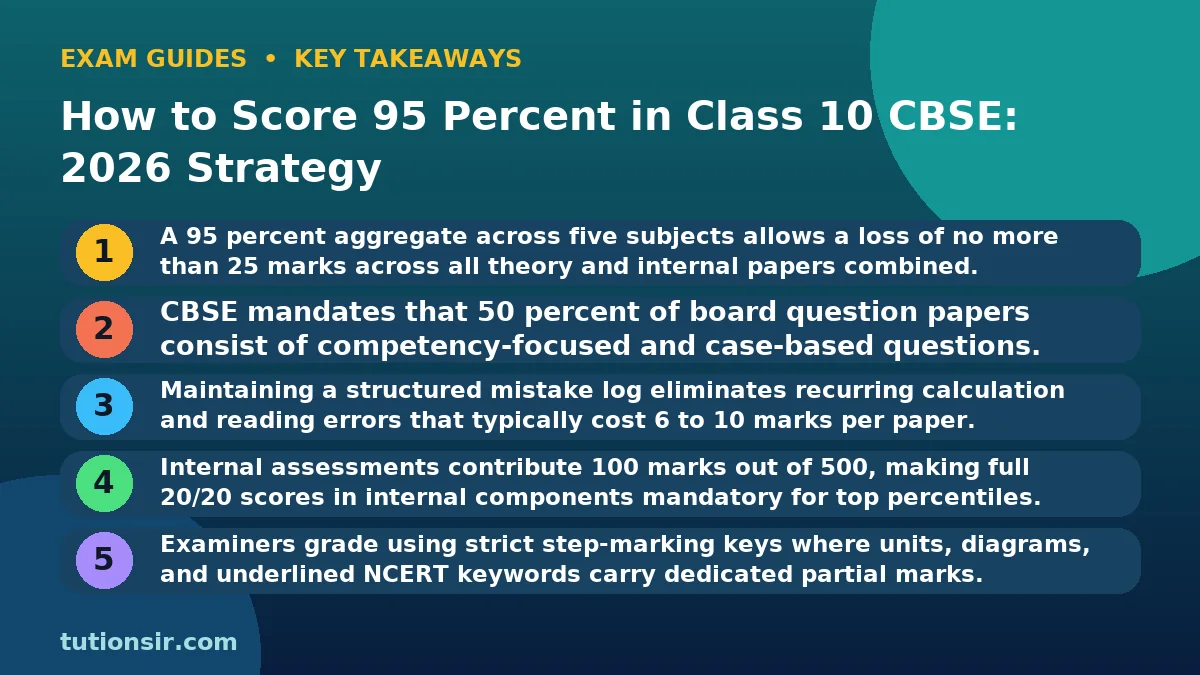
- A 95 percent aggregate across five subjects allows a loss of no more than 25 marks across all theory and internal papers combined.
- CBSE mandates that 50 percent of board question papers consist of competency-focused and case-based questions.
- Maintaining a structured mistake log eliminates recurring calculation and reading errors that typically cost 6 to 10 marks per paper.
- Internal assessments contribute 100 marks out of 500, making full 20/20 scores in internal components mandatory for top percentiles.
- Examiners grade using strict step-marking keys where units, diagrams, and underlined NCERT keywords carry dedicated partial marks.
Try Tution Sir free for your class and subject.
No card. Registering takes about two minutes.
How Many Marks Can You Afford to Lose to Get 95 Percent in CBSE Class 10?
A candidate targeting a 95 percent aggregate across five academic subjects must achieve an aggregate of at least 475 out of 500 total marks. This simple mathematical boundary dictates your entire preparation threshold: you can afford to surrender at most 25 total marks across all subjects combined. In practical terms, that leaves a slim buffer of just 5 marks per subject across both theory and internal components.
Under the Central Board of Secondary Education (CBSE) evaluation model, every core subject carries an 80-mark external theory paper and a 20-mark school-level internal assessment. Scoring full 20/20 marks in internal assessments—comprising periodic tests, multiple assessments, portfolio maintenance, and subject enrichment activities—is the single most effective cushion a student can build. When you enter the examination hall with 100 out of 100 internal marks secured, your required score on each 80-mark theory paper is 75 marks (93.75 percent in theory). If you lose even 2 marks in internal assessments per subject, your required theory threshold climbs to 77 out of 80, narrowing your margin for human error during the 3-hour written examination.
Students stuck in the 80 to 88 percent bracket often believe they need to learn obscure reference material to bridge the gap. In reality, the difference between an 85 percent student and a 95 percent student is rarely a deficit of advanced knowledge; it is almost universally a leak of avoidable marks scattered across multiple-choice questions (MCQs), unlabelled diagrams, missing units in calculations, and incomplete answers in language sections.
How Does a Mistake Log or Error Notebook Help Improve Board Exam Marks?
A mistake log—also known as an error notebook—is a targeted revision journal that tracks every incorrect answer, calculation slip, and conceptual misunderstanding across your practice tests and pre-boards. Most candidates complete a sample paper, check their total score, feel momentary disappointment over lost marks, and immediately flip to the next test. This habit guarantees that the exact same errors reappear on the final board exam.
High-scoring students treat their mistakes as precise diagnostic data. Whenever you lose marks during self-testing or school pre-boards, you must isolate the psychological or technical trigger behind the loss. Errors generally fall into four distinct categories: conceptual blind spots (misunderstanding a law or formula), calculation errors (algebraic signs, decimal placement, unit conversions), reading comprehension errors (missing words like 'not', 'except', or misinterpreting the sub-questions), and presentation failures (skipping formula statements or omitting units).
To operationalize this method, maintain a dedicated physical notebook or digital sheet divided into five distinct tracking columns. Before starting any new sample paper or mock exam, dedicate 10 minutes to reviewing your mistake log entries to prime your working memory against repeat blunders.
The 5-Column Mistake Log Framework
Column 1: Subject, Chapter & Question Reference (e.g., Science, Light: Reflection and Refraction, Question 14, Pre-Board 1).
Column 2: Error Classification (Conceptual, Calculation Slip, Reading Failure, or Presentation Deficit).
Column 3: Root Cause Analysis (e.g., 'Assumed concave lens has positive focal length instead of negative due to rushing through sign convention').
Column 4: Corrected Rule or Principle (e.g., 'Cartesian sign convention: Focal length of concave lens is always negative (f < 0). Always sketch a thumbnail diagram before plugging numbers into 1/f = 1/v - 1/u').
Column 5: Re-Test Status & Date (Track whether the problem was re-solved correctly without notes 7 days later).
cbse class 10 subject wise preparation strategy: Mastering Core Subjects
A balanced 95 percent score requires tailored mastery of each subject's unique evaluation framework. Treating Mathematics the same way you treat History or Biology leads to imbalanced scores where one weak paper compromises your aggregate. The following blueprints outline the specific execution steps needed for each core subject.
Mathematics (Standard 041 & Basic 241): How to Score 100 in Maths Class 10 CBSE
Scoring a perfect 100 in Class 10 Mathematics demands absolute procedural fluency and rigorous step adherence. Start by completing every single example, in-text exercise, and miscellaneous exercise in the NCERT textbook twice. NCERT Exemplar problems must be prioritized next, especially for high-weightage chapters like Triangles, Introduction to Trigonometry, Surface Areas and Volumes, and Quadratic Equations.
Board examiners award marks according to explicit steps. For any 3-mark or 5-mark question, marks are allocated across four tiers: stating given values and constructing a clean labeled figure (0.5 to 1 mark), writing the standard formula in algebraic terms (0.5 to 1 mark), substituting numerical values accurately (1 to 2 marks), and writing the final answer enclosed in a box with correct dimensional units such as cm² or cm³ (0.5 to 1 mark). Never jump straight from substitution to the final value without showing intermediate cancellation steps.
Standard Mathematics students should also solve higher-order thinking skill (HOTS) questions from previous years' papers to master multi-concept problems, such as combining coordinate geometry with area calculations or trigonometry applications involving two moving observation points.
Science (086): NCERT Rigor and Activity-Based Conceptual Clarity
CBSE Science papers heavily assess NCERT practical activities and conceptual reasoning. In Chemistry, memorize every balanced chemical equation in Chapters 1 to 4, including physical states (s, l, g, aq), reaction conditions (catalysts, temperature), and visible indicators (precipitate color changes, gas evolution, temperature shifts). Questions based on textbook activities—such as heating ferrous sulphate crystals or the electrolysis of water—appear routinely in 3-mark and 5-mark slots.
In Physics, master ray diagrams for concave/convex mirrors and lenses with strict adherence to light ray arrows. An un-arrowed ray diagram in the board exam forfeits half to one full mark automatically. Practice numerical problems on electric circuits, Joule's law of heating, and mirror/lens equations with careful attention to positive and negative signs.
In Biology, diagrams must be drawn clearly with straight-line labels (avoid crisscrossing label lines). Incorporate standard scientific vocabulary: write 'nephron' instead of 'kidney filter', 'peristaltic movement' instead of 'food pushing', and clearly define regulatory hormones and feedback mechanisms.
Social Science (087): Point-Wise Presentation and Map Work Precision
Social Science is an 80-mark theory paper where candidates frequently drop marks due to unstructured narrative paragraphs. To score 75+ in Social Science, abandon long narrative essays and write answers strictly in numbered bullet points. A 3-mark question requires 3 distinct points with brief sub-headings; a 5-mark question requires 5 well-developed points with clear bolded headings.
In History and Political Science, incorporate specific dates, treaty names (e.g., Treaty of Vienna 1815), leader names, and constitutional terms directly from the NCERT text. For Geography and Economics, support your answers with relevant flowcharts, tables, and sector comparisons (such as Organized vs. Unorganized sectors).
Map work accounts for an easy 5 marks (2 marks History, 3 marks Geography). Practice every location identified in the official CBSE Class 10 syllabus on blank outline maps of India. A small slip in marking cotton textile mills, nuclear power plants, or major ports can unnecessarily cost you full marks.
| Subject | Typical 80% Level Practice | Targeted 95% Mastery Strategy | Crucial Resource to Add |
|---|---|---|---|
| Mathematics | Practicing only basic NCERT exercises; skipping step proofs and units. | Solving every NCERT Exemplar problem; showing full formula-substitution steps; box-framing answers. | CBSE Official Marking Scheme & NCERT Exemplar |
| Science | Rote memorizing definitions; drawing rough diagrams without directional arrows. | Mastering all textbook activity setups; practicing balanced equations with state symbols; ray diagrams with arrows. | CBSE Competency-Focused Practice Questions (Portal) |
| Social Science | Writing long narrative paragraphs; neglecting exact dates and map coordinates. | Structuring answers into numbered bullet points with bold sub-headings; practicing all official map coordinates. | CBSE Previous 5-Year Question Papers & Topper Scripts |
| Languages (English/Hindi) | Reading chapter summaries online; ignoring letter/essay formatting rules. | Thorough reading of original prose/poetry; embedding textbook keywords in answers; adhering to standard formats. | NCERT Original Textbooks & Formal Writing Formats |
Why Do Students Miss the 95 Percent Mark in English and Hindi Languages?
Language papers represent the single most common reason high-performing students drop from a 96 percent trajectory down to 91 or 92 percent aggregate. Candidates spend months practicing math equations and science derivations while neglecting English Language & Literature (184) and Hindi (Course A or B) until the final week before boards. Because languages carry the same 100-mark weight as Science or Mathematics, losing 8 to 12 marks here instantly destroys a 95 percent target.
Language marks are lost predominantly across three areas: reading comprehension inference, writing skill formats, and subjective literature evaluation. In Section A (Reading Skills), CBSE has shifted away from direct factual extraction toward inferential and tone-based questions. Candidates must answer questions asking for the author's tone, central theme, or vocabulary in context by analyzing the text rather than lifting whole sentences verbatim.
In Section B (Writing and Grammar), strict adherence to CBSE layout formats is compulsory. In formal letters and analytical paragraphs, half to one mark is reserved solely for layout (sender address, date, receiver designation, subject, salutation, coherent paragraphs, complimentary close). In analytical paragraph writing, students often express personal opinions instead of objectively summarizing given charts, graphs, or data points.
In Section C (Literature), examiners grade using specific value points outlined in the official CBSE marking scheme. If an answer asks why the baker was essential in traditional Goan village life, an answer that fails to mention key phrases from the textbook—such as 'marriage gifts are meaningless without the sweet bread known as the bol' or 'furnaces still exist'—will lose partial marks even if written in fluent, grammatically correct English.
cbse class 10 competency based questions: Tackling the 50 Percent Pattern
In accordance with the National Education Policy (NEP 2020) mandates, the Central Board of Secondary Education has permanently restructured Class 10 board question papers to include 50 percent competency-focused questions. These questions appear as case-based source assessments, data interpretation problems, real-life situational applications, and assertion-reason formats. Rote memorization of end-of-chapter questions is entirely inadequate to answer these correctly.
Competency questions do not test obscure theories; they test whether you can recognize a foundational NCERT concept disguised inside a real-world scenario. The most reliable framework for cracking case-based questions is to read the guiding questions first before diving into the case paragraph. By knowing what specific output is required, you can scan the stimulus text, graph, or data table with purpose, filtering out irrelevant background context.
For Assertion-Reason questions, follow a strict two-step verification algorithm: First, evaluate Statement 1 (Assertion) in isolation to determine if it is factually True or False. Second, evaluate Statement 2 (Reason) in isolation to determine if it is factually True or False. If both statements are True, ask yourself: 'Does Statement 2 logically explain why Statement 1 occurs?' Insert the word 'because' between Assertion and Reason. If the joined sentence makes logical scientific or historical sense, Reason is the correct explanation (Option A). If the sentence feels disjointed despite both facts being correct, choose Option B.
Step-Marking Presentation Strategies for the Board Exam Hall
Draw a vertical 1.5-inch margin on the right side of Mathematics answer sheets for rough calculations. Never do calculations on loose scratch sheets or behind the question paper. This allows evaluators to see your method even if a final calculation slip occurs.
Underline critical keywords, scientific terminology, and numerical answers using a simple pencil and ruler during the final 15 minutes of revision.
Always begin new long-answer sections on a fresh page. Clearly number your answers in the center or left margin following the exact numbering scheme printed on the question paper (e.g., 'Ans. 24 (b)').
Maintain uniform spacing. Leave at least two blank lines between consecutive answers to provide breathing room and prevent examiners from overlooking short 1-mark or 2-mark replies.
How to Interpret Lower Pre-Board Scores Without Losing Confidence
A sudden score of 72 percent or 78 percent in your school pre-board examinations is not a forecast of board failure; it is an engineered diagnostic test. Most CBSE-affiliated schools deliberately construct pre-board question papers that are 15 to 25 percent harder than actual CBSE board papers, and teachers grade them with intense strictness to break student complacency and expose weak areas before the final roll-call in February.
Instead of experiencing test anxiety or doubting your intellect, systematically deconstruct your pre-board answer sheets using your mistake log. Count the total marks lost to careless calculation slips, illegible writing, forgotten units, and timing bottlenecks. You will often discover that your conceptual competence was already at a 90 percent level, but poor execution dragged the raw score down.
Use the final 60 to 75 days before the board exams to shift your schedule toward timed 3-hour mock papers matching the official 10:30 AM to 1:30 PM CBSE exam window. Developing circadian rhythm alignment during morning exam hours ensures optimal cognitive focus and eliminates mid-morning sluggishness on the day of the board examination.
Frequently asked questions
Is it realistic to score 95 percent in CBSE Class 10 by starting preparation late?
Yes, scoring 95 percent is achievable even with late preparation if you concentrate strictly on NCERT textbooks, previous 5 years' board question papers, and official CBSE marking schemes. Prioritize high-weightage chapters, eliminate passive reading, and practice writing full timed 3-hour sample papers.
How many hours a day should a Class 10 CBSE student study to get 95 percent?
A focused routine of 4 to 5 hours of self-study on school days and 7 to 8 hours on weekends or preparatory holidays is sufficient. Consistency, active recall, and thorough analysis of your mistake log matter significantly more than logging unproductive, distracted study hours.
Is NCERT alone enough to score 95+ in CBSE Class 10 Science and Maths?
NCERT is foundational, but for a 95+ score, it must be paired with NCERT Exemplar problems and official CBSE sample papers. Exemplar questions prepare you for multi-step mathematical problems and competency-based case studies that standard textbook exercises do not cover.
What percentage of questions in CBSE Class 10 are competency-based?
As mandated under NEP 2020 guidelines, 50 percent of the total marks in CBSE Class 10 board question papers are allocated to competency-focused questions. These include case-based studies, assertion-reason problems, source-based questions, and data-interpretation exercises.
How are internal assessment marks counted towards the 95 percent target in CBSE Class 10?
Each core subject carries 20 internal assessment marks divided into periodic tests (5 marks), multiple assessments (5 marks), portfolio (5 marks), and subject enrichment activities (5 marks). Securing 20/20 across all 5 subjects contributes 100 marks toward your 500-mark total.
How can students avoid silly mistakes during the Class 10 board examination?
Maintain an error log during practice tests to catalog calculation slips, missed question words, and forgotten units. During the exam, reserve the final 15 minutes exclusively for verification, re-checking calculations, reading instructions, and verifying question numbering.
Sources and official links
- Central Board of Secondary Education (CBSE)
- CBSE Academic Portal (Curriculum & Sample Papers)
- National Council of Educational Research and Training (NCERT)
Exam rules and notifications change. Confirm dates, fees and eligibility on the official website before acting. Spotted an error? Email support@tutionsir.com. See our editorial policy.
Keep learning
How to Write Long Answers in Social Science Class 10 (2026)
Many Class 10 students know their history dates and economic terms thoroughly yet drop precious marks on 5-mar
Read →How to Solve Case Based Questions in CBSE Class 10
CBSE has raised competency-focused questions to 50 percent of the Class 10 board examination, turning Section
Read →How to Make Short Notes from NCERT: Class 9 to 12
NCERT textbooks pack immense academic depth into every paragraph, tempting students to transcribe entire pages
Read →Do not let another week go by without a plan
Reading about the exam does not raise marks. Practice does. Register free now and start with the one topic that worries you most. Small daily practice beats a last-minute rush.
- Free plan, no card needed
- Ask any doubt and get a step-by-step answer
- Practice questions with explanations
Free plan, no card needed. Your progress is saved to your account.