Class 11 Science • Numerical Strategy Guide
How to Solve Physics Numericals Class 11: 7-Step Guide
Transitioning from Class 10 to Class 11 physics often feels like hitting an intellectual brick wall when simple formula substitution is replaced by multi-step mathematical modelling. This practical, beginner-friendly roadmap gives you a repeatable framework to dissect word problems and score top marks.
Quick answer
To solve physics numericals in Class 11, read the question twice to extract explicit and hidden variables in standard SI units. Next, draw a labelled diagram or Free Body Diagram (FBD) with explicit sign conventions. Rearrange your chosen physical principle algebraically for the target variable before substituting numbers, and verify dimensions.

Key takeaways
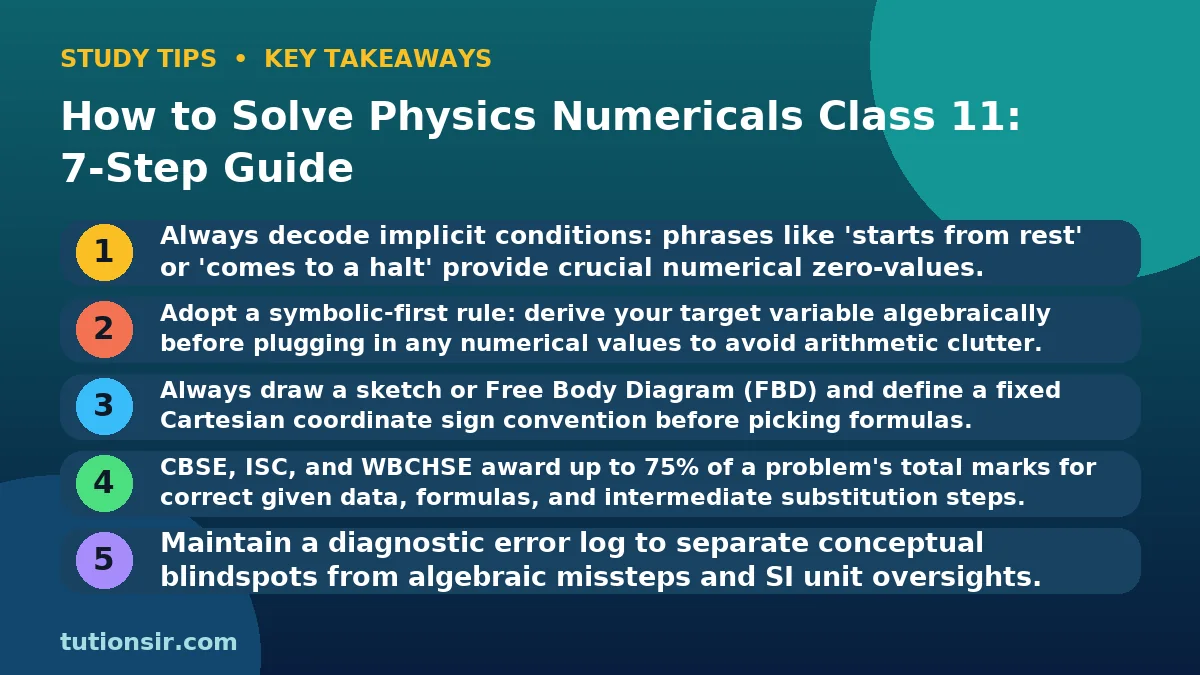
- Always decode implicit conditions: phrases like 'starts from rest' or 'comes to a halt' provide crucial numerical zero-values.
- Adopt a symbolic-first rule: derive your target variable algebraically before plugging in any numerical values to avoid arithmetic clutter.
- Always draw a sketch or Free Body Diagram (FBD) and define a fixed Cartesian coordinate sign convention before picking formulas.
- CBSE, ISC, and WBCHSE award up to 75% of a problem's total marks for correct given data, formulas, and intermediate substitution steps.
- Maintain a diagnostic error log to separate conceptual blindspots from algebraic missteps and SI unit oversights.
Try Tution Sir free for your class and subject.
No card. Registering takes about two minutes.
Why Am I Unable to Solve Physics Numericals Even After Knowing the Formulas?
In Class 10 general science, physics questions generally followed a predictable 'plug-and-chug' pattern. You memorised Ohm's Law or the mirror formula, plugged two explicit numbers into the equation, and calculated the third. In Class 11, the National Council of Educational Research and Training (NCERT) syllabus introduces vectors, calculus, multi-body constraints, and simultaneous equations. A formula in senior secondary physics is not merely a calculation tool; it is a mathematical statement of a fundamental physical law that applies only under rigorous boundary conditions.
Students get stuck because they view physics numericals as pure arithmetic rather than conceptual translation. When a textbook problem presents three sentences of technical description, your primary task is translating natural language into an accurate physical scenario, stripping away real-world noise, and identifying which conservation principle or dynamical law dictates the motion.
Another barrier is the premature insertion of numbers. Substituting raw numbers into equations at line one obscures the underlying relationships, generates messy decimals, and makes spotting algebraic mistakes nearly impossible. Shifting your mindset from formula-hunting to physical modelling is the single most important adjustment you will make this year.
The 7-Step Method: How to Approach Physics Numericals Systematically
Whether you are tackling basic problems from NCERT Class 11 physics or gearing up for competitive benchmarks like JEE Main and NEET UG, approaching a problem with an ad-hoc routine causes panic. Using a repeatable, structured framework eliminates second-guessing and establishes clarity.
Follow this standard 7-step sequence for every problem you encounter during self-study and school examinations.
- Step 1: Read the problem twice with a pen in hand. During your first pass, read for narrative comprehension to understand the scenario. During the second pass, circle every physical parameter and underline the target variable.
- Step 2: Decode explicit and hidden variables. Write down 'Given' data with assigned algebraic symbols (e.g., mass m, time t). Translate implied constraints into mathematical values: 'starts from rest' means initial velocity u = 0; 'comes to a halt' means final velocity v = 0; 'reaches maximum height' means vertical velocity vy = 0; and 'smooth surface' implies coefficient of friction μ = 0.
- Step 3: Harmonise all quantities into SI units immediately. Convert kilometres per hour to metres per second (multiply by 5/18), grams to kilograms (multiply by 10^-3), and centimetres or millimetres to metres. Never proceed with calculations across mixed unit systems.
- Step 4: Draw a schematic sketch and a Free Body Diagram (FBD). Physics is visual. In mechanics and Kinematics, sketch the scenario and assign a coordinate frame (+x to the right, +y upwards). In dynamics problems involving blocks, ropes, and inclined planes, isolate each body, draw all acting forces (normal reaction, gravity, tension, friction), and resolve non-axial vectors into orthogonal components.
- Step 5: Formulate the symbolic governing equation. Identify the physical principle that connects the knowns to the unknowns (e.g., Newton's Second Law, Work-Energy Theorem, or kinematic equations). Solve for the target variable completely in terms of symbols before touching a number.
- Step 6: Substitute values and calculate systematically. Replace symbols with numerical values in the final derived formula. Factor powers of ten separately using scientific notation to keep arithmetic operations straightforward.
- Step 7: Perform a sanity check and dimensional analysis. Inspect the final number. Does the sign make sense according to your coordinate system? Is the magnitude realistic (e.g., a person walking at 300 m/s is an obvious calculation error)? Verify that both sides of your working share identical dimensions as taught in Chapter 1: Units and Measurements.
Mastering the Symbolic-First Rule to Reduce Algebraic Clutter
Beginners often substitute numerical values right away: '15 = 2.5 × a + (0.5)(9.8)...' This creates heavy arithmetic that clutters your workspace. If you make a calculation slip early, you have to recalculate the entire page.
Instead, solve for your target variable algebraically first. For example, if solving for acceleration a from v² = u² + 2as, rearrange it purely into a = (v² - u²) / (2s). This symbolic approach ensures that intermediate constants often cancel out (such as mass m cancelling out on both sides of an inclined plane problem), vastly cutting down mental fatigue and calculator reliance.
How to Solve Numericals in Physics Class 11 Chapter 1 and Kinematics
Let us examine how this framework operates on a typical Class 11 Kinematics numerical that regularly trips up beginners across CBSE, ISC, and WBCHSE boards.
Problem: A car travelling along a straight highway at 72 km/h brakes with uniform deceleration and stops in a distance of 40 metres. Calculate the acceleration of the car and the time taken to come to rest.
- 1. Extract Given Data and Identify Implied Values: Initial velocity u = 72 km/h. Distance s = 40 m. Hidden condition: The car comes to a stop, so final velocity v = 0 m/s. Target variables: acceleration a and time t.
- 2. Unit Harmonisation into SI Units: Convert speed from km/h to m/s: u = 72 × (5/18) = 20 m/s. Distance s = 40 m is already in standard SI units.
- 3. Coordinate Frame: Choose the direction of motion as positive (+x). Because the car slows down, we expect our calculated acceleration to carry a negative sign indicating deceleration.
- 4. Symbolic Manipulation for Acceleration: Choose the kinematic equation relating u, v, s, and a: v² = u² + 2as. Rearrange for acceleration symbolically: a = (v² - u²) / (2s).
- 5. Numerical Substitution: a = (0² - 20²) / (2 × 40) = -400 / 80 = -5 m/s². The negative sign confirms deceleration opposing initial motion.
- 6. Symbolic Manipulation for Time: Choose the kinematic equation relating u, v, a, and t: v = u + at. Rearrange for time: t = (v - u) / a.
- 7. Substitution and Verification: t = (0 - 20) / (-5) = 4 seconds. Sanity check: Time is positive, deceleration magnitude (5 m/s²) is physically realistic for passenger vehicle braking, and units match seconds.
| Stage | Key Checkpoint | Common Student Oversight | Correct Practice |
|---|---|---|---|
| Data Extraction | Identify hidden variables | Assuming zero values must be explicitly stated in the text | Infer implied boundary values (e.g., 'comes to rest' implies v = 0) |
| Unit Harmonisation | Convert to coherent SI system | Mixing km/h with seconds or grams with Newtons | Convert all mass to kg, distances to m, time to s before starting |
| Vector Setup | Draw FBD and coordinate axes | Guessing component directions without a diagram | Sketch free body, indicate positive directions (+x, +y), resolve forces |
| Algebraic Derivation | Symbolic-first simplification | Plugging numbers into formulas at line one | Isolate target variable symbolically to allow term cancellations |
| Final Validation | Sign, magnitude, and unit check | Forgetting units or ignoring an impossible negative value | Verify dimensional consistency, append correct unit, check realism |
What Are the Most Common Silly Mistakes Students Make in Physics Numericals?
When students analyse their low scores on school term exams or mock tests, they often discover that conceptual misunderstanding accounted for only a fraction of lost marks. The bulk of deductions stem from avoidable execution errors.
The following four failure points appear consistently in Class 11 answer scripts across school boards:
- Unit Inconsistencies: Calculating force using mass in grams while acceleration is in m/s², or failing to convert time given in minutes into seconds before entering kinematic formulas.
- Ignoring Coordinate Sign Conventions: In vertical projectile motion, taking acceleration due to gravity g as positive while upward initial velocity is also taken as positive, causing mathematical contradictions.
- Angle Misidentification in Vector Resolution: Blindly assuming horizontal components are always cos(θ) and vertical components are sin(θ). If the angle is given relative to the vertical axis, the components invert (vertical becomes cos, horizontal becomes sin).
- Omitting Final Units: Leaving a pure numerical figure (e.g., 'Writing 25 instead of 25 N') results in an automatic half-mark deduction according to standard CBSE evaluation guidelines.
Does CBSE Give Step Marking in Class 11 Physics Numericals?
This marking structure means that even if you make a simple arithmetic mistake on the final line under exam pressure, you can still secure 2 or 2.5 marks out of 3, provided you recorded the given data, wrote the explicit formula, and substituted correctly.
Never leave a physics numerical blank in a school or board exam. Writing down the given physical quantities and stating the corresponding physical law guarantees partial credit.
- Formula / Conceptual Law (0.5 to 1 Mark): Awarded for explicitly stating the correct physical formula or law in symbolic form (e.g., F_net = ma or conservation of linear momentum).
- Data Substitution (1 Mark): Awarded for correctly inserting the numerical values into the formula with converted SI units.
- Mathematical Calculation (0.5 to 1 Mark): Awarded for accurate algebraic simplification leading to the final magnitude.
- Final Value with Unit and Sign (0.5 Mark): Awarded strictly if the numerical value is accurate, includes the appropriate SI unit, and exhibits the correct sign convention.
How Can Beginners Improve Calculation Speed in Class 11 Physics Numericals?
A common complaint among students transitioning to Class 11 is running out of time during exams. Lengthy calculations involving decimals, square roots, and powers of ten consume excessive minutes when handled inefficiently.
To speed up your execution without compromising precision, incorporate these specific mathematical habits into your daily practice routine:
- Separate Scientific Notation First: Immediately group all powers of ten together before performing multiplication or division on significant figures. For example, simplify (6.67 × 10^-11 × 6 × 10^24) / (6.4 × 10^6)² by isolating the powers of ten: 10^(-11 + 24 - 12) = 10^1, leaving you with simple arithmetic on the base numbers.
- Memorise Reciprocals and Standard Fractions: Know fraction equivalents cold (1/2 = 0.5, 1/3 = 0.33, 1/4 = 0.25, 1/6 = 0.167, 1/7 = 0.143, 1/8 = 0.125). In NEET UG and JEE Main multiple-choice questions, recognising fractions saves valuable minutes.
- Use g = 10 m/s² for Approximations When Permitted: Always check question instructions. If g = 9.8 m/s² is not strictly mandated, or when solving competitive MCQs with widely spaced options, using g = 10 m/s² speeds up arithmetic drastically.
- Master Right-Triangle Trigonometric Values: Beyond standard 30°, 45°, and 60° angles, Class 11 physics extensively relies on the 3-4-5 right triangle. Commit to memory that sin(37°) ≈ 0.6, cos(37°) ≈ 0.8, sin(53°) ≈ 0.8, and cos(53°) ≈ 0.6.
How to Start Physics Numericals from Zero Class 11: A 4-Week Action Plan
Throughout this progression, maintain a dedicated 'Error Log' notebook. Divide every mistake into four diagnostic categories: Conceptual (didn't know which law applied), Reading (missed a hidden constraint), Unit (forgot to convert to SI), or Arithmetic (calculation blunder). Reviewing this error log every Sunday ensures you do not repeat the same missteps.
When studying independently, pairing this diagnostic routine with intelligent learning platforms like Tution Sir allows you to clear doubts instantly, test step-by-step solutions, and receive targeted feedback on board-aligned practice questions.
- Week 1: Fundamentals of Units, Dimensions, and Vector Resolution. Master dimensional homogeneity from Chapter 1. Practise resolving at least 25 different force vectors into x and y components across various angles and inclined planes.
- Week 2: NCERT In-Text Solved Examples. Work through every single solved example in NCERT Kinematics (Motion in a Straight Line and Motion in a Plane). Do not read the solutions passively—cover the solution with paper, attempt it on your own, and uncover line by line to compare your approach.
- Week 3: Single-Concept End-of-Chapter Exercises. Move to NCERT back exercises and standard beginner reference texts. Solve 10 problems daily focusing strictly on single-concept questions before trying linked multi-body problems.
- Week 4: Timed Multi-Step Dynamics and Work-Energy Problems. Tackle problems involving friction, pulley systems, and energy conservation. Set a timer for 6 minutes per question to simulate realistic exam pressure.
Frequently asked questions
Why am I unable to solve physics numericals even after knowing the formulas?
Knowing formulas is only memory; solving numericals requires translating verbal descriptions into physical models. Students struggle because they fail to identify hidden constraints (like zero initial velocity), miss vector directions, or plug numbers in before establishing the governing physical laws and coordinate axes.
How do I identify which formula to use in a physics numerical?
List all given quantities and your target unknown with their algebraic symbols. Compare this list against your formula inventory to find the equation containing only those variables, or apply core conservation laws (energy or momentum) when intermediate motion details are unknown.
How can beginners improve calculation speed in Class 11 physics numericals?
Separate powers of ten using scientific notation before computing base numbers. Memorise decimal values of standard fractions (1/2 through 1/8) and 37°/53° right-triangle values. Always derive the final formula symbolically before inserting numbers to cancel common factors early.
Does CBSE give step marking in Class 11 physics numericals?
Yes. CBSE evaluation schemes distribute marks across stating the formula (0.5–1 mark), substituting data in SI units (1 mark), calculation steps (0.5–1 mark), and the final answer with units (0.5 mark). Writing correct initial steps guarantees partial credit even if calculations fail.
What are the most common silly mistakes students make in physics numericals?
The most frequent blunders are mixing non-SI units (like km/h with seconds), confusing vector resolution angles (swapping sine and cosine), assigning inconsistent signs to acceleration and velocity, and failing to write the correct SI unit at the end.
Is it necessary to memorize all physics formulas for numericals?
No. Rather than memorising dozens of specialised formulas, master fundamental laws (Newton's laws, equations of motion, work-energy theorem, and conservation principles). Most specialised formulas are easily derived from these root concepts in one or two algebraic steps.
How should I handle unit conversion and sign conventions in kinematics numericals?
Establish an explicit Cartesian frame at the start (e.g., upward and rightward as positive). Any vector pointing downward, such as gravitational acceleration (g = -9.8 m/s²), receives a negative sign. Convert all values to SI units (metres, seconds, kilograms) before entering calculations.
Which reference book is best for Class 11 physics numerical practice for beginners?
Start with NCERT in-text solved examples and exercises. For beginner-friendly graded practice, SL Arora's 'Simplified Physics' provides step-by-step scaffolding. Once comfortable, transition to HC Verma's 'Concepts of Physics' (Volume 1) to build analytical depth for competitive exams.
Sources and official links
- Central Board of Secondary Education - Senior Secondary Curriculum
- National Council of Educational Research and Training - Textbooks in Physics
Exam rules and notifications change. Confirm dates, fees and eligibility on the official website before acting. Spotted an error? Email support@tutionsir.com. See our editorial policy.
Keep learning
How to Solve Physics Numericals Easily: 5-Step Guide
Struggling to solve numerical problems even when you remember every formula is the single most common frustrat
Read →How to Avoid Silly Mistakes in CBSE Class 10 Maths: Guide
Every year, thousands of Class 10 board students drop from a 95 to an 85 not from a lack of mathematical knowl
Read →How to Solve ICSE Class 10 Topographical Map: 2026 Guide
Topographical map interpretation in ICSE Class 10 Geography (H.C.G. Paper 2) can feel daunting, but it follows
Read →Do not let another week go by without a plan
Reading about the exam does not raise marks. Practice does. Register free now and start with the one topic that worries you most. Small daily practice beats a last-minute rush.
- Free plan, no card needed
- Ask any doubt and get a step-by-step answer
- Practice questions with explanations
Free plan, no card needed. Your progress is saved to your account.