CBSE & ICSE • Study Strategies
How to Use Active Recall for Board Exams: 4-Step Guide
Staring at highlighted NCERT pages for hours often creates a false sense of mastery that evaporates in the exam hall. Mastering how to use active recall for board exams replaces passive rereading with mental retrieval, ensuring you can reproduce answers under strict exam pressure.
Quick answer
To use active recall for board exams, follow a four-step framework: first, convert textbook headings into syllabus questions; second, close your book and write down everything you remember; third, audit your answers against NCERT keys and board marking schemes; fourth, schedule spaced retrieval across day 1, 3, 7, and 21.

Key takeaways
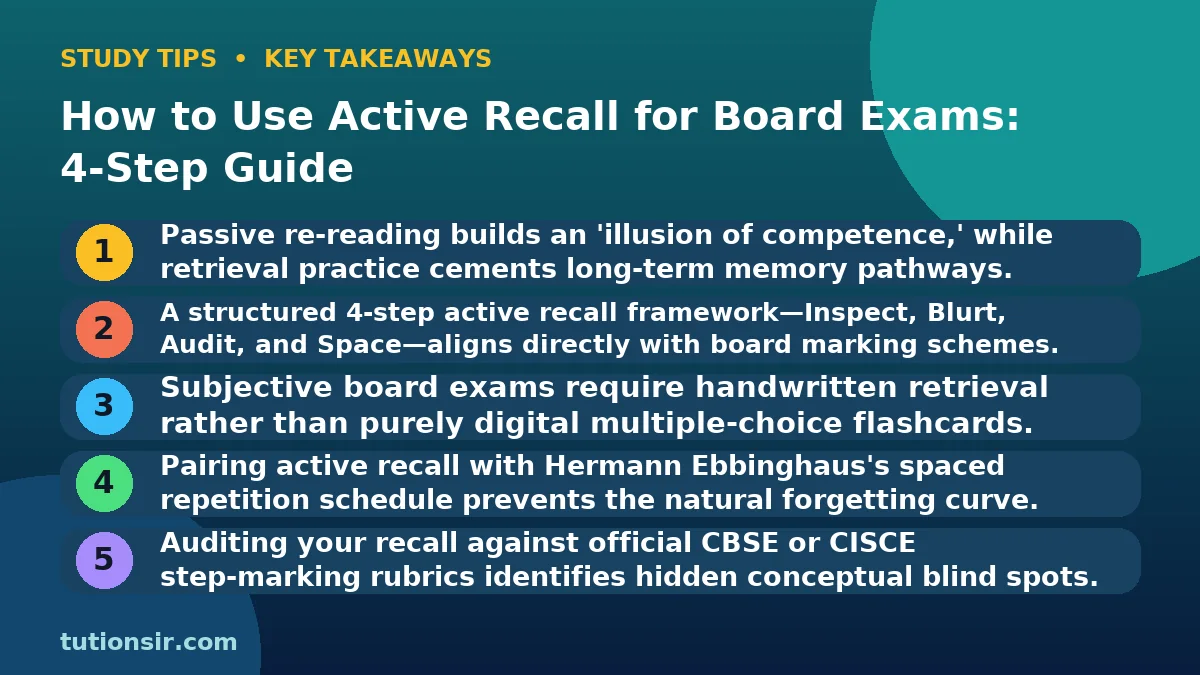
- Passive re-reading builds an 'illusion of competence,' while retrieval practice cements long-term memory pathways.
- A structured 4-step active recall framework—Inspect, Blurt, Audit, and Space—aligns directly with board marking schemes.
- Subjective board exams require handwritten retrieval rather than purely digital multiple-choice flashcards.
- Pairing active recall with Hermann Ebbinghaus's spaced repetition schedule prevents the natural forgetting curve.
- Auditing your recall against official CBSE or CISCE step-marking rubrics identifies hidden conceptual blind spots.
Try Tution Sir free for your class and subject.
No card. Registering takes about two minutes.
Active Recall vs Passive Learning: Why Re-reading NCERT Textbooks Fails
Every year, thousands of secondary and higher secondary students spend late nights highlighting paragraphs, reading summaries, and admiring neat, color-coded notes. Yet when they sit for their CBSE Class 10 Social Science paper or Class 12 Chemistry exam, their minds draw blanks on five-mark subjective questions. Cognitive psychologists call this phenomenon the 'illusion of competence.' When your eyes glide over an open textbook, your brain easily processes familiar text and tricks you into believing you have mastered the underlying concepts. In reality, recognition is not recall.
Groundbreaking research published by Henry L. Roediger III and Jeffrey D. Karpicke in Psychological Science demonstrated the profound power of the 'testing effect'. Their experiments proved that students who actively practice retrieving information from memory retain substantially more knowledge over long delays—such as weeks or months—than those who spend equivalent time restudying or re-reading notes. Re-reading deposits information passively into short-term working memory, where it quickly decays. In contrast, the mental effort of dragging facts out of memory strengthens neural connections and builds durable retrieval pathways.
Furthermore, German psychologist Hermann Ebbinghaus discovered through his pioneering research on memory that without intentional reinforcement, humans forget up to 70 percent of newly learned information within 24 hours. Indian board examinations—whether conducted by CBSE, CISCE (ICSE/ISC), or state boards like WBBSE and WBCHSE—do not test whether you recognize a concept when prompted. They demand that you reproduce precise definitions, labeled anatomical diagrams, chemical reactions, and mathematical derivations on an unassisted, blank answer sheet. Shifting from passive review to an active recall revision strategy is therefore essential for board exam success.
- Passive learning relies on recognition; active recall forces cognitive generation without visual prompts.
- Re-reading feels fluent and easy, whereas genuine retrieval feels challenging because it reconstructs long-term memory traces.
- Retrieval practice immediately exposes what you do not know, eliminating false confidence before exam day.
- Pairing retrieval with spaced practice interrupts the Ebbinghaus forgetting curve.
The 4-Step Active Recall Revision Strategy for Board Exams
Transitioning from passive textbook reading to cognitive retrieval requires a systematic routine. Many students abandon active recall because they find random quizzing disorganised or emotionally exhausting. To conquer voluminous board exam syllabi, use this proven, four-step revision strategy designed specifically around NCERT textbooks and board marking schemes.
Step 1: Inspect & Convert (Transform Content into Target Inquiries)
Never begin a chapter by merely reading it from front to back. Instead, perform an active inspection of the NCERT chapter to extract core learning objectives. Convert every major heading, sub-heading, and syllabus outcome into an active, board-style question. For example, instead of reviewing the heading 'Reactivity Series of Metals' in Class 10 Science, write down: 'What is the reactivity series, and how does displacement explain why zinc displaces copper from copper sulphate solution?'
Keep a dedicated 'Retrieval Prompts Notebook' alongside your textbook. Write down technical terms, governing laws, mechanism stages, and conditions (such as temperature, catalyst, and pressure). By converting static text into targeted inquiries, you provide your brain with the exact interrogative cues it will encounter in section B, C, and D of your board question papers.
Step 2: Retrieve & Blurt (Closed-Book Handwritten Brain Dump)
This step is where true learning happens. Close your books, tuck your notes out of sight, and place a blank sheet of paper in front of you. Pick a target topic or answer one of your generated questions from memory. Using a pen, write out everything you can remember about that concept. This is widely known as the blurting method for board exams.
Write definitions verbatim if your board requires exact phrasing, sketch diagrams with neat arrows, state SI units, and write out chemical equations with correct physical states. Crucially, do not use digital multiple-choice apps for this step. CBSE and ICSE exams require descriptive, pen-and-paper writing speed, neat handwriting, and structured formatting. Writing by hand engages motor memory and replicates exact exam hall conditions.
Step 3: Audit & Scheme (Evaluate Against NCERT and Board Rubrics)
Once you have exhausted your memory, open your NCERT textbook and the official board marking scheme. Take a red or green pen and audit your handwritten blurt against the authoritative source. This step must not be skipped; retrieval practice without timely correction can accidentally reinforce errors.
Compare your response line by line. Did you miss a vital keyword like 'semi-permeable' or 'inelastic'? Did you forget to balance your chemical equation or specify standard temperature and pressure? Both CBSE and CISCE employ rigorous step-marking. Award yourself marks based on whether your answer included the specific value points that official examiners look for. Add any omitted facts directly into your audit sheet in colored ink so that your conceptual blind spots stand out clearly.
Step 4: Space & Re-test (Overcome the Forgetting Curve)
A single retrieval session does not guarantee permanent memory. To overcome the Ebbinghaus forgetting curve, schedule your retrieval across widening temporal intervals. Re-test yourself on the same topic after 24 to 48 hours (Interval 1), then after 7 days (Interval 2), and once again at 21 days (Interval 3).
During these subsequent spaced sessions, focus exclusively on the specific value points you missed during your previous audit. If you blurted 80 percent of the steps of the Haber process correctly on Day 1 but forgot the optimum iron/molybdenum catalyst conditions, your Day 3 recall session should target those conditions first before expanding back to the entire unit.
Subject-Specific Active Recall Workflows for Classes 10 and 12
Active recall is not a one-size-fits-all method. Different academic disciplines make different cognitive demands, meaning your retrieval exercises must adapt to the structure of each syllabus.
Active Recall for Science & Biology (Diagrams and Mechanisms)
For subjects like Class 10 Life Processes or Class 12 Biology (Genetics, Biotechnology, Reproduction), focus heavily on closed-book diagramming and causal flowcharts. Instead of staring at the diagram of the human nephron or the reflex arc, draw the entire structure on a blank paper from memory, label every part, and annotate each label with its exact physiological function. For chemical reactions, write down the starting reactants and draw the reaction pathway, naming reagents, by-products, and catalyst temperatures entirely from recall.
Active Recall for Physics and Mathematics (Derivations and Problem Archetypes)
Derivations in Class 12 Physics (such as the mirror formula, electric field due to a dipole, or lens maker's equation) must be recalled logically. Do not memorize lines of algebra. Instead, write down the starting physical law or assumption, sketch the ray diagram or field geometry without looking at a guide, and derive the mathematical expression down to its final form. In Mathematics, maintain a 'Formula Retrieval Sheet' where you list only equation names (e.g., 'Integration by Parts Formula' or 'Section Formula') and write the raw equations from memory.
Active Recall Question Method for Social Science and Humanities
In Class 10 History or Political Science, chronological order and constitutional terminologies decide top marks. Use Cornell-style retrieval sheets: create a wide left margin for retrieval triggers (such as 'Causes of the Non-Cooperation Movement' or 'Provisions of the Poona Pact') and leave the right column covered while writing out primary actors, dates, and historical outcomes. For geography, practice sketch maps of India from memory, locating major ports, soil belts, and dam projects without an atlas.
| Revision Dimension | Passive Re-Reading / Highlighting | Digital Flashcard Apps (MCQ) | 4-Step Active Recall (Pen & Paper) |
|---|---|---|---|
| Cognitive Mechanism | Passive visual familiarity & recognition | Cued recognition from multiple options | Effortful free retrieval & neurological synthesis |
| Board Exam Alignment | Very low; creates false exam confidence | Moderate; useful for objective 1-mark MCQs | Exceptional; matches descriptive answer formats |
| Retention after 7 Days | Low (typically drops below 20-30%) | Moderate (heavily dependent on app triggers) | High (retains 60-80% of core value points) |
| Evaluation Method | None (assumes student knows highlighted text) | Automated right/wrong app check | Rigorous audit against official board marking rubrics |
| Writing Stamina Impact | Zero motor practice | Zero handwritten motor practice | Builds physical speed, neatness, and muscle memory |
How to Combine Active Recall with Spaced Repetition: A 3-Week Blueprint
Spaced repetition transforms isolated retrieval sessions into a synchronized revision calendar. Rather than revising Chapter 1 completely and ignoring it until February pre-boards, interleave multiple chapters across a three-week cyclical rotation.
The following weekly framework illustrates how a Class 10 or Class 12 student can organize daily 45-minute active recall blocks alongside regular school homework and laboratory preparation.
- Week 1 (Encoding & Initial Retrieval): Learn new NCERT chapter sub-units on Monday and Tuesday; perform Step 2 blurting on Wednesday evening; audit against marking schemes on Thursday.
- Week 2 (First Expansion Review): Re-test Week 1 material on Day 7 using high-yield Previous Year Questions (PYQs) without consulting solutions. Mark errors in red.
- Week 3 (Consolidation & Synthesis): Conduct closed-book timed mini-tests combining Week 1 and Week 2 concepts to build cognitive stamina and cross-topic retrieval fluency.
Common Active Recall Mistakes That Drain Study Time
While retrieval practice is scientifically backed by cognitive researchers worldwide, executing it incorrectly leads to frustration and wasted revision hours. Look out for these four common mistakes:
First, confusing recognition with retrieval via digital flashcard apps. Swiping through pre-made digital flashcards or multiple-choice quizzes often tests only whether you recognize the right option among distractors. Descriptive board exams require free-form generation. If an app provides four options, your brain works far less than if you must write the answer on a clean sheet of paper.
Second, passive blurting. Some students keep their textbooks open at an angle, peeking at headers or diagrams whenever they feel stuck. A glance breaks the cognitive retrieval effort. True neural strengthening occurs during the uncomfortable seconds when you actively strain to remember a half-forgotten term. If you cannot recall it, leave a blank, complete the blurt, and identify the gap during the audit phase.
Third, skipping the marking-scheme audit. Writing a two-page blurt is useless if you fail to check whether your answer meets the CBSE or CISCE word count, incorporates standard terminology, or includes necessary qualifying steps. Always align your practice with board evaluation guidelines.
To streamline this disciplined routine, platforms like Tution Sir provide students with structured, board-aligned retrieval prompts and instant feedback to verify whether self-generated answers meet official evaluation benchmarks.
Pre-Exam Active Recall Execution Checklist
Before entering your intensive preparatory leave or pre-board testing series, run through this practical active recall checklist to ensure every chapter is thoroughly indexed in your long-term memory.
- All major NCERT headings transformed into distinct question prompts in your revision notebook.
- Closed-book blurts completed by hand on unlined paper under realistic time limits.
- Every blurt checked with a colored pen against the official NCERT answer keys and CBSE/ICSE sample paper marking schemes.
- All missed keywords, values, units, and steps compiled into an active 'Gap Bank' for targeted re-testing.
- Calendar dates logged for Day 1, Day 3, Day 7, and Day 21 spaced retrieval sweeps.
Frequently asked questions
What is the 4-step active recall method for exams?
The 4-step active recall method consists of: (1) Inspect & Convert, where textbook headings become questions; (2) Retrieve & Blurt, writing answers from memory on blank paper; (3) Audit & Scheme, checking outputs against NCERT texts and board marking rubrics; and (4) Space & Re-test, scheduling follow-ups at 1, 3, 7, and 21-day intervals.
Is active recall better than re-reading NCERT textbooks?
Yes. Research by Roediger and Karpicke shows retrieval practice produces significantly higher long-term retention than re-reading. Re-reading generates familiarity without building retrieval strength, leaving students unable to reconstruct long, multi-step answers independently during board examinations.
What is the blurting method in active recall revision?
The blurting method involves studying a specific syllabus topic, closing all textbooks and notes, and writing down every remembered fact, equation, diagram, and keyword on a blank sheet of paper. Once finished, you cross-check your blurt against your textbook to identify and fix omitted concepts.
How do you use active recall for CBSE board exams without digital flashcards?
You can use two-column Cornell notes, paper flashcards, or past-year question banks. Write questions on the left side of your notebook and conceal the right side while handwriting answers. This pen-and-paper method prepares you directly for the subjective, handwritten format required in CBSE and CISCE board exams.
Can active recall be used for maths formulas and science derivations?
Yes. Write the name of the theorem, derivation, or problem archetype on a blank page. Without looking at solutions, derive the complete mathematical proof or formula step-by-step from core axioms. Auditing against the board's official step-marking criteria ensures you do not omit crucial intermediary steps.
How often should you do active recall before board exams?
Conduct short active recall blurts daily at the end of each study block. For broader topic mastery, use spaced repetition intervals: test newly covered material after 24 hours, review it on Day 7, and re-test on Day 21. This distributed frequency halts memory decay before final board papers.
What is the difference between active recall and the Feynman technique?
Active recall is the overarching cognitive process of pulling information out of memory without looking at notes. The Feynman Technique is a specific form of active recall where you explain a concept in simple, plain language as if teaching a beginner, exposing gaps in your fundamental understanding.
Sources and official links
- Psychological Science (Roediger & Karpicke, 2006)
- Central Board of Secondary Education (CBSE Official)
- Council for the Indian School Certificate Examinations (CISCE)
- National Council of Educational Research and Training (NCERT)
Exam rules and notifications change. Confirm dates, fees and eligibility on the official website before acting. Spotted an error? Email support@tutionsir.com. See our editorial policy.
Keep learning
How to Solve Physics Numericals Easily: 5-Step Guide
Struggling to solve numerical problems even when you remember every formula is the single most common frustrat
Read →How to Avoid Silly Mistakes in CBSE Class 10 Maths: Guide
Every year, thousands of Class 10 board students drop from a 95 to an 85 not from a lack of mathematical knowl
Read →Feynman Technique for School Students: 4 Steps to Learn
Struggling to memorize dense Science and Social Science chapters before board exams? The Feynman Technique tra
Read →Do not let another week go by without a plan
Reading about the exam does not raise marks. Practice does. Register free now and start with the one topic that worries you most. Small daily practice beats a last-minute rush.
- Free plan, no card needed
- Ask any doubt and get a step-by-step answer
- Practice questions with explanations
Free plan, no card needed. Your progress is saved to your account.