Study Skills & Active Learning
Feynman Technique for School Students: 4 Steps to Learn
Struggling to memorize dense Science and Social Science chapters before board exams? The Feynman Technique transforms passive cramming into active mastery by forcing you to explain complex syllabus topics in plain, unmistakable language.
Quick answer
The Feynman Technique for school students is an active-recall study framework where you learn tough concepts by explaining them in plain, jargon-free words as if teaching a middle-school beginner. By identifying precisely where your explanation stumbles, you revisit source textbooks to fix knowledge gaps and build deep intuition.

Key takeaways
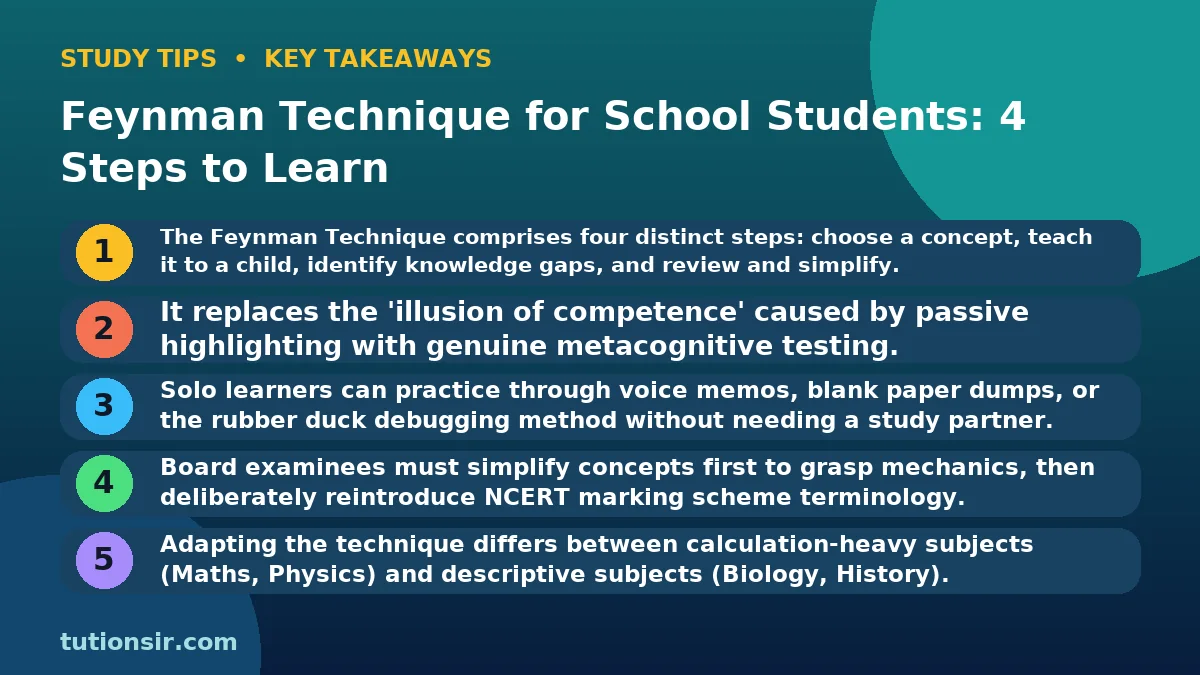
- The Feynman Technique comprises four distinct steps: choose a concept, teach it to a child, identify knowledge gaps, and review and simplify.
- It replaces the 'illusion of competence' caused by passive highlighting with genuine metacognitive testing.
- Solo learners can practice through voice memos, blank paper dumps, or the rubber duck debugging method without needing a study partner.
- Board examinees must simplify concepts first to grasp mechanics, then deliberately reintroduce NCERT marking scheme terminology.
- Adapting the technique differs between calculation-heavy subjects (Maths, Physics) and descriptive subjects (Biology, History).
What Are the 4 Steps of the Feynman Technique?
The Feynman Technique is a four-step mental framework designed to test and deepen your understanding of any complex subject by stripping away unnecessary jargon. Developed from the learning habits of Nobel Prize-winning physicist Richard Feynman—chronicled by biographer James Gleick in his 1992 work 'Genius'—the method challenges you to communicate ideas with radical simplicity. Feynman discovered as a student that there is a profound difference between knowing the name of something and truly understanding how it works.
For school students navigating rigorous boards like CBSE, ICSE, WBBSE, and WBCHSE, the technique serves as an honest diagnostic tool. Rather than allowing you to deceive yourself into believing you understand a chapter because you can recognize highlighted lines in your textbook, it reveals the exact boundaries of your comprehension. The classical model follows four sequential stages: selecting a targeted concept, explaining it to an imagined young learner, pinpointing where your explanation hesitates or defaults to jargon, and returning to primary textbooks to simplify the explanation using everyday analogies.
- Step 1: Choose a concept you want to learn and write its title at the top of a blank sheet of paper.
- Step 2: Explain the concept in simple words as if teaching an eleven-year-old child who has no prior background in the subject.
- Step 3: Identify your knowledge gaps where you stumble, get confused, or hide behind textbook jargon.
- Step 4: Return to your NCERT or board textbook to clarify those weak spots, then rewrite your explanation using clear analogies.
Why the Feynman Technique Works Better Than Rereading Notes
The Feynman Technique outperforms rereading because it leverages active recall and metacognition rather than passive visual familiarity. Educational psychologist John Dunlosky and his research team published a definitive review in 'American Educator' evaluating common student revision habits. Their findings confirmed that popular techniques like passive rereading and color highlighting offer low utility, fostering what cognitive scientists call the 'familiarity illusion' or the 'illusion of competence.' When you read a solved derivation or a paragraph on cellular respiration repeatedly, the text feels fluid to your eyes, fooling your brain into assuming you have mastered the underlying principles.
When an exam paper confronts you with an application-oriented question, that passive recognition evaporates. In contrast, the Feynman Technique activates the 'testing effect.' By compelling your brain to retrieve stored information, organize it logically, and generate novel sentences without peeking at notes, the technique forces deep neurological encoding.
Furthermore, stripping out memorized textbook vocabulary prevents you from using high-sounding words as crutches. If you cannot explain why water rises in capillary tubes or how monetary inflation erodes savings without quoting a verbatim dictionary definition, you do not yet own the knowledge. Self-explanation exposes hidden misconceptions long before you sit in the board exam hall.
Feynman Learning Technique Step by Step Guide for School Students
Applying the Feynman technique study method to dense school curricula requires discipline and a clean desk. Here is the exact operational sequence you should execute for tough chapters in Class 9 through 12 Science and Social Science.
Step 1: Target a Single Micro-Concept
Do not attempt to apply the technique to an entire chapter like 'Electricity' or 'Ecosystems' in one sitting. Select a distinct sub-topic that can be tackled in a single study block. For instance, pick 'How a p-n junction diode conducts current under forward bias' or 'The difference between vegetative propagation and sexual reproduction.' Take a clean, unruled sheet of paper and write this concept title at the top.
Step 2: Write Out the Explanation in Everyday Words
Imagine an intelligent student from Class 6 sitting across from you. Without looking at your reference guides, lecture notes, or textbooks, explain how the mechanism works from scratch. Write your explanation in clear, simple sentences. If you must introduce a technical term, you are required to define it immediately using a practical analogy. If you find yourself writing down formal definitions verbatim, pause and rephrase them in your own conversational voice.
Step 3: Pinpoint Knowledge Gaps and Language Breakdowns
Inevitably, your explanation will stall. You might realize you do not know why electrons cross the barrier, how a constitutional amendment actually passes through parliament, or why a minus sign appears in a thermodynamic equation. These points of friction are your learning targets. Circle these gaps on your sheet in red ink. They represent the exact gaps where you would lose marks on higher-order thinking skill (HOTS) questions.
Step 4: Review Source Material, Refine, and Build Analogies
Now reopen your NCERT textbook, reference guides, or class notes. Study only the specific sections corresponding to your circled gaps until the causal sequence makes absolute sense. Close the textbook again and complete your written explanation. Finally, anchor the idea with an intuitive analogy from daily life, ensuring the concept is permanently lodged in your long-term memory.
| Study Method | Cognitive Effort | Risk of False Fluency | Retention After 30 Days | Ideal Use Case |
|---|---|---|---|---|
| Passive Rereading | Low | Extremely High (creates illusion of competence) | Low (under 20% on conceptual tests) | Initial orientation to a brand-new syllabus topic |
| Linear Highlighting | Low | High (marks pages without active processing) | Low (focuses on isolated phrases) | Bookmarking crucial tables and numerical data points |
| Flashcards / Active Recall | Medium to High | Low to Medium (tests isolated facts) | High (strengthens neural retrieval pathways) | Memorizing dates, chemical valencies, and formula sets |
| The Feynman Technique | Very High | Near Zero (exposes gaps immediately) | Extremely High (builds relational schema) | Mastering complex theories, mechanisms, and derivations |
Subject-Wise Execution: Feynman Method for Physics, Maths, and Descriptive Theory
A common mistake among secondary school students is trying to use the exact same explanation style for every discipline. Calculation-heavy STEM topics and fact-dense humanities require distinct adaptations of the Feynman framework.
Adapting for Mathematics and Physics Derivations
In quantitative subjects, the trap is memorizing algebraic transitions without grasping the physical intuition. When applying the Feynman technique for maths and science formulas, your explanation must answer three underlying questions: What physical reality does this formula measure? Why does changing one variable force another to increase or drop? What is the logical bridge connecting Step A of the derivation to Step B?
For example, when deriving the lens formula or kinematic equations, explain each algebraic operation as a physical balance. Describe the equals sign not as a procedural command, but as a weighing scale where energy, mass, or dimensional symmetry must remain conserved throughout the problem.
Adapting for Biology, History, and Social Sciences
For descriptive subjects like Class 10 History or Class 12 Biology, the Feynman framework works best by treating topics as causal narratives rather than disconnected bullet points. When studying the Non-Cooperation Movement or human endocrine regulation, explain the material as a cause-and-effect chain. Who was unhappy, what catalyst triggered the reaction, what intermediate mechanisms escalated the situation, and what was the final equilibrium?
Constructing a coherent narrative removes the need to memorize disjointed dates and nomenclature. If you understand the social pressures leading to the Rowlatt Act or the hormonal feedback loop controlling blood glucose levels, the associated details fall into place effortlessly.
Feynman Technique Examples for CBSE and ICSE Board Exams
To see how to explain difficult concepts simply using the Feynman method, consider these three real-world syllabus topics from NCERT and ICSE curricula.
Example 1: Chemical Bonding (CBSE Class 10 Science)
Textbook jargon: 'An ionic bond is formed by the electrostatic attraction between oppositely charged ions produced by the complete transfer of one or more valence electrons from an electropositive atom to an electronegative atom.'
Feynman child-level explanation: 'Think of two friends at lunch. Sodium has a heavy sweet snack that it does not want because holding onto it makes it feel unstable and bloated. Chlorine is sitting right next to it, starving, and needs exactly one sweet snack to feel completely satisfied. Sodium hands the snack directly over to Chlorine. Now, Sodium feels lighter and gets a positive mood boost (+1), while Chlorine has taken on an extra item and gains a negative charge (-1). Because one is positive and the other is negative, they snap together like two opposite poles of a magnet. That strong magnetic grip is an ionic bond.'
Example 2: Heredity and Monohybrid Cross (ICSE Class 10 Biology)
Textbook jargon: 'Mendel’s Law of Segregation states that allele pairs separate or segregate during gamete formation, and randomly unite at fertilization, maintaining phenotypic and genotypic ratios.'
Feynman child-level explanation: 'Imagine every plant receives two secret recipe cards for stem height—one card from its mother plant and one card from its father plant. The card for "Tall" is written in bold black ink (dominant), while the card for "Dwarf" is written in faint pencil (recessive). If a young plant holds even one bold card, the builder reads only that bold card and constructs a tall plant. But when this plant creates seeds of its own, it does not blend the two cards together; it neatly splits the deck and slips just one recipe card into each seed packet. If two seeds carrying faint pencil cards happen to meet, the builder finally builds a short plant because no bold card is there to override it.'
Example 3: Trigonometric Identities (Class 10 Mathematics)
Textbook jargon: 'Prove that sin squared theta plus cos squared theta equals one for all acute angles theta.'
Feynman child-level explanation: 'Picture a right-angled triangle as a walking ramp. The hypotenuse is the walking surface itself, which we will set as a standard length of one meter. Sine represents how high above the ground you are standing, while cosine represents how far along the floor you have walked forward. Pythagoras discovered thousands of years ago that the square of your floor distance added to the square of your vertical height must always equal the square of the ramp slope. Since our ramp slope is exactly one, and one multiplied by itself is still one, your vertical height squared plus your horizontal distance squared will always equal one, regardless of how steep or shallow you tilt the ramp.'
Can You Use the Feynman Technique Alone Without a Study Partner?
A frequent objection raised by students studying at home in India is the lack of a suitable study partner or an available younger sibling. You do not need an actual human listener to make the Feynman Technique effective. Independent learners rely on three proven solo workflows.
- The Blank Sheet Brain Dump: Clear your desk of all gadgets and textbooks. Take an unlined A4 sheet, draw a line down the middle, and write your child-level explanation on the left side. Use the right-hand column exclusively for drawing rough diagrams, stick figures, and conceptual arrows.
- Voice Memo Dictation: Open the standard voice recorder app on your smartphone or computer. Press record, set the phone face down, and speak out loud for three minutes, explaining the concept as if you were hosting a podcast for middle-schoolers. Play the recording back while holding your NCERT textbook. You will instantly cringe at every hesitation, vague claim, and inaccurate transition—marking those exact spots for restudy.
- The Rubber Duck Method: Originally invented by software engineers who explain stubborn coding bugs line-by-line to an inanimate plastic duck on their desks, the rubber duck method adapts seamlessly to exam revision. Place a small toy, figurine, or even a water bottle on your study desk. Direct your spoken explanation entirely to that object. The cognitive effort required to verbalize your thoughts aloud activates speech centers that force clarity, bypassing silent mental shortcuts.
Bridging the Gap: From Simple Analogies to Board Exam Marking Schemes
While simplifying concepts builds deep comprehension, Indian board evaluators for CBSE, ICSE, and state boards grade your answer sheets against precise, rubric-based marking schemes. If a CBSE Class 12 Chemistry question asks about nucleophilic substitution and you only write an analogy about two people swapping seats on a bus, you will receive zero marks. Understanding and exam presentation are two distinct phases of the revision cycle.
The solution is the 'Two-Layer Feynman Workflow.' Layer One is the simplification phase: strip away the technical vocabulary, find the causal mechanism, and build intuitive analogies until you could explain the concept to an eleven-year-old. Once that mental model is solid, you transition immediately to Layer Two: the technical translation phase.
In Layer Two, you rewrite your plain-English explanation into a formal board-style response. You take the child-friendly skeleton and deliberately graft the essential NCERT keywords back onto it—terms like 'electronegativity gradient,' 'steric hindrance,' 'conservation of angular momentum,' or 'equitable distribution.' Because you already understand the underlying gears, these keywords now act as precise labels for real concepts rather than hollow sounds memorized under stress. Platforms like Tution Sir help students practice this transition by pairing AI-driven concept diagnostics with board-specific mock evaluations to ensure technical accuracy matches intuitive grasp.
A 25-Minute Feynman Micro-Sprint Study Plan for Revision
Attempting to run the Feynman Technique for four continuous hours causes severe cognitive fatigue. The self-explanation effect requires intense mental exertion. To make this study habit sustainable during exam preparation months, structure your revision into 25-minute Feynman micro-sprints.
- Minutes 0 to 5 (Target & Read): Select a single sub-topic from your syllabus. Spend five minutes skimming the core definitions, formulas, or diagrams in your NCERT text to refresh the parameters.
- Minutes 5 to 15 (Active Solo Retrieval): Close all books. Take a blank page and spend ten uninterrupted minutes writing or speaking your simplified explanation and sketching functional analogies.
- Minutes 15 to 20 (Gap Analysis): Reopen your textbook. Compare your explanation against the official material. Highlight missed steps, flawed logic, or unaddressed conditions in your notebook.
- Minutes 20 to 25 (Refinement & Keyword Integration): On the bottom half of your page, draft the final three-sentence summary combining your conceptual clarity with the formal technical keywords demanded by board mark schemes. Take a five-minute break before your next micro-sprint.
Frequently asked questions
What are the 4 steps of the Feynman Technique?
The four steps are: 1. Choose a concept and write its name at the top of a page. 2. Explain it in plain, simple language as if teaching a child. 3. Identify knowledge gaps where your explanation stumbles. 4. Review source material to fix those gaps, then simplify with analogies.
How can school students use the Feynman Technique for tough concepts?
School students should break heavy chapters into bite-sized concepts, like refraction or cell division. Explain each concept on blank paper without opening notes. When you stumble, consult your NCERT or ICSE textbook to clarify that specific mechanism, then summarize it using a relatable daily life analogy.
Why is the Feynman Technique better than rote memorization or rereading?
Rereading creates an illusion of competence where text looks familiar, but cannot be retrieved under exam pressure. The Feynman Technique forces active recall and metacognition. By explaining ideas without jargon, students identify real misunderstandings and construct durable mental models that withstand unfamiliar exam questions.
Can you use the Feynman Technique alone without a study partner?
Yes. Solo students can write explanations on blank rough sheets, record three-minute spoken summaries on voice memos, or use the rubber duck debugging technique—explaining the concept aloud to an inanimate desk object to expose hesitation and gaps in reasoning.
Does the Feynman Technique work for CBSE and ICSE board exams?
Yes, provided you follow a two-step approach. First, use Feynman simplification to understand the core scientific or mathematical principle. Second, reintroduce official NCERT or board-prescribed keywords into your final answer so examiners can award full credit according to the official marking scheme.
How do you apply the Feynman Technique to Math and Physics formulas?
Instead of memorizing symbols, explain what each variable physically does. Clarify why increasing one factor makes another rise or fall, and describe each line of a mathematical derivation as a physical balance rather than purely abstract algebraic manipulation.
What is the difference between active recall and the Feynman Technique?
Active recall involves retrieving information from memory, such as answering flashcards or practice questions. The Feynman Technique is a specialized, comprehensive form of active recall that combines memory retrieval with self-explanation, simplification, and analogy creation to build relational conceptual understanding.
How much time does a single Feynman Technique study session take?
A single focused Feynman micro-sprint takes approximately 25 minutes: five minutes to review the target concept, ten minutes to self-explain from memory, five minutes to diagnose gaps against the textbook, and five minutes to refine the final explanation with keywords.
Sources and official links
- American Educator (John Dunlosky et al., 2013)
- Genius: The Life and Science of Richard Feynman by James Gleick
Exam rules and notifications change. Confirm dates, fees and eligibility on the official website before acting. Spotted an error? Email support@tutionsir.com. See our editorial policy.
Keep learning
How to Stop Phone Addiction While Studying: 7 Fixes
Compulsive scrolling and constant notification pings derail revision faster than a difficult syllabus. Here is
Read →How to Avoid Feeling Sleepy While Studying at Night: 7 Ways
Struggling to keep your eyes open over textbooks after a long day of school or coaching? Drowsiness is not a l
Read →How to Balance School Tuition and Self Study: Class 9-12
Juggling seven hours of school, evening tuition classes, and towering piles of homework leaves many secondary
Read →Practise what you just read
Free plan, no card needed. Full mock tests and the complete question bank are on the Pro plan.