CBSE . Curriculum Update
NCERT Personal Finance Chapter Class 9: Syllabus & Guide
The National Council of Educational Research and Training has overhauled secondary school economics by adding practical money skills to Grade 9 textbooks. Students will now study budgeting, mutual funds, compounding, equated monthly installments, and income tax alongside fundamental social science theories.
Quick answer
The NCERT personal finance chapter Class 9, titled 'Managing Your Personal Finances', is Chapter 5 of the textbook 'Understanding Society: India and Beyond, Grade 9, Part 2'. It teaches secondary students five core pillars: income, budgeting, saving, investing (compounding, mutual funds), and risk management (EMIs, insurance, and new regime income tax).

Key takeaways
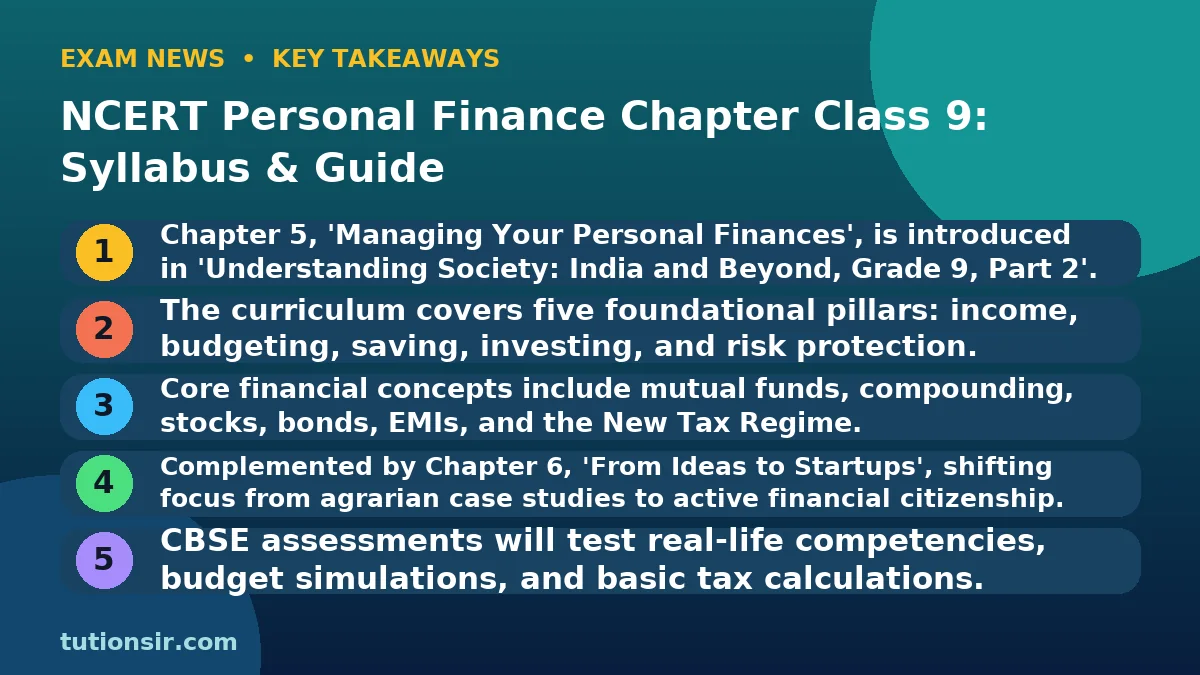
- Chapter 5, 'Managing Your Personal Finances', is introduced in 'Understanding Society: India and Beyond, Grade 9, Part 2'.
- The curriculum covers five foundational pillars: income, budgeting, saving, investing, and risk protection.
- Core financial concepts include mutual funds, compounding, stocks, bonds, EMIs, and the New Tax Regime.
- Complemented by Chapter 6, 'From Ideas to Startups', shifting focus from agrarian case studies to active financial citizenship.
- CBSE assessments will test real-life competencies, budget simulations, and basic tax calculations.
What is the new personal finance chapter in NCERT Class 9?
Under the mandate of the National Education Policy 2020 (NEP 2020) and the National Curriculum Framework for School Education (NCF-SE), the National Council of Educational Research and Training (NCERT) has introduced Chapter 5, titled 'Managing Your Personal Finances', in its new Social Science textbook, 'Understanding Society: India and Beyond, Grade 9, Part 2'. This update replaces the legacy, theoretical focus of older editions with actionable, real-life competencies.
The change gained widespread public visibility when Sanjeev Sanyal, member of the Economic Advisory Council to the Prime Minister (EAC-PM), highlighted the inclusion of topics such as mutual funds, equated monthly installments (EMIs), and tax liabilities. For decades, Class 9 Economics opened with 'The Story of Village Palampur', introducing factors of production through an agrarian lens. While understanding farming inputs remains valuable, modern teenagers require practical guidance on handling digital payments, saving pocket money, and avoiding debt traps.
Alongside Chapter 5, the council has integrated Chapter 6, titled 'From Ideas to Startups'. Together, these additions bridge academic theory and modern enterprise, guiding learners through small business planning, profit-and-loss statements, and the vital role played by Micro, Small and Medium Enterprises (MSMEs) across the Indian economy.
What are the five pillars of personal finance in the NCERT syllabus?
Chapter 5 organises money management into five foundational modules designed to take 14-year-olds from basic cash allocation to sophisticated risk management. Each pillar balances clear theoretical definitions with worked scenarios reflecting common Indian household experiences.
Instead of treating money as an abstract macroeconomic statistic, the syllabus presents it as a dynamic resource requiring conscious stewardship across a citizen's life cycle.
- Pillar 1: Income (Earnings) — Explains wages, salaries, professional fees, business profits, agricultural returns, and investment yields. It highlights how skills and education influence lifetime earning potential.
- Pillar 2: Budgeting — Differentiates essential 'needs' from discretionary 'wants'. Students learn practical budgeting steps: listing income sources, categorising fixed and variable expenses, tracking leakage, and balancing monthly allocations.
- Pillar 3: Saving — Establishes the purpose of emergency funds, liquid bank savings accounts, and recurring deposits. It underscores the psychological discipline needed to defer gratification.
- Pillar 4: Investing — Explores wealth creation through compounding, fixed deposits (FDs), government savings bonds, equity shares, and mutual funds. It introduces inflation and demonstrates how real purchasing power erodes if money sits idle in cash.
- Pillar 5: Protection and Risk Management — Demystifies insurance policies, borrowing principles, credit scores, debt obligations like EMIs, and civic responsibilities through direct and indirect taxes.
How does the curriculum cover mutual funds, compounding, and taxes?
The NCERT Class 9 mutual funds and taxes sections demystify concepts that previous curricula reserved for senior secondary commerce streams. In the investment module, students learn the classic risk-return trade-off: higher potential returns come with greater market volatility, whereas capital preservation tools offer lower, steady yields.
Compounding is introduced with clear step-by-step illustrations. Learners examine how reinvesting accumulated interest generates exponential growth over multi-year horizons, reinforcing the advantage of starting early with systematic investment habits.
In the taxation unit, the textbook distinguishes direct taxes (such as personal income tax) from indirect taxes (such as GST). Crucially, the chapter explains the slab system under India's New Tax Regime, walking students through standard deductions and demonstrating how taxable income translates into statutory government revenue used for national public infrastructure.
| Financial Instrument | Primary Objective | Risk Profile | Expected Return & Liquidity | Best Suited For |
|---|---|---|---|---|
| Savings Bank Account | Everyday cash access & safe storage | Very Low | Low interest rate (2.5%–4%); Instant daily liquidity | Emergency reserves & regular bills |
| Fixed Deposit (FD) | Guaranteed capital preservation | Low | Moderate fixed yield; Penalties apply on early premature withdrawal | Defined short-to-medium term goals |
| Government Bonds | Sovereign-backed fixed income | Low | Moderate fixed periodic coupon; Tradable on secondary debt markets | Risk-averse long-term investors |
| Mutual Funds (SIP) | Wealth creation via diversified portfolios | Moderate to High | Market-linked returns; High to medium liquidity depending on fund scheme | Long-term wealth building & beat inflation |
| Direct Equities (Stocks) | Ownership stake in corporate growth | High | Variable returns with capital volatility; High liquidity during market hours | Informed investors with high risk appetite |
Aligning school lessons with RBI, SEBI, and NCFE literacy standards
The inclusion of practical money skills in school textbooks directly reflects the National Strategy for Financial Education (NSFE), formulated jointly by the Reserve Bank of India (RBI), the Securities and Exchange Board of India (SEBI), the Insurance Regulatory and Development Authority of India (IRDAI), and the Pension Fund Regulatory and Development Authority (PFRDA) under the aegis of the National Centre for Financial Education (NCFE).
Regulators have long pointed out that while digital payment adoption through UPI has surged across tier-2 and tier-3 towns, foundational financial literacy has lagged behind. By introducing concepts of compound interest, loan amortisation, and phishing protections into mandatory Grade 9 Social Science, the state ensures that all secondary students—regardless of whether they pick Arts, Science, or Commerce in Class 11—graduate with functional economic agency.
How to teach personal finance in Class 9: activities and CTET pedagogy
For school teachers and candidates preparing for Central Teacher Eligibility Test (CTET) or state TET exams, teaching Chapter 5 demands a shift from rote lectures to experiential pedagogy. Social Science educators should ground each lesson in tangible exercises that teenagers can relate to directly.
Classroom strategies recommended by curriculum developers include three high-impact practical activities:
- Pocket Money Budget Tracker: Assign students a hypothetical monthly allowance (e.g., Rs 1,000) and have them balance a 50-30-20 budget (Needs, Wants, Savings) across four weeks.
- Compound Interest vs. Simple Interest Showdown: Run simple simulation tables comparing money kept in a non-interest cash box versus a compound-yield recurring deposit over 10 years.
- Mock Loan Repayment & EMI Chart: Give learners a fictional consumer durable purchase (such as a laptop for online study) to calculate how loan tenure and interest rates impact total payout.
Sample competency-based question: budget allocation and tax calculation
To help students prepare for CBSE periodic tests and annual examinations, here is a representative competency-based problem aligned with the exercise style in 'Understanding Society: India and Beyond, Grade 9, Part 2'.
Classroom Case Study: The 50-30-20 Rule and Basic Tax Slab
Problem: Rohan earns a gross annual salary of Rs 8,50,000. He receives a standard deduction of Rs 75,000 under the New Tax Regime. (a) What is his net taxable income? (b) If his post-tax monthly take-home salary is Rs 60,000, calculate his monthly allocation for essential Needs, discretionary Wants, and Savings using the 50-30-20 budgeting principle.
Solution: (a) Net Taxable Income = Gross Salary (Rs 8,50,000) minus Standard Deduction (Rs 75,000) = Rs 7,75,000. Under current progressive tax slabs, his tax liability is assessed on this net amount. (b) For his monthly take-home income of Rs 60,000: Needs (50%) = Rs 30,000; Wants (30%) = Rs 18,000; Savings/Investments (20%) = Rs 12,000.
Exam implications for CBSE Class 9 and the path ahead
CBSE-affiliated schools will assess Chapter 5 through school-based term assessments and internal evaluation projects. Rather than testing passive definitions, examination question papers will feature assertion-reason items, source-based case questions, and short practical numericals testing risk assessment, budget division, and credit choices.
Students transitioning from legacy textbooks should download the official PDF from the NCERT portal and practice creating their own budget sheets and investment comparisons. Digital learning platforms such as Tution Sir provide targeted chapter-end solutions, interactive quiz modules, and CTET-aligned Social Science pedagogical material to help students and teachers master these applied economics skills with confidence.
Frequently asked questions
What is the new personal finance chapter in NCERT Class 9?
The new personal finance chapter is Chapter 5, titled 'Managing Your Personal Finances', published in the Class 9 Social Science textbook 'Understanding Society: India and Beyond, Grade 9, Part 2'. It introduces secondary learners to budgeting, saving, mutual funds, loans, EMIs, and income tax.
Which NCERT textbook includes the chapter Managing Your Personal Finances?
It is included in 'Understanding Society: India and Beyond, Grade 9, Part 2', which covers the updated Economics and Sociology components under the National Curriculum Framework for School Education (NCF-SE 2023).
What specific money management topics are taught in Class 9 Economics?
The chapter teaches the five pillars of finance: earnings, budgeting (needs vs. wants), emergency savings, investment instruments (FDs, bonds, stocks, mutual funds), compounding, inflation, loan mechanics, equated monthly installments (EMIs), insurance basics, and income tax calculation under the slab system.
Why did NCERT introduce income tax slabs and mutual funds in Class 9?
NCERT integrated these topics to foster practical financial literacy early in life. As highlighted by EAC-PM member Sanjeev Sanyal, modern students require functional survival skills to navigate banking, digital investments, tax compliance, and consumer credit responsibly.
What is the difference between saving and investing in the Class 9 NCERT book?
According to the textbook, saving focuses on capital preservation and liquidity for immediate or emergency needs (like bank deposits). Investing involves committing capital into productive assets (like mutual funds, bonds, or shares) to earn returns that outpace inflation over time, accompanied by calculated market risk.
Will CBSE school exams test students on personal finance and EMIs?
Yes. Class 9 internal and annual examinations administered by CBSE-affiliated schools will include competency-based, case-study questions, short calculation problems on budgets and tax slabs, and conceptual queries examining financial risk-return dynamics.
How does this update connect with the entrepreneurship chapter in Class 9?
Chapter 5 ('Managing Your Personal Finances') is paired directly with Chapter 6 ('From Ideas to Startups'). While Chapter 5 covers personal financial planning, Chapter 6 guides learners through entrepreneurial business plans, profit-and-loss accounts, and MSME growth.
Sources and official links
Exam rules and notifications change. Confirm dates, fees and eligibility on the official website before acting. Spotted an error? Email support@tutionsir.com. See our editorial policy.
Keep learning
NCERT New Class 10 Books: December 2026 Release Guide
The National Council of Educational Research and Training (NCERT) has confirmed that revised Class 10 textbook
Read →CBSE Aryabhata Ganit Challenge 2026: Dates, Fees & Guide
The Central Board of Secondary Education has officially rolled out the Aryabhata Ganit Challenge 2026 for stud
Read →How to Solve Physics Numericals Easily: 5-Step Guide
Struggling to solve numerical problems even when you remember every formula is the single most common frustrat
Read →NCERT chapter-wise study help
Free practice and study help
Read →Practise what you just read
Free plan, no card needed. Full mock tests and the complete question bank are on the Pro plan.