Teacher Education · Policy Explainer
NCERT Reimagined NISHTHA Master Trainers: NEP Rollout Plan
The National Council of Educational Research and Training has concluded a foundational capacity-building drive for over 100 master trainers in New Delhi under the Reimagined NISHTHA framework. The initiative prepares educators across foundational, preparatory, and middle stages for revised textbooks and competency-based pedagogy.
Quick answer
NCERT Reimagined NISHTHA master trainers are over 100 selected educators trained to operationalise NEP 2020 pedagogical shifts across foundational, preparatory, and middle school tiers. Acting as a State Resource Group, they guide district teachers on revised textbooks, experiential learning, and Holistic Progress Cards ahead of Class 10 textbook updates.
Key takeaways
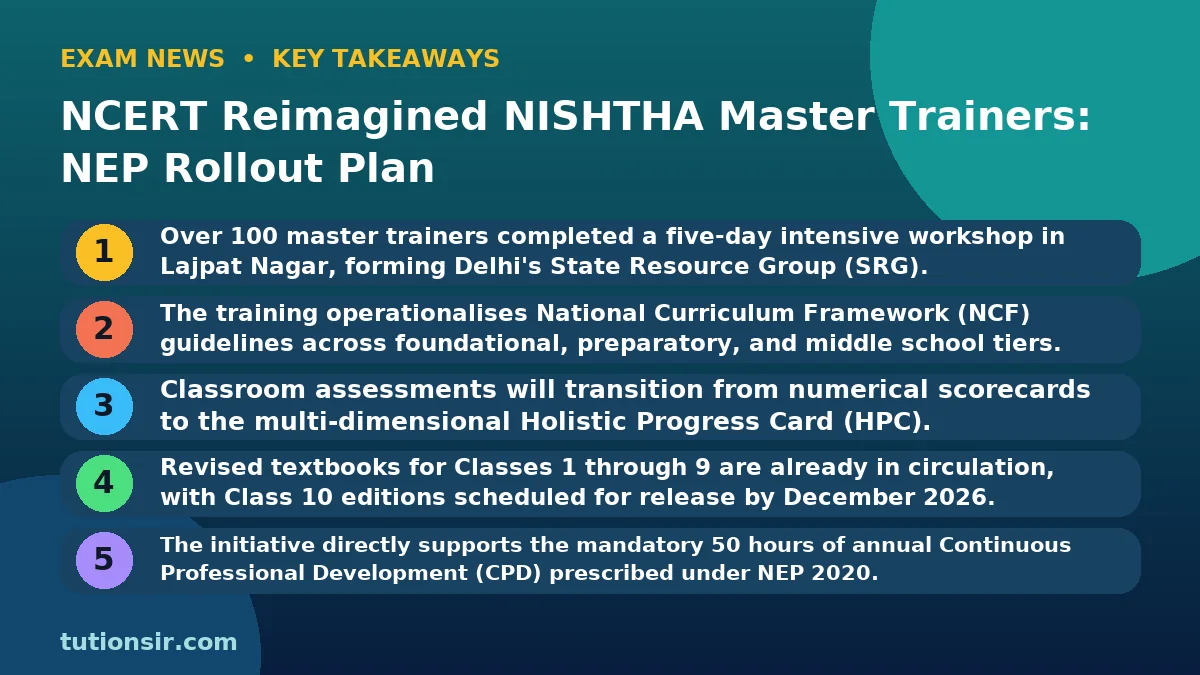
- Over 100 master trainers completed a five-day intensive workshop in Lajpat Nagar, forming Delhi's State Resource Group (SRG).
- The training operationalises National Curriculum Framework (NCF) guidelines across foundational, preparatory, and middle school tiers.
- Classroom assessments will transition from numerical scorecards to the multi-dimensional Holistic Progress Card (HPC).
- Revised textbooks for Classes 1 through 9 are already in circulation, with Class 10 editions scheduled for release by December 2026.
- The initiative directly supports the mandatory 50 hours of annual Continuous Professional Development (CPD) prescribed under NEP 2020.
Find yours this week with a free CTET mock test.
No card. Registering takes about two minutes.
What is the Reimagined NISHTHA Programme Launched by NCERT?
The Reimagined NISHTHA (National Initiative for School Heads' and Teachers' Holistic Advancement) programme represents an evolved, post-pandemic iteration of India's flagship in-service teacher training model. Organised under the centrally sponsored Samagra Shiksha scheme, this initiative shifts teacher training from generic, lecture-oriented delivery to stage-specific, hands-on pedagogical mentoring. As reported by ANI and The New Indian Express, NCERT collaborated with SCERT Delhi to conduct a pilot foundational training from November 2 to November 6, 2026, at Shaheed Hemu Kalani Sarvodaya Bal Vidyalaya in Lajpat Nagar, New Delhi.
NCERT Director Prof. Dinesh Prasad Saklani inaugurated the workshop, stating that curricular reform remains meaningless without empowering grassroots educators. In his address, Prof. Saklani underscored that professional capacity-building must never devolve into a checklist exercise or administrative tokenism. Instead, the redesigned modules focus on translating the philosophical aims of the National Education Policy (NEP) 2020 and the National Curriculum Framework for School Education (NCF-SE) into everyday teaching plans.
Five-Day Master Trainer Drive in Lajpat Nagar: Structure and SRG Role
The intensive five-day programme in Lajpat Nagar brought together more than 100 handpicked school teachers, headmasters, and academic mentors from across the National Capital Territory of Delhi. These educators now constitute the core State Resource Group (SRG). An NCERT official confirmed that this marks the first time master trainers have been curated under the reimagined model to spearhead direct peer training.
Under the valedictory leadership of Prof. Sridhar Srivastava, Dean (Coordination) at NCERT, the master trainers produced actionable lesson templates and evaluation rubrics. In the subsequent phases of the NISHTHA cascade framework, these SRG members will train block-level resource persons, cluster resource centre coordinators, and classroom educators across municipal and state-run institutions.
- Phase 1: Foundational capacity building of 100+ master trainers by central NCERT faculty.
- Phase 2: District-level cascading workshops across Delhi's school zones led by the State Resource Group.
- Phase 3: Cluster-based classroom observations, peer mentoring, and digital feedback tracking via DIKSHA.
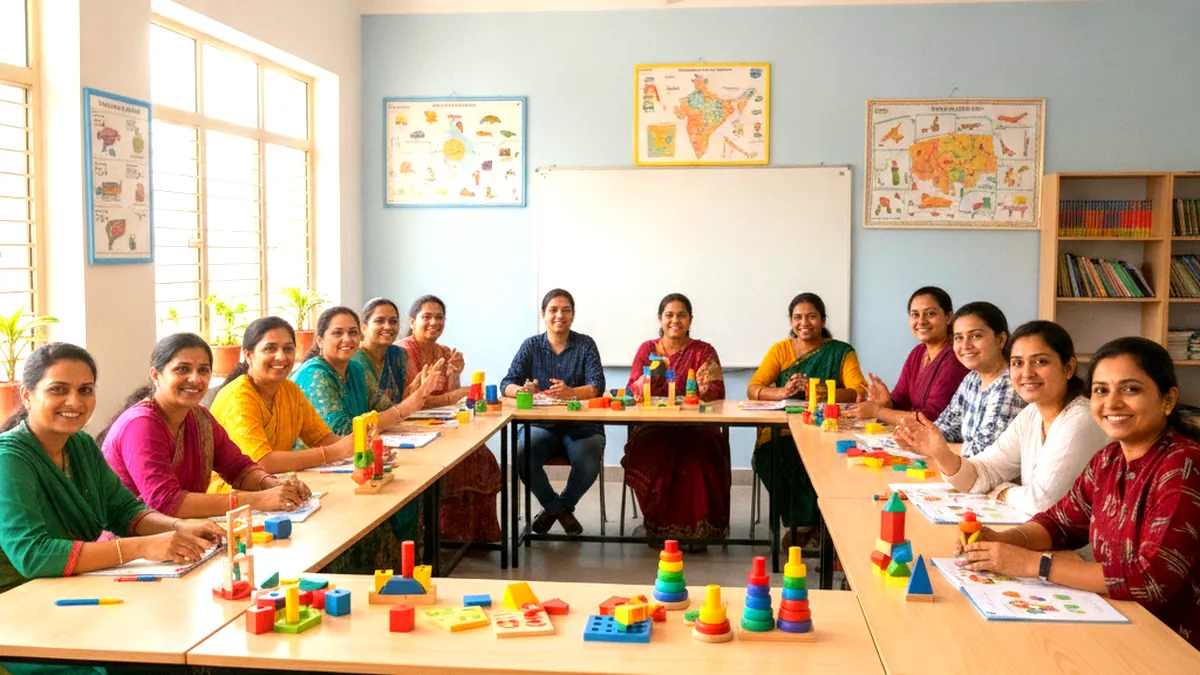
Pedagogical Shifts: Moving from Rote Memorisation to Experiential Learning
The curriculum overhaul addresses three crucial stages defined by NEP 2020: foundational (ages 3–8), preparatory (ages 8–11), and middle (ages 11–14). Traditional chalk-and-talk lectures are being systematically replaced by experiential, discovery-oriented methods. For the foundational stage, trainers demonstrated the integration of the Jaadui Pitara (magic box)—a play-based learning kit containing puzzles, puppets, indigenous toys, and story cards designed to foster early literacy and numeracy.
For preparatory and middle stages, the training placed heavy emphasis on arts integration, cross-disciplinary science inquiries, and toy-based pedagogy. Rather than memorising formulas, students will explore mathematical and scientific concepts through tactile experiments and everyday household materials, building analytical thinking from an early age.
| Dimension | Traditional Classroom Model | Reimagined NISHTHA / NCF Model |
|---|---|---|
| Primary Learning Method | Rote memorisation and passive lecture-based delivery | Experiential, activity-oriented, and play-based pedagogy |
| Foundational Tools | Standard textbooks and blackboard transcription | Jaadui Pitara, manipulative toys, and storytelling kits |
| Assessment Strategy | Periodic marks-oriented summative examinations | Holistic Progress Card (HPC) with 360-degree multidimensional evaluation |
| Teacher Development | Ad-hoc, isolated seminars without systematic credits | Mandatory 50 hours/year Continuous Professional Development (CPD) |
| Textbook Implementation | Passive chapter-by-chapter reading | Competency-mapped inquiries linked directly to real-life applications |
Assessment Overhaul: Replacing Marksheets with the Holistic Progress Card
A central pillar of the Reimagined NISHTHA modules is the complete restructuring of classroom evaluations through the Holistic Progress Card (HPC). Unlike traditional report cards that rely exclusively on periodic summative testing, the HPC acts as a dynamic, 360-degree reflective portrait of a child’s progress.
The SRG master trainers practiced evaluating non-cognitive and cognitive parameters concurrently. The HPC framework incorporates self-assessment by the child, peer evaluation through collaborative tasks, descriptive input from parents, and competency tracking by teachers across socio-emotional and critical-thinking dimensions.
NCERT Revised Textbooks Timeline: Classes 1 to 9 Released, Class 10 by December
A major operational challenge driving this capacity-building initiative is the rapid rollout of new school literature. NCERT has already released revised textbooks for Classes 1 through 9 aligned with the NCF-SE. Education ministry sources confirmed to The New Indian Express that the revised Class 10 textbooks are on schedule for official release by December 2026.
Because the upcoming Class 10 books will introduce competency-based problem structures and eliminate obsolete rote chapters, middle and secondary teachers must acquire immediate pedagogical fluency. By training the State Resource Group now, NCERT aims to prevent instructional bottlenecks when secondary schools adopt the updated syllabus in early 2027.
Continuous Professional Development: What the 50-Hour Mandate Means for Aspirants
NEP 2020 Clause 5.15 explicitly mandates that every school head and teacher participate in at least 50 hours of Continuous Professional Development (CPD) each year. The Reimagined NISHTHA modules, hosted through blended physical workshops and the online DIKSHA portal, serve as the primary vehicle for teachers to log these mandatory hours.
This institutional shift carries profound implications for teaching aspirants preparing for examinations like CTET, West Bengal TET, and state teacher recruitment drives. Modern eligibility papers have moved away from factual recall, testing applied classroom scenarios instead. Candidates are now routinely assessed on inclusive classroom design, NCF-SE staging, toy pedagogy, and continuous evaluation rubrics. To master these evolving pedagogical models, future educators rely on tailored practice platforms like Tution Sir, where foundational policy concepts are broken down into targeted mock questions.
Frequently asked questions
What is the Reimagined NISHTHA programme launched by NCERT?
It is an updated national capacity-building programme designed by NCERT under the Samagra Shiksha scheme. It equips teachers and school heads with stage-specific pedagogical practices, inclusive teaching methods, digital competencies, and evaluation strategies aligned with NEP 2020 and the National Curriculum Framework.
Why did NCERT train over 100 master trainers in Delhi?
NCERT trained over 100 master trainers from November 2 to 6, 2026, at Lajpat Nagar to form a specialised State Resource Group (SRG). These trainers will mentor district and cluster educators across Delhi to ensure smooth implementation of newly revised NCERT textbooks.
Which school education stages are covered under the Reimagined NISHTHA training?
The five-day drive specifically focused on the foundational stage (ages 3–8), preparatory stage (ages 8–11), and middle stage (ages 11–14), preparing educators for distinct developmental and cognitive learning needs across early schooling.
When will the revised NCERT textbooks for Class 10 be released?
NCERT textbooks for Classes 1 through 9 have already been revised in accordance with NEP 2020 and NCF-SE. Ministry officials confirmed that the revised Class 10 textbooks are scheduled for formal release by December 2026.
What is the Holistic Progress Card (HPC) introduced in the training?
The Holistic Progress Card is an assessment tool that replaces conventional numerical report cards. It provides a 360-degree view of student development, tracking cognitive, socio-emotional, and psychomotor progress using self-assessment, peer feedback, parental inputs, and competency evaluation.
How does the training support the NEP 2020 mandate of 50 CPD hours?
NEP 2020 mandates that all school teachers complete at least 50 hours of Continuous Professional Development annually. Reimagined NISHTHA in-person workshops and online courses hosted on DIKSHA provide structured, accredited training modules that count directly toward this requirement.
How does Reimagined NISHTHA impact CTET and State TET aspirants?
Teacher eligibility tests now heavily feature scenario-based questions drawn from NEP 2020, NCF-SE, and NISHTHA frameworks. Aspirants must understand competency-based learning, inclusive education, and HPC assessment rubrics to clear modern pedagogy sections.
Sources and official links
- The New Indian Express
- The Times of India
- ANI News
- National Council of Educational Research and Training (NCERT)
Exam rules and notifications change. Confirm dates, fees and eligibility on the official website before acting. Spotted an error? Email support@tutionsir.com. See our editorial policy.
Keep learning
CTET Paper 2 Preparation: Maths, Science & SST Plan
Passing CTET Paper 2 means balancing teaching ideas with strong subject knowledge. The exam covers NCERT sylla
Read →CBSE Kaushal Bodh Skill Education Training Begins
The Central Board of Secondary Education launched its offline Capacity Building Programme series for middle sc
Read →How to Choose Language 1 and Language 2 in CTET: 2026 Guide
Choosing between Language 1 and Language 2 is one of the most critical decisions in your CTET registration, di
Read →NCERT chapter-wise study help
Free practice and study help
Read →Do not let another week go by without a plan
Most CTET aspirants only find their weak topics after the real exam. Register free now and start with the one topic that worries you most. Small daily practice beats a last-minute rush.
- Free CTET mock test, Paper 1 and Paper 2
- Instant score with topic-wise weak areas
- Explanations in simple language, in your preferred language
Free plan, no card needed. Your progress is saved to your account.