Class 10 • Exam Strategy
How to Prepare for Pre Boards Class 10: Incomplete Syllabus
Facing school pre-boards with 40 to 50 percent of your syllabus still uncovered can trigger intense panic. You do not need to finish every textbook chapter overnight to score well; you need an emergency triage system that protects your marks and turns pre-boards into your greatest diagnostic tool.
Quick answer
To prepare for Class 10 pre-boards with an incomplete syllabus, immediately stop opening new low-yield chapters. Apply the 80/20 triage rule: consolidate the 60% high-weightage syllabus you already know, solve NCERT examples and past five-year board questions, and master core formulas, key diagrams, and map skills to secure passing marks.

Key takeaways
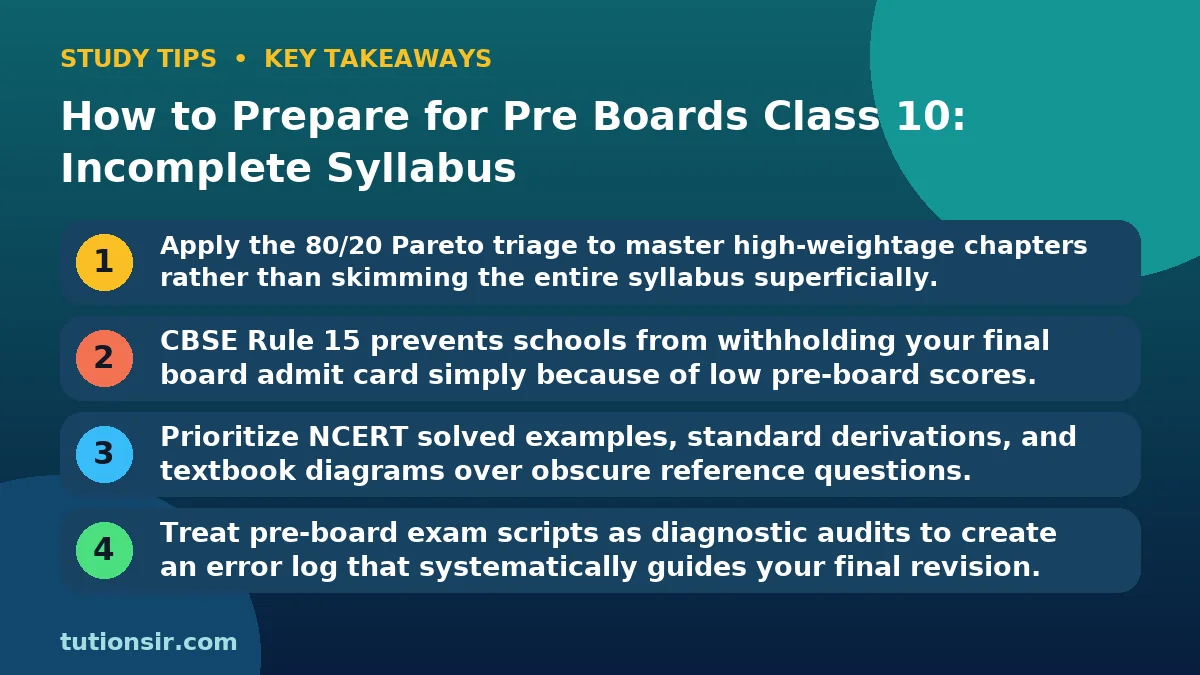
- Apply the 80/20 Pareto triage to master high-weightage chapters rather than skimming the entire syllabus superficially.
- CBSE Rule 15 prevents schools from withholding your final board admit card simply because of low pre-board scores.
- Prioritize NCERT solved examples, standard derivations, and textbook diagrams over obscure reference questions.
- Treat pre-board exam scripts as diagnostic audits to create an error log that systematically guides your final revision.
Get a free study plan and practice questions for your class.
No card. Registering takes about two minutes.
How Can I Prepare for Pre-Boards if Half of My Syllabus Is Incomplete?
Preparing for pre-boards when half of your syllabus remains incomplete requires shifting your mindset from syllabus completion to mark maximization. Between November and January, Class 10 students across CBSE, ICSE, and state boards such as WBBSE encounter a standard institutional bottleneck: schools schedule pre-board examinations while classroom lectures are still rushing through the final units. Trying to read twelve new chapters in ten sleepless nights invariably backfires. You end up confusing fundamental concepts, forgetting formulas, and performing poorly across sections you previously understood.
The solution is an academic triage framework governed by the 80/20 Pareto principle. In board examination blueprints, roughly 80 percent of the aggregate marks originate from approximately 20 percent of core foundational topics. Instead of attempting to finish 100 percent of the curriculum at a superficial 30 percent depth, freeze the curriculum. Focus entirely on securing 100 percent accuracy across the 50 to 60 percent of high-weightage topics you have already touched. A student who writes technically perfect, high-scoring answers across 50 marks of the question paper will consistently outperform a panicked classmate who attempts all 80 marks with flawed logic, missing steps, and factual inaccuracies.
- Audit your textbook contents into three strict categories: Green (thoroughly understood), Amber (partially learned or missing practice), and Red (completely untouched).
- Allocate 70 percent of your daily preparation time to converting Amber chapters into Green chapters before opening any Red chapter.
- Discard third-party guidebooks and heavy reference compendiums; anchor your emergency review strictly to NCERT textbooks or prescribed ICSE primers.
- Dedicate the final two hours of every study evening to active recall and numerical problem-solving rather than passive reading.
Do Pre-Board Marks Matter in CBSE Class 10 Final Result?
Pre-board marks do not appear on your official CBSE or ICSE Class 10 final board marksheet and have zero direct impact on your final board percentage. The Central Board of Secondary Education (CBSE) awards your final secondary school certificate strictly on the basis of your external board theory examination (usually 80 marks) plus the internal assessment (20 marks). The internal assessment component is divided among periodic tests, continuous portfolio evaluation, practical lab work, and subject enrichment activities. While schools may utilize the best scores from your periodic unit tests and mid-terms to compute internal grades, pre-board test scores do not dictate your final board certificate standing.
A frequent source of acute anxiety during November and December is the verbal warning by school staff that failing pre-board tests will lead to the cancellation or withholding of your board examination admit card. According to official CBSE regulations, this threat has no legal standing. Under Rule 15 of the CBSE Examination Bye-Laws, the board explicitly states that 'in no case the Heads of affiliated schools shall detain eligible candidates from appearing at the examination.' Once a school registers a student on the official List of Candidates (LOC) and the candidate fulfills the mandatory attendance threshold (normally 75 percent), the school cannot withhold the roll number slip or hall ticket due to academic performance in mock or pre-board tests.
Schools intentionally structure pre-board test papers to be substantially more rigorous than the actual board exams, and teachers frequently grade answer scripts with extreme strictness. Principals and teachers use this pressure tactic to shatter student complacency and compel serious revision during the winter break. Understanding that pre-board tests are private, school-level simulation drills frees you from unproductive anxiety. You can treat the upcoming exam room not as a courtroom sentencing your future, but as a risk-free flight simulator designed to reveal blind spots.
The Administrative Reality: What Schools Can and Cannot Do
Schools possess the authority to conduct mandatory remedial classes, demand parent-teacher conferences, and assign supplementary winter break worksheets if you score poorly. However, they cannot debar you from the final board examination provided your registration fees are cleared and your board attendance is valid. Channel your energy away from fear of administrative retaliation and direct it into targeted chapter recovery.
Which High-Weightage Chapters Should I Prioritize First for Class 10 Pre-Boards?
You should prioritize foundational units that carry guaranteed section marks and feature recurring long-answer question formats in board blueprints. When time is severely limited, selecting the right chapters prevents you from spending three days on a two-mark topic while leaving a ten-mark unit unrevised. Below is the tactical triage roadmap across the core subjects of Mathematics, Science, and Social Science.
Class 10 Mathematics: Focus on Algebra and Geometry Blueprints
In CBSE Class 10 Mathematics, Algebra (comprising Polynomials, Pair of Linear Equations in Two Variables, Quadratic Equations, and Arithmetic Progressions) carries 20 marks, while Geometry (Triangles and Circles) accounts for 15 marks. If your syllabus is incomplete, immediately master Arithmetic Progressions (AP) and Quadratic Equations. These chapters have predictable formula applications (nth term, sum of n terms, and quadratic formula) and minimal conceptual ambiguity.
Next, master the Basic Proportionality Theorem (Thales's Theorem) proof in Triangles, along with the two tangent theorems in Circles. Boards routinely ask these exact proofs in 3-mark and 5-mark sections. For Statistics, memorize the step-by-step algorithms for calculating the mean, median, and mode of grouped data, which guarantees an effortless 6 to 8 marks. Postpone complex Surface Areas and Volumes word problems or advanced Trigonometric identities until these high-yield zones are impenetrable.
Class 10 Science: Balancing Chemistry Equations, Biology Processes, and Physics Optics
In Science, Chemical Reactions and Equations, Acids, Bases and Salts, and Metals and Non-Metals constitute the chemical foundation. Rather than memorizing every corner of the textbook, write out and balance all chemical reactions highlighted in NCERT text boxes and chapter-end exercises. In Biology, Life Processes (nutrition, respiration, circulation, and excretion) is the heaviest scoring chapter; practice drawing neat, labeled diagrams of the human alimentary canal, nephron, and heart, as well as the schematic representation of transport and exchange of oxygen and carbon dioxide.
For Physics, Optics (Light: Reflection and Refraction) carries immense weight. Master the ray diagrams for concave and convex mirrors as well as convex and concave lenses. Ensure complete fluency with the Cartesian sign convention and numerical problems calculating image distance, object distance, and focal length using the mirror and lens formulas. Electric Current and Magnetic Effects can be triaged by learning Ohm's law, series-parallel resistor networks, and Fleming's Left-Hand Rule.
Class 10 Social Science: Timelines, Map Skills, and Institutional Geography
In Social Science, Nationalism in India (History) must be mastered first. It contains mandatory 2-mark map pointing questions (Congress sessions at Calcutta, Nagpur, Madras; Satyagraha centers like Champaran, Kheda, Ahmedabad, and Jallianwala Bagh) and predictable 5-mark analytical questions on the Non-Cooperation and Civil Disobedience movements. In Geography, secure full marks on Resources and Development, Agriculture, and Manufacturing Industries by mastering the official map items (soil distributions, major crop belts, and iron and steel plants). In Political Science, focus on Power Sharing and Federalism, which feature recurring comparative questions regarding Belgium and Sri Lanka.
Subject-Specific Damage Control: How to Prepare for Class 10 Maths, Science, and Social Science Fast
Fast-tracking your preparation requires deliberate, exam-oriented study techniques rather than aimless textbook reading. Different academic subjects demand distinct damage-control mechanisms when you are racing against a ticking calendar.
The Mathematics Formula Bank and NCERT Solved Examples Method
When Math backlogs feel insurmountable, do not attempt every single exercise question in reference books like R.D. Sharma or R.S. Aggarwal. Open your NCERT textbook and solve every single 'Solved Example' by hand. Board exam question-setters frequently lift multi-mark questions verbatim from solved textbook illustrations. Create a two-page formula ledger listing quadratic roots, AP general terms, coordinate geometry distance and section formulas, trigonometric standard values, and surface area ratios. Review this sheet for twenty minutes every morning before breakfast.
The Science Diagram, Law, and Equation Protocol
Science exam papers punish vague narrative answers. Damage control in Science consists of structuring answers into crisp bullet points featuring technical vocabulary. Practice writing definitions of core scientific laws (such as Joule's Law of Heating, Snell's Law, and the Modern Periodic Law) exactly as stated in the textbook. Ensure that every biological diagram includes clean horizontal label lines on the right margin. In chemistry, never write a chemical reaction merely in words; always provide the balanced symbolic equation along with physical state notations (s, l, g, aq) to secure full step marks.
The Social Science Keyword, Timeline, and Map Strategy
In History and Political Science, board evaluators scan answer sheets for specific historical dates, acts, and constitutional terms. Instead of writing endless prose paragraphs, train yourself to break answers into distinct subheadings with three to five explanatory points. Memorize the exact years for the Rowlatt Act (1919), the Chauri Chaura incident (1922), the Simon Commission arrival (1928), and the Lahore Congress session (1929). Keep an outline map of India pinned above your study desk and spend ten minutes daily marking major dams, international airports, sea ports, and mineral reserves to pocket five guaranteed marks without opening a notebook.
Day Wise Study Plan for Class 10 Pre Board Incomplete Syllabus
If your pre-board examination commences in approximately fifteen days and you still have substantial syllabus backlogs, abandon relaxed school-day habits. You need an intensive, structured 15-day recovery schedule that balances consolidating known units with selective high-yield coverage of unread chapters.
This schedule assumes you can dedicate 6 to 8 hours daily during pre-exam study leaves, weekends, or early morning and evening blocks around regular school hours. It enforces a strict ratio: 60 percent active problem solving and writing, 20 percent rapid conceptual review of new high-yield units, and 20 percent time-bound testing.
| Days | Morning Block (2 Hours) | Afternoon Block (2 Hours) | Evening Block (2.5 Hours) | Night Audit (1 Hour) |
|---|---|---|---|---|
| Days 1 - 3 | Maths: Real Numbers, Polynomials & Linear Equations (NCERT examples) | Science: Chemical Reactions & Acids, Bases, Salts (Equations review) | SST: Nationalism in India + Mandatory History Map Pointing | Formula sheet revision & daily mistake logging |
| Days 4 - 6 | Maths: Quadratic Equations & Arithmetic Progressions | Science: Life Processes (Diagrams: Digestive, Heart, Excretory) | SST: Resources & Development, Agriculture + Geography Maps | Quick flashcard recall of scientific laws & definitions |
| Days 7 - 9 | Maths: Triangles (BPT Proof) & Circles (Tangent Theorems) | Science: Light: Reflection & Refraction (Ray diagrams & Numericals) | SST: Power Sharing, Federalism & Political Parties | Timed 30-minute test on 5-mark long-answer questions |
| Days 10 - 12 | Maths: Statistics & Probability (Mean, Median, Mode algorithms) | Science: Electricity (Ohm's Law, Resistors & Power formulas) | English / Hindi: Formal letter formats, grammar rules & prose summaries | Full review of weak formulas and incorrect equations |
| Days 13 - 14 | Maths: Coordinate Geometry & Basic Trigonometric ratios | Science: Magnetic Effects & Our Environment (Trophic levels) | SST: Money and Credit, Sectors of the Indian Economy | Mock Section Tests: Solve Section C and D from 2024 Board Paper |
| Day 15 | Consolidated Formula Run: Solve 10 mixed NCERT examples | Diagram & Map Marathon: Redraw 8 key diagrams; fill 3 blank maps | Rapid scan of Amber chapter summaries & NCERT back-questions | Stationery check, admit card readiness, sleep by 10:30 PM |
How to Use Your Pre-Board Mistakes to Improve Your Final Board Exam Score
The greatest error a Class 10 student can make is stowing graded pre-board answer sheets inside a desk drawer out of disappointment. Your marked pre-board script is an unfiltered diagnostic audit of your exam temperament, handwriting speed, and conceptual gaps. Scoring 45 out of 80 in December is not a failure if you extract the thirty-five lost marks and systematically rectify them before February.
Establish a dedicated 'Error Log Notebook' divided into four columns: Question Number, Nature of Mistake (Calculation error, Conceptual misunderstanding, Missing key technical term, or Time management panic), Correct Concept / Model Answer, and Next Review Date. When your teacher hands back your pre-board papers, conduct a post-mortem review question by question. If you lost two marks in a physics numerical because you omitted the unit 'Joules' or inverted the lens formula signs, record that error immediately.
Modern diagnostic platforms make this error analysis far more precise. Rather than guessing why your answers lose marks on subjective criteria, you can leverage diagnostic AI platforms such as Tution Sir to pinpoint specific conceptual gaps across CBSE, ICSE, and state board curriculums, generating targeted remedial practice sets tailored to your individual weaknesses.
Once your error log is populated, convert every single red-pen correction on your school script into an open-book rewrite. Sit down with your textbook and draft a flawless version of every question where you received partial or zero credit. Re-attempt that specific set of questions under timed conditions seven days later to confirm that the gap in your memory has permanently closed.
Exam-Hall Time Management and Presentation Strategy
Even with an incomplete syllabus, intelligent exam presentation can elevate your score by ten to fifteen marks. Pre-board papers set by schools are deliberately lengthy to test whether students can maintain clarity under pressure. If you lack time to complete the final chapter, you cannot afford to squander marks through messy handwriting, disorganized calculations, or poor reading-time allocation.
During the mandatory 15-minute question-paper reading time, do not read through every single question passively. Immediately scan Section B, C, and D to identify the optional questions where internal choice is provided. Select your preferred options instantly and mark them lightly with a pencil. In Mathematics, identify the 5-mark geometry proofs or statistics problems you know with complete certainty so you can approach them without hesitation.
When writing your answers, observe these presentation ground rules: write Section headers prominently in the center of your page; maintain clear two-line spacing between successive answers; draw a crisp horizontal pencil line at the end of each completed answer; and highlight final numerical answers by enclosing them in neat rectangular pencil boxes with proper units. If you are uncertain about the middle steps of a question from an incomplete chapter, write down the applicable general formula, declare the given variables clearly, and attempt the initial substitution. Board and pre-board marking schemes assign fractional credit for every valid step, allowing you to salvage valuable marks even from half-solved questions.
- Always tackle your strongest section first; starting with questions you can answer flawlessly settles test anxiety and creates a positive impression on the evaluator.
- Never spend more than 1.5 minutes per single mark (allocate a maximum of 15 minutes for a 10-mark block of multiple-choice questions).
- Reserve the final 15 minutes of the three-hour exam for auditing question numbering, checking equation balancing, and confirming that all map inserts are tied securely inside the main answer booklet.
Frequently asked questions
Do pre-board marks affect CBSE Class 10 final board exam results?
No, pre-board marks do not appear on your final board marksheet. The Central Board of Secondary Education calculates final scores strictly from the external theory board examinations and internal school assessments. While internal assessments consider periodic tests and assignments, pre-board exam marks are not directly transferred to your board marksheet.
How can I prepare for pre-boards if half of my syllabus is incomplete?
Apply the 80/20 triage framework. Stop attempting to cover every new chapter superficially. Instead, consolidate the 50 to 60 percent of high-weightage chapters you already understand, practice NCERT solved illustrations, master key diagrams and formulas, and solve the last five years of board questions to guarantee passing marks.
Can a school hold back the board exam admit card if a student fails pre-boards?
No. Under Rule 15 of the CBSE Examination Bye-Laws, affiliated schools cannot withhold the admit card of an eligible student whose name is registered on the board's List of Candidates (LOC). As long as your attendance meets the minimum requirement (typically 75 percent), withholding admit cards violates board regulations.
Is it possible to score 90+ in board exams after getting poor marks in pre-boards?
Yes, thousands of students score above 90 percent in their final board exams despite scoring 50 to 60 percent in pre-boards. Schools intentionally design pre-board papers to be significantly harder and grade them strictly. If you analyze your pre-board mistakes and remediate them systematically, your final score will improve dramatically.
Should I focus on finishing new chapters or revising completed ones before pre-boards?
Prioritize consolidating completed chapters first. Attempting an unread chapter right before an examination yields weak retention and low accuracy. Solidify your completed topics so you achieve 100 percent accuracy on those questions, and only skim high-weightage formulas or basic concepts from unfinished chapters.
How many hours should a Class 10 student study daily during pre-board season?
During dedicated study leaves or weekends, aim for 6 to 8 hours of focused, active study divided into 90-minute blocks. On regular school days, 3.5 to 4.5 hours of evening revision is sufficient. Prioritize handwritten problem-solving and active recall over passive reading.
How can I use my pre-board mistakes to improve my final board exam score?
Create an error log notebook cataloging every mistake from your corrected pre-board answer script. Classify each error as a calculation slip, a conceptual gap, or missing keywords. Rewrite the correct answers in full, consult your teachers on unclear points, and re-test yourself weekly.
Sources and official links
- Central Board of Secondary Education (CBSE)
- National Council of Educational Research and Training (NCERT)
- Council for the Indian School Certificate Examinations (CISCE)
Exam rules and notifications change. Confirm dates, fees and eligibility on the official website before acting. Spotted an error? Email support@tutionsir.com. See our editorial policy.
Keep learning
How to Solve Case Based Questions in CBSE Class 10
CBSE has raised competency-focused questions to 50 percent of the Class 10 board examination, turning Section
Read →How to Increase Handwriting Speed in Board Exams: Top Tips
Every year, thousands of Indian board examinees lose 10 to 15 marks simply because their hands cannot keep up
Read →ICSE Class 10 Date Sheet 2027: Dates + Study Plan
The date sheet tells you when. This guide tells you how to use the 13 weeks before the first paper, so that ea
Read →Do not let another week go by without a plan
Knowing the ICSE dates is step one. Using the weeks before them well is what decides marks. Register free now and start with the one topic that worries you most. Small daily practice beats a last-minute rush.
- Free plan, no card needed
- Ask any doubt and get a step-by-step answer
- Practice questions with explanations, chapter by chapter
Free plan, no card needed. Your progress is saved to your account.