Student Wellbeing & Focus
How to Stop Phone Addiction While Studying: 7 Fixes
Compulsive scrolling and constant notification pings derail revision faster than a difficult syllabus. Here is an actionable, friction-based blueprint designed to help school students reclaim their attention and build lasting study stamina.
Quick answer
To stop phone addiction while studying, remove the device from your room entirely to eliminate cognitive brain drain. Replace brute willpower with friction: enable grayscale mode, block non-academic apps, batch school WhatsApp checks to scheduled intervals, and practice active pen-and-paper problem-solving during uninterrupted twenty-five-minute Pomodoro study blocks.

Key takeaways
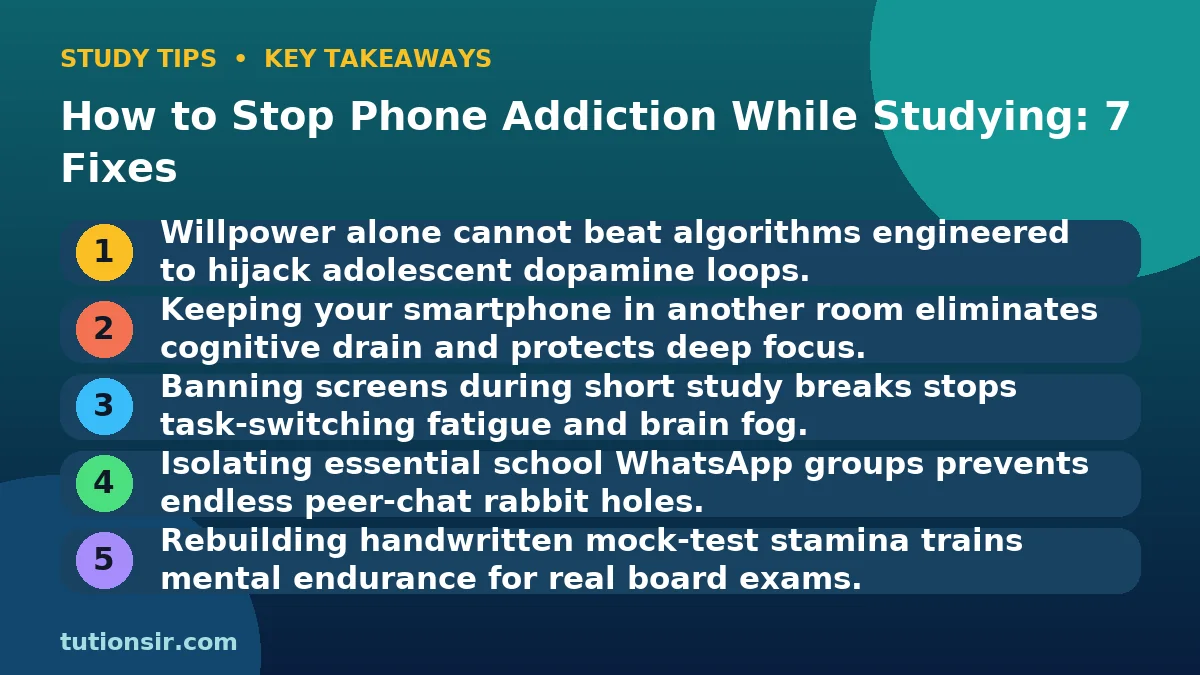
- Willpower alone cannot beat algorithms engineered to hijack adolescent dopamine loops.
- Keeping your smartphone in another room eliminates cognitive drain and protects deep focus.
- Banning screens during short study breaks stops task-switching fatigue and brain fog.
- Isolating essential school WhatsApp groups prevents endless peer-chat rabbit holes.
- Rebuilding handwritten mock-test stamina trains mental endurance for real board exams.
Why Willpower Fails: The Brain Chemistry Behind Phone Distraction While Studying
If you find yourself opening Instagram, YouTube Shorts, or Snapchat every five minutes while trying to memorize formulas or historical dates, realize this first: you are not lazy, weak-willed, or broken. Modern smartphone applications are designed by behavioral engineers using variable reward schedules—the exact psychological mechanism behind slot machines. Every vibration, notification badge, and algorithmically served vertical video triggers an anticipation spike of dopamine in your brain. When faced with demanding textbooks, your brain naturally seeks the quickest path to relief and stimulation.
Relying purely on willpower to resist this urge is scientifically flawed. A landmark research study led by Dr. Adrian Ward at the University of Texas at Austin McCombs School of Business revealed a phenomenon known as 'brain drain.' The researchers found that the mere physical presence of a student's smartphone on their study desk—even when turned upside down or switched completely off—reduces available cognitive capacity and working memory. A significant portion of your mental energy is constantly consumed just by resisting the urge to reach out and touch the glass.
Furthermore, attention researcher Dr. Gloria Mark at the University of California, Irvine, documented that after an interruption, it takes an average of 23 minutes and 15 seconds to return to the original task with the same level of mental immersion. When you pause your revision for 'just twenty seconds' to check a WhatsApp notification, you are not losing twenty seconds; you are effectively resetting your cognitive focus clock and spending your entire evening in a perpetual state of mental recovery.
Where Should I Keep My Phone While Studying? The Power of Physical Friction
To stop phone addiction for students, the most reliable intervention is physical separation rather than digital restraint. If your phone is within arm's reach, picking it up requires zero conscious thought; muscle memory takes over before your rational brain can intervene. By introducing physical distance between yourself and your device, you create a deliberate delay that forces conscious decision-making.
Establish an inviolable boundary: the device must live in another room during study blocks. Place it on a charging dock in the living room, kitchen, or your parents' room. If you live in a single-room setup or study in a shared hostel space, store the handset inside a zipped backpack placed at least twenty feet away from your study chair, or inside a high wardrobe shelf that requires standing up and walking across the room to access.
- Apply the 20-second rule: Make accessing your phone take at least twenty seconds of physical effort (standing up, opening a latch, unlocking a high drawer).
- Enlist external accountability: Hand your smartphone to a parent or sibling with a clear instruction: 'Please do not hand this back to me until 8:00 PM.'
- Invest in a physical timer: Replace the clock on your smartphone screen with an inexpensive mechanical kitchen timer or digital desk clock so you never have to check your screen to see the time.
- Charge outside the bedroom: Never charge your device beside your study desk or bed overnight, eliminating late-night scrolling that destroys morning focus.
Can I Use My Phone for Online Study Without Getting Distracted by Social Media?
A major dilemma faced by school students preparing for CBSE, ICSE, or state board examinations like WBBSE Madhyamik and WBCHSE Higher Secondary is that total device bans are often impractical. Teachers send homework PDFs over WhatsApp, tuition batches share assignment deadlines through group chats, and challenging concepts often require educational video explanations. Overcoming smartphone addiction for exams does not mean abandoning technology; it requires building defensive environments on your devices.
The first step is aggressive WhatsApp hygiene. Tuition and school groups generate non-stop chatter, memes, and casual banter that derail revision. Archive and mute all batch chats so they never trigger unread banners or vibration cues on your screen. Pin only the critical official teacher announcement channels. When you must review reference PDFs or recorded lectures, access them via WhatsApp Web on a desktop or tablet browser where social feeds are signed out, rather than holding a notification-heavy handheld phone in your palm.
Second, reconfigure your operating system settings. Switch your screen display to Grayscale Mode (Monochrome). Social media apps use hyper-saturated neon reds, blues, and yellows specifically engineered to trigger emotional arousal; stripping the color turns Instagram and YouTube into bland, dull gray slates, instantly reducing compulsive scrolling. Combine this with built-in Digital Wellbeing or Focus Mode tools on Android and iOS to strictly lock non-academic apps behind passwords during daytime study windows.
| Revision Dimension | The Willpower Trap (High Relapse) | The Friction System (Proven Focus) |
|---|---|---|
| Device Placement | Phone kept face down or on silent on the study desk. | Phone placed in another room or locked inside a backpack 20 feet away. |
| Screen Settings | Vibrant full-color display with push alerts and banners active. | Display set to Grayscale (Monochrome); Focus Mode active with notifications silenced. |
| Study Break Activity | Checking Instagram Reels, WhatsApp stories, or gaming apps for 5 minutes. | Hydrating, stretching, looking out the window, or practicing deep diaphragmatic breathing. |
| Doubt Resolution | Instantly picking up phone to search doubts, leading into algorithmic feeds. | Writing doubts in a physical 'Parking Lot' notebook; batch-resolving them during designated slots. |
| Study Format | Passively watching multi-hour marathon videos on handheld screens. | Active handwritten notes, offline textbook reading, and timed paper practice. |
Structured Revision: How to Implement the Pomodoro Technique Without Relapsing
The classic Pomodoro Technique—studying in focused 25-minute bursts followed by a 5-minute break—is one of the most effective study habits to avoid phone distraction, but only if executed with strict rules. The most common pitfall secondary school students make is using their five-minute rest period to check social media feeds, reply to chats, or watch short reels. This instantly defeats the biological purpose of a break.
When you look at social media during a five-minute pause, your brain receives high-velocity visual stimulation, emotional prompts, and unresolved social messages. This induces what cognitive scientists call 'attention residue.' Even when you return to your textbook, your working memory remains preoccupied with the photo you just saw or the message you just sent. Your five-minute break turns into a thirty-minute cognitive hangover.
- Adopt screen-free micro-breaks: During your 5-minute pause, stand up, stretch your back, drink a glass of water, look out a window to relax your eye muscles, or take deep breaths.
- Track sessions on paper: Use a physical notebook to draw four small boxes for your planned two-hour revision block, ticking each box only after a pristine, phone-free 25-minute sprint.
- Earn genuine screen time: Reserve leisure phone use for a single consolidated 30-to-45-minute window in the evening after your daily syllabus target has been written down and completed.
Stress-Induced Escapism: How to Control Mobile Addiction During Board Exams
Mobile phone addiction frequently spikes to severe levels right before major examinations like CBSE Class 10/12 boards, ICSE/ISC, or competitive exams like CTET. Parents and teachers often mistake this for defiance or lack of seriousness, but psychological research demonstrates that procrastination is an emotional regulation problem, not a time-management flaw. When faced with an overwhelming chapter, confusing numericals, or the fear of scoring poorly, students experience acute anxiety.
The smartphone serves as an immediate, friction-free sedative. Scrolling numbs the uncomfortable feeling of academic inadequacy for ten minutes, but it leaves behind intensified guilt and compounded time pressure, triggering a vicious avoidance cycle. To break this, you must learn to recognize the emotional trigger before reaching for the screen.
Practice the 'Urge Surfing' technique: when an overwhelming concept makes your hand twitch toward your phone, stop and set a timer for ten minutes. Acknowledge the sensation—'I feel stressed because this organic chemistry mechanism is difficult.' Tell yourself that you only need to work on the problem for ten minutes. In most instances, once the initial hurdle of task initiation is crossed, the craving for digital distraction dissipates naturally.
Transition to Handwritten Paper Practice: Rebuilding Deep Exam Endurance
Digital detox for school students should not occur in a vacuum; it must be paired with active physical learning. Real board examinations—whether conducted by CBSE, CISCE, or state councils—are pen-and-paper tests requiring sustained physical handwriting speed, neat diagrammatic presentation, and three hours of unbroken seated concentration. Watching educational videos passively from a phone screen does not develop the motor memory or mental stamina required to write an 80-mark theory paper.
Shift your daily preparation balance from passive consumption to active paper-and-pencil retrieval. Print past years' question papers (PYQs) or keep official physical question bank books on your desk. Time yourself solving full sections under strict exam conditions: no screens, no music, and no checking answers until the timer rings. The physical friction of writing with a pen grounds your cognitive faculties, dramatically lowering the urge to glance at a device.
When you do require technology to test your conceptual understanding, use focused, ad-free educational platforms rather than open social algorithms. Structured platforms like Tution Sir provide targeted curriculum-aligned question practice and step-by-step diagnostic feedback in a clean, distraction-free environment, allowing learners to test their knowledge without exposing their focus to algorithmic rabbit holes.
Frequently asked questions
How can I stop checking my phone every 5 minutes while studying?
Place your smartphone in another room to eliminate the cognitive effort of resisting temptation. Research from UT Austin confirms that having a phone on your desk drains working memory even if silenced. Keep a physical notepad on your desk; whenever an urge to check something pops up, write it down and batch-check it after your study session.
How do I get rid of mobile addiction during board exam preparation?
Remove social media and short-video apps from your primary handheld device during board exam months. Switch your display to grayscale mode to diminish visual dopamine rewards, mute school tuition group chats, and commit to timed three-hour offline handwritten mock papers to rebuild physical focus and exam stamina.
Where should I keep my phone while studying?
Keep your phone at least 20 feet away in a separate room, such as the living room or kitchen, ideally on a charger. If staying in a hostel, place it inside a zipped bag on top of a wardrobe that requires standing up and walking across the room to reach.
Does keeping the phone on silent stop distraction while studying?
No, silent mode does not eliminate distraction. Cognitive studies show that seeing the device on your desk or seeing vibration flickers causes subconscious 'brain drain' and anticipation anxiety. Physical distance from the device is the only proven method to preserve deep concentration.
What is the 20-second rule for phone addiction?
The 20-second rule, popularized by behavioral researchers, states that adding just twenty seconds of physical friction to an undesirable habit makes your brain reconsider the action. Storing your smartphone inside a high drawer or handing it to a parent creates sufficient conscious delay to break automatic, impulsive phone checking.
Which apps help students block phone distractions while studying?
Native tools like Android Digital Wellbeing Focus Mode and Apple Screen Time allow you to schedule strict lockouts of distracting apps. Independent productivity tools like Forest and StayFree add gamified friction, penalizing you if you attempt to leave your study session to open restricted apps.
How does smartphone addiction affect academic performance and memory retention?
Frequent phone checking fragments working memory through context switching. UC Irvine research demonstrates that refocusing after an interruption takes over 23 minutes. Compulsive scrolling impairs long-term memory consolidation, causes mental fatigue, elevates exam anxiety, and robs students of the handwriting stamina required for board exams.
Sources and official links
- University of Texas at Austin (McCombs School of Business)
- Donald Bren School of Information and Computer Sciences, UC Irvine
- Journal of the Association for Consumer Research
Exam rules and notifications change. Confirm dates, fees and eligibility on the official website before acting. Spotted an error? Email support@tutionsir.com. See our editorial policy.
Keep learning
How to Avoid Feeling Sleepy While Studying at Night: 7 Ways
Struggling to keep your eyes open over textbooks after a long day of school or coaching? Drowsiness is not a l
Read →Feynman Technique for School Students: 4 Steps to Learn
Struggling to memorize dense Science and Social Science chapters before board exams? The Feynman Technique tra
Read →Madhyamik Study Timetable: 3-Month Class 10 Routine
As the November school test examinations conclude, Class 10 WBBSE candidates enter the decisive 90-day countdo
Read →Practise what you just read
Free plan, no card needed. Full mock tests and the complete question bank are on the Pro plan.