WBBSE • Madhyamik Alert
WBBSE Madhyamik Selection Test: Guidelines, Papers & Rules
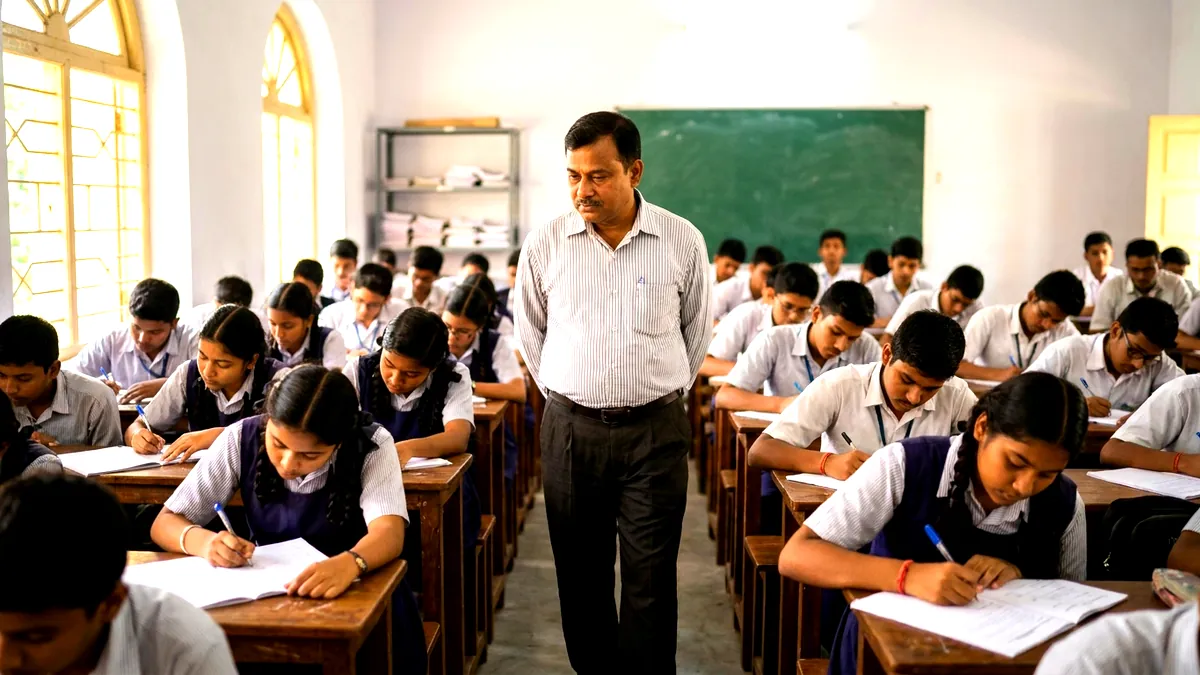
Recognized secondary schools across West Bengal have commenced the Class 10 Selection Test under strict directives from the state education board. The institutional screening marks the final internal gateway for students aiming to qualify for the upcoming Madhyamik board examinations.
Quick answer
The WBBSE Madhyamik selection test is the mandatory Class 10 third summative evaluation conducted by recognized West Bengal secondary schools in November. Internal subject teachers set the full-syllabus papers. Qualifying with at least 25% in each subject is compulsory to secure enrollment for the state Madhyamik Pariksha board examination.
Key takeaways
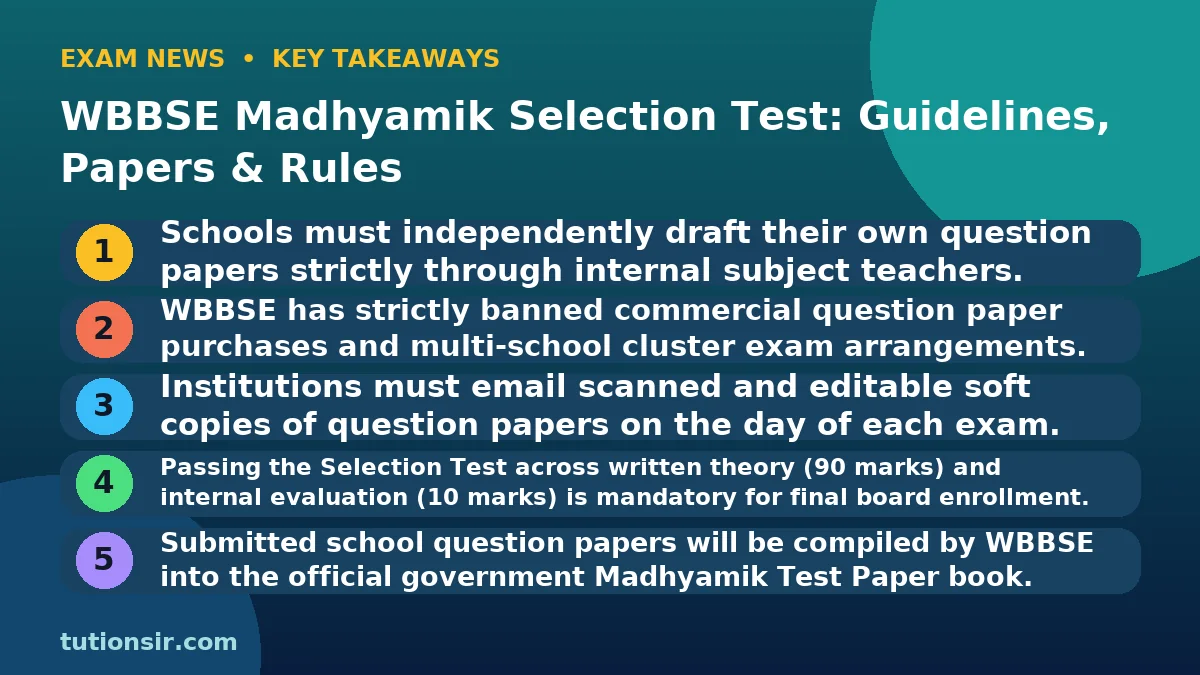
- Schools must independently draft their own question papers strictly through internal subject teachers.
- WBBSE has strictly banned commercial question paper purchases and multi-school cluster exam arrangements.
- Institutions must email scanned and editable soft copies of question papers on the day of each exam.
- Passing the Selection Test across written theory (90 marks) and internal evaluation (10 marks) is mandatory for final board enrollment.
- Submitted school question papers will be compiled by WBBSE into the official government Madhyamik Test Paper book.
Start free: doubts answered in English, Bengali or Hindi.
No card. Registering takes about two minutes.
What are the latest WBBSE guidelines for Madhyamik selection test question papers?
The West Bengal Board of Secondary Education (WBBSE) issued a formal circular through the Deputy Secretary (Academic), notifying all recognized secondary institutions to conduct the Class 10 Selection Test—also known as the Third Summative Evaluation—across November. The notification outlines rigorous procedural requirements designed to safeguard academic standards and question paper confidentiality.
Under the board directives, every question paper must be framed entirely in-house by the school's own appointed subject teachers. WBBSE made it explicit that questions must strictly align with the full Class 10 syllabus and the board-approved blueprint. Head of Institutions (HOIs) have been cautioned against framing any controversial, ambiguous, or out-of-syllabus questions that could disrupt examinees or cause administrative embarrassment.
- In-house preparation: Papers must be authored only by existing institutional faculty.
- Curriculum fidelity: 100% adherence to prescribed Class 10 learning outcomes and marks distribution.
- HOI responsibility: Heads of Institutions carry direct administrative accountability for paper integrity.
Can schools conduct joint or cluster-based Madhyamik selection tests?
The Board has reiterated an unequivocal prohibition against the commercialization of institutional exams. Schools are explicitly barred from forming regional school clusters or consortiums to run common screening assessments. Furthermore, sourcing pre-printed question sets from external publishers, coaching businesses, or private third-party agencies is strictly prohibited under disciplinary rules.
This directive stems from previous administrative concerns regarding leaked question packets and unregulated commercial test papers circulating in secondary schools. By mandating isolated, school-level drafting, the Board ensures that classroom teachers directly evaluate what their students have mastered over the academic session.
How do schools submit selection test question papers to the WBBSE board?
In an effort to enforce transparency and curate its annual publication, WBBSE has outlined a mandatory same-day digital submission protocol for all secondary schools. Immediately following the conclusion of each day's examination, schools must transmit the corresponding question paper to the Board.
School authorities are required to email both a scanned PDF copy and an editable soft copy (DOC/text format) to the official Board repository at testpaperwbbse@gmail.com. Submissions must clearly specify the institution's official school index number, school name, and subject in the email subject line.
These submitted papers form the empirical basis for the government-issued WBBSE Madhyamik Test Paper compendium. An expert academic committee at Nivedita Bhawan screens hundreds of high-quality school papers, selects representative sets balancing varying difficulty levels, and compiles the official test book, which is subsequently printed and distributed free of charge to Madhyamik candidates statewide.
| Exam Parameter | Official Board Specification | Institutional Compliance Rule |
|---|---|---|
| Question Paper Setting | Must be set solely by in-house school subject teachers | Commercial publishers and agency question purchases strictly banned |
| Exam Administration | Independent school-level testing | Cluster testing and inter-school consortiums prohibited |
| Board Digital Submission | Same-day transmission via email (testpaperwbbse@gmail.com) | Both scanned copy and editable non-PDF soft copy required |
| Paper Scoring Structure | 90 Marks Written Theory + 10 Marks Internal Formative Evaluation | Strictly aligned with Class 10 board blueprint and syllabus |
| Exam Duration | 3 Hours written exam + 15 minutes dedicated reading time | Held during designated morning or afternoon session |
| Qualifying Criteria | Minimum 25% aggregate per subject | Mandatory requirement for regular Madhyamik enrollment |
West Bengal Madhyamik selection test passing marks and blueprint
The Madhyamik Selection Test mirrors the exact structural pattern of the final board examination. For each compulsory subject—First Language, Second Language, Mathematics, Physical Science, Life Science, History, and Geography—the full assessment carries 100 marks.
The evaluation is bifurcated into a 90-mark written theoretical examination and a 10-mark Internal Formative Evaluation (IFE). The written paper follows standard board timing: 3 hours for writing, preceded by 15 dedicated minutes exclusively for question paper reading.
To clear the test, students must attain the qualifying threshold of at least 25% overall in each individual subject (combining written marks and IFE components). Achieving qualifying marks in every subject is an statutory prerequisite for board eligibility.
What happens if a student fails or misses the Madhyamik selection test?
Because clearing the Selection Test is compulsory for final Madhyamik Pariksha enrollment, scoring below the 25% cut-off or missing the exam entirely can jeopardize an examinee's academic year. However, WBBSE empowers Heads of Institutions and school Managing Committees to exercise procedural discretion under genuine circumstances.
If a student fails by a narrow margin in one or two subjects, schools frequently organize remedial intervention sessions followed by an immediate departmental re-test before finalizing board registration lists.
In the event of an unavoidable medical emergency, the candidate's guardians must promptly submit formal medical documentation and an official leave application to the HOI. Upon verifying hospital records and the candidate's past academic consistency in earlier summative assessments, the school head may conduct a special supplementary test or clear the candidate under documented institutional review.
How selection test results link to Madhyamik Pariksha board enrollment
The completion of the Selection Test sets off a rapid administrative schedule leading directly to final board enrollment. Once answer scripts are evaluated and marks entered, school administrators log into the official WBBSE portal (wbbse.wb.gov.in) to verify regular candidate eligibility and complete online exam forms.
Students who clear the selection barrier are enrolled as regular candidates, enabling the Board to generate their official Madhyamik Pariksha Admit Cards. For examinees, this period signals the end of new chapter learning and the beginning of intensive revision.
Transforming selection test feedback into higher board percentages requires consistent error correction and targeted problem-solving. Practicing with full-length model sets, reviewing chapter-wise weightage, and using smart self-study aids like Tution Sir can help students isolate weak chapters, build exam endurance, and master time management before sitting for the state boards.
Frequently asked questions
Is the Madhyamik selection test compulsory for all Class 10 students in West Bengal?
Yes, clearing the Selection Test is mandatory for all regular Class 10 candidates in WBBSE-affiliated institutions. The test serves as the statutory pre-board filter, and passing it is required to qualify for Madhyamik Pariksha enrollment.
What are the latest WBBSE guidelines for Madhyamik selection test question papers?
WBBSE mandates that all question papers must be set exclusively by the school's own subject teachers based on the complete Class 10 syllabus. External vendor papers are barred, and institutions must submit copies to the Board on the exam day.
Can schools conduct joint or cluster-based Madhyamik selection tests?
No, WBBSE has strictly prohibited cluster-based or combined selection examinations. Institutions cannot pool resources with neighboring schools or hire external agencies; each school must independently draft and supervise its own exams.
How do schools submit selection test question papers to the WBBSE board?
Schools must email their question papers immediately after each exam to testpaperwbbse@gmail.com. The submission must include both a scanned copy and an editable DOC format, referencing the school index and subject.
What are the minimum passing marks in the Madhyamik selection test?
Students must achieve at least 25% marks in each compulsory subject, combining the 90-mark written theory paper and the 10-mark Internal Formative Evaluation (IFE), in line with standard state board qualifying norms.
What happens if a student fails or misses the Madhyamik selection test?
Failing or missing the test puts board enrollment at risk. However, schools can conduct departmental re-tests or review verifiable medical emergencies under the Head of Institution's discretion to assess candidate fitness before final registration.
When does WBBSE publish the official Madhyamik Test Paper book?
WBBSE typically publishes and distributes its official Madhyamik Test Paper volume in late December or January. It is compiled directly from selected school test papers submitted during the November selection exams.
How does the selection test performance impact Madhyamik Pariksha board enrollment?
The selection test is the final institutional verification step. Students who successfully clear the test are certified by the Head of Institution on the WBBSE portal, granting them eligibility to receive admit cards for the state board exams.
Sources and official links
Exam rules and notifications change. Confirm dates, fees and eligibility on the official website before acting. Spotted an error? Email support@tutionsir.com. See our editorial policy.
Keep learning
CISCE Exam Rules Frisking AI Gadgets: 2027 Exam Guide
The Council for the Indian School Certificate Examinations has authorised centre heads to frisk ICSE and ISC c
Read →Delhi High Court CBSE Calculator Class 12: Notice Issued
The Delhi High Court has sought answers from CBSE, NCERT, and the Centre on whether Class 12 students should b
Read →Madhyamik 2027 Postponed to March? New Dates and What To Do
The West Bengal Board of Secondary Education has submitted a formal proposal to reschedule the 2027 Madhyamik
Read →Do not let another week go by without a plan
Students who start revising early rarely panic in the last week. Register free now and start with the one topic that worries you most. Small daily practice beats a last-minute rush.
- Free plan, no card needed
- Chapter-wise explanations and practice
- Ask in the language you think in
Free plan, no card needed. Your progress is saved to your account.