CBSE Class 10 . Science Exam Guide
How to Solve Assertion Reason Questions: CBSE Class 10
Assertion-reason questions in CBSE Class 10 Science can make or break your perfect score in Section A. Mastering a repeatable three-step validation framework guarantees clarity, saves critical time, and completely eliminates the dreaded confusion between Option A and Option B.
Quick answer
To solve assertion reason questions in CBSE Class 10 Science, first evaluate the truth value of Assertion and Reason independently. If either statement is false, choose Option C or D. If both are true, insert 'because' between them; if Reason logically justifies Assertion, select Option A. If not, choose Option B.

Key takeaways
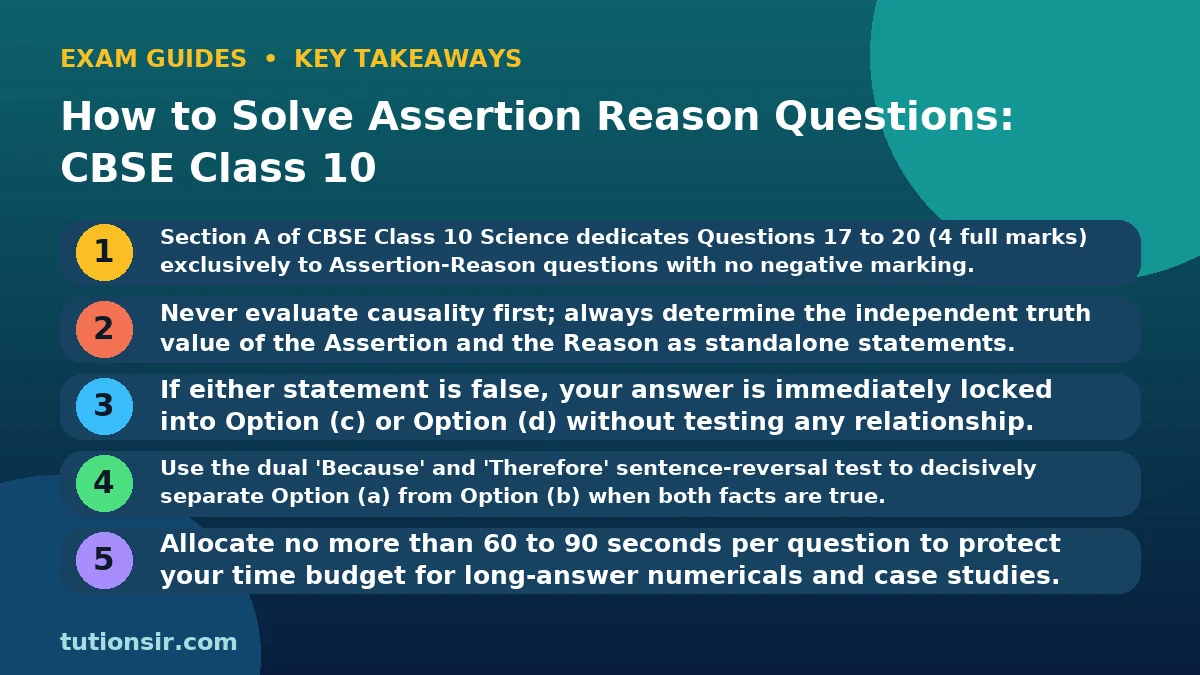
- Section A of CBSE Class 10 Science dedicates Questions 17 to 20 (4 full marks) exclusively to Assertion-Reason questions with no negative marking.
- Never evaluate causality first; always determine the independent truth value of the Assertion and the Reason as standalone statements.
- If either statement is false, your answer is immediately locked into Option (c) or Option (d) without testing any relationship.
- Use the dual 'Because' and 'Therefore' sentence-reversal test to decisively separate Option (a) from Option (b) when both facts are true.
- Allocate no more than 60 to 90 seconds per question to protect your time budget for long-answer numericals and case studies.
What Is the Assertion Reason Question Pattern in CBSE Class 10 Science?
In the Central Board of Secondary Education (CBSE) Class 10 Science annual examination, Section A contains 20 objective questions worth 1 mark each. While Questions 1 through 16 are standard multiple-choice questions, Questions 17, 18, 19, and 20 are compulsory Assertion-Reason items. These four questions represent a crucial scoring block designed under the National Education Policy (NEP 2020) competency-based assessment guidelines to measure conceptual clarity over rote memorization.
Each question presents two distinct statements: an Assertion (denoted as A), which makes a factual, observational, or theoretical claim, and a Reason (denoted as R), which provides an explanation, underlying mechanism, or related statement. Candidates must evaluate both statements against the prescribed National Council of Educational Research and Training (NCERT) syllabus and choose exactly one of four standardized options.
- Option (a): Both Assertion (A) and Reason (R) are true, and Reason (R) is the correct explanation of Assertion (A).
- Option (b): Both Assertion (A) and Reason (R) are true, but Reason (R) is not the correct explanation of Assertion (A).
- Option (c): Assertion (A) is true, but Reason (R) is false.
- Option (d): Assertion (A) is false, but Reason (R) is true.
The Built-In CBSE Pattern Advantage
Notice a critical structural feature verified in official CBSE sample papers published on cbseacademic.nic.in: there is no option where both Assertion and Reason are simultaneously false. If your conceptual check shows that Assertion (A) is unambiguously false, you do not even need to debate causality—your answer is automatically Option (d). Similarly, if Reason (R) is demonstrably false, the answer must be Option (c). Recognizing this structure cuts your decision time in half.
The 3-Step Strategy: How to Solve Assertion Reason Questions in Science Class 10
Most students lose marks on assertion reason questions for class 10 science because they jump immediately into searching for a causal relationship before verifying basic scientific facts. This premature reasoning creates confirmation bias, where your brain invents imaginary connections between two statements simply because they appear side by side.
To achieve a flawless score, replace guesswork with a strict, repeatable three-step elimination protocol. Treat each statement with forensic independence before examining their interaction.
- Step 1: Isolate and Validate the Assertion (A) — Read Statement A in complete isolation as an independent true/false statement. Ignore Statement R entirely. Consult your NCERT foundational definitions, laws, formulas, and conditions. If Assertion (A) is scientifically incorrect or contradicts an established NCERT concept, stop immediately. Select Option (d). If Assertion (A) is accurate, proceed to Step 2.
- Step 2: Isolate and Validate the Reason (R) — Cover Statement A and read Statement R strictly on its own merits. Ask yourself: 'Is this statement an accurate scientific fact, law, or property regardless of what is written above?' If Reason (R) contains incorrect chemical formulas, inverted biological functions, or flawed physical conventions, mark it false. Your answer is immediately locked into Option (c). If Reason (R) is undeniably true, move to Step 3.
- Step 3: Execute the Causal Linkage Test ('Because' and 'Therefore') — When both A and R are individually true, your choice narrows exclusively to Option (a) versus Option (b). Read Assertion (A), insert the conjunction 'BECAUSE' directly after it, and read Reason (R). Does Reason provide the direct scientific mechanism, governing law, or driving force that makes Assertion happen? If yes, confirm with the reverse test: 'Reason (R), THEREFORE Assertion (A).' If the logic holds organically both ways, mark Option (a). If the transition sounds disjointed or merely adds supplementary information, mark Option (b).
Difference Between Option A and Option B in Assertion Reason: How to Break the Trap
The single most challenging hurdle in cbse class 10 science assertion reason rules is distinguishing between Option (a) and Option (b). Exam question setters deliberately select two genuine, verbatim facts from the same NCERT chapter to bait students into selecting Option (a). Both statements sound true and familiar, so students instinctively feel they belong together.
To avoid falling into this trap, apply the 'Mechanism Versus Fact' test. An Assertion is frequently an observable macroscopic phenomenon (what happens), while a valid Reason must supply the microscopic or governing principle (why or how it happens). If Statement R simply presents another true observation without explaining the origin of Statement A, the correct answer is unequivocally Option (b).
- The Direct Cause Test: Ask, 'Does Statement R explain the operational mechanism of Statement A?' If Statement A says 'White silver chloride turns grey in sunlight' and Statement R says 'Silver chloride is stored in dark bottles', both are correct NCERT facts. However, storing it in dark bottles is a precautionary measure, not the cause of decomposition. Hence, the answer is Option (b).
- The Missing Link Test: If you feel compelled to add two or three intermediate explanatory sentences of your own to bridge the gap between A and R, they are not directly causally linked on the page. In the CBSE board exam, the reason must be self-sufficient.
- The Reverse 'Therefore' Validation: Read Reason first, insert 'Therefore', and read Assertion. For example: 'Decomposition of silver chloride into silver and chlorine occurs by light energy absorption [R], THEREFORE white silver chloride turns grey in sunlight [A].' The logic clicks instantly, confirming Option (a).
| Step 1: Assertion (A) | Step 2: Reason (R) | Step 3: Causal Link ('Because' Test) | Correct CBSE Option | Action / Verification Rule |
|---|---|---|---|---|
| False | True | Not Applicable | Option (d) | Lock answer instantly; no need to analyze causality. |
| True | False | Not Applicable | Option (c) | Lock answer instantly; Reason contradicts NCERT fact. |
| True | True | Fails Causal Test (No explanation) | Option (b) | Both are true facts, but Reason does not give the scientific 'why'. |
| True | True | Passes Causal Test (Valid mechanism) | Option (a) | Reason is the direct governing principle or cause of Assertion. |
Subject-Specific Trap Analysis: Physics, Chemistry, and Biology
Assertion-reason questions in CBSE Class 10 Science stem from three different disciplines, each harboring distinct traps designed to test competency-based thinking. Being conscious of how examiners construct distractor statements in Physics, Chemistry, and Biology enables you to spot errors in seconds.
Physics: Formula Conditions and Sign Convention Traps
In Physics chapters such as Light (Reflection and Refraction) and Electricity, assertions often state numerical outcomes or image characteristics, while reasons quote mathematical formulas. The classic trap occurs when the quoted formula is scientifically correct in general, but invalid for the specific boundary conditions stated in the assertion.
Watch out for signs: concave versus convex focal lengths, virtual versus real image magnification signs, and the critical distinction between resistance (a constant physical property of a resistor at constant temperature) and resistivity (an intrinsic material property independent of length and area). If an assertion claims the resistance of a wire doubles when stretched, and the reason states resistivity depends on length, the reason is scientifically false (Option c).
Chemistry: Phenomenon vs. Underlying Chemical Mechanism
In Chemistry (Chemical Reactions, Acids, Bases, and Salts, Metals and Non-Metals, Carbon and Its Compounds), examiners love pitting an empirical observation against a general reactivity trend.
A frequent trap involves displacement and redox reactions. The assertion might observe a color change (e.g., iron nail in copper sulphate solution), while the reason describes electron transfer or reactivity series rank. Ensure the reason names the exact species being oxidized or reduced. Misidentifying the reducing agent or writing an inverted reactivity order immediately renders the reason false.
Biology: Anatomical Location vs. Biochemical Function
In Biology chapters like Life Processes, Control and Coordination, and Heredity, questions frequently mix anatomical structures with enzymatic functions. A common trick is pairing an assertion about an organ's physiological action with a reason that correctly describes a neighboring organ's function.
For instance, an assertion stating that 'The inner lining of the small intestine has numerous finger-like projections called villi' might be paired with a reason stating 'Villi produce digestive enzymes that convert proteins to amino acids.' While both sentences sound biological, the reason is factually false: villi increase surface area for absorption, whereas enzymes are secreted by intestinal glands and the pancreas. That makes it a swift Option (c).
Worked NCERT Examples with Step-by-Step Breakdown
To cement this method, let us work through authentic, board-standard examples covering each major science stream using our structured 3-step decision protocol.
Worked Example 1: Chemistry (Chemical Reactions and Equations)
Assertion (A): Calcium oxide reacts vigorously with water to produce slaked lime, releasing a large amount of heat.
Reason (R): The reaction between calcium oxide and water is an endothermic combination reaction.
Step 1 (Validate A): From NCERT Chapter 1, quicklime (CaO) reacting with water forms Ca(OH)2 with substantial heat evolution. This statement is factually true.
Step 2 (Validate R): The statement claims the reaction is endothermic. However, a reaction that releases heat is exothermic, not endothermic. Thus, Reason (R) is completely false.
Conclusion: Since A is true and R is false, no causal test is needed. The correct answer is Option (c).
Worked Example 2: Biology (Life Processes)
Assertion (A): The walls of the ventricles are thicker than those of the atria.
Reason (R): Ventricles have to pump blood into various organs with high pressure, whereas atria primarily receive blood.
Step 1 (Validate A): As stated in NCERT Biology, ventricles possess thicker, muscular walls compared to atria. Statement A is true.
Step 2 (Validate R): Ventricles push blood to distant organs (lungs and systemic circulation) requiring higher force, while atria receive incoming blood. Statement R is true.
Step 3 (Causal Linkage Test): Connect with 'because': 'The walls of the ventricles are thicker than those of the atria BECAUSE ventricles have to pump blood into various organs with high pressure.' The reason directly explains the functional adaptation of the muscular structure.
Conclusion: Both are true, and R is the correct explanation of A. The correct answer is Option (a).
Worked Example 3: Physics (Light – Reflection and Refraction)
Assertion (A): The refractive index of diamond is much higher than that of water.
Reason (R): Diamond is an allotrope of carbon, while water is a compound of hydrogen and oxygen.
Step 1 (Validate A): NCERT refractive index values show diamond at 2.42 and water at 1.33. Statement A is scientifically true.
Step 2 (Validate R): Diamond is indeed a crystalline allotrope of carbon, and water is a chemical compound of hydrogen and oxygen. Statement R is factually true.
Step 3 (Causal Linkage Test): Connect with 'because': 'Diamond has a higher refractive index than water BECAUSE diamond is an allotrope of carbon and water is a compound of hydrogen and oxygen.' Does chemical composition alone explain the optical density ratio? No. Optical density depends on the speed of light within the medium, optical polarizability, and internal structure, not merely the chemical classification. Both are true, but R does not explain A.
Conclusion: The correct answer is Option (b).
Common Mistakes in Assertion Reason Questions Class 10 CBSE
Even high-achieving students stumble on assertion-reason questions due to easily preventable psychological and procedural errors. Being aware of these pitfalls during practice prevents painful mark deductions.
- Jumping to Conclusions Before Reading Reason: Skimming Assertion, nodding along, and assuming Reason must be an explanation without reading every word carefully.
- Overlooking Subtle Negatives: Missing words like 'not', 'never', 'all', 'inversely', or prefixes like 'un-' and 'in-'. For instance, reading 'hydrochloric acid creates an alkaline medium in the stomach' as true because the eyes register acid and stomach without checking the word 'alkaline'.
- Inventing Extraneous Context: Adding external assumptions not provided in the question. Stick strictly to NCERT facts; do not justify a broken statement by imagining hypothetical, non-standard laboratory conditions.
- Equating 'Same Topic' with 'Direct Explanation': Believing that because Assertion and Reason both discuss Ohm's Law, one must explain the other. Shared subject matter does not equal scientific causality.
- Spending Excessive Time: Debating a single 1-mark question for five minutes. If stuck between Option A and Option B, mark your best assessment based on the 'Therefore' test and return during final revision.
Exam-Hall Time-Management and Revision Protocol
The CBSE Class 10 Science paper consists of 39 questions spanning 80 marks over an allocated time of 3 hours (180 minutes). You cannot afford to lose your composure or schedule in Section A. Since Questions 17 to 20 carry 1 mark each with no negative marking, your strict operational target should be 60 to 90 seconds per assertion-reason question.
During your initial 15-minute question paper reading time, circle the keywords, operators, and sign conventions in Questions 17 through 20. Mark whether Assertion and Reason are individually True or False directly in pencil on your question paper so you enter the writing time with predetermined solutions.
- Active NCERT Highlighting: When revising NCERT science textbooks, actively circle transitional words like 'because', 'due to', 'since', 'as a result', and 'therefore'. These sentences represent readymade assertion-reason items favored by CBSE exam moderators.
- Chapter-Wise Error Logs: Maintain a dedicated notebook where you record every assertion-reason question you answered incorrectly in school pre-boards, unit tests, and sample papers. Categorize each error: was it a fact-check failure (Step 1/2) or a causality failure (Step 3)?
- Timed Drill Sessions: Regularly practice timed sets of 10 to 15 competency-based questions. Utilizing intelligent self-paced diagnostic tools on platforms like Tution Sir allows you to sharpen your logical deduction speed, test NCERT line-by-line understanding, and eliminate option confusion under realistic exam conditions.
Frequently asked questions
How to solve assertion reason questions easily in CBSE Class 10?
Evaluate Assertion and Reason independently as standalone true or false statements first. If either is false, choose Option (c) or (d) immediately. If both are true, connect them with 'because'; choose Option (a) if Reason gives the scientific mechanism, or Option (b) if it does not.
What is the trick to distinguish between Option A and Option B in assertion reason?
Use the reverse 'Therefore' test. Read Reason, say 'therefore', and read Assertion. If Reason describes the fundamental scientific mechanism causing the Assertion to happen, select Option (a). If Reason merely adds an unrelated true fact from the same chapter, select Option (b).
How many assertion-reason questions are asked in CBSE Class 10 Science board exam?
CBSE Class 10 Science papers feature exactly 4 assertion-reason questions, numbered 17, 18, 19, and 20 in Section A. Each question carries 1 mark, contributing 4 marks to the 80-mark theory paper, with no negative marking.
What does Assertion and Reason mean in CBSE board exam?
In CBSE board exams, Assertion (A) is a stated claim, scientific observation, or factual scenario. Reason (R) is a supporting statement that provides an explanation, underlying mechanism, property, or supplementary fact related to the topic under assessment.
Can both assertion and reason be true but reason not be the correct explanation?
Yes, this corresponds directly to Option (b). Both statements can be 100% accurate scientific facts straight from NCERT, but if Reason does not explain the biological, physical, or chemical cause behind the Assertion, Option (b) is the correct choice.
Is there any negative marking for assertion reason questions in CBSE Class 10?
No, CBSE Class 10 board examinations do not have negative marking for incorrect answers. If you are uncertain between Option (a) and Option (b), always make an educated attempt using the 'Because' test rather than leaving the question blank.
What if an assertion is false in the CBSE Science question paper?
If Assertion (A) is scientifically false, you can immediately select Option (d) without further debate. In the standard CBSE 4-option format, there is no option where both statements are false, so a false assertion guarantees Option (d).
Sources and official links
Exam rules and notifications change. Confirm dates, fees and eligibility on the official website before acting. Spotted an error? Email support@tutionsir.com. See our editorial policy.
Keep learning
CBSE 15-Minute Reading Time Strategy: How to Plan Paper
The mandatory 15 minutes before writing begins can determine your entire CBSE board exam score. Rather than fl
Read →How to Increase Handwriting Speed in Board Exams: Top Tips
Every year, thousands of Indian board examinees lose 10 to 15 marks simply because their hands cannot keep up
Read →How to Solve Physics Numericals Easily: 5-Step Guide
Struggling to solve numerical problems even when you remember every formula is the single most common frustrat
Read →Practise what you just read
Free plan, no card needed. Full mock tests and the complete question bank are on the Pro plan.