Study Techniques & Board Prep
How to Use SQ3R Study Method for NCERT Textbooks
Passive reading and indiscriminate highlighting leave NCERT facts forgotten within days. Francis P. Robinson's SQ3R framework—Survey, Question, Read, Recite, Review—turns dense textbook lines into active mental retrieval, helping Indian students secure top marks in CBSE, NEET, and competitive exams.
Quick answer
To use the SQ3R study method for NCERT, first survey chapter headings, diagrams, and summary points to build a mental framework. Next, convert subheadings into analytical questions. Read line by line to locate answers, recite the key concepts aloud without looking, and review the chapter systematically using exercises and spaced repetition.

Key takeaways
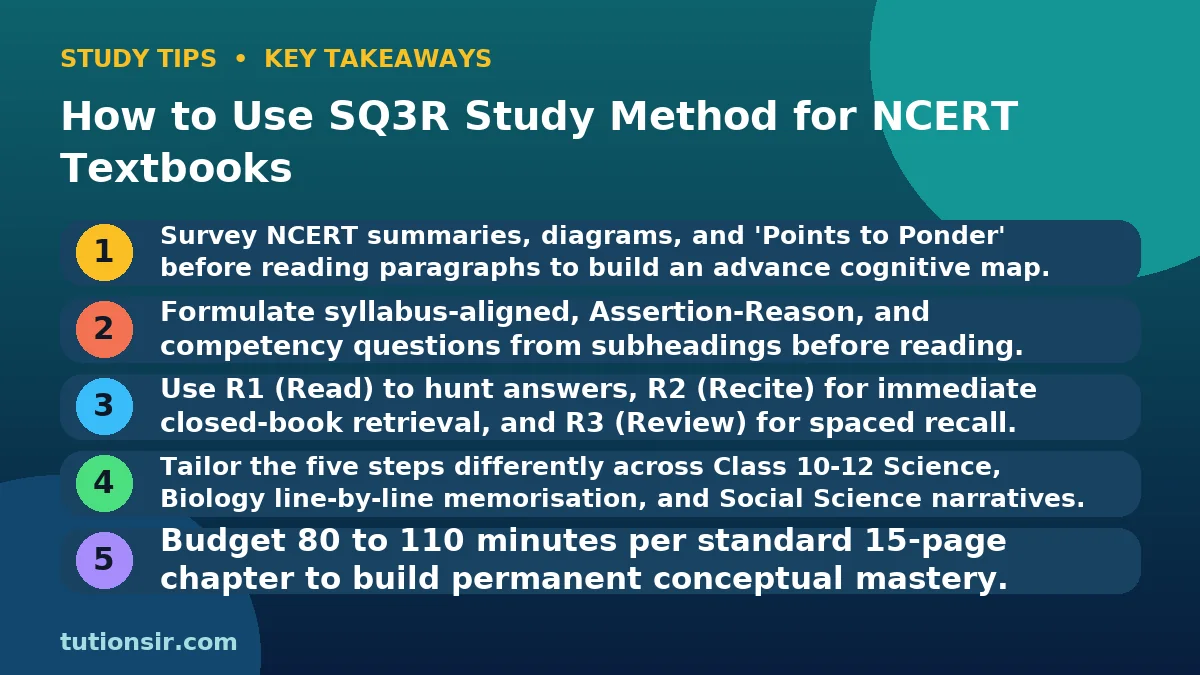
- Survey NCERT summaries, diagrams, and 'Points to Ponder' before reading paragraphs to build an advance cognitive map.
- Formulate syllabus-aligned, Assertion-Reason, and competency questions from subheadings before reading.
- Use R1 (Read) to hunt answers, R2 (Recite) for immediate closed-book retrieval, and R3 (Review) for spaced recall.
- Tailor the five steps differently across Class 10-12 Science, Biology line-by-line memorisation, and Social Science narratives.
- Budget 80 to 110 minutes per standard 15-page chapter to build permanent conceptual mastery.
Try Tution Sir free for your class and subject.
No card. Registering takes about two minutes.
What is the SQ3R Study Method and Why Does Passive NCERT Reading Fail?
The SQ3R study method is a five-stage reading comprehension system devised in 1946 by American educational psychologist Francis P. Robinson in his landmark book Effective Study. The acronym stands for Survey, Question, Read, Recite, and Review. While originally developed to help military trainees absorb complex manuals rapidly, educational research from institutions like Virginia Tech's Cook Counseling Center has proven SQ3R to be one of the most durable frameworks for scientific reading comprehension worldwide.
Most secondary and senior secondary students in India approach their National Council of Educational Research and Training (NCERT) textbooks like fiction novels. They open chapter one, run a yellow highlighter across whole paragraphs, and re-read the text three or four times before unit tests. Cognitive scientists call this the 'illusion of competence': familiarising your eyes with printed fonts creates a false sense of mastery, yet your brain fails to encode the fundamental concepts into long-term memory.
According to the Ebbinghaus Forgetting Curve, learners forget nearly 70% of passively consumed material within 48 hours without deliberate retrieval practice. NCERT textbooks are uniquely dense. Written by subject panels under the Ministry of Education, every sentence carries compressed conceptual weight, subtle qualifiers, and implicit interconnections. Approaching NCERT through passive reading directly conflicts with higher-order testing systems under Bloom's Taxonomy, which now govern CBSE competency-based questions, NEET biological reasoning, and UPSC Civil Services analytical items.
- Passive re-reading builds recognition rather than active recall, collapsing under timed exam pressure.
- Highlighting entire pages triggers cognitive fatigue without stimulating analytical evaluation.
- SQ3R forces continuous retrieval practice, moving facts from working memory into resilient long-term schema.
Step by Step Guide to SQ3R Method for NCERT Textbooks
Applying SQ3R to an NCERT textbook requires aligning Robinson's five cognitive phases with the distinct pedagogical layout curated by NCERT authors. NCERT books do not present continuous narrative blocks; they feature chapter summaries, blue intext question panels, laboratory activities, margin notes, and specialized 'Points to Ponder' sections. Here is how to navigate all five steps deliberately.
Step 1: Survey (S) — Mapping the NCERT Chapter Landscape (8–10 Minutes)
Before reading a single sentence of body text, survey the entire chapter to create an advance conceptual scaffold in your mind. Flip immediately to the back of the chapter and read the section titled 'What you have learnt' (in Classes 9 and 10 Science) or the 'Summary' and 'Points to Ponder' boxes (in Classes 11 and 12 Physics, Chemistry, and Biology).
Next, flip through the chapter from start to finish. Read the chapter title, every bold major heading, every italicised subheading, and inspect every diagram, graph, chemical reaction flow, and labelled cartoon. Pay close attention to coloured side-boxes containing historical context, biographical notes on scientists, or supplementary discoveries. Do not attempt to memorize details during this pass; your sole objective is to provide your brain with a mental index of what lies ahead.
Step 2: Question (Q) — Transforming Headings into Competency Queries (7–10 Minutes)
Engage your curiosity by converting every bold heading and subheading into targeted, testable questions before diving into the paragraphs. If an NCERT Class 10 Science heading reads 'Autotrophic Nutrition', do not just register the phrase; write down prompts in your study margin or notebook: 'What are the essential raw materials required for autotrophic nutrition?', 'How do guard cells regulate gas exchange in stomatal pores?', and 'What sequence of biochemical reactions occurs during the light and dark phases of photosynthesis?'
Under modern CBSE and NEET exam formats, simple definitional questions are insufficient. Frame analytical, condition-based, and Assertion-Reason questions during this step. For example: 'Assertion: Desert plants take up CO2 at night. Reason: Stomata remain closed during the day to prevent transpiration loss. Is this pair both true and causally linked?' Also examine the built-in NCERT 'Intext Questions' placed between sections; they clearly mark what the authors expect you to deduce from the preceding paragraphs.
Step 3: Read (R1) — Active, Line-by-Line Detective Reading (40–50 Minutes)
Now begin reading the section line by line with a clear objective: hunting down the answers to the questions you constructed in Step 2. Keep a pencil in hand, but avoid highlighting on this initial reading pass. Highlighting while reading creates passive complacency.
Scrutinise every word, paying strict attention to qualifying terms such as 'always', 'rarely', 'some', 'most', or 'inversely'. In NCERT Science and Biology, examine every numbered 'Activity' box thoroughly. CBSE and NEET examiners routinely draw experimental setup MCQs, indicator colour changes, and reasoning questions directly from these practical activity procedures and observations rather than general prose.
Step 4: Recite (R2) — Immediate Active Recall and Self-Testing (15–20 Minutes)
After completing a distinct thematic section (typically 2 to 3 pages), close the book entirely. Do not look at your notes. Stand up or look away from your desk and explain the fundamental mechanisms aloud in your own words, using the Feynman Technique as if teaching a younger classmate.
If the section involves diagrams, biological pathways, or mathematical derivations (such as the nephron structure, the Haber process, or refraction through a glass prism), sketch the diagram or write out the formulas onto a blank rough sheet purely from memory. If you stumble or encounter a conceptual gap, reopen the NCERT textbook, pinpoint the missing link, close the book again, and repeat the recitation until your retrieval is seamless.
Step 5: Review (R3) — Spaced Consolidation and Problem Application (15–20 Minutes)
Review is not a quick passive glance; it is the scheduled consolidation phase that seals synaptic neural pathways against the Ebbinghaus Forgetting Curve. Once you complete the entire chapter through repeated Question-Read-Recite cycles, take a clean notebook and answer all end-of-chapter NCERT Exercise questions without opening the text.
Complete your initial review within 24 hours of finishing the chapter. Follow this with a second spaced review after 7 days, and a third review after 28 days. During these secondary review sessions, test yourself against high-order items from the NCERT Exemplar and solve Previous Years' Questions (PYQs) to confirm your retrieval speed under genuine exam constraints.
SQ3R Method Example Chapter: Step-by-Step Demonstration
To illustrate how SQ3R works in real study conditions, let us take a high-yield NCERT chapter: Class 10 Science, Chapter 5 (Life Processes), specifically the section on 'Respiration'.
Step 1: Survey — You skim the section. You spot the bold heading 'Respiration', followed by the sub-topic 'Breakdown of glucose by various pathways'. You examine Figure 5.8 showing the three-pathway flowchart (absence of oxygen in yeast, lack of oxygen in muscle cells, presence of oxygen in mitochondria). You flip to the end of the chapter and notice the summary line stating that ATP is the energy currency for most cellular processes, and you scan Activity 5.4 involving lime water turning milky when breath is exhaled through it.
Step 2: Question — Before reading the text, you generate four specific exam-style questions in your notebook margins: 1) 'How does the accumulation of lactic acid cause muscle cramps during sudden physical activity?' 2) 'What are the distinct intermediate products and ATP yields of aerobic versus anaerobic respiration?' 3) 'Why do aquatic organisms exhibit a significantly faster breathing rate than terrestrial organisms?' 4) 'Assertion: Fermentation in yeast yields ethanol and carbon dioxide. Reason: Glycolysis requires oxygen to proceed in the cytoplasm. Is the reasoning valid?'
Step 3: Read — You read the section line by line. You find that the initial conversion of 6-carbon glucose into 3-carbon pyruvate occurs in the cytoplasm independent of oxygen. You note that terrestrial animals breathe atmospheric oxygen while aquatic animals must absorb dissolved oxygen, which is present in much lower concentrations, directly answering your third question.
Step 4: Recite — You cover the book with your notebook. On a blank sheet of paper, you draw the complete three-branch breakdown pathway of glucose from memory: Pyruvate yielding Ethanol + CO2 + Energy (Yeast), Lactic Acid + Energy (Human muscle tissue), and CO2 + H2O + Energy (Mitochondria). You orally explain why cramps develop during sudden sprints without glancing at the textbook.
Step 5: Review — The following afternoon, you open the NCERT Exemplar for Class 10 Science and independently answer the short-answer questions concerning respiratory pigment haemoglobin and alveolar surface area expansion. Seven days later, you flash-test your memory of the glucose breakdown flowchart in under two minutes.
| SQ3R Phase | Recommended Time | NCERT Specific Target Elements | Tangible Student Output |
|---|---|---|---|
| Survey (S) | 8–10 Minutes | Summary, Points to Ponder, Headings, Diagrams, Blue Info Boxes | Broad chapter mental map and topic flow index |
| Question (Q) | 7–10 Minutes | Subheadings, Intext questions, Assertion-Reason framing | Written list of 8–15 analytical questions in margins |
| Read (R1) | 40–50 Minutes | Line-by-line body text, numbered Activities, diagram labels | Identification of precise answers, zero premature highlighting |
| Recite (R2) | 15–20 Minutes | Sectional concepts, mechanisms, equations, flowcharts | Closed-book oral Feynman summaries and rough sketch diagrams |
| Review (R3) | 15–20 Minutes (24h later) | End-of-chapter NCERT Exercises, Exemplar, PYQs | Solved back-exercises and error log of weak concepts |
Subject-Specific Adaptations: Science vs Social Science vs Biology
While Francis P. Robinson's foundational principles remain constant, tailoring SQ3R to the exact structural composition of individual NCERT subjects maximizes study efficiency.
- NCERT Biology (NEET & Classes 11–12): Treat every line, diagram caption, and scientist biography (such as Ernst Mayr or Katherine Esau) as potential direct questions. In the 'Survey' phase, inspect structural flowcharts and anatomical diagrams first. In the 'Recite' phase, practice zero-error diagram labeling and oral reproduction of biochemical pathways (e.g., Krebs Cycle, Calvin Cycle).
- NCERT Physics and Chemistry (Classes 11–12 & JEE Main): During the 'Survey' phase, prioritize the 'Points to Ponder' boxes at the chapter end; they summarize edge cases, frame-of-reference conditions, and common misconceptions. In the 'Question' phase, focus on boundary conditions ('What happens when temperature approaches absolute zero?'). In the 'Recite' phase, derive core equations and mechanism arrows without looking at solved textbook examples.
- NCERT Social Science (History, Geography, Polity for CBSE & UPSC Prelims): Convert chronological headings into cause-and-effect interrogatives during the 'Question' stage ('What socioeconomic triggers precipitated the Non-Cooperation Movement in 1920?'). In the 'Survey' stage, study historical maps, primary source boxes, and editorial cartoons. In the 'Recite' phase, summarize events in bulleted cause-event-consequence chains.
Common SQ3R Mistakes Students Make and How to Avoid Them
Despite its clinical efficacy, students frequently encounter hurdles when implementing SQ3R for the first time. Recognizing these friction points ensures you maintain momentum without reverting to passive habits.
The most pervasive mistake is treating the Survey step as a rushed reading session or skipping it entirely out of impatience. When you skip Survey, you dive into dense paragraphs without cognitive anchors, drastically slowing your processing speed. Keep the Survey under ten minutes; you are assembling the exterior frame of a jigsaw puzzle, not placing every interior piece.
Another critical failure is generating superficial, low-level factual questions in the Question step, such as 'What is a magnet?' instead of 'How does magnetic field line density determine the force experienced by a moving charge?' Low-level questions yield low-level comprehension. Force yourself to use interrogative words that demand depth: 'Compare', 'Why', 'Under what conditions', and 'How does X influence Y?'
Finally, many students confuse Recite with Review. Recitation happens immediately after reading a 2-page sub-section and tests your immediate grasp. Review is spaced out across days and weeks, testing your ability to retrieve facts after natural decay has begun. Skipping spaced reviews allows the forgetting curve to erase up to 80% of your initial effort.
Realistic Time-Budgeting and Actionable NCERT Study Checklist
A recurring complaint among students is that SQ3R feels too time-consuming compared to reading straight through. However, cognitive timing studies indicate that passive reading requires 4 to 5 separate revisions prior to exams to achieve shaky retention, whereas SQ3R delivers durable retention in two deliberate passes.
To manage your academic workload, break large 25-page NCERT chapters (such as Class 12 Molecular Basis of Inheritance or Class 10 Nationalism in India) into two distinct 90-minute study blocks over consecutive days rather than forcing an exhaustive marathon session.
Frequently asked questions
What is the SQ3R study method and how does it work?
The SQ3R study method is a five-step cognitive reading system developed by Francis P. Robinson: Survey, Question, Read, Recite, and Review. It transforms passive textbook reading into active learning by requiring students to preview the structure, set investigative questions, read purposefully, test memory immediately, and consolidate information through spaced review.
What does each letter in SQ3R stand for?
In the SQ3R system, S stands for Survey (previewing headings and summaries), Q stands for Question (framing conceptual queries), the first R stands for Read (focused reading to locate answers), the second R stands for Recite (recalling facts from memory without looking), and the third R stands for Review (spaced self-testing).
How do you turn NCERT headings and subheadings into questions?
Turn NCERT headings into analytical prompts using 'How', 'Why', and 'Under what conditions'. For example, convert the Class 10 Science heading 'Refraction through a Glass Prism' into: 'Why does light disperse into components when entering a prism, and which wavelength experiences maximum deviation?' Also frame modern CBSE Assertion-Reason questions.
What is the difference between Recite and Review in the SQ3R method?
Recite occurs immediately after reading a brief 2-to-3-page section; you close the book and speak or write out the concepts to test working memory. Review takes place after completing the whole chapter and at spaced intervals (such as 1 day and 7 days later), using back exercises and exemplar problems.
Is the SQ3R method effective for NEET, JEE, and CBSE preparation?
Yes. SQ3R is exceptionally effective for NEET and CBSE because these exams directly assess line-by-line NCERT statements, diagrams, experimental activities, and subtle qualifications. Active recall and recitation ensure you do not miss micro-details, while systematic review prevents negative marking caused by confusion between close multiple-choice options.
How long should it take to finish one NCERT chapter using SQ3R?
A standard 12-to-16-page NCERT chapter takes roughly 80 to 110 minutes using SQ3R. While this is slightly longer than an initial passive reading pass, it dramatically reduces the weeks of panicked re-reading before term exams because knowledge is already deeply anchored in long-term memory.
Can SQ3R be combined with active recall and spaced repetition for board exams?
Yes, SQ3R natively incorporates active recall during the Recite phase and spaced repetition during the Review phase. For board exams, reinforce this by coupling the Review stage with flashcards, NCERT Exemplar questions, and diagnostic quizzes on smart platforms like Tution Sir to track your concept retention curve.
Sources and official links
Exam rules and notifications change. Confirm dates, fees and eligibility on the official website before acting. Spotted an error? Email support@tutionsir.com. See our editorial policy.
Keep learning
Feynman Technique for School Students: 4 Steps to Learn
Struggling to memorize dense Science and Social Science chapters before board exams? The Feynman Technique tra
Read →How to Make an Error Notebook for Exams: 3-Column Method
Solving test papers without analyzing your blunders guarantees you will repeat them in the final exam. The 3-c
Read →How to Make Short Notes from NCERT: Class 9 to 12
NCERT textbooks pack immense academic depth into every paragraph, tempting students to transcribe entire pages
Read →NCERT chapter-wise study help
Free practice and study help
Read →Do not let another week go by without a plan
Reading about the exam does not raise marks. Practice does. Register free now and start with the one topic that worries you most. Small daily practice beats a last-minute rush.
- Free plan, no card needed
- Ask any doubt and get a step-by-step answer
- Practice questions with explanations
Free plan, no card needed. Your progress is saved to your account.